

Class 7 Science Solved Model Papers: CBSE Class 7 Science Sample Paper Set 18
Explore authentic exam practice materials through the CBSE Class 7 Science Sample Paper Set 18. Tailored for Class 7 learners, utilizing these Science sample papers ensures thorough preparation and strengthens time management skills before final CBSE evaluations.
Download Class 7 Science Sample Paper PDF
Access the complete sample paper PDF for Class 7 Science below. Regular practice with these targeted mock exams builds familiarity with expected question patterns and chapter weightage to help secure higher marks.
CBSE Class 7 Science Sample Paper Set R.Sample Papers are the very important for every student. The sample papers should be practiced to gain extra marks in examinations. The sample papers have been prepared based on summative assessment1 and summative assessment 2 pattern. The sample papers have been prepared based on pattern of last year examinations and as per latest changes in the syllabus. Students, teachers and parents can download all CBSE educational material and very well prepared worksheets from this website. All CBSE educational material is developed by our panel of teachers, have also been submitted by CBSE teachers and students.
Section- A
Q.1. Fill in the blanks:- (1)
(v) The wire used for making element of an electric heater is made up of _________.
(vi) An image that cannot be obtained on a screen is called a __________ image.
Q.2. Write any other one name of cyclone. (1)
Q.3. What are the essential parts of an electric circuit? (Any two) (1)
Q.4. Answer in one word. (2)
(i) A transparent glass piece thinner in the middle and thicker at the edges.
(ii) A mirror which can form magnified image of an object.
Q.5. Correct the following statements: (2)
(i) The speed of wind is measured with an instrument called speedometer.
(ii) The device used to prevent flow of excess current in a circuit is a switch.
Q.6. Give one use each of a concave mirror and a concave lens. (2)
Q.7. How does a thunderstorm become a cyclone? (2)
Q.8. Will the bulbs glow in the given circuit?
Give reason to support your answer. (2)
Q.9. Explain the working of an electric bell (without diagram). (3)
Q.10. Give reason, why (3)
(i) We keep melting point of a fuse lower than the melting point of remaining circuit.
(ii) A closed plastic bottle filled with warm water shrinks, when cold water is poured over it.
Q.11. What safety measures one must take in advance to tackle with the problems created by a cyclone? (Write 3 points) (3)
Q.12. (i) What is magnetic effect of electric current? (1 + 2 +2= 5)
(ii)What are the factors on which the strength of an electromagnet depends?
(iii)Paheli takes a wire „A‟ of radius 1 cm and Boojho takes a wire „B‟ of radius 2 cm and pass same amount of current through them. In which case, heat produced will be more and why?
Section- B (CHEMISTRY)[26]
Q.26 The point of origin of sullage water is (1)
(i) Kitchen
(ii) Industries
(iii) Toilets
(iv) Hospitals
Q.27 The water holding capacity is highest in (1)
(i) Sandy soil
(ii) Clayey soil
(iii) Loamy soil
(iv) Mixture of sand and loam
Q.28 This layer is made up of small lumps of broken rocks and lacks humus (1)
(i) A horizon
(ii) B- horizon
(iii) C- horizon
(iv) Bedrock
Q.29 The gas which protect us from harmful ultraviolet radiations coming from the sun is (1)
(i) Nitrogen
(ii) Oxygen
(iii) Ozone
(iv) None of these
Q.30 Name 2 organic impurities present in sewage. (1)
Q.31 (i) Which type of soil is the best for making toys and statues? (½ + ½ + 1= 2)
(ii)Name the plant which grows well in this type of soil.
(iii)Mention 1 difference between the above type of soil and sandy soil.
Q.32 Calculate the rate of percolation of a soil sample if the soil takes 50 minutes for
250 ml of water to percolate through it. (2)
Q.33 Draw the sketch of the soil profile and label the various horizons. (2)
Q.34 (i) Complete the following word equation: (½ + ½ + 1= 2) Citric acid + _________ sodium citrate + _________ + water
(ii)Mention the standard test or confirmatory test for carbon dioxide.
Q.35 (i) Give reason: (2)
If a copper wire is added in a solution of ferrous sulphate it will not react.
(ii)Identify the molecule of the elements from the following: NaCl, H2, CO2, N2
Q.36 (i) Choose the old one out and give a reason for your choice. (1½ + 1½= 3)
(a) Stretching of a rubber band
(b) Formation of clouds
(c) Photosynthesis in plants
(d) Melting of wax
(ii)Define alloying and name an alloy of iron.
Q.37 (i) Why should oil and fats be not released in the drain? (1 + 1 + 1= 3)
(ii) Expand WWTP.
(iii)Differentiate between sludge and activated sludge. (1 point)
Q.38 Observe the diagram given below and answer the following questions:
(i) What is the role of bar screens in WWTP? (1)
(ii) What is the waste deposited in tank (b). Which process helps in the removal of this waste? (½ + ½= 1)
(iii) Which bacteria grows in aeration tank. What is the role of this bacteria in this tank? (½ + 1= 1½)
(iv) How is the sludge decomposed in digester tank? (½)
(v) Mention two uses of biogas produced in this tank. (½ + ½ =1)
Section- C(BIOLOGY)[27]
Q.2. Name the following: (1)
(i) the air tube of insects
(ii) small openings on the sides of an insect body
Q.3. Name the blood component: (1)
(i) Which helps in fighting against germs.
(ii) Which helps in clotting of blood.
Q.4. What is common between transpiration in plants and sweating in human beings?(1)
Q.5. Correct the following statements: (1)
(i) Fruit is the ripened ovule.
(ii) Root, stem and leaves are reproductive parts of plant.
Q.6. (i) Fragmentation : _________ : : spore formation : fern. (1)
(ii)Pollen grain : male gamete :: _________ female gamete.
Q.7. Lime water turns _________ when we exhale into it, as exhaled air contains more ________ than inhaled air. (1)
Q.8. Observe the diagram and answer these questions: (2)
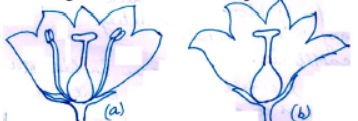
(i) Identify the flowers. (unisexual/ bisexual) (a) __________ (b) __________
(ii) In which flower (a)/ (b) is self pollination possible? Can it perform cross pollination too? (Yes/ No)
Q.9. (i) Name two types of vascular tissues. (2)
(ii)Give one difference between the two vascular tissues.
Q.10. Complete the table: (2)
Characteristics Asexual reproduction Sexual reproduction
i) Seeds produced or not
ii)New individuals identical to parents or characters of both the parents
Q.11. Choose the correct option: (2)
(i) Egg is formed in which part of the flower?
(i) Sepal
(ii) Ovary
(iii) Stamen
(iv) Petal
(ii) Yeast reproduces by which of the following asexual method?
(i) Budding
(ii) Spore formation
(iii) Fragmentation
(iv) Fusion of gametes
(iii) Veins have __________ wall.
(i) Thin
(ii) Thick
(iii) Thin and elastic
(iv) Thick and elastic
(iv) The major excretory waste produced in aquatic animals like fishes is _________.
(i) Urea
(ii) Uric acid
(iii) Ammonia
(iv) None of these
Q.12. (i) Which type of blood (O2 rich/ C O2 rich) is carried by: (2)
(i) Pulmonary vein
(ii) Pulmonary Artery
(ii)Define capillaries.
Q.13. Ravi drew the following diagram in his notebook to show the process of exhalation during breathing. (3)
(i) Is this diagram correct? Yes/ No.
Give one reason in support of your answer?
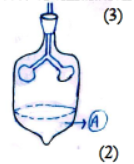
(ii) Write the percentage of CO2 in inhaled and exhaled air.
(iii) Name the part (A)
Q.14. (i)Give reason: (2)
(i) Why do veins have valves?
(ii) Seed dispersal is an important process. Give one reason.
(ii) Define transpiration. (1)
Q.14. (i) (a) Draw a neat diagram of human excretory system. (1)
(b) Label the following in the diagram: (1)
• a part in which tiny filtering units called nephrons are present.
• a part which stores urine.
(ii)Give one example and one feature of the seeds for which dispersal agent is wind. (1)
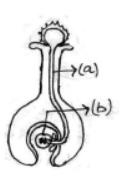
Q.15. Observe the diagram and answer the questions:
(i) Name the process in this diagram. (½)
(ii) Label parts (A) and (B). (1)
(iii) (B) will develop into __________ after this process.
Please click the below link to access CBSE Class 7 Science Sample Paper Set R.
Free study material for Science
CBSE Class 7 Science Sample Paper Set 18 & Sample Question Papers for Class 7 Science
Download Sample Paper: CBSE Class 7 Science Sample Paper Set 18 (Class 7 Science)
Explore downloadable sample sets for Class 7 Science. Utilizing the CBSE Class 7 Science Sample Paper Set 18 allows learners to gauge exam readiness and master official CBSE assessment structures.
Why Practice Class 7 Science Sample Papers?
- Exam Blueprint: Understand mark allocations and structural guidelines relevant to Class 7 evaluations.
- Targeted Improvement: Identify weak areas in Class 7 Science requiring focused revision.
- Pacing & Precision: Practice mixed question formats to build execution speed and ensure timely paper completion.
Post-Practice Strategy for Class 7 Science
- Verify Answers: Compare your responses against professional teacher solutions provided in the sample paper keys.
- Error Analysis: Class 7 learners must review incorrect answers carefully to understand underlying mistakes.
- Concept Reinforcement: Consult the official NCERT book for Class 7 Science when stuck before re-attempting problems.
FAQs
You can download the complete PDF for CBSE Class 7 Science Sample Paper Set 18 for free from StudiesToday.com. Our resources for Class 7 Science are updated for the latest academic session and follow the official exam pattern.
Yes, CBSE Class 7 Science Sample Paper Set 18 comes with detailed, teacher-verified solutions. We have provided step-by-step answers for Science to help students of Class 7 understand correct methodology and marking scheme.
Practicing this Science paper helps in time management and identifying important topics. For Class 7, solving mock papers is the best way to gain confidence and reduce exam-day anxiety.
Yes, all our study materials for Class 7 Science are provided in a mobile-friendly PDF format. You can easily download CBSE Class 7 Science Sample Paper Set 18 on your mobile device.