

Official Class 8 Science Worksheets: Chapter 13 Sound
Explore structured practice materials through the CBSE Class 8 Science Sound Worksheet. Tailored for Class 8 learners, utilizing these Science worksheets ensures thorough preparation and strengthens problem-solving accuracy before final school evaluations.
Solved Practice Worksheets for Science
Navigate directly to the solved Science worksheets using the digital viewer below. Each practice set includes detailed step-by-step solutions, allowing students to instantly cross-check their work and identify areas requiring further revision.
Sound - Production and Propagation of Sound
Sound is form of energy that produces the sensation of hearing in our ears.
Sound is produced due to the vibration of objects.
Intensity of sound is the amount of sound energy incident per unit time per unit area.
Sound propagates through a medium.
A wave is disturbance that moves through medium set neighbouring particles into motions
Wave form are categorised into two types:
• Transverse waves
• Longitudinal waves
In a longitudinal wave:
• A compression is a region of high pressure.
• A rarefaction is a region of low pressure.
Sound waves in air are longitudinal waves.
The wavelength is the distance between two consecutive compressions or two consecutive rarefactions. It is denoted byT.
The time period is the interval between two successive or two successive
rarefactions. It is denoted by T.
The frequency is the number of waves produced in a unit, ‘T’. It is denoted by ‘n’: n =1/T
Pitch is the interpretation of frequency of a sound by brain.
The amplitude is the maximum displacement of the vibrating particles from their mean position. It is denoted by A.
The speed of a wave is the ration of its wavelength to its time period or the product of its frequency wavelength. It is denoted by v.
V = λ/T = nλ
The quality or timbre is the characteristic that distinguishes a sound from other sounds with the same pitch or loudness.
A tone is a sound of a single frequency.
A note is a sound produced due to blend of several frequencies.
The speed of sound of sound in a medium depends on the properties of the
medium through which it propagates.
Supersonic speed is the speed of an object when it travels in air at speed faster than that of sound in air. The sharp and loud sound produced by a supersonic object is called a sonic boom.
Sound- Reflection of sound
When a sound wave is incident on a hard surface, it bounces back into the same medium. This is known as the reflection of sound.
Echo is the repetition of sound that results when a sound wave reflects from a surface.
The minimum distance required to hear an echo is 17.2metres (velocity of sound = 344 m s-1).
Multiple reflection of sound is the success reflection of sound from various reflecting surfaces.
The phenomena of persistence of sound in a closed enclosure, due to multiple reflections are called reverberation.
The ear converts audible frequencies in air into electric impulses that reach the brain.
Hearing aids helps us compensate for reduction in our auditory capabilities.
A human ear can hear sounds ranging from 20 hertz to 20000 hertz.
Sound waves are classified into three categories based on their frequencies.
• Infrasonic sounds (0 to 20 hertz)
• Audible sounds (20 hertz to 20000 hertz)
• ultrasounds (above 20000 hertz)
Ultrasound waves have a wide range of applications in the medical and industrial field.
SONAR stands for Sound Navigation and Ranging. Sonar is a device that uses ultrasonic waves to measure the distance, direction and speed of underwater objects.
The distance travelled by the ultrasound ray is given by the equation: 2d = v x t Where:
d = Distance from the ship to the seabed
v = Speed of sound waves
t = Time taken by the sound wave to get back.
Free, Damped and Forced Vibrations
The oscillations of a body when set into vibration and left to itself are called Free Vibration or Natural Vibrations.
The frequency of a body executing natural vibration is called its NaturalFrequency.
The periodic vibrations of a body of decreasing amplitude are called Damped vibrations.
When a body vibrates under the influence of an external periodic force with a frequency equal to that of the external periodic force, then the vibrations of the body are called Forced Vibrations.
Sound - Characteristics of Sound
Sound propagates in the form of waves.
The time taken to complete one oscillation is called the time period.
The maximum displacement of a vibrating object from its rest position is equal to the amplitude of its vibration.
Frequency is equal to the number of oscillation per second. The unit of frequency is hertz (Hz).
The loudness of sound is proportional to the square of the amplitude of vibration. The loudness of sound is expressed in decibel (db).
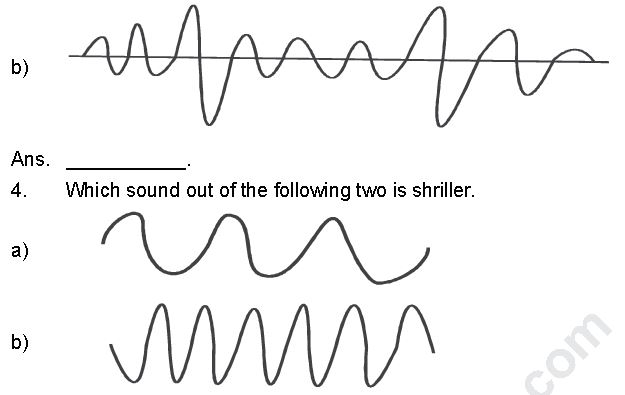
The shrillness or pitch of a sound is determined by its frequency.
Human beings can only hear sounds of frequencies between 20 and 20,000 Hz.
such sounds are called audible sounds.
Resonance
When a body is set into vibrations and left to itself, it executes vibration called natural vibrations or free vibrations.
The periodic vibrations of a body with decreasing amplitude are called damped oscillations.
When a body vibrates under the influence of an external periodic force, it is said to execute force vibrations.
When a body vibrates under the influence of an external periodic force whose natural frequency is equal to its own natural frequency, it executes vibrations of increasing amplitude. This phenomenon is called resonance.
Sounds - Noise and Music
The distinction between sound and noise differ from person to person.
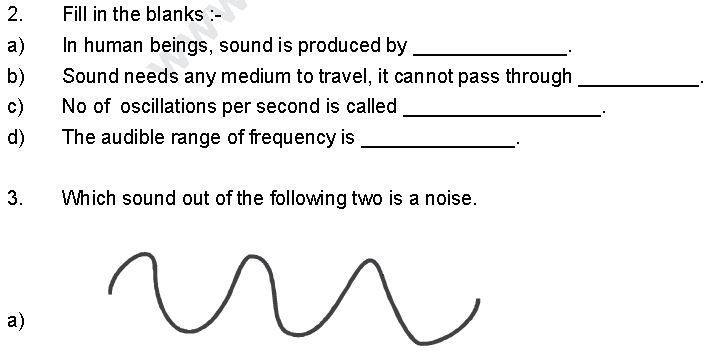
Any intolerable and irritating sound is called noise.
The term “Music” refers to any sound that you like listening to.
Undesirable sounds and disturbance cause noise pollution.
Noise pollution may cause high blood pressure, panic attacks and lack of sleep among those exposed to it.
Continuous exposure to loud noise may cause temporary or even permanent hearing impairment.
People suffering from total hearing disability are usually born with it.
Children who are born hearing impaired need special care as they find it difficult to communicate. They may also suffer from defective speech.
People with hearing disabilities use sign language and various devices to communicate.
To minimise noise pollution:
• Silencer devices should be installed in air craft engines, vehicles, industrial machines and home appliances.
• Trees should be planted along roads and in residential areas.
• Factories should not be set up in residential areas.
• Vehicles should not blow horns around schools, hospitals and residential areas.
• TVs and music systems should not be played at high volumes.
Fill in the blanks :
1. Time taken by an object to complete one oscillation is called _______________.
2. Loudness is determined by the _______________________of vibration.
3. The unit of frequency is ________________________.
4. Unwanted sound is called ______________________.
5. Shrillness of a sound is determined by the __________________________.
6. The number of oscillation in one second is called ____________________.
7. The hearing range of human ear is _____________
8. Sound cannot travel in __________________.
9. Sound can travel in _____________________.
10. The pitch of sound depends on __________________.
Choose the correct answer :
1. Ear drum is a part of ____________________ [ sound producing organ or hearing organ]
2. The voice box is also called _________________ [ Larynx / mouth]
3. Large amplitude of sound vibrations will produce __________________________ [ Loud sound / slow sound]
4. Voice of which of following is likely to have minimum frequency _____________________________ [ Baby girl / A woman]
5. The unit of loudness is ________________ ( decibel / Hertz)
Answer the following :
1. Name the sound producing organ in human.
2. How does sound travel from one place to another ?
3. How is sound produced ?
4. What do you mean by musical sound ?
5. How does the amplitude affect the loudness of vibration?
6. What is noise pollution?
7. What is outer part of ear is called ?
8. What are the two main properties of a sound.
9. Which help us to recognize sound?
10. On which factors loudness of sound depend?
11. What is infrasonic vibration? What is their range in Hertz?
Question. Voice of which of the following is likely to have minimum frequency?
(a) Baby girl
(b) Baby boy
(c) A man
(d) A woman
Answer: C
Question. Choose the correct answer. Sound can travel through
(a) gases only
(b) solids only
(c) liquids only
(d) solids, liquids and gases
Answer: D
True and False:
Question. If the amplitude of vibration is large, sound is feeble.
Answer: False
Question. Unwanted or unpleasant sound is termed as music.
Answer: False
Question. For human ears, the audible range is 20 Hz to 20,000 Hz.
Answer: True
Question. Sound cannot travel in vacuum.
Answer: True
Question. The number of oscillations per second of a vibrating object is called its time period.
Answer: False
Question. Noise pollution may cause partial hearing impairment.
Answer: True
Question. The lower the frequency of vibration, the higher is the pitch.
Answer: False
Fill in the blanks:
Question. The unit of frequency is _____.
Answer: Hertz.
Question. Shrillness of a sound is determined by the _____ of vibration
Answer: Frequency
Question. Time taken by an object to complete one oscillation is called _____.
Answer: Time period
Question. Unwanted sound is called _____.
Answer: Noise
Question. Loudness is determined by the _____ of vibration.
Answer: Amplitude
Question and Answers:
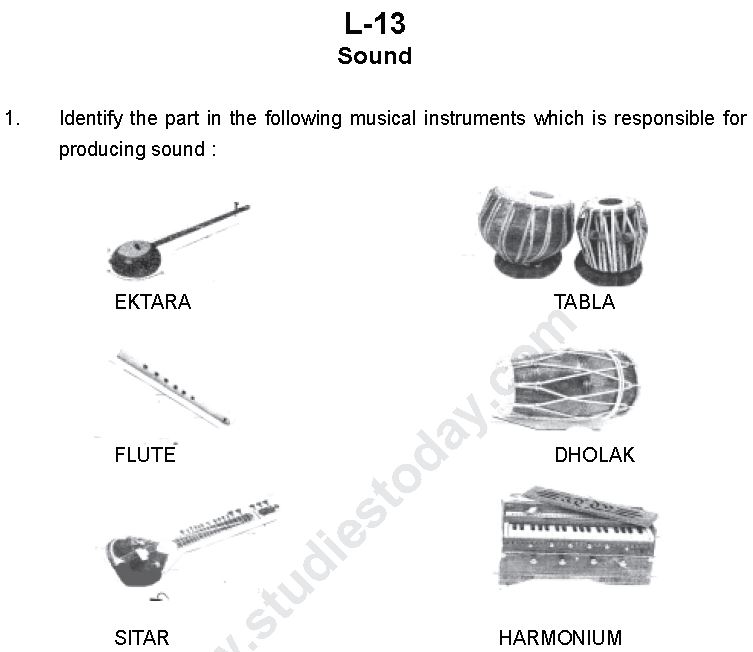
Question. Identify the part which vibrates to produce sound in the following instruments.
(a) Dholak
(b) Sitar
(c) Flute
Answer: (a) Dholak - Stretched membrane.
(b) Sitar - Stretched string.
(c) Flute - Air column.
Question. Your parents are going to buy a house. They have been offered one on the roadside and another three lanes away from the roadside. Which house would you suggest your parents should buy? Explain your answer.
Answer: I would suggest my parents to buy the house which is three lanes away from the roadside. This would protect us from noise pollution which is maximum at roadside building.
Question. What is the difference between noise and music? Can music become noise sometimes?
Answer: The type of sound which is unpleasant to listen is known as noise whereas music is a pleasant sound, which produces a sensation.
Yes, music can become noise when it’s too loud.
Question. A pendulum oscillates 40 times in 4 seconds. Find its time period and frequency.
Answer: Number of oscillations in 4 seconds = 40
Number of oscillations in 1 seconds = 40/4 = 10
Therefore, frequency of pendulum = f = 10 Hz
Now Time period = 1/f = 1/10 = 0.1 sec.
Question. Explain in what way noise pollution is harmful to humans.
Answer: Noise pollution causes: (a) Lack of sleep, (b) Anxiety, (c) Hypertension.
Question. Sketch larynx and explain its function in your own words.
Answer: The other name of larynx is voice box. It is present at the upper end of the windpipe. The function of larynx is to produce sound with the help of two vocal cords on passing air. 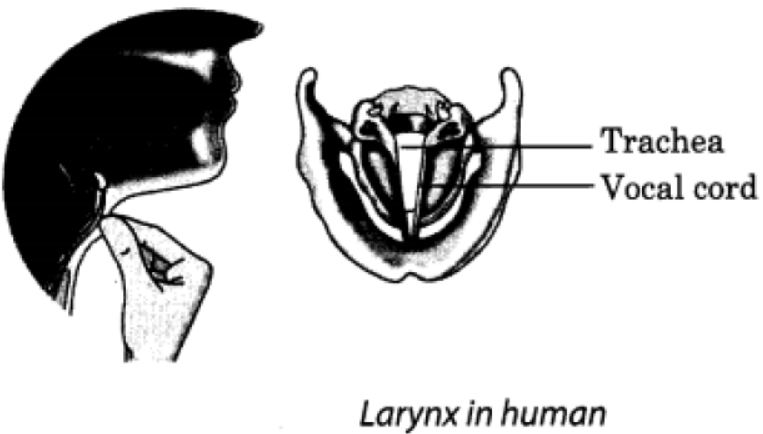
Question. The sound from a mosquito is produced when it vibrates its wings at an average rate of 500 vibrations per second. What is the time period of the vibration?
Answer: Number of vibrations in 1 seconds = 500
Therefore, frequency of vibration = f = 500 Hz
Now Time period = 1/f = 1/500 = 0.002 sec.
Question.. Lightning and thunder take place in the sky at the same time and at the same distance from us. Lightning is seen earlier and thunder is heard later. Can you explain why?
Answer: Speed of the light is much more than the speed of sound. Thus, lightning is seen earlier than thunder.
Question. List the sources of noise pollution in your surroundings.
Answer: Noise pollution sources are:
(a) Bus and car horns.
(b) Firecrackers and loudspeakers.
(c) High volumes in televisions and DJ etc.
(d) Sound of kitchen appliances.
(e) Sirens from factories
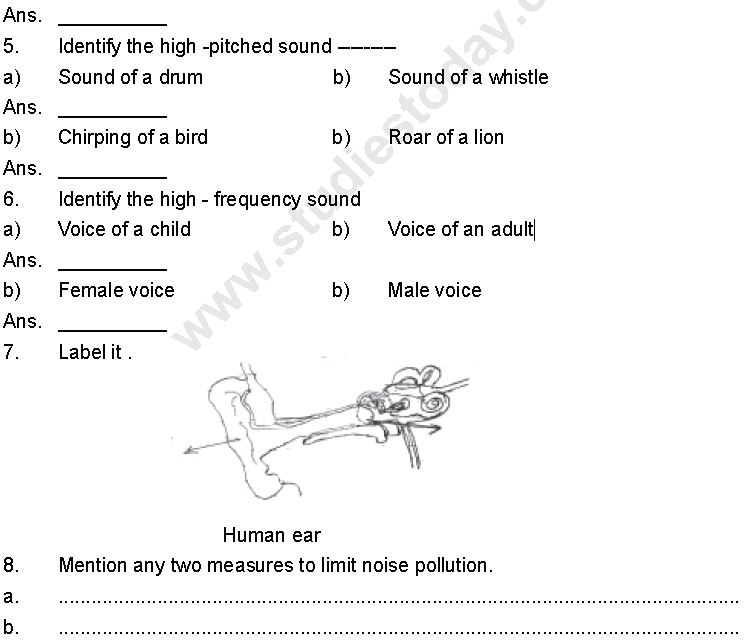
Q1. Fill in the blanks:
1. Sound is produced by ________________ bodies.
2. In humans, the sound is produced by the ____________.
3. Sound always travels through a ___________. It cannot travel in a ____________.
4. The thin membrane called _____________ present in our ears, senses the vibrations and sends them as signals to the _____________.
5. The no. of vibrations per second is called ______________. It is expressed in _____________.
6. Loudness of sound is proportional to the square of the ____________
7. Larger is the amplitude of vibration, the __________ is the sound.
8. Higher the frequency of vibration, the higher is the ____________.
9. A bird makes ____________ sound whereas a lion makes ___________ sound. (low pitched/high pitched)
10. For human ears, the range of audible frequency is from _____________Hz. to ______________ Hz.
Q2. Answer in one word:
1. Two important properties of any sound.
2. Time taken by a vibrating body to complete one vibration.
3. Vibrations of frequency higher than 20,000Hz.
4. Vibrations of frequency lower than 20 Hz.
5. The frequency of a vibrating body that makes 512 vibrations in a second.
6. Unwanted and unpleasant sounds.
7. It determines the shrillness or pitch of a sound.
8. Length of vocal chords in men.
9. Name any four causes of noise pollution our surroundings.
10. Name any two health related problems caused due to noise pollution.
Q3. Answer the following:
1. Describe how is sound produced by humans?
2. Explain how the human ear drum helps them to hear.
3. Define: a) Amplitude b) Time period c) Frequency
4. How is loudness of sound related to amplitude?
5. How is frequency of sound related to pitch?
6. What is noise pollution? How can it be controlled?
Q4. Give reasons:
1. Voice of men and women are different.
2. Trees planted along the roads reduce noise.
3. A child with a hearing loss may also have defective speech.
4. We should never put sharp pointed objects in our ear.
5. Astronauts are not able to talk with each other on the surface of moon.
Q5. In the foll. musical instruments, name the vibrating part which produces sound:
1. Guitar 2. Shehnai 3. Drums 4. Violin
Q6. Describe simple experiments to show each of the following:
1. Vibrating objects produce sound.
2. Sound can travel through water.
3. Sound can travel through solids.
4. To make a toy telephone.
5. To make a jaltarang.
6. Sound needs a medium to travel.
Free study material for Science
Free CBSE Practice Worksheets: Class 8 Science Chapter 13 Sound
Mastering Chapter 13 Sound with Printable Worksheets
Access structured practice worksheets for Chapter 13 Sound aligned with the 2026 CBSE curriculum. These downloadable exercises for Class 8 Science help students build accuracy and reinforce core concepts for upcoming school tests.
Verified Solutions and NCERT Alignment
Built using official NCERT guidelines for Class 8 Science, these practice sheets provide reliable academic support. Cross-reference your completed work with our detailed solutions to learn standard answer-writing formats for CBSE exams.
Additional Study Resources for Class 8 Science
Follow up your worksheet practice by attempting the interactive online MCQ tests for Chapter 13 Sound to evaluate your execution speed. All printable assignments and revision sheets on our platform are updated for the 2026 session and available free of charge.
FAQs
You can download the latest chapter-wise printable worksheets for Class 8 Science Chapter 13 Sound for free from StudiesToday.com. These have been made as per the latest CBSE curriculum for this academic year.
Yes, Class 8 Science worksheets for Chapter 13 Sound focus on activity-based learning and also competency-style questions. This helps students to apply theoretical knowledge to practical scenarios.
Yes, we have provided solved worksheets for Class 8 Science Chapter 13 Sound to help students verify their answers instantly.
Yes, our Class 8 Science test sheets are mobile-friendly PDFs and can be printed by teachers for classroom.
For Chapter 13 Sound, regular practice with our worksheets will improve question-handling speed and help students understand all technical terms and diagrams.