

Official Class 8 Science Worksheets: Chapter 02 Microorganisms Friend or Foe
Access comprehensive chapter-wise worksheets for Chapter 02 Microorganisms Friend or Foe using the CBSE Class 8 Science Micro Organisms Friend And Foe Worksheet. Designed to align with the 2026-27 academic syllabus for Class 8 Science, these printable practice sets help students reinforce key concepts and improve their overall exam readiness.
Solved Practice Worksheets for Science
Access the complete worksheet PDF for Class 8 Science below. Regular practice with these targeted academic tasks builds familiarity with standard question patterns and helps secure higher marks in final school examinations.
Q1. Answer the following:
i. Microbes that reproduce only inside the hostii.
ii.A viral diseaseiii.
iii.An example of a fungiiv.
iv.Single celled microbesv.
v.Microorganism that increases soil fertilityvi.
vi.Microbes that could be present in form of coloniesvii.
vii.Bacteria which causes anthrax diseaseviii.
viii.Any one preservativeix.
ix.A plant that can show root nodule formation –
x. A useful Fungixi.
xi.A disease that has been eradicated from most parts of the world –
xii. A bacterial disease in plants-
Q2. Tick the correct option:
1. Microbe involved in curd formation:
i) Amoeba
ii) Lactobacillus
iii) Rhizobium
iv) Bread Mould
2. Which of the following is not a fungi:
i) Bread Mould
ii) Penicillium
iii) Aspergillus
iv) Spirogyra
3. The carrier of malarial parasite:
i) Anopheles
ii) Aedes
iii) Housefly
v) Virus
4. Rust of wheat is caused by:
i) Bacteria
ii) Virus
iii) Fungi
iv) Protozoa
5. Which of the following can result in spread of microbes:
i) Air
ii) Water
iii) Food
iv) All of these
6. The term vaccine was introduced by which scientist?
i) Edward Jenner
ii) Robert Hooke
iii) Alexander Flemming
iv) Robert Koch
7. Chlorophyll is present in which of the following organisms
i) Bacteria
ii) Virus
iii) Algae
iv) Protozoa
8. Yeast is used in the production of:
i) Hydrochloric acid
ii) Alcohol
iii) Sugar
iv) Oxygen
9. Which of the following does not contribute to nitrogen availability in the soil?
i) Decay of organic matter
ii) Lightning
iii) Rhizobium i
v) Lactobacillus
Q3. Give the contributions of the following:
A. Louis Pasteur
B. Alexander Fleming
C. Robert Koch
Q4. Name some antibiotics obtained from microbes?
Q5. Define:
A. Microbes
B. Pathogens
C. Nitrogen Fixation
D. Pasteurization
E. Preservatives
F. Carriers
Q6. Give two uses of microorganisms in the following areas:
i) Food Industry ii) Medicinal Use iii) Environment related
Q7. Why milk in polypacks does not get spoiled?
Q8. List few differences between Antibiotics and Antibodies?
Q9. List some harmful effects of microorganism?
Q10. How can we control the spread of diseases caused by mosquitoes?
Q11.Why does sugar solution with yeast powder become alcoholic in taste?
Q12. Megha, a class VIII student was asked to submit a project report on mosquito transmitted diseases. She visited a nearby hospital where her aunt was staffed as a nurse. Her aunt took her to a patient suffering from malaria. Megha talked to the patient and asked him about his health and also took some flowers for him.
(a) Name the mosquito that spreads malaria.
(b) What is the name given to such organisms that transmit the diseases from infected to healthy persons?
(c) How can we control the spread of diseases by mosquitoes?
(d) Identify two important values as shown by Megha.
Q13. Kushal's family is happy as he became a proud father to a baby girl. Upon a routine visit to the hospital, the doctor advised him not to skip the vaccination schedule. While discussing the same at home, one of the family members suggested that vaccination is not necessary for a girl
child. Kushal opposed this suggestion.
(a) What is vaccination?
(b) Name the scientist who prepared the first vaccine?
(c) Critically comment upon Kushal's viewpoint.
Q14. Fill ups:
1. Tuberculosis is caused by _________________________.
2. Tetanus disease is caused by _____________________.
3. ____________________ fixes atmospheric nitrogen useful to plants.
4. ______________ is used in production of vinegar from alcohol.
5. A micro-organism that has no cellular structure.____________.
6. Fungi used in bakeries._________________ .
7. Microbes lying on the border of living and non-living._______________ .
Q15. Name 2 bacterial diseases that spread through the medium of
a) AIR: __________________, _______________________
b) Contaminated food and water :____________________,_______________________
1. What is microbiology?
2. Study of Algae is called ( Phycology/ Mycology)
3. Antibiotic penicillin is made from ______________( a fungus)
4. Tuberculosis is caused by _________________________.
5. Tetanus disease is caused by _____________________.
6.____________________ fixes atmospheric nitrogen useful to plants.
7. ______________ is used in production of vinegar from alcohol
8.______________is used for production of citric acid in soft drink industries
9. Name the protozoan which Causes Malaria._______________________
10. Name the carrier of Dengue fever. ________________________
11. A micro-organism that has no cellular structure.____________
12. Anthrax is caused by (Virus/ Bacteria/ Fungi)
13. The first antibiotic. ___________________
14. Fungi used in bakeries._________________
15. Algal product used in laboratories.___________________
16. Microbes lying on the border of living and non-living._______________
17. Diseases transmitted from infected person to a healthy person are called as______________
18. Why does sugar solution with yeast powder become alcoholic in taste?
19. Name the scientist:
a) Who discovered the process of fermentation?
b) Who discovered Germ theory of disease?
c) Who discovered penicillin?
d) Who developed Vaccine?
20. Name 2 Multicellular
(a) Fungi: ____________, ___________
(b) Algae: ____________, ____________
21. Name 2 Unicellular
(a) Protozoa_________, ____________
(b) Algae: __________, __________
22. Name 2 bacterial diseases that spread through the medium of
a) AIR: ___________, _________
b) Contaminated food and water :__________,_________
23. Expand (a) TB (b) BCG (c) DPT (d) OPV
24. Name 2 Fungi causing food poisoning: __________, _________
25. Name 2 Bacteria causing food poisoning: __________, _________
1) Identify the class of micro organisms to which the following organisms belong.
Key -- Algae, Protozoa, Fungi, Bacteria
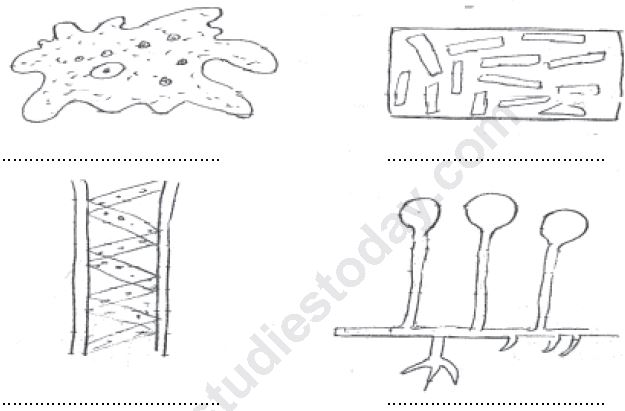
2) Give one word for the following statements :-
a) The organisms which we cannot see with naked eyes. .........
b) Bacteria which promotes the formation of curd. .........
c) The medicines used to kill or stop the growth of micro organisms. .........
d) Cholera, common cold, chicken pox and tuberwlosis is are examples of .........
e) Malaria is caused by .........
3) Complete the following table.
Human&Disease Casual Organism Mode of Transmission
Measles ............................. AirTyphoid Bacteria .............................
Malaria ............................. Mosquito
Polio Virus .............................
Tuberculosis ............................. Air
4. After studying Nitrogen - Cycle, Answer following Questions
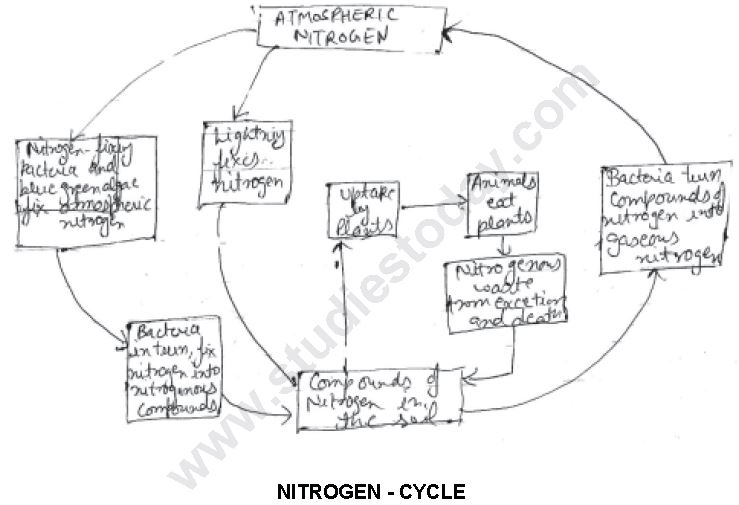
a) Which orgainsm converts atmospheric nitrogen into nitrogenous compounds. .........................
b) Which gas is fixed by lightning.
5. Fill in the blanks :
i) Conversion of sugar into alcohol is called ________________.
ii) Atmosphere has _______________% of nitrogen gas
iii) Yeast produces _______________ gas during respiration.
iv) During Pasteurisation, milk is heated upto _______0c for ________secs.
Free study material for Science
CBSE Class 8 Science Worksheets for Chapter 02 Microorganisms Friend or Foe
Download Chapter Worksheets: Class 8 Science
Access structured practice worksheets for Chapter 02 Microorganisms Friend or Foe aligned with the 2026 CBSE curriculum. These downloadable exercises for Class 8 Science help students build accuracy and reinforce core concepts for upcoming school tests.
Concept Clarification for Chapter 02 Microorganisms Friend or Foe
Designed around the official curriculum for Class 8 Science, these practice sheets guarantee standard compliance. Reviewing step-by-step solutions after completion sharpens your accuracy and clarifies complex sub-topics within Chapter 02 Microorganisms Friend or Foe.
Effective Revision Strategies for School Exams
Wrap up your chapter revision by testing your knowledge against standard objective question formats. Explore our full library of free, up-to-date printable assignments to maximize your academic results in upcoming CBSE evaluations.
FAQs
You can download the latest chapter-wise printable worksheets for Class 8 Science Chapter 02 Microorganisms Friend or Foe for free from StudiesToday.com. These have been made as per the latest CBSE curriculum for this academic year.
Yes, Class 8 Science worksheets for Chapter 02 Microorganisms Friend or Foe focus on activity-based learning and also competency-style questions. This helps students to apply theoretical knowledge to practical scenarios.
Yes, we have provided solved worksheets for Class 8 Science Chapter 02 Microorganisms Friend or Foe to help students verify their answers instantly.
Yes, our Class 8 Science test sheets are mobile-friendly PDFs and can be printed by teachers for classroom.
For Chapter 02 Microorganisms Friend or Foe, regular practice with our worksheets will improve question-handling speed and help students understand all technical terms and diagrams.