

Class 8 Science Practice Sheet: CBSE Class 8 Science Conservation Of Plants And Animals Worksheet
Explore structured practice materials through the CBSE Class 8 Science Conservation Of Plants And Animals Worksheet. Tailored for Class 8 learners, utilizing these Science worksheets ensures thorough preparation and strengthens problem-solving accuracy before final school evaluations.
Download Chapter 07 Conservation of Plants and Animals Worksheet PDF with Answers
Navigate directly to the solved Science worksheets using the digital viewer below. Each practice set includes detailed step-by-step solutions, allowing students to instantly cross-check their work and identify areas requiring further revision.
Question. Your friend finds a plant with a vascular system and roots, but no seeds. You tell her it is a __________.
(a) moss
(b) fern
(c) gymnosperm
(d) angiosperm
Answer : B
Question. Night-blooming flowers often LACK which of these?
(a) colours
(b) strong scent
(c) pollen grains
(d) (nothing - they are no different from day-blooming flowers)
Answer : A
Question. Which species was the first to become extinct?
Answer the question with the information given in the diagram below. Letters P through Y represent different species of organisms.

(a) R
(b) S
(c) T
(d) V
Answer : B
Question. Which species has managed to successfully remain unchanged through the years?
Answer the question with the information given in the diagram below. Letters P through Y represent different species of organisms.
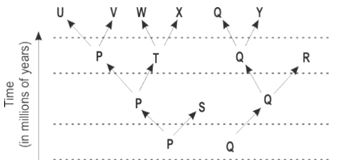
(a) P
(b) Q
(c) U
(d) Y
Answer : B
Question. Most flowers bloom in the day and are brightly coloured. Compared to day-blooming flowers, it is likely that night-blooming flowers __________.
(a) are brighter but not so strongly scented
(b) are not as bright but more strongly scented
(c) are not as bright and not so strongly scented
(d) (follow no comparable pattern of brightness or scentedness )
Answer : B
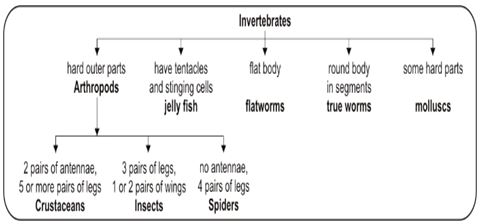
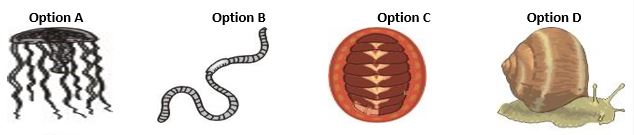
Question. Among the following which would classify as a jellyfish?
Look at the flow chart given below and answer the question.
Answer : A
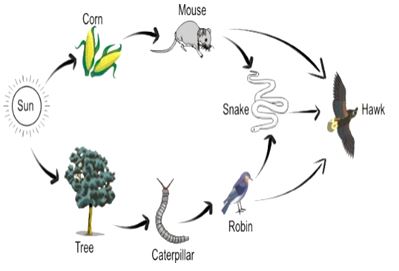
Question. The pesticide DDT accumulates in the fatty tissue of animals and is transferred along food chains. DDT's concentration increases along each link of the food chain. Which of the following organisms in the food web would accumulate the highest concentration of DDT?
Look at the food web given here and answer the question.
(a) corn
(b) mouse
(c) snake
(d) Hawk
Answer : D
Question. The graph given shows the population of two species ladybirds and aphids over time. Which of these appears to be a possibility based on this graph?
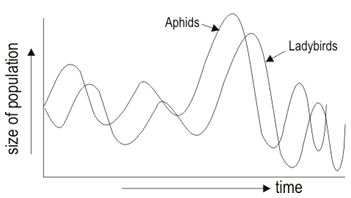
(a) Ladybirds probably feed on aphids
(b) Aphids probably feed on ladybirds
(c) Ladybirds and aphids do not feed on each other
(d) Nothing can be said about them based on this
Answer : A
Question. The Wildlife Institute of India survey reveals that 70-80% of individual freshwater marshes and lakes in the Gangetic plains have been lost in the last five decades. At present only 50% of India's wetlands remain. Which of the following is a NOT a cause for the disappearance of wetlands?
(a) Increasing urbanization and industrialisation
(b) Increased tree-cutting and deforestation
(c) Increase in migratory bird population
(d) Recovery of marsh land for agriculture
Answer : C
Question. Use the information given in the picture and answer the following question. Which among the following statements is a VALID conclusion?
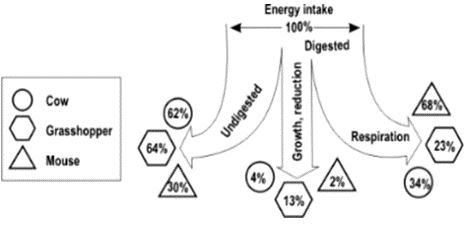
(a) The total energy intake by each of these animals is the same.
(b) A mouse needs more energy for growth and reproduction than a cow.
(c) For these animals, the undigested component is more than that used for growth/reproduction.
(d) A Grasshopper uses a very small part of the energy from digested food for respiration.
Answer : C
Question. A desert is a region that receives very little rainfall. Not all deserts are hot - cold deserts occur in temperate regions at high latitudes.
Which of the following temperature - rainfall graphs corresponds to a desert? [In these graphs the line refers to the temperature and the bars refer to the rainfall]
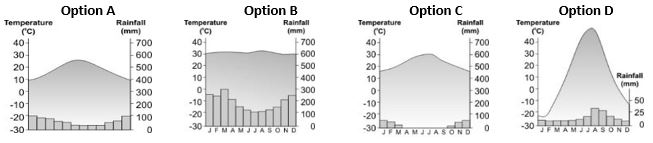
Answer : C
Question. Study the flowchart shown and also see the four types of leaves marked P, Q, R and S. Which of these correctly identifies them?
| Alternate simple | Alternate compound | Opposite simple | Opposite compound | |
| A | P | Q | R | S |
| B | Q | P | S | R |
| C | Q | S | R | P |
| D | P | S | Q | R |

(a) A
(b) B
(c) C
(d) D
Answer : D
Question. The cross section of a flower is shown below. Which letter correctly represents the part of the flower where the pollen grains are transferred?
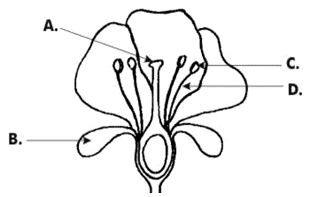
(a) A
(b) B
(c) C
(d) D
Answer : A
Question. K and L are likely to be
Observe the food web shown below and answer the question.
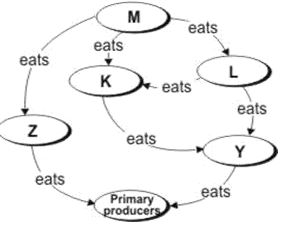
(a) Organisms that feed on plants.
(b) Organisms that feed on other animals.
(c) Organisms that feed on plants as well as animals.
(d) Non-living objects.
Answer : B
Question. Identify the list below that contains only INVERTEBRATES.
(a) crabs, turtles, tortoises, whales.
(b) fish, spiders, men, monkeys
(c) sponges, scorpions, crabs.
(d) centipedes, earthworms, crocodiles
Answer : C
Question. Given below is an incomplete food chain. Identify the right animals from the list given to complete the food chain.
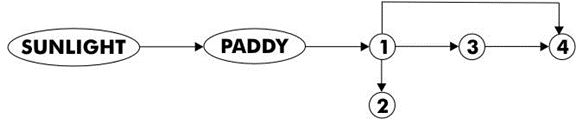
(a) 1-rat, 2-cat, 3-snake, 4-hawk
(b) 1-rat, 2-snake, 3-cat, 4-hawk
(c) 1-rat, 2-hawk, 3-snake, 4-cat
(d) 1-rat, 2-hawk, 3-cat, 4-snake
Answer : A
Question. A girl found the skull of an animal. She did not know what the animal was but she was sure that it preyed on other animals for its food. What clue led to this conclusion?
(a) The eye sockets faced sideways.
(b) The skull was much longer than it was wide.
(c) Four of the teeth were long and pointed.
(d) The jaws could move sideways as well as up and down.
Answer : C
Question. Observe the food web shown here. Which list contains all the CONSUMERS in this food web?
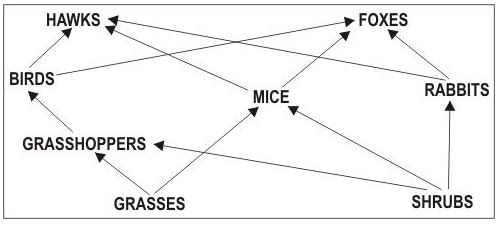
(a) Grasses, shrubs
(b) Grasses, shrubs, grasshoppers, mice, rabbits
(c) Hawks, foxes,Grass
(d) Grasshoppers, mice, rabbits, birds, hawks, foxes
Answer : D
Question. An armadillo is a small animal. Sometimes, it curls up, and then its armored body looks like a ball. A coral snake can curl its tail into a tight spiral and hold it up. This attracts attention to its tail, protecting its head. Under what situation is it likely that the animals behave in the way described above?

(a) When it gets very cold.
(b) When they have to protect themselves.
(c) When they have to attack enemies.
(d) When they are hibernating.
Answer : B
Question. Shown here is a food web. Study it carefully and answer questions.
Which of the following characteristics is shown by the members of level II.
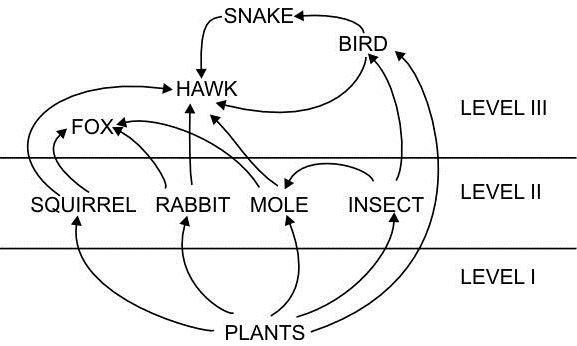
(a) They are animals.
(b) They feed mostly on plants.
(c) They are eaten by plants.
(d) They make their own food.
Answer : B
Question. Which of the following is a probable consequence of a decrease in the number of trees on Earth?
(a) An increase in the concentration of atmospheric ozone
(b) A decrease in the amount of ultraviolet light reaching Earth's surface
(c) An increase in silt found in Earth's rivers
(d) A decrease in silt found in Earth's rivers
Answer : C
Question. Plants have unique features that help them fit into the environment they live in. Which among these is NOT an illustration of the above statement?
(a) Lotus leaves have a wax like coating on their upper surface
(b) A submerged water plant hydrilla has finger like leaves.
(c) Money plant is a climber.
(d) Cactus has leaves reduced in size.
Answer : C
Question. Shown here is an aquatic food web. According to the figure, who are the competitors for 'Big Fish'?
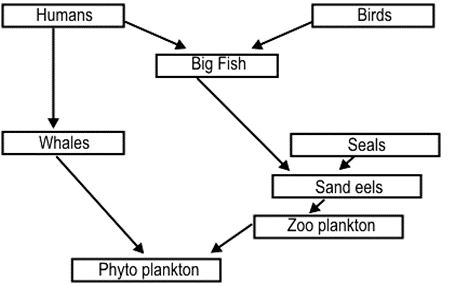
(a) Humans and birds only
(b) Sand eels and seals only
(c) Humans, birds and sand eels only
(d) Seals only
Answer : A
Question. Which of these cannot be considered a direct effect of increase in human population?
(a) Increase in number of new micro-organisms.
(b) increase in the area of deforested land.
(c) increase in the amount of carbon dioxide in the air.
(d) increase in the number of people below poverty line.
Answer : A
Question. Which of the following parts is present in a plant cell but absent in an animal cell?
(a) Centriole
(b) Nucleus
(c) Cytoplasm
(d) Cell wall
Answer : D
Question. Cartilage is a tough, elastic, fibrous connective tissue found in various parts of the body. Which of these is a place where cartilage is found?
(a) Backbone
(b) Femur (thigh bone)
(c) Finger bones
(d) The tip of the nose
Answer : D
Question. The increase in rate of respiration observed probably serves what purpose?
(a) More glucose is delivered to the muscles as their energy source
(b) More haemoglobin is delivered to the muscles as their energy source.
(c) More oxygen is delivered in order to break down glucose to do work.
Answer : C
Question. Plants have unique features that help them fit into the environment they live in. Which among these is NOT an illustration of the above statement?
(a) Lotus leaves have a wax like coating on their upper surface.
(b) A submerged water plant hydrilla has finger like leaves.
(c) Money plant is a climber.
(d) Cactus has leaves reduced in size.
Answer : C
Question. When Sheila's blood was tested, none of the three samples clotted. What is her blood group?
(a) A+
(b) AB-
(c) O-
(d) There is an error in the results.
Answer : C
1. Deforestation means
a) Cleaning of forests
b) To grow plants
c) To look after plants
d) None of these
2. The plants found in particular area are termed as .
a) Fauna
b) Flora
c) Endemic species
d) wild animals
3. Red data book keeps the record of
a) Endangered species
b) Sanctuary
c) Plants
d) Animals
4. Project - Tiger means.
a) Hunting of tigers
b) Rearing of tigers
c) Survival & maintanance of tigers
d) All of these
5. Write one word for the following sentences.
(Hint : Ecosystem, National Park, Endangered species, Biosphere reserve, Sanctuary)
a) Animals whose numbers are diminishing to a level and they might face extinction ________
b) All the plants, animals and micro-organism in an area along with non-living component ____________.
c) An area where animals are protected from any disturbance to them and their habitat ___________.
d) An area reserved for wild life, where they can freely use the habitats & natural resources _____________.
e) A large area of protected land for conservation of wild life, plant & animal resourceS.
6. Do you Know?
a) How many tress are cut to get I tonne paper ________________.
b) How many times a paper can be recycled __________________.
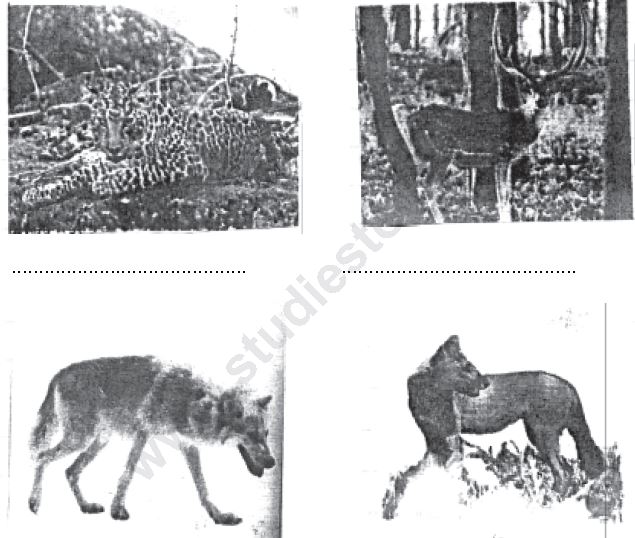
7. Some animal and given below which belong to pachmarhi biosphere reserve, identity them and write their names.
CONSERVATION OF PLANTS AND ANIMALS
- Deforestation : The loss or continual degradation of forest habitat due to natural or human activities.
- Afforestation : Planting of trees on a large scale to regenerate forest.
- Desertification : The process of conversion of fertile land into deserts due to the removal of top layer of soil.
- Ecosystem: The basic unit of ecology which consists of the biotic and abiotic components.
- Reforestation : It is the restocking of the destroyed forests by planting new trees.
- Fauna : The community of animals in a specific region or habitat.
- Flora : The plant life of particular area.
- Endemic species : The species that are exclusively found in any geographical unit like a state, zone or a country or a habitat type are referred as endemic species.
- Sanctuaries : The protected area which is reserved for the conservation of animals only and human activities upto a certain extent are allowed in these areas.
- National Park : The large and diverse reserves to protect whole sets of ecosystem including flora, fauna, landscape and historical objects of an area are termed as national park.
- Biosphere Reserve : A biosphere reserve is a unique concept which includes one or more protected areas and surrounding lands that are managed to combine both conservation and sustainable use of natural resources.
INTRODUCTION
We have read in earliar classes that humans use a number of natural resources for their survival. However, as human population has been increasing at a high rate, the natural resources are also being used in greater quantity than ever before. With recent advances in science and technology, people now have a higher standard of living. As a result, there is a far great demand for the natural resources.
It is for this reason that the natural resources must be 'conserved' so that there will be enough resources available for the future generations. It must be clearly understood that conservation does not mean that we have to stop the use of these resources completely. It only means that we have to use the resources wisely and judiciously. conservation is the wise and judicious use of resources. The overuse or wastage of resources would lead to imbalanaces among the various components of nature.
Aims of conservation
- To preserve the quality of environment, i.e., maintain a pollution-free environment.
- To ensure a continuous yield of useful plants, animals and materials for generations to come.
Importance of Forests
- Forests are natural habitat of wild animals and plants.
- Roots of trees keep the topsoil bound and prevent it from being washed away through water erosion as well as through wind erosion.
- Trees give a large amounts of water by the process of transpiration. This helps in formation of rain clouds and bringing fresh water to the earth.
- Forests help in maintaining oxygen and carbondioxide levels in atmosphere.
- Forests also act as saviour from various solar radiations.
- Forests provide raw material for paper industry.
- Forests have various protective functions like prevention of drought, protection against wind, cold, noise, radiations and even conservation of soil and water.
- Forests are important for production of timber, bamboos, food and wide variety of compounds like resins, alkaloids, essential oils, latex and various pharmaceutical products.
- Forests are home to several kinds of plants and animals. The number and type of plants and animals found in a forest depends on the soil and climatic conditions of the region. For example, a type of forests called the rainforests are believed to house of millions of the species of plants and animals, some of them yet undiscovered by human beings. Rainforests cover less than 6% of the earth's total land surface, but are home for up to almost three fourths of all known species of plants and animals.
DEFORESTATION
The loss or continual degradation of forest habitat due to natural or human activities is called deforestation.
OR
Large scale cutting of trees is called deforestation
Causes of Deforestation
Trees are cut in the forest on a large scale to clear the land for some useful purposes listed below.
- Procuring land for agricultural use.
- Procuring timbers for building houses, roads, railway tracks, dams, etc.
- Procuring land for setting up industries and mining.
- Procuring land for setting up special economic zones (SEZ).
- To obtain forest products like wood, food, rubber, honey, resins, etc.
- Overgrazing.
Natural Causes of deforestation
(i) Forest fire (ii) Drought
CONSEQUENCES OF DEFORESTATION
- Flood and Droughts : Trees check the flow of rainwater. When mountain slopes and uplands are deforested, the water rushes down and causes rivers to overflow and flood in lower lands. The silt carried by the water from denuded slope chokes rivers and aggravates the problem of flooding. Siltation of rivers not only causes floods, but harms fisheries and waterways. Deforestation can lead to droughts as well. Forests hold water and release it slowly. When they are cut down, the water rushes down very fast, and the uplands, especially, are deprived of water soon after the rains. By holding water and improving the water-retaining capacity of the soil, forests also help recharge groundwater. In India, deforestation of the Himalayas has changed perennial streams into seasonal streams, which run out of water soon after the monsoon. It has causes an acute shortage of water even in Cherapunji (in Meghalaya), which is one of the wettest place in the world.
- Induces More Soil Erosion : The top soil is easily carried away by wind or water in the absence of tree cover, thus increases soil erosion. The soil thus loses its fertility. Gradually a fertile land gets converted into a desert. It is called desertification.
- Imbalance of Atmospheric Gases
- Change in Climate : Most (over 95%) of the warter absorbed by trees from the soil is released into the air during transpiration. This increases rainfall and brings down temperature in the region around a forest. Naturally, when a large area is deforested, there are changes in the climate of that area. Deforestation can also lead to global changes in the weather pattern by increasing the amount of carbon dioxide in the air. This is because trees absorb carbon dioxide from the air. Cutting down trees means a loss of this service. Also, when trees are used as fuel, the carbon locked in them is released into the air as carbon dioxide. Even when they are used as timber or for other purposes, the branches and leaves rot and carbon dioxide is released into the air. It is estimated that the destruction of tropical forests alone accounts for more than 25% of the carbon dioxide released into the air annually. Global warming is believed to be causing uncharacteristically frequent and severe cyclones, floods, droughts and forest fires across the world. It is also affecting plants and animals in the polar region. According to one study, for example, the number of emperor penguins in the Antarctic has reduced alarmingly due to global warming.
- Natural Calamities : Deforestation increases the chances of natural calamities such as floods, droughts, landslides, cloudburst, etc.
- Destruction of Natural Habitat : Cutting of trees on a large scale destroys the natural habitat of several plants, animals and microorganisms. This disturbs the ecological balance in nature. Several food chains and food webs get affected due to this imbalance. The destruction, degradation or modification of forests endangers the survival of the organisms in it. It may even cause some to become extinct (disappear) from a region, a country or the world. Habitate destruction often has a direct impact on the lives of the people living near forests. It makes wild animals stray into villages and destroy crops, kill livestock or even attack people. It also disturbs natural pollinators, like birds, bats, butterflies and bees. The pollinators move away to other areas and stop pollinating the crop and fruit plants cultivated near forests.
- Scarcity of Forest Products
- Reducing Water Table : In the absence of tree cover, rainwater cannot infiltrate into the ground to recharge the aquifer. It leads to the lowering of ground water level in the absence of replenishment.
STEPS FOR THE CONSERVATION OF FORESTS
The people living in cities, villages, forests, etc., must be educated about the importance of forests through Government and Non-Government social agencies. As a matter of fact, people must realise that cutting a tree is a crime like killing a human being or an animal. The forst department must be highly organised. They should see to it that no illegal felling of trees take place and the criminals must be brought to justice.
As we need wood for various purposes, we cannot altogether stop cutting the forests. Therefore, Forest Department must earmark the trees in a given forest, so that only dead or very old trees are cut. Furthermore, for cutting each tree, two or more tree saplings should be planted so that in 10 years or more they grow into fully grown trees.
As the forests provide grass for the domestic animals, people living around the forest let their animals in it for grazing. This should be altogether stopped. It is because the grazing animals, especially the goats and the sheep uproot the grass. This leads to soil erosion. Instead, the grass should be cut manually and then fed to the animals. Furthermore, the grazing animals trample the young saplings, thereby, slowing down the growth of trees.
In summer, the grass in the forest is very dry. Any spark can set it on fire. Thus, the people living in the forest must be taught not to leave uncovered fire or throw butts of burning cigarettes or "bidis" carelessly in the dry grass. Any forest fire leads to large economic loss and makes the land infertile.
Timberwood should be used only where it is absolutely necessary. For example, doors, windows, chairs, tables, etc., can be easily made from plastics and they are durable like wood. Large amounts of wood and grass are used in the manufacture of paper. The wood and grass are converted into pulp by chemicals. The pulp is then converted into paper by the use of machines. The paper so produced finds use in printing books, newspapers, copy books and for packaging. Every year vast tracts of forest are cut to prepare paper. This leads to deforestation. To reduce the deforestation we must recycle the waste paper, by again converting it into pulp. This no doubt reduces the quality of paper, but can be used for packaging. Furthermore, in order to reduce deforestation, the cleared forest land should be replanted with fast growing grass and bamboo. This will meet future requirements of paper industry. Even the old cotton clothes should be collected and sent to paper mills for making pulp and the paper.
CONSERVATION OF FORESTS
The maintenance and upkeep of forest is called forest conservation. The following steps should be undertaken to conserve them.
- Massive afforestation work should be undertaken to cover large areas of land with appropriate trees.
- Felling of trees in the forest should be banned.
- Every piece of barren land should be planted with trees.
- Weeds, damaged trees, crowded trees, diseased trees, etc. should be removed.
- Forest fire must be prevented.
- Forest nurseries should be established on a large scale.
Biodiversity or Biological Diversity
If you look around yourself, you may get to see several different kinds of plants and animals. A typical neighbourhood park may be home to a variety of flowers, each differing in size, shape, colour, and smell. The kind of trees found here could range from big trees such as the banyan tree to small bushes that may have been planted to border the pavement.
Biodiversity refers to existence of a wide range of different types of organisms in a given place at a given time.
Variety of life on earth and variability among living organisms.
OR
Variety of life forms and habitats found in a particular area.
Uses of Biodiversity
- Source of food and improved varieties : Biodiversity is used to modern agriculture in three ways as a source of
- (a) New crops
- (b) Material for breeding improved varieties
- (c) New biodegradable pesticides.
- Drugs & Medicines : e.g. Morphine : Papaver somniferum [Analgesic], Quinine- Chincona ledgeriana [Treatment of malaria], Taxol- Taxus brevifolia [Anticancer drug].
- Aesthetic and cultural benefits : e.g. Ocimum sanctum- Tulsi, Ficus religiosa- Pipal, Prosopis cineraria- Khejri.
- Ecosystem services
Project Tiger
'Project Tiger' is one of the successful operations for conserving wildlife in India. There were about 40,000 Bengal tigers in 1910. There was a sharp decline in their numbers to 1827 in 1972. The main reasons for the extinction of tigers are hunting, deforestation and taming of rivers for human needs. Realizing this decline, a project named 'Project Tiger' was initiated in 01 April 1973. The project was funded by the World Wide Fund for Nature. The project focussed on protecting tiger habitats by creating sanctuaries and extending the existing ones. Under this project, there are 18 tiger reserves in India.
- Jim Corbett National Park (Uttaranchal)
- Periyar National Park (Kerala)
- Ranthambore National Park (Rajasthan)
- Kanha National Park (Madhya Pradesh)
- Sariska National Park (Rajasthan)
- Sunderban National Park (West Bengal)
Species : A group of population which are capable of interbreeding. This means that the members of a species can reproduce fertile offspring only with the members of their own species and not with members of other species.
Endemic Species : Those species of plants and animals which are found exclusively in a particular area.
OR
Plant and animal species confined to specific geographic areas are called endemic species.
Sal, Wild mango, Bison, Indian giant squirrel and flying squirrel are endemic species in Pachmarhi Biosphere Reserve.
Some Endemic Species of India
1. Lion-tailed Macaque (Western Ghats)
2. Malabar Parakeet (Malabar region)
3. Nilgiri Langur (Nilgiri hills)
4. Nilgiri Tahr (Nilgiri hills)
WHO CONSERVES ?
Conserving the biodiversity on earth is the duty of every human being. To promote conservation, government and non-government bodies at the international, national, and local levels are constantly organizing awareness programmes and issuing rules and regulations to protect the existing forests and wildlife.
The International Union for Conservation of Nature and Natural Resources (IUCN), now known as the World Conservation Union, works towards assessing the global conservation status of plant and animal species. IUCN maintains a comprehensive list known as the IUCN Red List of Threatened Species. Here, species are classified into nine groups, set through criteria such as rate of decline, population size, area of geographic distribution, and degree of population and distribution fragmentation.
Red Data Book : It is a record of animals and plant species which are in danger. On the basis of degree of threat 9 red list categories have been given :
- (i) Extinct
- (ii) Extinct in the wild
- (iii) Critically Endangered.
- (iv) Endangered
- (v) Vulnerable
- (vi) Near Threatened
- (vii) Least concern
- (viii) Data deficient
- (ix) Not evaluated
- Head office of IUCN - Morges in Switzerland.
- Red Data Book listed about 11096 species in 2000. Animal species - 5485, Plant species - 5611.
CAUSES OF EXTINCTION AND DEPLETION OF WILDLIFE
- Indiscriminate Hunting : Several species have become extinct due to their hunting by man for food, pleasure and animal products. The examples are disappearance of the bird dodo in Mauritius and the cheetah in India.
- Destruction of Natural Habitat : Man has destroyed the natural habitats of wildlife for his settlement, cropping, plantation, mining and raising of dams, overgrazing by domestic animals, etc.
- Introduction of Exotic Species : Man not only destroys the natural habitat, but also sometimes changes the structure of the biotic community of a place by introducing exotic species of his interest. Such species compete with the native species for food and space and may threaten the later will extinction. For example, the introduction of exotic trout and bass fish in the USA is endangering the native species of fish.
- Forest Fires : Setting the forest on fire not only kills the useful animals but also causes large scale destruction of the plant life.
- Overexploitation of Natural Resources : Several animals and plants are valuable sources of food and other materials. Fish, prawns and crabs constitute an important part of human food. Man has, however, over exploited these resources. Overfishing in sea is causing a grave situatoin and the picture is not encouraging with respect to fresh water fishing. The rate of consumption of fish is greater than its replenishment.
- International Trade of Animal Products
- Legal lapse : The failure of enforcement of the existing laws of wildlife management is yet another reason for the rapid depletion of wild life.
- Human Ignorance : Man is mainly responsible for depletion and extinction of wildlife on the earth. This is largely due to ignorance of common man regarding the value of wildlife and the probable consequences of the disappearance of wildlife to man himself.
Poaching : Illegal hunting of animals is called poaching. Organized poaching by anti-social elements threatens extinction of a number of species, especially those which have valuable body parts. These include:
- (A) Body parts valued as ornaments : Examples include elephants for ivory and turtles for shells.
- (B) Body parts used in traditional medicine (particularly in Asia) : Examples include the rhinoceros for horns and tigers for bones.
- (C) For fur and hides : Animals killed for their hides include deer and cattle for leather, alligators and snakes for their skins, and wild cats, minks, and bears for fur.
- (D) The Tibetan antelope, also known as chiru, is mainly killed for its fine fleece, which is popularly known as shahtoosh. Shahtoosh shawls are very expensive, and considered a fashion statement by many. To check the population of the Tibetan antelope, a ban has been declared in India on the sale and usage of Shahtoosh shawls.
Threatend Species : The living species which have been greatly reduced in their number are called threatend species.
Endangered Species : These are the species which face immediate threat of extinction. Their number has been drastically reduced to a critical level either due to their indiscriminate hunting or due to destruction of their habitats. If the same factors continue, these species would soon become extinct. Indian rhino, Asiatic lion & Great Indian bustard.
Endangered species in Satpura National Park : Lion, Elephants, Wild buffaloes and Barasingha.
Vulnerable Species : These are species that are declining but still have sufficient number of individuals in their natural habitat. However, in near future they might represent the category of endangered species, in case the causal factors for their decline are not removed. Musk deer, Sambhar, Spotted deer and Black buck.
Rare Species : These are localised in certain geographical area and exhibit scattered population considering the global environment. Thus their overall population in the world is small. In future these species may enter into the category of vulnerable or endangered species. Indian elephant, Wild buffalo and Asiatic wild ass.
PROTECTED SPECIES OF INDIAN WILDLIFE
The following wild animals have been enlisted as threatened and protected species in India.
1. Musk deer 2. Bharat Swamp Deer 3. Duck 4. Horned Pheasant 5. Monal Pheasant 6. Great Indian Bustard 7. Indian Gazelle or Chinkara 8. Pea fowl 9. Gharial 10. Marsh crocodile 11. Python 12. Leathery turtle 13. Albino snow leopard
- Karnataka Government had launched "Project Elephant" to save Asian elephants in the states.
- One of the most important factor that threatens wildlife today is habitat destruction due to encroachment.
- India contains 172 species of animals considered globally threatend or 2.9% of the world's total number of threatened species. This includes 53 species of mammals, 69 of birds, 23 of reptiles and 3 species of amphibians.
- India contains globally important population of some of Asia's rarest animals such as the Bengal fox, Marbled cat, Asiatic lion, Indian elephant, Asiatic wild ass, Indian rhinoceros, Wild asiatic water buffalo etc.
PROTECTED AREAS IN INDIA
To protect and conserve the wildlife in India the government has passed the Wildlife Protection Act in 1972.
(A) National park : A national park is characterised by an area reserved for the betterment of wildlife where foresting, grassing or cultivation is prohibited. It protects the flora and fauna of the reserved area. Private ownership is not allowed in a national park.
OR
Areas reserved for wild life where they can freely use the habitats and natural resources. There are 97 national parks in India.
- World's first National park - Yellow Stone National Park, Kew [England]
- India's first National park - Jim Corbett National Park, Nainital [Uttaranchal]
- Kaziranga National Park - Assam
- Kanha National Park (M.P.) - Tiger
- Gir Forest National Park (Gujarat) - Asiatic Lion, Chital, Sambhars.
- Khangchendzonga National Park- Gangtok famous for protection of Snow Leopard (Panthera uncia)
(B) Sanctuaries : A wildlife sanctuary is aimed at protecting the wild animals. In a wildlife sanctuary, cutting of trees for timber and other forest products is permitted to private operators with specific instructions to ensure that the well being of wild animals does not suffer. At present there are 508 santuaries in India.
OR
Areas where animals are protected from any disturbance to them and their habitat.
- Keoladeo Ghana Bird Sanctuary, Bharatpur (Rajasthan) Famous for migratory bird - Siberian Crane, Egrets.
- Shikari Devi Sanctuary- Mandi (Himachal Pradesh) Black bear, Snow leopard, Flying fox, Barking deer.
- Dachigam Sanctuary, Srinagar (Jammu & kashmir) Hangul- Kashmir stag.
- Annamalai Sanctuary, Coimbatore [Tamilnadu] Tiger, elephants
- Desert National Park - Jaiselmer, Rajasthan
- Sariska National Park - Alwar, Rajasthan
(C) Biosphere Reserves : A biosphere reserve is designed to provide protection to the wild flora and fauna, the domesticated animals and plants, as well as to the traditional life styles of the tribals of the area.
OR
Large areas of protected land for conservation of wild life, plant and animal resources and traditional life of the tribals living in the area. At present there are 14 biosphere reserves in India.
This concept was launched by MAB [Man and Biosphere] programme in 1971. A biosphere reserve is much larger than a national park or a sanctuary. There are 3 zones of biosphere Reserve. (1) Core Zone (2) Buffer Zone (3) Manipulating zone or Transition zone.
Important Biosphere Reserves in India
1. Nilgiri Biosphere Reserve
2. Nanda Devi Biosphere Reserve
3. Uttarakhand Biosphere Reserve
4. Nokrok Biosphere Reserve
5. Sundarbans Biosphere Reserve
(D) Zoological Park : Zoos are places where animals and birds are protected by keeping them in special cages or enclosures for public exhibition.
(E) Botanical Gardens : Botanical gardens have been established to conserve rare and threatened plants. There are about 1600 botanical gardens all over the world.
CONSERVATION OF WILD LIFE
(A) Ex-situ Conservation : The protection of wild life in other than their natural habitate e.g., zoos and botanical gardens, Other examples of Ex-situ conservation are - (a) Gene banks (b) Germ plasm bank. (c) Seed bank.
(B) In situ conservation : It is the protection of species (wild life) in their natural habitat e.g., National parks.
Wildlife can be conserved by :
(a) Preventing illegal hunting of animals.
(b) Preventing sale and export of animal products and hunting of rare and endangered animals.
(c) Setting up wildlife sanctuaries and national parks.
(d) Reforestation.
MIGRATION
The movement of animals in large numbers from one place to another and back to their original home is called migration. Animals migrate during winter and breeding seasons. Birds are well known for their long migratory flights. The Arctic tern is a sea bird which travels from the north pole to the south pole each year. Siberian cranes travel large distances and come to India during winter. Migration often provides the migrating species with more favourable conditions of temperature, food, or water. For instance, bats of cold and temperate regions are known to migrate to warmer areas during winter.
Reforestation : Restocking of the destroyed forests by planting new trees is called reforestation.
- The planted trees should generally be of the same species which were found in that forest.
- We should save, reuse the used paper and recycle it because 17 full grown trees required to make one tonne of paper. And by it we cannot only save trees but also save energy and water needed for manufacturing paper.
EXERCISE - I (FOUNDATION CORNER)
Question. 1. Which of the following is a famous bird sanctuary of Rajasthan ?
(a) Kaziranga
(b) Keoladeo
(c) Pariyar
(d) Bandhavgarh
Answer: A
Question. 2. Which of the following is killed for its’s horn ?
(a) Elephant
(b) Black rhino
(c) Peacock
(d) Tiger
Answer: B
Question. 3. Which national park preserves Asiatic lions ?
(a) Gir
(b) Keoladeo
(c) Periyar
(d) Corbett
Answer: B
Question. 4. How many botanical gardens are there all over the word ?
(a) 1632
(b) 62
(c) 1600
(d) 432
Answer: A
Question. 5. What is the expanded form of IUCN ?
(a) International Union for Conservation of Nature and natural Resources
(b) Indian Union for Conservation of Nature and National Resources
(c) International Union for Culture and nature
(d) Indian Union for Culture and Natural Resources
Answer: C
Question. 6. Which of the following is a threatened species ?
(a) Dodo
(b) Dinosaur
(c) The giant panda
(d) All of the above
Answer: A
Question. 7. Kaziranga sanctuary is located in -
(a) Kerala
(b) Gujrat
(c) Bharatpur
(d) Assam
Answer: C
Question. 8. Blue whale has been killed for -
(a) ivory
(b) skin
(c) oil and blubber
(d) bones
Answer: D
Question. 9. The diverse plant species found in their natural surrounding is called -
(a) flora
(b) fauna
(c) both of above
(d) none of above
Answer: C
Question. 10. Dinosaurs can be included in which of the following category ?
(a) Threatened
(b) Extinct
(c) Endangered
(d) Vulnerable
Answer: A
Question. 11. Chipko movement is related to -
(a) conservation of trees
(b) conservation of fossils
(c) conservation of soil
(d) conservation of water
Answer: B
Question. 12. Hot spots are those area where
(a) Endemic species is found
(b) Minium biological diversity is observed
(c) Climatic temparature is high
(d) Maximum biological diversity is found
Answer: A
Question. 13. Environment in which an animal lives is called its
(a) habitat
(b) home
(c) reservoir
(d) resort
Answer: A
Question. 14. Indiscriminate cutting of forests is called
(a) afforestation
(b) reforestation
(c) deforestation
(d) none of these
Answer: A
Question. 15. Species which are at the verge of extinction are called
(a) extinct
(b) endangered
(c) endemic
(d) none of these
Answer: C
Question. 16. Species which are restricted only to specific area and not in any other geographical area are called
(a) exticnt
(b) endangered
(c) endemic
(d) none of these
Answer: B
Question. 17. Natural causes of deforestation include
(a) forest fires
(b) lightning
(c) electric currents
(d) both (A) and (B)
Answer: C
Question. 18. Growing of plants in an area where forest existed earlier but has been removed is known as
(a) deforestation
(b) reforestation
(c) afforestation
(d) both (A) and (B)
Answer: D
Question. 19. The practice of clearing a part of a forest for cultivation and then moving on to a new part is called
(a) shifting cultivation
(b) crop rotation
(c) step farming
(d) monoculture
Answer: B
Question. 20. Which of the following are the uses of IUCN Red Data Book ?
(a) Developing awareness about the importance of threatened biodiversity
(b) Identification and documentation of endangered species.
(c) Providing a global index of the decline of biodiversity.
(d) All of these
Answer: A
Question. 21. Which of the following are living resources in nature?
(a) Flora
(b) Fauna
(c) Soil
(d) Both (A) and (B)
Answer: D
Question. 22. What is an endangered animal ?
(a) An animal on the verge of extinction.
(b) An animal which is extinct
(c) An animal that is dangerous to other animals
(d) An animal that is useful to other animals
Answer: D
Question. 23. How does our Government protect the rain forests of our country ?
(i) Prohibit the cutting of trees that are not mature enough
(ii) Trees that have been chopped down are replanted
(iii) Discourage the use of pesticides in agriculture.
(a) (i) and (ii)
(b) (i) and (iii)
(c) (ii) and (iii)
(d) (i), (ii) and (iii)
Answer: A
EXERCISE - II (COMPETITIVE CORNER)
Question. 1. More soil erosion occurs where there is-
(a) No rainfall
(b) Low rainfall
(c) High rainfall
(d) None of the above
Answer: C
Question. 2. Which is most suitable soil for plant growth ?
(a) Gravel
(b) Loam
(c) Sand
(d) Clay
Answer: B
Question. 3. Frequent floods in plains of Northern India is due to–
(a) Excessive rainfall
(b) Siltation of dams
(c) Deforestation in catchment areas
(d) Agriculture
Answer: C
Question. 4. Conservation refers to -
(a) Management of natural resources
(b) Judicious use of natural resources
(c) Protection of natural ecosystems
(d) All of the above
Answer: D
Question. 5. Soil conservation is –
(a) Aeration of soil
(b) Erosion of soil
(c) Protection of soil against loss
(d) Conversion of sterile soil into fertile soil
Answer: C
Question. 6. Removal of top fertile layer of soil by wind or water is called –
(a) Leaching
(b) Erosion
(c) Siltation
(d) Weathering
Answer: B
Question. 7. Soil erosion can be prevented by–
(a) Increase in bird population
(b) Afforestation
(c) Over-grazing
(d) Removal of vegetation
Answer: B
Question. 8. MAB stands for –
(a) Man and Biodiversity
(b) Mammals and Biosphere
(c) Man and Biosphere
(d) Man and Biology
Answer: C
Question. 9. What is the main cause of extinction of wild life ?
(a) Urbanisation
(b) Poaching
(c) Felling of trees
(d) All of the above
Answer: D
Question. 10. A National Park provides protection to -
(a) Flora only
(b) Fauna only
(c) Flora and fauna
(d) Entire ecosystem
Answer: D
Question. 11. Conservation refers to -
(a) Management of natural resources
(b) Protection of natural resources
(c) Proper use of natural resources
(d) All of the above
Answer: D
Question. 12. Deforestation is the major cause of-
(a) Environmental pollution
(b) Genetic erosion
(c) Desertification of habitat
(d) Depletion of natural resources
Answer: C
Question. 13. 'Red Data Book' provides information of :
(a) Threatened species
(b) Biota of Red Sea
(c) World flora
(d) World fauna
Answer: A
Question. 14. Forests control drought through-
(a) Increasing rainfall
(b) Functioning as water shed
(c) Large trees
(d) Retention of water and prevention of soil erosion
Answer: A
Question. 15. Plants and animals are best protected in-
(a) Sanctuaries
(b) Botanical gardens
(c) Zoos
(d) National parks
Answer: D
Question. 16. Forests-
(a) Maintain natural balance
(b) Control atmospheric pollution
(c) Prevent soil erosion
(d) All of the above
Answer: D
Question. 17. \( 5^{\text{th}} \) June is -
(a) World population day
(b) World health day
(c) World environment day
(d) World animal day
Answer: C
Question. 18. 'Chipko movement' is connected with-
(a) Project tiger
(b) Plant breeding
(c) Protection of environment including habitat and wild life
(d) Conservation of natural resources
Answer: C
Question. 19. A threatened species is-
(a) Rare
(b) Endangered
(c) Vulnerable
(d) All of the above
Answer: D
Question. 20. An example of in situ conservation is-
(a) Zoo
(b) Pond
(c) Biosphere reserve
(d) Seashore
Answer: C
Question. 21. Wildlife refers to :
(a) Any living organism kept in cage
(b) Any living organism present in sanctuary
(c) Any plant species growing in garden
(d) Any living organism in its natural habitat
Answer: D
Question. 22. The cause of extinction of species is :
(a) Man made forest fire
(b) Excessive grazing
(c) Inroduction of exotic species
(d) All of the above
Answer: D
Question. 23. Aim of conservation is :
(a) To preserve the quality of environment i.e. maintain a pollution - free environment.
(b) To ensure a continuous yield of useful plants, animals and materials for generations to come
(c) 1 and 2 both
(d) None of the above
Answer: C
Question. 24. How many megadiversity centres present in all over the world?
(a) 5
(b) 7
(c) 10
(d) 12
Answer: D
Question. 25. Asiatic lion protected in :
(a) Gir Forest National Park, Gujarat.
(b) Sunderban National Park, Westbengal.
(c) Kanha National Park, Madhya Pradesh.
(d) All the above
Answer: A
Question. 26. Which of the following is endangered species :
(a) Indian Rhinoceros
(b) Asiatic lion
(c) Blue whale
(d) All the above
Answer: D
Question. 27. We can conserve biodiversity by :
(a) Planting of trees should be undertaken
(b) Hunting of animals which is banned should be strictly enforced.
(c) Protected areas like National Parks, Wildlife sanctuaries and biosphere reserves should be established.
(d) All the above
Answer: D
Question. 28. Which of the following statement is incorrect :
(a) Project tiger was initiated on 1 April 1973
(b) Biosphere reserves are multipurpose protected areas.
(c) Sanctuaries are special protected areas for protection of wild animals.
(d) None of them
Answer: D
Question. 29. Which of the following is a biosphere reserve :
(a) Bandipure Sanctuary, Karnataka.
(b) Bharatpur Bird Sanctuary, Rajasthan.
(c) Kaziranga National Park, Assam
(d) Sunderban, West Bengal
Answer: D
Question. 30. Which of the following is the site of project tiger :
(a) Jim Corbett National Park, Uttaranchal.
(b) Periyar National Park, Kerala.
(c) Kanha National Park, Madhya Pradesh.
(d) All the above.
Answer: D
Question. 31. The main object of Man and Biosphere programme is to :
(a) Conserve representative samples of ecosystem
(b) Provide opportunities for education and training
(c) Provide appropriate sustainable managements of the living resources.
(d) All te above
Answer: D
Question. 32. Which of the following is killed for oil and blubber?
(a) Tiger
(b) Blue whale
(c) Chiru
(d) All of them
Answer: B
Question. 33. Which of the following is a wildlife sanctuary in Rajasthan?
(a) Ranthambore
(b) Periyar
(c) Kaziranga
(d) Bandhavgarh
Answer: A
Question. 34. Which of the following is a bird sanctuary?
(a) Ranthambore
(b) Periyar
(c) Keoladeo
(d) All of them
Answer: C, D
Question. 35. The black rhino is killed for its :
(a) Ivory
(b) Fur
(c) Horn
(d) Meat
Answer: D
Free study material for Science
CBSE Class 8 Science Worksheets for Chapter 07 Conservation of Plants and Animals
Daily Practice Questions for Class 8 Science
Explore reliable practice questions for Chapter 07 Conservation of Plants and Animals tailored for Class 8 Science learners. Use these structured worksheets to evaluate exam preparedness and strengthen problem-solving skills throughout the 2026 academic session.
Detailed Answers for Class 8 Science Chapter 07 Conservation of Plants and Animals
Built using official NCERT guidelines for Class 8 Science, these practice sheets provide reliable academic support. Cross-reference your completed work with our detailed solutions to learn standard answer-writing formats for CBSE exams.
Complete Your Chapter Revision
Follow up your worksheet practice by attempting the interactive online MCQ tests for Chapter 07 Conservation of Plants and Animals to evaluate your execution speed. All printable assignments and revision sheets on our platform are updated for the 2026 session and available free of charge.
FAQs
You can download the latest chapter-wise printable worksheets for Class 8 Science Chapter 07 Conservation of Plants and Animals for free from StudiesToday.com. These have been made as per the latest CBSE curriculum for this academic year.
Yes, Class 8 Science worksheets for Chapter 07 Conservation of Plants and Animals focus on activity-based learning and also competency-style questions. This helps students to apply theoretical knowledge to practical scenarios.
Yes, we have provided solved worksheets for Class 8 Science Chapter 07 Conservation of Plants and Animals to help students verify their answers instantly.
Yes, our Class 8 Science test sheets are mobile-friendly PDFs and can be printed by teachers for classroom.
For Chapter 07 Conservation of Plants and Animals, regular practice with our worksheets will improve question-handling speed and help students understand all technical terms and diagrams.