

Class 8 Science Practice Sheet: CBSE Class 8 Science Chemical Effect Of Electric Current Worksheet
Explore structured practice materials through the CBSE Class 8 Science Chemical Effect Of Electric Current Worksheet. Tailored for Class 8 learners, utilizing these Science worksheets ensures thorough preparation and strengthens problem-solving accuracy before final school evaluations.
Download Chapter 14 Chemical Effects of Electric Current Worksheet PDF with Answers
Navigate directly to the solved Science worksheets using the digital viewer below. Each practice set includes detailed step-by-step solutions, allowing students to instantly cross-check their work and identify areas requiring further revision.
1) Give some examples of good conductors and poor conductor liquids -
Good Conductor liquids Poor conductor liquids
.................................................... ....................................................
2) Fill in the blanks :-
i) Distilled water is _________________ of electricity.
ii) Bulb gets heated and glows due to _____________ effect of electric current
iii) The process of depositing a layer of any desired metal on another material by means of electricity is called ______________.
iv) Most liquids that conduct electricity are ________, ________ and _________.
3. Give three examples of electroplating.
i) ....................................
ii) ....................................
iii) ....................................
5. Match the column _
Column ‘A’ Column ‘B’
a) Process of deposition of i) Good Conductor gold or silver on ornaments
b) Carbon rod ii) Electrode
c) Distilled water iii) Poor conductor
d) Vinegar iv) Electro-plating.
6. Identify the following pictures and name them -
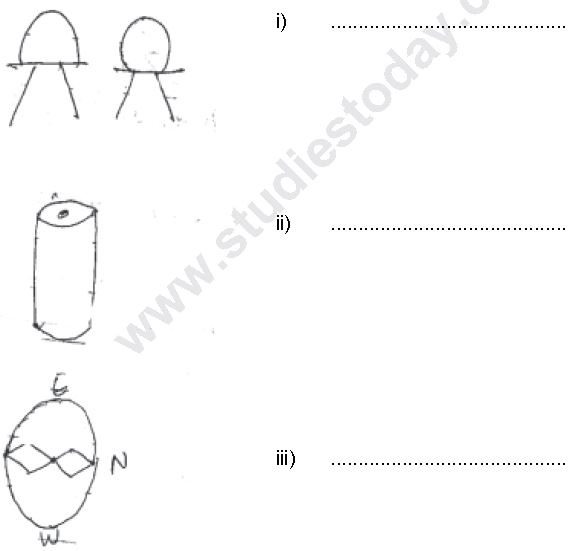
I. Write answer for the following as directly :
1. What is LED ?
2. Name a gas which burns with a pop sound.
3. Which electrode is connected to the negative terminal of a cell ?
4. Name the ions which are positively charged.
5. Name a device which is used for the electrolysis of water ?
6. Write a chemical equation for the electrolysis of water.
II Answer the following in 2 or 3 lines :
1. Define the following :
a) Electrolyte b) Cathode c) Anode d) Jons e) Voltameter
2. What is electroplating ?
3. Draw a neat diagram of voltameter and label it
4. Identify the following as electrolytes and non electrolytes :
a) dil HNo3 b) Benzene c) Petrol d) Zinc Chloride solution e) a solution of Naoh g) Ether h) Alcohol i) Common salt solution
5. State three uses of electrolysis.
III Define the following in detail :
1. Describe an experiment to show chemical effect of electric current.
2. Describe an experiment for the electroplating of an iron object with copper.
Q1. What do you understand by chemical effect of current?
Q2. Differentiate between conductors and insulators with examples.
Q3. Why distilled water isused an insulator? How can it be made a conductor?
Q4. What are electrodes? Name two elements that can be used to make electrodes.
Q5. List the various chemical effects produced when electric current is passed through a conducting solution.
Q6. What happens when electric current passes through water by keeping two electrodes immersed in it?
Q7. What is electroplating? Give its three uses.
Q8. What is the disadvantage of electroplating?
Q9. Describe an experiment to show the process of electroplating. Alsoexplain in detail why we find a coating of copper on the negative electrode.
Q10. You are given a carbon rod, a copper plate and copper sulphate solution. Explain the arrangement you will do to get a coating of copper on the carbon rod.
Q11.Give reasons for the following:
1. Chromium is used for electroplating.
2. Iron cans used for storing food items are electroplated with tin.
3. Bridges and automobiles are either painted or coated with zinc to prevent rusting. Why aren’t they electroplated?
4. We should never handle electrical appliances with wet hands.
Q12. Fill in the blanks:
1. Three effects of electric current are ___________, ___________ and _____________.
2. When current is passed through a conducting solution it causes __________________ reactions.
3. Full form of LED is ________________________. The longer lead in LED is always connected to the ____________ terminal of the battery.
4. Liquids that conduct electricity are solutions of acids, bases and __________.
5. When electric current is passed through acidulated water, the gases produced are ___________ and __________.
6. The object to be electroplated is connected to the ____________ terminal of the battery in the circuit.
Free study material for Science
CBSE Class 8 Science Worksheets for Chapter 14 Chemical Effects of Electric Current
Mastering Chapter 14 Chemical Effects of Electric Current with Printable Worksheets
Explore reliable practice questions for Chapter 14 Chemical Effects of Electric Current tailored for Class 8 Science learners. Use these structured worksheets to evaluate exam preparedness and strengthen problem-solving skills throughout the 2026 academic session.
Verified Solutions and NCERT Alignment
Designed around the official curriculum for Class 8 Science, these practice sheets guarantee standard compliance. Reviewing step-by-step solutions after completion sharpens your accuracy and clarifies complex sub-topics within Chapter 14 Chemical Effects of Electric Current.
Additional Study Resources for Class 8 Science
Wrap up your chapter revision by testing your knowledge against standard objective question formats. Explore our full library of free, up-to-date printable assignments to maximize your academic results in upcoming CBSE evaluations.
FAQs
You can download the latest chapter-wise printable worksheets for Class 8 Science Chapter 14 Chemical Effects of Electric Current for free from StudiesToday.com. These have been made as per the latest CBSE curriculum for this academic year.
Yes, Class 8 Science worksheets for Chapter 14 Chemical Effects of Electric Current focus on activity-based learning and also competency-style questions. This helps students to apply theoretical knowledge to practical scenarios.
Yes, we have provided solved worksheets for Class 8 Science Chapter 14 Chemical Effects of Electric Current to help students verify their answers instantly.
Yes, our Class 8 Science test sheets are mobile-friendly PDFs and can be printed by teachers for classroom.
For Chapter 14 Chemical Effects of Electric Current, regular practice with our worksheets will improve question-handling speed and help students understand all technical terms and diagrams.