

Official Class 8 Science Worksheets: Chapter 17 Stars and the Solar System
Review targeted academic worksheets with the CBSE Class 8 Science Stars And The Solar System Worksheet. Built according to official educational standards for the 2026-27 term, these downloadable Class 8 Science resources support effective daily practice and detailed self-evaluation for Chapter 17 Stars and the Solar System.
Solved Practice Worksheets for Science
Navigate directly to the solved Science worksheets using the digital viewer below. Each practice set includes detailed step-by-step solutions, allowing students to instantly cross-check their work and identify areas requiring further revision.
Question. Which of the following is not an inner planet?
(a) Mercury
(b) Neptune
(c) Mars
(d) Earth
Answer : B
Question. Which of the following planets is the largest planet of the solar system?
(a) Jupiter
(b) Earth
(c) Uranus
(d) Saturn
Answer : A
Question. The planet that has minimum time period of rotation is the______________ .
(a) Earth
(b) Mercury
(c) Venus
(d) Jupiter
Answer : D
Question. When the moon is in between the Earth and the Sun, we see_____________ .
(a) New moon
(b) Full moon
(c) Quarter moon
(d) Crescent moon
Answer : A
Question. Which of the following has no satellite?
(a) Saturn
(b) Venus
(c) Neptune
(d) Jupiter
Answer : B
Fill In The Blanks :
Question. A meteoroid that lands on the Earth’s surface is called_________.
Answer : Meteorite
Question. The full moon night is also called __________________.
Answer : Purnima
Question. The ________is the brightest star in the sky at night.
Answer : Sirius
Question. ____________ comet appears nearly after every 76 years.
Answer : Halley’s
Question. Pole Star is not visible in _________________________.
Answer : Southren hemisphere
Question. The moon rotates about its axis in about the __________ time that it to orbit the Earth.
Answer : 27days 8 hours
Question. Ursa Major is also called _________________________.
Answer : Great Bear constellation
Question. Orion constellation is also called the _________constellation.
Answer : Hunter
Very Short Answer Type Questions :
Question. In which parts of the sky can you find Venus if is visible as an evening star?
Answer : Venus appears in the western sky after sunset that is why it is called as evening star.
Question. What is a comet?
Answer : A comet is a small body of ice and dust that revolves around the sun in highly elliptical orbit.
Question. What is the temperature of the moon’s surface (a) in daytime (b) at night?
Answer : The temperature of the moon’s surface is
(a) In daytime = 123o C (b) at night = --- 233o C
Question. Name two planets that rotate from the east to the west.
Answer : Venus and Uranus are the two planets that rotate from the east to the west.
Question. Name two dwarf planets.
Answer : Two dwarf planets are Pluto and Ceres.
Question. Name the largest planet in our solar system.
Answer : The largest planet in our universe is Jupiter.
Short Answer Type Questions :
Question. Give three uses of artificial satellites.
Answer : Artificial satellites are used for:-
1. Forecasting weather
2. Transmitting radio and television signals.
3. Telecommunication- -- cellular phones and long distance telephones, fax,etc., are few of the services provided by satellite communication.
Question. Which planet is called red planet and why?
Answer : Mars is called as red planet as its whole surface is covered with red coloured dust (iron oxide) and rock.
Question. Write any three differences between meteors and meteorites.
Answer :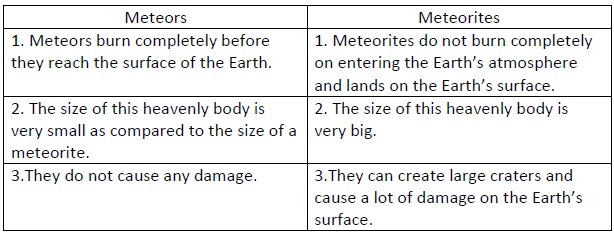
Question. What are asteroids?
Answer : Asteroids are small irregular shaped heavenly bodies of rocks and metals that revolve around the Sun in the gap between the orbits of Mars and Jupiter.
Question. Why does the pole star appear stationary?
Answer : Pole star is situated above the axis of rotation of the earth, so it appears stationary from the earth.
Question. Why does life exists on the Earth? Write three conditions.
Answer : The Earth is at the right distance from the Sun. So, it has some special environmental conditions like right temperature range, the presence of water, a suitable atmosphere and a blanket of ozone. These are responsible for the existence and continuation of life on the Earth.
Question. Why does the Sun appear to be larger and brighter than other stars?
Answer : The Sun appear to be larger and brighter than other stars because it is closer to the Earth than any other star.
Question. What do you mean by light year?
Answer : One light year is the distance travelled by the light in one year, that is equal to 9.46x 10¹² Km.
Question. Write any three points about Ursa Minor constellation.
Answer : (1) It is clearly seen in the northern part of the sky in July during the summer season.
(2) There are seven prominent stars in this constellation that form the shape of a dipper.
(3) At the end of the tail of Ursa Minor is the pole star.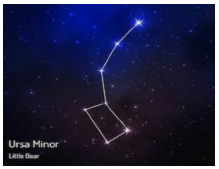
Question. Why can we never see the backside of the moon from the Earth?
Answer : We never see the backside of the moon from the Earth because the moon rotates about its axis in about the same time that it takes to orbit the Earth. This results in the same face turned towards the Earth at all times.
Question. What are artificial satellites?
Answer : An artificial satellite is a human-made object that has been placed into the orbit around the Earth or other planets to perform specific fuctions.
First artificial satellite was Sputnik-I by USSR and the first Indian satellite was Aryabhatta.
Long Answer Type Questions :
Question. Differentiate between a star and a planet.
Answer :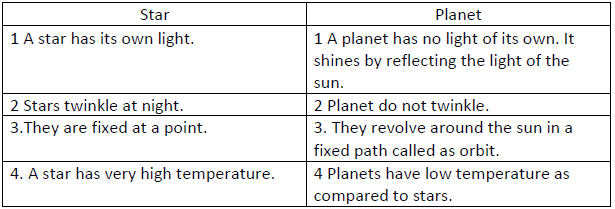
Question. What is meant by the following phases of the moon: -
(a) New moon, (b) crescent moon, (c) first quarter moon, (d) gibbous moon and (e) full moon?
Answer : (a) New moon : When the moon is between the Earth and the Sun and we do not see the moon at all, it is called new moon. It is also known as Amavasya.
(b) Crescent moon : When we see a small sun – lit portion of the moon, it is called crescent moon. The increasing size of the lighted part of the moon is called waxing crescent moon where as the decreasing size of the lighted part of the moon is called waning crescent moon.
(c) first quarter moon : After new moon, when we see half the moon, it is called the first quarter moon.
(d) Gibbous moon : When we see more than half of the moon, it is called gibbous moon. The increasing and decreasing size of the lighted part of the moon is called waxing and waning gibbous moon.
(e) Full moon : After two weeks when the whole sun –lit portion of the moon is visible, it is called full moon. The full moon night is called `purnima’. The full moon is very bright because of the maximum moonlight.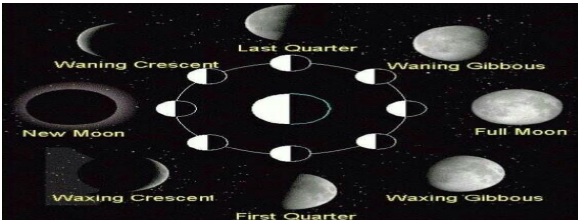
I. Answer the following as directed :
1. What is the distance between the sun and the earth ?
2. Which planet is called a red planet ?
3. Name the two moons of Mars.
4. Which constellation appears as a letter “W” ?
5. How much time will be taken by the moon to complete one revolution around the earth ?
6. Name a planet which rotates from east to west about its axis.
7. Which planet has a great red spot ?
8. Name a planet which removed from the solar system.
9. What is Pluton ?
10. What are shooting stars ?
II Answer the following :
1. Define Solar System.
2. What is light minute ?
3. What is a Comet? Why does a Comet develop a tail while approaching the sun?
4. Write the difference between :
a) Meteors and Stars
b) Meteors and Meteorites
5. What is a star? What makes the star give out vast amount of energy ?
6. What is New Moon?
7. What are artificial satellites? Give examples.
8. Write three differences between a star and a planet.
9. What is a light year ? Express in km.
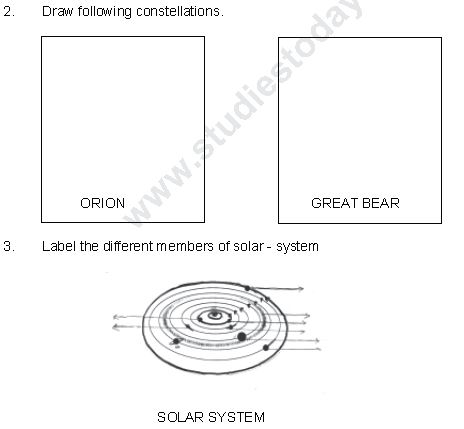
10. Draw a neat diagram of a constellation „Ursa Major‟
1) Fill in the blanks.
a) The celestial objects which revolve around the planets are called ____________.
b) ____________ is the biggest planet of solar system.
c) ____________ is the natural satellite of earth.
d) ____________ are used for weather forcast, transmitting television and radio signals.
e) ____________ is the first artificial satellite of India
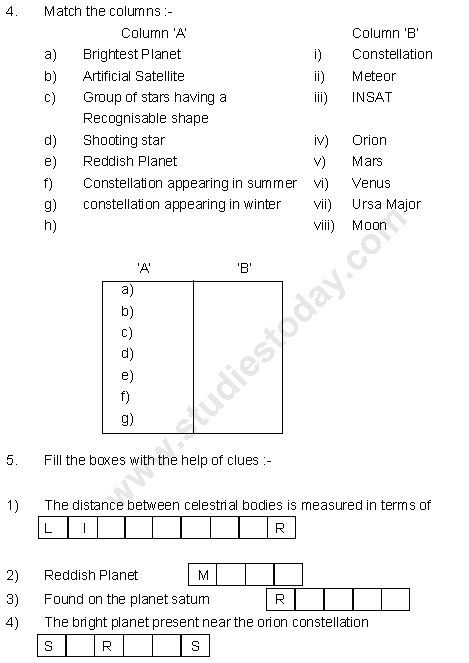
Fill in the blanks :
1. Asteroids are found between the orbits of _____________ and _____________.
2. The celestial body that reaches the earth is called ______________________.
3. Orion is seen during _______________________ seasons.
4. On the fifteenth day the moon is not visible. This day is known as ______________.
5. The various shapes of the bright part of the moon as seen during a month are called ____________________.
6. A planet which appears yellowish is ____________________.
7. __________________________ is not a member of the solar system.
8. The planet which appears reddish in colour is _____________________.
9. First artificial satellite launched by India is _____________________-.
10. The smallest planet is _________________.
Answer the following questions :
1. What is the speed of light ?
2. Name the star which is nearest to the earth.
3. What is the name of path on which planets revolves around the sun ?
4. Why do we see only the part of the moon?
5. Name the planet where there is no carbon dioxide.
6. Write other name of constellation Great Bear.
7. Which planet is called morning and evening star.
8. Why is the distance between stars expressed in light years ?
9. What is alight year?
10. How big is the sun as compared to earth?
11. Why are stars not visible during daytime ?
12. Why does the pole star not change its position in the sky ?
Free study material for Science
Download Class 8 Science Chapter 17 Stars and the Solar System Practice Worksheets
Daily Practice Questions for Class 8 Science
Access structured practice worksheets for Chapter 17 Stars and the Solar System aligned with the 2026 CBSE curriculum. These downloadable exercises for Class 8 Science help students build accuracy and reinforce core concepts for upcoming school tests.
Detailed Answers for Class 8 Science Chapter 17 Stars and the Solar System
Built using official NCERT guidelines for Class 8 Science, these practice sheets provide reliable academic support. Cross-reference your completed work with our detailed solutions to learn standard answer-writing formats for CBSE exams.
Complete Your Chapter Revision
Follow up your worksheet practice by attempting the interactive online MCQ tests for Chapter 17 Stars and the Solar System to evaluate your execution speed. All printable assignments and revision sheets on our platform are updated for the 2026 session and available free of charge.
FAQs
You can download the latest chapter-wise printable worksheets for Class 8 Science Chapter 17 Stars and the Solar System for free from StudiesToday.com. These have been made as per the latest CBSE curriculum for this academic year.
Yes, Class 8 Science worksheets for Chapter 17 Stars and the Solar System focus on activity-based learning and also competency-style questions. This helps students to apply theoretical knowledge to practical scenarios.
Yes, we have provided solved worksheets for Class 8 Science Chapter 17 Stars and the Solar System to help students verify their answers instantly.
Yes, our Class 8 Science test sheets are mobile-friendly PDFs and can be printed by teachers for classroom.
For Chapter 17 Stars and the Solar System, regular practice with our worksheets will improve question-handling speed and help students understand all technical terms and diagrams.