

Chapter-wise Worksheets for Class 8 Science: Chapter 04 Materials Metals and Non-Metals
Explore structured practice materials through the CBSE Class 8 Science Materials Metals And Non Metals Worksheet. Tailored for Class 8 learners, utilizing these Science worksheets ensures thorough preparation and strengthens problem-solving accuracy before final school evaluations.
Practice Class 8 Science Worksheets: Chapter 04 Materials Metals and Non-Metals
View or download the dedicated CBSE Class 8 Science Materials Metals And Non Metals Worksheet resource below. Engaging with these practice papers under focused study conditions ensures continuous academic progress and mastery of the 2026-27 curriculum for Chapter 04 Materials Metals and Non-Metals.
More questions-
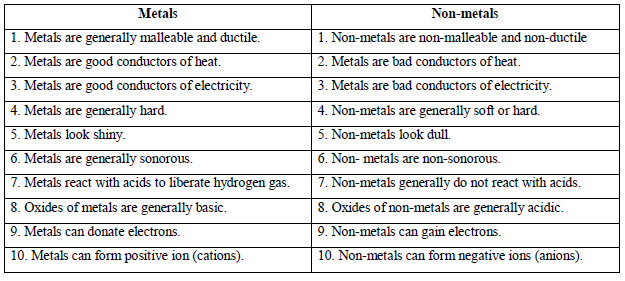
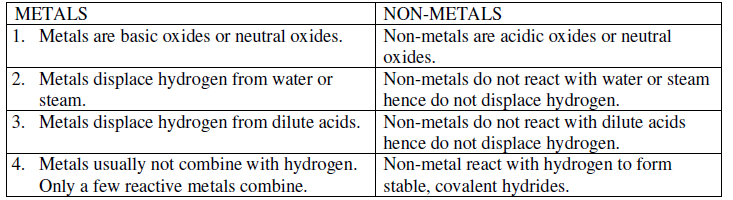
Question. Differentiate between metal and non-metal on the basis of chemical properties.
Ans. Difference between metals and non-metals on the basis of chemical properties.
Question. (i) Write the electron-dot structures for sodium and magnesium.
(ii) What are the ions present in Na2O and MgO.
Ans. (i) Electron-dot structures of sodium and magnesium:

(ii) Ion present in Na2O is Na+ and O2-
Ion present in MgO is Mg2+ and O2-
Question. A green layer is gradually formed on a copper plate left exposed to air for a week in a bathroom. What Could this green substance be?
Ans. It is due to the formation of basic copper carbonate (CuCO3.Cu(OH)2.
Question. Which gas is liberated when a metal reacts with an acid? How will you test the presence of this gas?
Ans. Hydrogen gas is formed. Bring a burning matchstick near to it, H2 will burn explosively with ‘pop’ Sound.
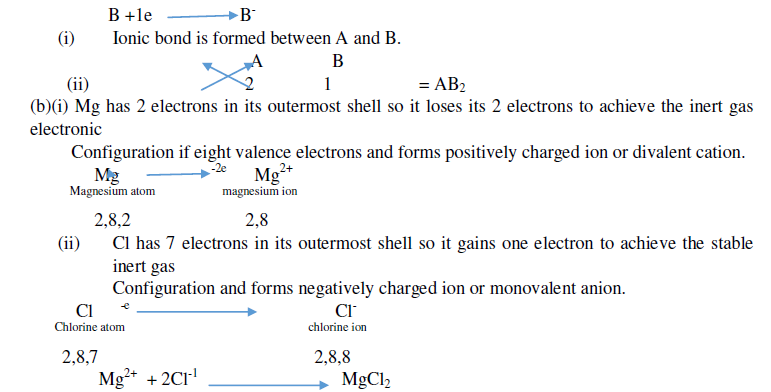
Question. (a) In the formation of compound between two atoms A and B, A loses two electrons and B gains one Electron.
(i) What is the nature of bond between A and B?
(ii) Suggest the formula of the compound formed between A and B.
(b)On similar lines explain the formation of MgCl2 molecule.
(c)Common salt conducts electricity only in the molten state. Why?
(d)Why is melting point of NaCl high?
Ans. (a)

(c)Common salt is an ionic compound which conducts electricity only in molten state because in molten state
The electrostatic forces of attraction between opposite charged ions are overcome due to heat.
Thus ions Move freely and conduct electricity.
(d) NaCl is an ionic compound so there is a strong force of attraction between the positively charged Na Ion and negatively charged chloride ion. Therefore, a considerable amount of energy is required
Question. Explain the following:
(a) Reactivity of Al decreases if it is dipped in HNO3.
(b) Carbon cannot reduce the oxides of Na or Mg.
(c) Iron articles are galvanized.
Ans. (a) When Al metal reacts with HNO3, Al2O3 is formed which further gets deposited on aluminum metal. Hence, more Al metal is not available for the reaction because Al2O3 layer is passive in nature.
(b) Na and Mg both metals are very reactive. These metals have more affinity towards oxygen than carbon. Hence, carbon cannot reduce the oxides of these metals.
(c) Galvanization is a process to protect iron from rusting. Iron get rusted when come in contact with air and moisture.
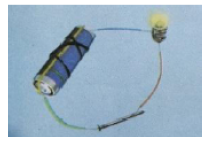
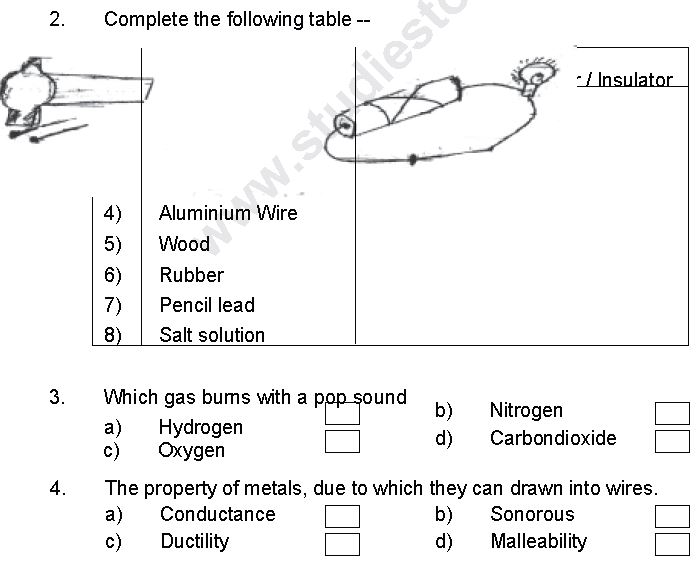
1. Following diagrams explain which Properties of metals .
Beating iron nail with hammer Passing electricity through any
Material

7. Name the following type of reaction :-
Copper sulphate (CuSo4) + Zinc (Zn) = Zinc Sulphate (Znso4) + Cu (Copper)
____________________ (Displacement / addition)
8. Write any three differences between metals and non-metals on the basis of following characters -
Property Metal Non-Metal
1) Appearance _____________ ______________
2) Conduction of heat _____________ ______________
3) Malleability _____________ ______________
4) Ductility _____________ ______________
Write one word for the following :
i) Materials having properties of both metals and non-metals __________.
ii) The property of metals due to which they produce sound _____________.
iii) The property of metals due to which they can be beaten into sheets _________.
iv) Nature of metal oxides is ______________.
v) The property of metals by virtue of which they can be drawn into wires ________.
A.TICK THE CORRECT OPTIONS:
Question. The elements that have some properties of metals and some properties of non-metals are called____
a. ores
b. metal mix
c. metalloids
d. gangue
Answer. c metalloids
Question. The only metal that exists as liquid at room temperature is_____
a. mercury
b. chlorine
c. bromine
d. gold
Answer. a-mercury
Question. The property of metals that allows them to be hammered into thin sheets is called____
a. ductility
b. hardness
c. malleability
d. sonority
Answer. c-malleability
Question. The oxides of non-metals are generally ________ in nature.
a. acidic
b. basic
c. neutral
d. Both a and c
Answer. a-acidic
B. FILL IN THE BLANKS:-
1. The property that allows the metals to be drawn into thin wires is called _______.
2. Metals like ______ is a poor conductor of heat.
3. _______is the hardest known substance in nature.
4. ______is a non metal that is a good conductor of electricity.
5. Silver objects turn black due to the formation of a layer of ______ on their surfaces.
Answer.
1. Ductility 2. Bismuth
3 Diamond 4. Graphite
5 silver sulphide
C.VERY SHORT ANSWER QUESTIONS:-
Question. What happens when copper vessel is exposed to moist air for a long time?
Answer. When copper vessel is exposed to moist air for a long time, it slowly reacts with carbon dioxide and moisture (water) present in the air and loses its shine due to the formation of a green coating of copper hydroxide and copper carbonate.
Question. Name the second most abundant element in the earth’s crust.
Answer. Silicon is the second most abundant element in the earth’s crust.
Question. What is formed when metals react with oxygen?
Answer. When metals react with oxygen, it forms metal oxides that are basic in nature.
Question. Name the metal that is used in household electric wiring.
Answer. Copper is the metal that used in household electric wiring.
Question. Name one metal that is highly unreactive.
Answer. Gold
Question. Name (a) a solid metal and (b) a liquid metal at room temperature.
Answer. (a) Iron (b) Mercury
D.SHORT ANSWER QUESTIONS:-
Question. What happens when the following metals react with dilute hydrochloric acid?
(a) magnesium (b) aluminium
Answer.
(a). Magnesium reacts quite rapidly with dilute hydrochloric acid and forms magnesium chloride and hydrogen gas.
Mg + 2HCl -------------> MgCl2 + H2
Magnesium hydrochloric acid Magnesium chloride hydrogen gas
(b ) Aluminium reacts with dilute hydrochloric acid and forms aluminium chloride and hydrogen gas.
2Al + 6HCl -------------> 2AlCl3 + 3H2
aluminium hydrochloric acid aluminium chloride hydrogen gas
Question. Which of the following elements would form (i) acidic oxides and (ii) basic oxides?
a. carbon b. magnesium c. sulphur d. zinc e. iron
Answer.
(a) carbon--acidic oxide
(b) magnesium—basic oxide
(c) sulphur—acidic oxide
(d) zinc—basic oxide
(e) iron—basic oxide
Question. What is meant by `rusting of iron’?
Answer. when an iron object is left in damp air (moisture) for a considered amount of time, it gets covered with a reddish-brown flaky substance. This is called rusting of iron.
Question. What will be the change in the colour of copper sulphate solution when magnesium is added to it? Write a balanced chemical equation for the same.
Answer.-a. The magnesium would replace the copper from copper sulphate solution (blue colour) and form magnesium sulphate, which is colourless solution and a fine copper powder precipitate would form.
CuSo4 + Mg ----------------> MgSo4 + Cu
Copper magnesium magnesium sulphate copper (reddish
Sulphate (blue colour) (colourless solution) brown)
Question. Give reasons for the following:
a. Electric wires are made of copper.
Answer. Electric wires are made of copper because it conducts electricity with high flexibility and very little resistance.
b Gold and silver are used for making jewellery.
Answer. Metals such as gold and silver are quite unreactive, due to this property they are used for making jewellery.
C Graphite is used for making electrodes in electric cells.
Answer. Graphite is used for making electrodes in electric cells because Graphite is a good conductor of electricity and it is cheaper.
Question. In evening, Sonu plays guitar for the poor children of his colony. They all enjoy listening to the guitar. Sonu even teaches some of them how to play guitar, free of cost.
a. Name the property because of which strings in guitar are made of metal.
Answer. a The string of guitar are made up of metal because it is sonorous. Sonority is the property of ringing when strikes by an object.
b What do we learn from Sonu?
Answer. We learn from Sonu that we should show our talent to everyone and help the needy.
LONG ANSWER QUESTIONS:-
Question. State any three physical and two chemical properties to prove that copper is a metal.
Answer. PHYSICAL PROPERTY:-
a. Copper is malleable and ductile.
b. Copper is good conductor of electricity.
c. Copper has high melting and boiling point.
CHEMICAL PROPERTY:-
a. Copper reacts with oxygen to form copper oxide which is basic in nature.
2Cu +O2 → 2CuO
b. Copper displaces less reactive metals from their salt solution.
Cu + Ag2So4 → CuSo4 + 2Ag
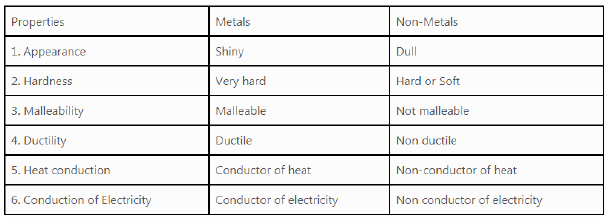
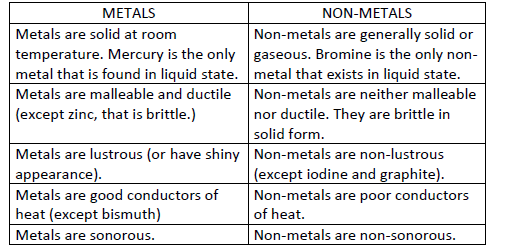
Question. State any five physical properties on the basis of which metals can be distinguished from non-metals.
Answer.
More Question
Name the following questions:-
1. Name some common non-metals used in our daily life.
2. Hardest naturally occurring substance.
3. Property of metals which make them useful as electric wires.
4. Non – metal which has metallic luster.
5. Two non metals which are soft solids.
6. Non metals do not conduct electricity or heat except for one . Name it.
7. An allotrope of carbon which is as tensile as steel.
8. Metals that are not attacked by cold water, boiling water or stream.
9. The property of metals by virtue of which these can beaten into sheets.
10.Non metals used in disinfection of drinking water.
II. Answer the following( in one or two words)
1. What are the elements called which can neither fit with metals nor non metals?
2. Which of the following metals is the best conductor of heat and electricity? Gold, Silver, Copper, Aluminum
3. Which property of metals makes them useful as ringing bells?
4. Arrange the following elements in order of increasing reactivity. Sodium, Magnesium, Copper, Zinc, Aluminum
5. An oxide solution of which of the following elements will turn blue litmus red.
6. Which non-metal is used in making pencil lead?
7. Identify the most reactive and least reactive metal amongst the following Aluminum, Potassium, Copper, zinc, Gold
8. State the nature of oxides of non-metals.
9. Give an example of neutral oxide .
10.Which non metal is kept under water and why?
METALS AND NON METALS
Name the following questions:-
1. Name some common non-metals used in our daily life.
2. Hardest naturally occurring substance.
3. Property of metals which make them useful as electric wires.
4. Non – metal which has metallic luster.
5. Two non metals which are soft solids.
6. Non metals do not conduct electricity or heat except for one . Name it.
7. An allotrope of carbon which is as tensile as steel.
8. Metals that are not attacked by cold water, boiling water or stream.
9. The property of metals by virtue of which these can beaten into sheets.
10.Non metals used in disinfection of drinking water.
II. Answer the following( in one or two words)
1. What are the elements called which can neither fit with metals nor non metals?
2. Which of the following metals is the best conductor of heat and electricity? Gold, Silver, Copper, Aluminum
3. Which property of metals makes them useful as ringing bells?
4. Arrange the following elements in order of increasing reactivity. Sodium, Magnesium, Copper, Zinc, Aluminum
5. An oxide solution of which of the following elements will turn blue litmus red.
6. Which non-metal is used in making pencil lead?
7. Identify the most reactive and least reactive metal amongst the following Aluminum, Potassium, Copper, zinc, Gold
8. State the nature of oxides of non-metals.
9. Give an example of neutral oxide .
10.Which non metal is kept under water and why?
III. Fill in the blanks
1. The number of metals is much _____________________ than non metals.
2. The smallest unit of an element is known as _________________________.
3. Metals like _____________________ and ____________________ exist in liquid state.
4. Elements which do not react chemically are known as _______________________.
5. Oxides of metals which are acidic as well as basic in nature are called _________ oxides.
IV. Multiple Choice Questions
1. Pb is the symbol of
a. Copper
b. Phosphorus
c. Lead
2. Helium, Neon, Argon are
a. Metals
b. Noble gases
c. Metalloids
3. Which of the following metal burns with dazzling while flame.
a. Sodium
b. Potassium
c. Magnesium
4. Which of the following displaces Hydrogen on reaction with dilute mineral acids.
a. Silver
b. Sodium
c. Sulphor
5. Metals which are used for making electric wires and cooking vessels-
a. Copper and Aluminum
b. Copper and Iron
c. Aluminum
6. Non metals which is used in making microchips
a. Carbon
b. Silicon
c. Sulphur
7. Metals which can be cut with knife.
a. Iron
b. Calcium
c. Sodium
8. Compounds of which non-metal are used as fertilizers
a. Chlorine
b. Nitrogen
c. Phosphorus
9. Alloys of which of the following metal are used for making aero planes and automobile engine.
a. Copper
b. Aluminum
c. Iron
10. Metals react with oxygen to form their oxides which are generally.
a. Neutral in nature
b. Acidic in nature
c. Basic in nature
Q.1. Fill in the blanks
1) __________ and _________ metals are soft and can be cut with a knife.
2) __________ is the only metal, which is found in liquid state at room temperature.
3) A suspension of rust in water turns __________litmus ____________. So it is __________ in nature.
4) In general, metallic oxides are ___________ in nature whereas oxides of nonmetals are _______ in nature.
5) Metals react with acids to produce___________ gas which burns with a __________ sound.
6) A _____________ reactive metal can replace a ___________ reactive metalfrom its salt solution.
7) The elements which possess character of both metals and non metals are called __________.
8) The non-metal _______________ is used in water purification process.
9) The non-metal ________________ is found in the liquid state
Q.2. Give reasons for the following.
1) Bells used in temples are made of metals and not wood.
2) A copper vessel when exposed to moist air for long acquires a dull green coating.
3) Sodium metal is kept stored in kerosene.
4) Phosphorus is kept stored in water.
5) Gold and Silver are used for making jewellery.
6) Copper is used in electrical wiring.
Q3. Choose the correct answer.
1) The property of metals by which they can be beaten into thin sheets is called:
(i) Malleability
(ii) Ductility
(iii) Conductivity (iv) None of the above
2) Materials which are generally hard, lustrous, malleable, ductile, sonorous and good conductors of heat and electricity are:
(i) Non-metals
(ii) Metals
(iii) Metalloid
(iv) None of the above
3) Which of the following is a non-metal:
(i) Sodium
(ii) Aluminum
(iii) Sulphur
(iv) Calcium
4) The metal which is the best conductor of electricity is:
(i) Silver
(ii) Gold
(iii) Copper
(iv) Zinc
Q.4. How do metals and non-metals differ in their reaction with acids?
Q.5. What are displacement reactions? Give one example.
Q.6. Write four differences in the physical properties of metals and non metals.
Q.7. When zinc granules are put in copper sulphate solution and left undisturbed for sometime, we find that the blue colour of the solution disappears and a powdery red mass is deposited at the bottom of the beaker. Write the equation involved. What type of reaction is this? Explain the observations.
Q.8. . When we keep copper turning in zinc-sulphate solution for sometime, we find that there is no change. Explain why is it so?
Q.9.What is reactivity series of metals? Arrange the following metals in decreasing order of reactivity- Iron, Sodium , Copper, zinc.
Q10 Sneha and Neha are friends.Sneha belongs to a rich family and believes in throwing things after use,while Neha does not like wastage and reuses things.Answer the following questions
(i) How reusing things avoids wastage?
(ii) List any two examples where you can reuse things.
(iii) What change can you make in your habits to become more eco-friendly?
Free study material for Science
Download Class 8 Science Chapter 04 Materials Metals and Non-Metals Practice Worksheets
Practice Exercises for Class 8 Science Chapter 04 Materials Metals and Non-Metals
Access structured practice worksheets for Chapter 04 Materials Metals and Non-Metals aligned with the 2026 CBSE curriculum. These downloadable exercises for Class 8 Science help students build accuracy and reinforce core concepts for upcoming school tests.
Step-by-Step Solutions and Practice Guidelines
Each worksheet draws directly from authorized standard textbooks to maintain academic accuracy. Evaluating your finished exercises against expert-verified solutions helps master the formal presentation standards expected in school evaluations.
Enhance Speed with Online Practice
Consistent engagement with these exercises builds familiarity with recurring exam themes. If specific areas within Chapter 04 Materials Metals and Non-Metals cause trouble, utilize our dedicated NCERT solutions for Class 8 Science to clear up doubts immediately.
FAQs
You can download the latest chapter-wise printable worksheets for Class 8 Science Chapter 04 Materials Metals and Non-Metals for free from StudiesToday.com. These have been made as per the latest CBSE curriculum for this academic year.
Yes, Class 8 Science worksheets for Chapter 04 Materials Metals and Non-Metals focus on activity-based learning and also competency-style questions. This helps students to apply theoretical knowledge to practical scenarios.
Yes, we have provided solved worksheets for Class 8 Science Chapter 04 Materials Metals and Non-Metals to help students verify their answers instantly.
Yes, our Class 8 Science test sheets are mobile-friendly PDFs and can be printed by teachers for classroom.
For Chapter 04 Materials Metals and Non-Metals, regular practice with our worksheets will improve question-handling speed and help students understand all technical terms and diagrams.