

Chapter-wise Worksheets for Class 8 Science: Chapter 09 Reproduction in Animals
Access comprehensive chapter-wise worksheets for Chapter 09 Reproduction in Animals using the CBSE Class 8 Science Reproduction In Animals Worksheet. Designed to align with the 2026-27 academic syllabus for Class 8 Science, these printable practice sets help students reinforce key concepts and improve their overall exam readiness.
Practice Class 8 Science Worksheets: Chapter 09 Reproduction in Animals
Access the complete worksheet PDF for Class 8 Science below. Regular practice with these targeted academic tasks builds familiarity with standard question patterns and helps secure higher marks in final school examinations.
Fill in the blanks :
1. __________ is essential for the continuation of a species.
2. __________ reproduction is characterised by the fusion of two cells called gametes.
3. The animals which lay eggs are called ________ animals.
4. The animals which give birth to young ones are called __________
5. Organisms in which both types of gametes are produced by the same individual are called __________
6. Organisms in which male and female gametes are produced by two different individuals are called __________
7. The process of transformation of larva or tadpole into an adult through drastic changes is called _______
8. The type of asexual reproduction in which an individual reproduces by dividing into two individual is called __________
Answer the following questions in one or two words :
1. Name the method of asexual reproduction in which individuals develops from the bud.
2. Give two examples of unisexual organism.
3. Give two examples of bisexual organisms.
4. Name the process of reproduction in Amoeba.
5. Give example of an animal which reproduce by budding.
Reproduction in animals
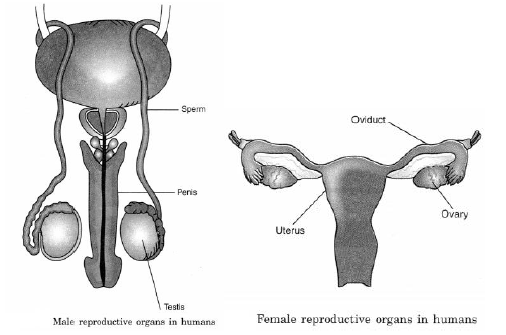
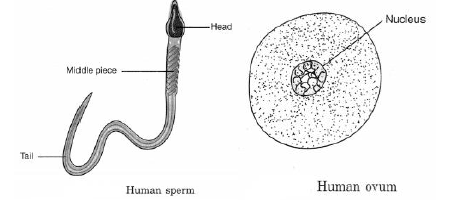
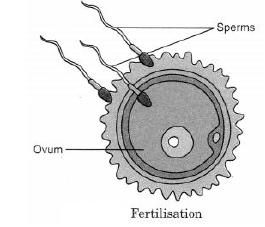
1. Write one word for following sentences.
a) Fusion of male gamete and female gamete _____________.
b) Name of male gamete ______________.
c) Name of female gamete ________________.
d) Fertilisation which takes place inside the female body ____________.
e) Fertilisation which takes place outside the female body ___________.
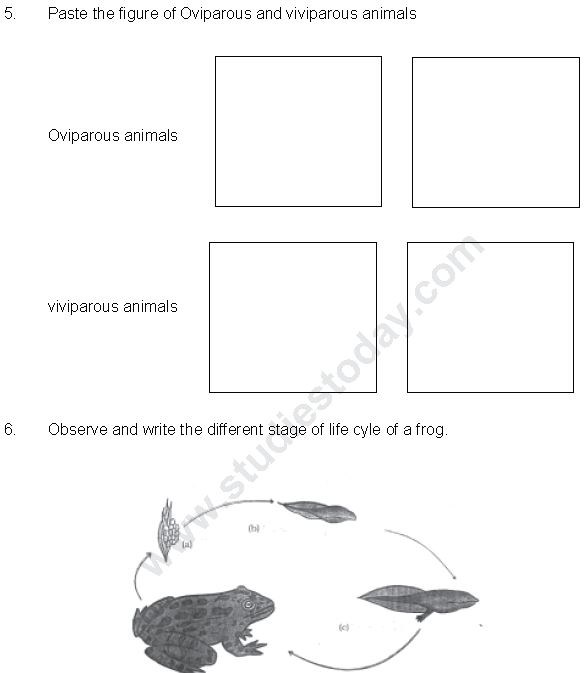
f) Animals which lays eggs ______________.
g) Animals which give birth to young ones _____________.
h) Drastic changes which transform larva into adult ___________.
2. Two modes of reproduction ____________ ___________
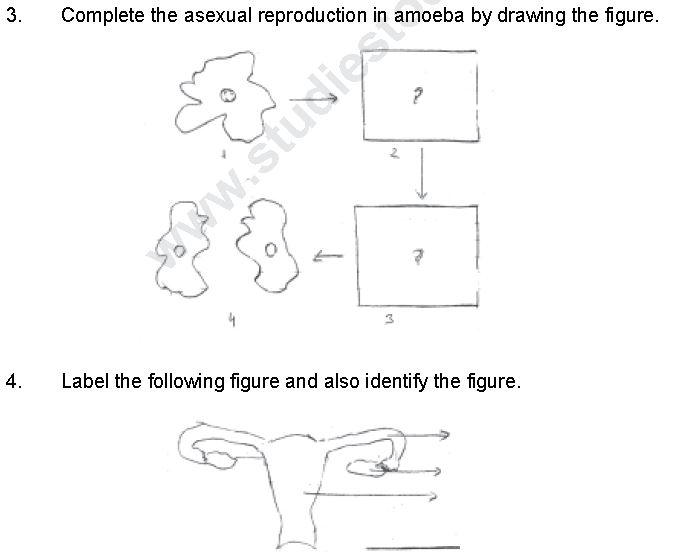
Q1. Answer the following :
i. Female Gamete in humansii.
ii.Organism with largest eggiii.
iii.Part where development of the baby takes placeiv.
iv.Name the first successfully cloned sheepv.
v.Type of fertilisation in hensvi.
vi.Example of viviparous organismvii.
vii.Example of an organism with internal fertilisation and external growth of babyviii.
viii.Example of an organism with external fertilisation –
Q2. Fill ups:
i. In humans __________ is the male reproductive organ and _____________ is the female reproductive organ.
ii. _____________ is the male gamete produced by _____________.
iii. Fertilized egg is also called _____________.
iv. The female reproductive organs include______________, ________________ and _____________.
v. The male reproductive organs include _______________, _____________ and _________________.
vi. ______________ and ___________ lays hundreds of eggs at a time.
vii. _____________ reproduces by budding.
viii. All living organisms ______________ to produce young ones like them.
ix. Organisms reproduce by two ways ______________ and _________________.
x. Tadpole is the developing stage of the _____________.
xi. The cell formed after fertilization is called _________________.
xii. Frogs undergo ____________________ to become adults from tadpoles.
xiii. ___________________________ is essential for the continuation of species.
xiv. ___________________________ reproduction is characterised by the fusion of two cells called gametes.
xv. The cells involved in sexual reproduction are called _______________.
Q3. Choose the correct option:
1. Which of the following is not a part of human sperm:
a) Tail
b) Middle Piece
c) Sperm Duct
d) Head
2. In IVF the fertilization is :
a) Always External
b) Always Internal
c) Can be any one of the two
d) Fertilisation does not occur
3. Choose the correct sequence:
a) Zygote Fertilisation Ball of cells Foetus Embryo
b) Fertilisation Ball of cells Foetus Zygote Embryo
c) Ball of cells Zygote Fertilisation Embryo Foetus
d) Fertilisation Zygote Ball of cells Embryo Foetus
4. Which of the following statements is true:
a) Each sperm is a single cell
b) Zygote is a single cell
c) Ovum is a single cell
d) All of these
5. The offsprings produced from asexual reproduction are ________ of parent.
a) Different
b) Slightly similar
c) Exact copy
d) None of these
6. The main reproductive organ of human male is
a) a pair of testes
b) Vas deferens
c) Urethra
d) penis
7. What marks the beginning of the reproductive life of a woman
a) fertilisation
b) Menopause
c) Menarche
d) Embryo formation
8. Where does fertilisation take place
a) Vagina
b) Fallopian Tubes
c) Uterus
d) Any one Ovary
9. A tadpole develops into an adult by the process of
a) fertilisation
b) metamorphosis
c) budding
d) None of these
10. In the human male, the tube used to carry both sperm and urine is the
a) ureter
b) testes
c) vas deferens
d) urethra
Q4. List differences between the following:
A. Sexual and Asexual Reproduction
B. Internal and External Fertilisation
C. Oviparous and Viviparous Animals
Q5. Write few lines on the development of human embryo?
Q6. Explain the human female reproductive system in detail.
Q7. Why reproduction is considered an essential life process?
Q8. List the functions of each of the following:
A. Tail in a sperm
B. Testis
C. Jelly cover around frog’s eggs
Q9. Define metamorphosis? List some metamorphic changes that occur during the development of a tadpole into an adult frog?
Q10. List one difference and one similarity between Budding and Binary Fission?
Q11. What are buds?
Q12. Write a short note on IVF?
Q13. Define:
A. Foetus
B. Reproduction
C. Fertilisation
D. Cloning
E. Embryo
Q14. Why sperm needs to have motility.
Q15. How is zygote formed?
Q16. What happen to zygote after it is formed?
Q17. What is asexual reproduction? What are the advantages of this method?
Free study material for Science
Free CBSE Practice Worksheets: Class 8 Science Chapter 09 Reproduction in Animals
Mastering Chapter 09 Reproduction in Animals with Printable Worksheets
Review targeted practice exercises for Class 8 Science Chapter 09 Reproduction in Animals. Curated to match official CBSE guidelines, these printable problem sets support daily revision and improve overall test readiness.
Verified Solutions and NCERT Alignment
Built using official NCERT guidelines for Class 8 Science, these practice sheets provide reliable academic support. Cross-reference your completed work with our detailed solutions to learn standard answer-writing formats for CBSE exams.
Additional Study Resources for Class 8 Science
Follow up your worksheet practice by attempting the interactive online MCQ tests for Chapter 09 Reproduction in Animals to evaluate your execution speed. All printable assignments and revision sheets on our platform are updated for the 2026 session and available free of charge.
FAQs
You can download the latest chapter-wise printable worksheets for Class 8 Science Chapter 09 Reproduction in Animals for free from StudiesToday.com. These have been made as per the latest CBSE curriculum for this academic year.
Yes, Class 8 Science worksheets for Chapter 09 Reproduction in Animals focus on activity-based learning and also competency-style questions. This helps students to apply theoretical knowledge to practical scenarios.
Yes, we have provided solved worksheets for Class 8 Science Chapter 09 Reproduction in Animals to help students verify their answers instantly.
Yes, our Class 8 Science test sheets are mobile-friendly PDFs and can be printed by teachers for classroom.
For Chapter 09 Reproduction in Animals, regular practice with our worksheets will improve question-handling speed and help students understand all technical terms and diagrams.