

Class 8 Science Practice Sheet: CBSE Class 8 Science Force And Pressure Worksheet
Explore structured practice materials through the CBSE Class 8 Science Force And Pressure Worksheet. Tailored for Class 8 learners, utilizing these Science worksheets ensures thorough preparation and strengthens problem-solving accuracy before final school evaluations.
Download Chapter 11 Force and Pressure Worksheet PDF with Answers
View or download the dedicated CBSE Class 8 Science Force And Pressure Worksheet resource below. Engaging with these practice papers under focused study conditions ensures continuous academic progress and mastery of the 2026-27 curriculum for Chapter 11 Force and Pressure.
Question. If Samira is driving at a speed of 70 kilometres per hour, approximately how much distance should she keep from the car in front?
(a) It depends on the speed of the car in front
(b) About 15 metres
(c) About 12 metres
(d) About 45 metres
Answer : D
Question. What probably happens to the thinking TIME as the car's speed increases?
(a) The thinking time reduces because the driver can think faster at faster speeds.
(b) The thinking time increases because of the driver's increased concentration.
(c) The thinking time increases because of the driver's reduced concentration.
(d) The thinking time does not change with a change in the car's speed.
Answer : D
Question. There are 8 balls M, N, O, P, Q, R, S and T. 7 of them are identical, the 8th is either heavier or lighter. Only an accurate beam balance with 2 pans is available.
The result of 3 weighings is as shown:
Which is the odd ball, and is it heavier or lighter?

(a) Q, heavier
(b) M, lighter
(c) O, lighter
(d) It is not possible to tell for sure
Answer : C
Question. Figure 1 shows an arrangement with a single pulley lifting a load. Figure 2, shows one more pulley attached to the same weight. If the weight pulled in figure 1 is 60 N, what would be the weight that string Q would need to support?

(a) 15 N
(b) 20 N
(c) 30 N
(d) 60 N
Answer : C
Question. Shown below is a diagram of a weightless piston, which can slide in and out of a cylinder. (Assume that the arrangement is air tight)
The gas inside the cylinder is heated (The dots inside the cylinder represent individual gas molecules).
Which of the following will happen after a few minutes?


Answer : B
Question. Three identical magnets are held as shown and then released together.
What arrangement will they form when they are released?

Answer : B
Question. The table below gives the mass and volume of three objects (P, Q and R). Answer the question based on it.Which statement about the densities of these three objects is correct?
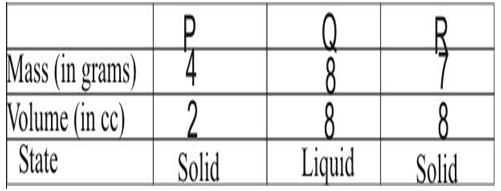
(a) Q is more dense than P
(b) P is more dense than R
(c) P and R have equal densities
(d) Q and R have equal densities
Answer : B
Question. A spring balance was used to measure the force needed to pull a wooden block across different surfaces. The table below shows the results. The force is expressed in Newton. The question is based on this. The force that opposes motion - due to the roughness of the surface - is called & lsquo; Friction'. On which of the above surfaces is the 'friction' greatest?
| Floor surface | Force needed to just star moving |
| Carpet | 8N |
| Glazed tiles | 5N |
| Wood | 4N |
| Door mat | 10N |
(a) Carpet
(b) Glazed tiles
(c) Door mat
(d) Door mat
Answer : D
Question. A spring balance was used to measure the force needed to pull a wooden block across different surfaces. The table below shows the results. The force is expressed in Newton. The question is based on thisIf the block is pulled on the wooden surface with a force of 4.1 N, ____________
| Floor surface | Force needed to just star moving |
| Carpet | 8N |
| Glazed tiles | 5N |
| Wood | 4N |
| Door mat | 10N |
(a) the block just starts to move.
(b) the block does not move.
(c) the block moves a bit and stops.
(d) the block moves a larger distance and stops.
Answer : C
Question. About how much would a jerry-can (a type of container) having 10 litres of water weigh?
(a) 100 grams
(b) 1 kilogram
(c) 10 kilograms
(d) 20 kilograms
Answer : C
Question. Lata investigated some rocks and recorded her results in a table. Study it and answer the question A harder material can scratch another material which is not so hard. Most hard rocks cannot be split into thin layers. An exception, going by the data above, seems to be:
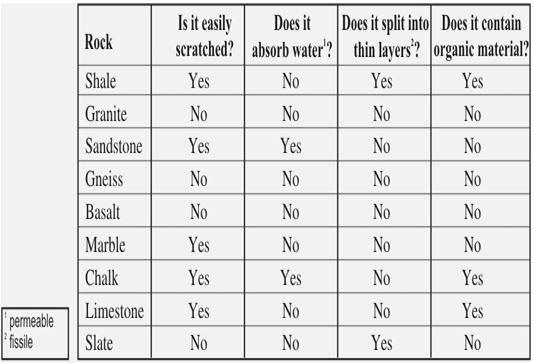
(a) Shale
(b) Granite
(c) Basalt
(d) Slate
Answer : D
Question. An apartment with ten floors has a water supply design as shown in the figure. If three people on the 1st, 5th and 10th floors open their taps at the same time, where will the pressure be the maximum?

(a) the tenth floor
(b) the first floor
(c) the fifth floor
(d) all the floors will have the same water pressure.
Answer : C
Question. Which of these screws would the easiest to drive into a piece of wood?

Answer : C
Question. Four school bags of the same size and dimensions but with different strap sizes are available. Among these, the strap offering the most comfort while carrying the bag would be ___________.
(a) a 2 cm wide strap
(b) a 3 cm wide strap
(c) a 4 cm wide strap
(d) a 5 cm wide strap
Answer : D
Question. The level of tea in a kettle is shown here. Which of these correctly shows the level of the tea in the kettle later (after some tea has already been poured) while it is being poured into another cup?


Answer : B
1) Write one word for the following sentences.
a) A pull or a push on an object is called ______________.
b) A force exerted by a magnet ______________________.
c) A force acting on a unit area of a surface ______________.
d) A pressure exerted by air ___________________.
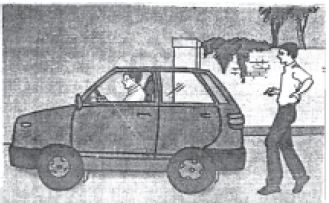
2) Suppose a man is standing behind a car. Does the man exert the force on the car?
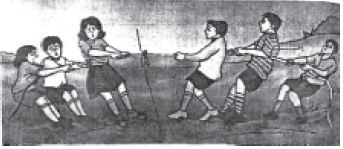
3) If the members of two teams, in a game of tug-of-war, are trying to pull the rope in their respective directions and the rope does not move. Which team pulls with more force.
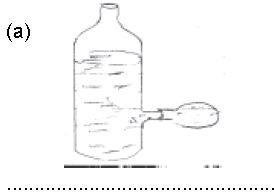
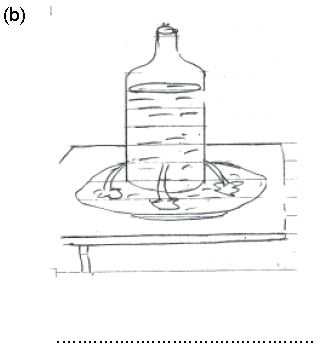
4) In the figures shown below, what conclusion can you draw about the pressure exerted by liquids.
5. A forced exerted by a magnet on another magnet is
a) contact force
b) Frictional force
c) Non contact force
d) Muscular force
6) The weight of air in a column of the height of the atmosphere and area 10cm x 10cm is as large as
a) 1 Kg.
b) 10 kg.
c) 100 kg.
d) 1000 kg.
7) When air is filled in a container, air
a) Exert pressure at the bottom
B) Exert pressure on upper side.
c) Exert pressure on the walls
d) Non of these
8) The shoulder bags are provided with broad straps.
a) To decrease the pressure
b) To exert more force
c) To increase the pressure
d) None of these.
1. S.I unit of pressure is ____________.
2. The amount or the strength of force is called its_______________.
3. Pressure in solid depends upon ________________ and ____________.
4. Pressure in liquids depends upon _____________ and ______________.
5. Force generated by moving of non living materials is called ______________.
6. Give 2 examples of contact forces.
7. Name the scientist who invented a pump to extract air from a vessel.
8. Name the force which acts upon another body without any connector.
9. Name the type of force involved in the following.
a) To pick your school bag.
b) To collect scrap iron from garbage.
c) To push or pull a loaded trolley ay supermarket.
d) Flying of seeds away from each other in plastic bag when gently rubbed.
10. Name the device used to measure pressure in fluids.
11. How much force is required to lift a mass of 1Kg (10N/1N).
12. A rolling ball stops after sometime due to (gravitational force/ Frictional force).
13. When 2 forces are applied at the same point but in opposite directions the net force is equalto the (sum/ difference) of forces acting separately.
14. Force used to stretch the spring is (muscular force/ magnetic force)
15. Application of force brings the change in
a) shape and size of object
(b) speed and direction of object
(c) position of object
(d) all the above
Q1) Fill in the blanks
a. A force arises due to __________ between two objects.
b. An example of a non-contact force is __________.
c. The pressure exerted by air around us is known as __________.
d. Strength of the force is expressed by its __________.
e. Application of force can change the __________, __________ and __________ of an object.
f. Force exerted by our muscles is called __________ force.
g. Direction of force of friction is always __________ to the direction of motion.
h. Force per unit area is called ___________.
Q2) Complete the following sentences:
a. If two equal forces act in the opposite directions on an object, the net force acting on it is __________.
b. It is easier to cut with a sharp knife than with a blunt one because _________ ____________.
c. Porters place a round piece of cloth on their heads, when they have to carry heavy loads because ____________ _____________
Q3) Give four effects of force. Write one example of each.
Q4) Name
a) the force exerted by all matter on all other matter
b) the force which tends to slow down objects or keep them from moving
c) the force with which a charged body attracts an uncharged body.
Q5) An example of a contact force is
1) Magnetic force
2) Frictional force
3) Gravitational force
4) All of these
Q6) A Force cannot change the
1) Speed of an object
2) Mass of an object
3) Shape of an object
4) The direction of a moving object
Q7) The pull of the earth is a force called
a) Gravitational force
b) Frictional force
c) Electrostatic forces
d) None of these
Q8) If a force is applied on a smaller area of contact, the pressure exerted by it is
1) Greater
2) Lesser
3) The same
4) None of these
Q9) Why do the pillars holding the track of Metro trains have a broader base?
Q10) Define Pressure. Explain why shoulder bags are provided with broad straps and not thin strap.
Q11) Describe an activity to show that
(i) the pressure exerted by a liquid at the bottom of the container, depends on the height of its column.
(ii) liquids exert pressure on the walls of the container.
(iii) liquids exert equal pressure at the same depth.
Q12) Explain why we do not feel the atmospheric pressure.
Q 13) A ball rolling on the ground comes to rest after some time. Name the force involved.
Q 14) Explain the following types of forces. Give one example where each of these could be found operating:
a. Magnetic force c) Electrostatic force
b. Gravitational force d) Frictional force
Q15) Bhola was impressed by the miracle performed by baba Shyamdev, when Baba lied down on a bed of nails. The nails did not hurt him. Bhola narrated this miracle to his friend Rahul. Rahul explained to Bhola that, there is no magic or miracle here. Even he can do the same trick.
(a) Why did Rahul say that , there is no miracle in this trick? Why did Baba Shaymdev not hurt himself?
(b) Which quality is shown by Rahul here?
FORCE
Introduction
The external agent which tends to set a body in motion or which changes the speed and direction of motion of a body or which can change the shape of a body is called force.
- To push or to pull is also called as force.
- It is a vector quantity
Types of forces :
(A) Contact forces :
The forces that act on bodies when they are in actual contact are known as contact forces. eg. Frictional force, normal reaction force, tension in string, force exerted during collision, force applied as a push or a pull etc.
(B) Non-contact forces :
The forces that act on bodies without being touched are called non-contact forces. eg. gravitational force, electrostatic force, magnetic force etc.
Newton's Laws of Motion
(A) Newton’s I law :
A body can not change its state of motion by itself. If the object is at rest it will remain at rest and if it is in uniform motion, it continues to be in motion unless some external force is applied on it.
Inertia :
- There is an inherent property of an object by virtue of which it cannot change its state of motion or rest by if self. This property is called 'inertia'.
- Inertia is of two types– inertia of rest and inertia of motion.
(A) Inertia of rest:
If the body is at rest, it will continue to be at rest unless some external force is applied on it. Examples are following.
- When a train at rest starts moving suddenly, a passenger standing inside the compartment tends to fall backward.
- When a carpet is beaten up with a stick, the dust particles are detached.
- When a bullet is fired into a glass pane, it pierces a hole only at the pt where the bullet hits the glass without breaking the entire glass pane into pieces.
(B) Inertia of motion :
When a body is in uniform motion, it will continue to remain in its uniform motion, i.e. it resists any change in its state of motion due to inertia of motion.
- when a person jumps out of a moving bus, he should run in the direction in which bus is moving otherwise he will fall down.
- A train moving with a uniform speed and if a ball is thrown upwards inside the train by a passenger, then the ball comes back to his hand.
Mass and Inertia :
- Larger the mass of the body, larger is the inertia.
- eg. it is more difficult to stop a cricket ball than a tennis ball.
(B) Newton's second law of motion
- Momentum \(\rightarrow\) The product of mass and velocity is called 'momentum'. i.e. \( p = mv \)
- (a) Unit : SI unit of momentum is kg-m/s.
- (b) It is a vector quantity.
- Newton's second law states that "the rate of change of momentum of a body is directly proportional to force and takes place in the direction of force."
(a) i.e. \( F \propto \frac{p_2 - p_1}{t} \) or \( F = km \left( \frac{v - u}{t} \right) \)
where \( k \) = proportionality constant
\( p_1 \) = initial momentum = \( mu \)
\( p_2 \) = final momentum = \( mv \)
(b) \(\therefore F = kma \)
If we consider proportionality constant \( k = 1 \),
\(\Rightarrow F = ma \)
(c) Unit of force in SI system is newton.
(d) \( 1 \text{ newton} = 1\text{kg-m/s}^2 \)
(e) 1 N is equivalent to that force which can produce an acceleration of \( 1\text{m/s}^2 \) in a body of mass 1 kg.
(f) Unit of force in CGS system is dyne.
(g) \( 1 \text{ dyne} = 1 \text{ gm - cm/s}^2 \)
(h) \( 1 \text{ N} = 10^5 \text{ dynes} \)
Newton's second law can be written as \( \vec{F} = m\vec{a} \)
Question. Ex. : Calculate the force required to produce an acceleration of \( 5 \text{ m/s}^2 \) in a body of mass 2.4 kg.
Answer: We know that force = mass \(\times\) acceleration = \( 2.4 \text{ kg} \times 5 \text{ m/s}^2 = 12.0\text{N} \)
Question. Ex. : A body of mass 2.5 kg is moving with a velocity of 20 m/s. Calculate its momentum.
Answer: Momentum, \( p = \text{mass} \times \text{velocity} \)
Here, mass \( m = 2.5 \text{ kg} \)
Velocity, \( v = 20 \text{ m/s} \)
\(\therefore\) Momentum, \( p = mv = 2.5 \times 20 \text{ kg-m/s} = 50 \text{ kg-m/s} \)
Impulse
- If a force F is applied on a body of mass m for a time interval \(\Delta t\) and if the change in velocity is \(\Delta v\) then, \( m \Delta v = F \Delta t \)
- \(\therefore \text{Impulse} = F dt = m \Delta v \)
- Impulse = change in momentum
- Unit of impulse is newton \(\times\) second, i.e. NS
Examples of impulse
- A bullet fired from a gun with a large velocity resulting in a large momentum when strikes a body, its velocity becomes zero in a short interval of time.
- The rate of change of momentum is very large and it exerts a large force and so that it can easily pierce the body.
- while catching a cricket ball a player moves his hands backwards. Cricket ball coming towards fielder has a large momentum. By doing so he increases the time interval to reduce the momentum of the ball. Rate of change of momentum becomes slow.
- The ball exerts lesser force.
- He does not get hurt.
Question. Ex. : A force acts for 0.2 s on a body of mass 2.5 kg initially at rest. The force then ceases to act and the body moves through 4m in the next one second. Calculate the magnitude of force.
Answer: When the force ceases to act, the body will move with a constant velocity. Since it moves a distance of 4 m in 1 s, therefore, its uniform velocity = 4m/s.
Now, initial velocity, \( u = 0 \)
Final velocity, \( v = 4 \text{ m/s} \)
Time interval \(\Delta t = 0.2 \text{ s} \)
\(\therefore\) Acceleration, \( a = \frac{v - u}{\Delta t} = \frac{4 - 0}{0.2} = 20\text{m/s}^2 \)
From the relation, \( F = ma \), we get
Force, \( F = 2.5 \times 20 = 50 \text{ N} \)
Question. Ex. : A ball of mass 20 gm is initially moving with a velocity of 100 m/s. On applying a constant force on the ball for 0.5s, it acquires a velocity of 150 m/s. Calculate the following :
(i) Initial momentum of the ball (ii) Final momentum of the ball
(iii) Rate of change of momentum (iv) Acceleration of the ball
(v) Magnitude of the force applied
Answer: Given , \( m = 20 \text{ gm} = \frac{20}{1000} \text{ kg} = 0.02 \text{ kg} \)
Initial velocity, \( u = 100 \text{ m/s} \)
Time interval, \( t = 0.5 \text{ s} \)
Final velocity, \( v = 150 \text{ m/s} \)
(i) Initial momentum of the ball = mass \(\times\) initial velocity or \( P_1 = mu = 0.02 \text{ kg} \times 100 \text{ m/s} = 2 \text{ kg-ms}^{-1} \)
(ii) Final momentum of the ball = mass \(\times\) final velocity or \( P_2 = mv = 0.02 \text{ kg} \times 150 \text{ m/s} = 3 \text{ kg-ms}^{-1} \)
(iii) Rate of change of momentum = \(\frac{\text{Final momentum} - \text{Initial momentum}}{\text{Time}}\) or \( \frac{\Delta P}{\Delta t} = \frac{3 - 2}{0.5} = \frac{1}{0.5} = 2.0 \text{ kg-ms}^{-1} = 2.0\text{N} \)
(iv) Acceleration, \( a = \frac{v - u}{t} = \frac{150 - 100}{0.5} = 100\text{ms}^{-2} \)
(v) Force, \( F = \text{mass} \times \text{acceleration} = 0.02 \times 100 = 2.0 \text{ N} \)
Question. Ex. : A cricket ball of mass 200 gm moving with a speed of 40 m/s is brought to rest by a player in 0.04s. Calculate the following :
(i) change in momentum of the ball, (ii) average force applied by the player.
Answer: Mass, \( m = 200 \text{ gm} = \frac{200}{1000} \text{ kg} = 0.2 \text{ kg} \)
Initial velocity, \( u = 40 \text{ m/s} \)
Final velocity, \( v = 0 \)
Time, \( t = 0.04\text{s} \)
(i) Initial momentum, \( p_1 = mu = 0.2 \text{ kg} \times 40 \text{ m/s} = 8.0 \text{ kg-ms}^{-1} \)
Final momentum, \( p_2 = m \times v = 0.2 \times 0 = 0 \text{ kg-ms}^{-1} \)
Change in momentum, \( \Delta p = p_2 - p_1 = 0 - 8.0 \text{ kg ms}^{-1} = - 8.0 \text{ kg-ms}^{-1} \)
(ii) Average force = \(\frac{\text{Change in momentum}}{\text{Time}}\) = \( \frac{-8.0 - 0}{0.04} = - 200 \text{ N} \)
(The negative sign shows that the force is applied in a direction opposite to the direction of motion of the ball).
Question. Ex. : A motorcycle is moving with a velocity of 108 km/hr and it takes 5 s to stop it after the brakes are applied. Calculate the force exerted by the brakes on the motorcycle if its mass along with the rider is 250 kg.
Answer: Given that initial velocity of the motorcycle = 108 km/hr = 30 m/s
Final velocity = 0 m/s
Time taken to stop = 5s, the mass of the motorcycle with rider = 250 kg.
The change in the velocity of the motorcycle in 5s = 0 – 30 = –30 m/s
Therefore, the acceleration of the motorcycle, \( a = \frac{-30}{5} = -6 \text{ m/s}^2 \)
The magnitude of the force applied by the brakes is given by the equation, \( F = \text{mass} \times \text{acceleration} = 250 \text{ kg} \times (6)\text{m/s}^2 = 1500 \text{ N} \)
(C) Newton's third law of motion
- Newton's first law of motion gives a qualitative idea of force, while the second law provides us an idea to measure the force.
- Newton's third law of motion states that " if a body A exerts a force on the body B, the body B will also exert an equal and opposite force on A."
- The force exerted by A on B is called action while the force exerted by B on A is called the reaction.
- Newton's third law is also stated as "to every action there is an equal and opposite reaction."
- Action and reaction always act on different bodies.
- eg. by hitting a table with palm we apply a force. The table also exerts a force on palm on hitting it.
- Forces always occur in pairs.
Applications of Newtons III law :
- Recoil of a gun – where the bullet is fired from a gun, an equal and opposite force is applied on the gun, due to which the gun recoils in backward direction.
- Application in walking : while moving in forward direction we push the ground backwards that is the action. An equal and opposite force is applied by the ground on the man, thus the reaction due to which man moves forward.
- Rowing a boat in river : when we push the water backward with the help of oars (applying a force backward), an equal and opposite force acts on the boat. This is the reaction which moves the boat forward.
- Launching Rocket : In rocket, gases are produced in large amount. Due to internal combustion they come out and move backwards with an equal and opposite force which in turn acts on the rocket and moves it forward.
Question. Ex. : Due to internal combustion inside a rocket, gases are ejected at the rate of 2.4 kg/minute. The velocity of the gases with respect to the rocket is 400 m/s. Calculate force exerted on the rocket
Answer: Since gases are ejected at the rate of 2.4 kg/minute, i.e. \( \frac{\Delta m}{\Delta t} = \frac{2.4}{60} \text{ kg/s} \)
Change in momentum per second = \( v \times \frac{\Delta m}{\Delta t} = 400 \times \frac{2.4}{60} \)
Now since force, F = Rate of change of momentum = \( 400 \times \frac{2.4}{60} = 16 \text{ N} \)
Question. Ex. : A rifle man, who together with his rifle has a mass of 100 kg, stands on a smooth surface fires 10 shots horizontally. Each bullet has a mass 10 gm a muzzle velocity of 800 m/s. What velocity does rifle man acquire at the end of 10 shots?
Answer: Let \( m_1 \) and \( m_2 \) be the masses of bullet and the rifleman and \( v_1 \) and \( v_2 \) their respective velocities after the first shot. Initially the rifleman and bullet are at rest, therefore initial momentum of system = 0. As external force is zero, momentum of system is constant i.e. initial momentum = final momentum = \( m_1v_1 + m_2v_2 \) or \( v_2 = -\frac{m_1v_1}{m_2} = - \frac{(10 \times 10^{-3} \text{ kg})(800\text{m/s})}{100\text{kg}} = - 0.08 \text{ m/s} \). Velocity acquired after 10 shots = \( 10 v_2 = 10 \times (-0.08) = - 0.8 \text{ m/s} \). i.e, the velocity of rifle man is 0.8 m/s in a direction opposite to that of bullet.
EXERCISE - I (FOUNDATION CORNER)
Question. 1. Which of the following is the action-at-distance force ?
(a) muscular force
(b) frictional force
(c) magnetic force
(d) mechanical force
Answer: (c)
Question. 2. The force exerted by one object on another by virtue of their masses is
(a) magnetic force
(b) electrostatic force
(c) gravitational force
(d) frictional force
Answer: (c)
Question. 3. The standard unit of force is
(a) metre/second
(b) newton
(c) metre/second\(^2\)
(d) gram-weight
Answer: (b)
Question. 4. A spring balance is used for measuring
(a) weight
(b) speed
(c) acceleration
(d) mass
Answer: (a)
Question. 5. A force applied on a moving body may
(a) bring it to rest
(b) increase its speed
(c) decrease the speed
(d) all of the above
Answer: (d)
Question. 6. Earth always pulls everything towards it due to
(a) muscular force
(b) mechanical force
(c) gravitational force
(d) electrostatic force
Answer: (c)
Question. 7. A cart being carried by a horse is an example of
(a) muscular force
(b) mechanical force
(c) gravitational force
(d) electrostatic force
Answer: (a)
Question. 8. If you press an inflated balloon, it deforms due to a type of
(a) contact force
(b) non-contact force
(c) gravitational force
(d) none of these
Answer: (a)
Question. 9. Force exerted by the muscles is known as
(a) mechanical force
(b) gravitational force
(c) electrostatic force
(d) muscular force
Answer: (d)
Question. 10. A hockey player uses his hockey stick –
(a) To push the ball
(b) To pull the ball
(c) To change its direction
(d) All of these
Answer: (d)
Question. 11. A force when applied brings change in –
(a) Direction of motion of the body
(b) Speed of moving body
(c) Shape of the body
(d) Any of these
Answer: (d)
Question. 12. The force responsible for the wearing out of the car tyres is –
(a) Frictional force
(b) Gravitational force
(c) Magnetic force
(d) Muscular force
Answer: (a)
Question. 13. The force you will use to collect the iron nails scattered on a sandy ground is –
(a) Frictional force
(b) Gravitational force
(c) Magnetic force
(d) None of these
Answer: (c)
Question. 14. The force you use to stretch a rubber band is –
(a) Frictional force
(b) Gravitational force
(c) Magnetic force
(d) Muscular force
Answer: (d)
Question. 15. The SI unit of force is
(a) metre
(b) newton
(c) pascal
(d) second
Answer: (b)
Question. 16. A contact force cannot act through
(a) empty space
(b) touching
(c) touching with a metal rod
(d) touching with a wooden rod
Answer: (a)
Question. 17. A force that opposes the motion of one surface sliding over another is called
(a) friction
(b) newton
(c) lubrication
(d) ball bearing
Answer: (a)
EXERCISE - II (COMPETITIVE CORNER)
Question. 1. Force is a :
(a) Vector quantity
(b) Scalar quantity
(c) Both (a) & (b)
(d) None of these
Answer: (a)
Question. 2. When an object undergoes acceleration:
(a) Its speed always increases
(b) Its velocity always increases
(c) It always falls towards the earth
(d) A force always acts on it
Answer: (d)
Question. 3. External forces are:
(a) Always balanced
(b) Never balanced
(c) May or may not be balanced
(d) None of these
Answer: (c)
Question. 4. The net force acting on a body of mass 1 kg moving with a uniform velocity of \( 5 \text{ ms}^{-1} \) is;
(a) 5 N
(b) 0.2 N
(c) 0
(d) None of these
Answer: (c)
Question. 5. How many dynes are equal to 1 N ?
(a) \( 10^6 \)
(b) \( 10^4 \)
(c) \( 10^5 \)
(d) \( 10^3 \)
Answer: (c)
Question. 6. A force can :
(a) Change the direction of a moving body
(b) Change the state of rest or uniform motion of a body
(c) Change the shape of body
(d) All of the above
Answer: (d)
Question. 7. SI unit of force is :
(a) dyne
(b) newton
(c) gf.
(d) can’t say
Answer: (b)
Question. 8. If a rock is brought from the surface of the moon.
(a) Its mass will change
(b) Its weight will change, but not mass
(c) Both mass and weight will change
(d) Its mass and weight will remain the same
Answer: (b)
Question. 9. A body is moving with certain velocity towards right. A force of 5N is applied on it towards right and a force of 6 N is applied on it towards left then:
(a) Speed of body increases towards right
(b) Speed of body increases towards left
(c) Speed of body remains the same
(d) Speed of body decreases
Answer: (d)
Question. 10. How much force is required to lift a mass of 100g:
(a) 10 N
(b) 1 N
(c) 100 N
(d) 1000 N
Answer: (b)
Question. 11. A force can be completely described by
(a) Its magnitude
(b) Its direction
(c) Its magnitude and direction
(d) Neither magnitude nor direction
Answer: (c)
Question. 12. When a body is stationary:
(a) There is no force acting on it
(b) The forces acting on it are not in contact with it.
(c) The combination of forces acting on it balance each other
(d) The body is in vacuum
Answer: (c)
Question. 13. If the normal reaction R between the two surfaces in contact is double what happen to the coefficient of friction.
(a) Double
(b) Halved
(c) Unchanged
(d) Depend on the nature of surface.
Answer: (c)
Question. 14. A stretching force of 10 N is applied at one end of a spring balance and an equal stretching force is applied at the other end at the same time. What will be reading of the balance ?
(a) 0 N
(b) 5 N
(c) 10 N
(d) 20 N
Answer: (c)
Question. 15. Which of the following statements are true ? No net force acts on:
(a) A drop of rain falling vertically with a constant speed
(b) A cork floating on water
(c) A car moving with constant velocity on rough road
(d) A body moving in a circular path at constant speed
Answer: (a)
Question. 16. Which is not a non-contact force:
(a) Gravitational
(b) Electrostatic
(c) Magnetic
(d) Frictional
Answer: (d)
Question. 17. 1 dyne is equal to :
(a) \( 10^4 \text{ N} \)
(b) \( 10^5 \text{ N} \)
(c) \( 10^{-5} \text{ N} \)
(d) \( 10^{-4} \text{ N} \)
Answer: (c)
Question. 18. 1 Newton is a force which produces:
(a) An acceleration of \( 1 \text{ ms}^{-2} \) in a body of mass 1g.
(b) An acceleration of \( \text{ms}^{-2} \) in a body of mass 1kg
(c) An acceleration of \( 1 \text{ cms}^{-2} \) in a body of mass 1kg
(d) An acceleration of \( \text{ms}^{-2} \) in a body of mass 10g.
Answer: (b)
Question. 19. When a boy weighing 30 kgf sits at one end of a 4 m long see-saw, it gets depressed at this end. It can be brought to the horizontal position if a man weighing 20 kgf sits at :
(a) The opposite end of the see-saw
(b) 1.5 meter distance on the side of the boy
(c) 1.5 meter distance on the side opposite to the boy.
(d) The center of gravity of the whole system.
Answer: (c)
Question. 20. When 2 bodies are moving wih equal acceleration then, the relation of force, F and mass M is-
(a) \( F \propto \frac{1}{M} \)
(b) \( F \propto M \)
(c) \( F \propto \frac{1}{M^2} \)
(d) None of these
Answer: (b)
EXERCISE - III (CBSE CORNER)
Question. 1. Define force.
Answer: Force is a push or pull on an object.
Question. 2. An inflated balloon was pressed against a wall after it has been rubbed with a piece of synthetic cloth. It was found that the balloon sticks to the wall. What force might be responsible for the attraction between the balloon and the wall ?
Answer: Electrostatic force.
Question. 3. How many objects should be present for a force to come into play ?
Answer: There should be atleast two objects for a force to come into play.
Question. 4. Two friends A and B are applying a force of 2 newton and 4 newton on a box in the same direction. What will be the total force applied by them ?
Answer: The total force will be 6 newton, i.e., the sum of their individual forces.
Question. 5. In a tug of war, side A applies 10 newton force and side B applies 8 newton force. Which side will the rope move ?
Answer: The rope will move towards side A as more force is applied by side A.
Question. 6. What happens to the speed of a body when a force is applied ?
Answer: The speed of a body can be increased or decreased by applying force.
Question. 7. Can we change the direction of the moving object by applying a force ?
Answer: Yes, we can change the direction of the moving object by applying a force.
Question. 8. Is it possible that a force changes the direction of motion but not the speed of an object ?
Answer: Yes, it is possible when a body is moving on a circular path.
Question. 9. Give an example to show that force can change the shape of an object.
Answer: Pressure a rubber ball with the hand.
Question. 10. What is meant by contact force ?
Answer: A force which is applied only when it is in contact with an object is called a contact force.
Question. 11. Give two examples each of situations in which you push or pull to change the state of motion of objects.
Answer: Push – moving a loaded cart, batsman hitting a ball. Pull – opening a drawer, drawing a bucket of water from a well.
Question. 12. Give two examples each of situations in which applied force causes a change in the shape of an object.
Answer: (a) Pressing a lump of dough with hand. (b) Pressing an inflated balloon.
Question. 13. If the force is applied opposite to the motion, what will happen to the speed of the object?
Answer: When the force is applied opposite to the motion of the object, then either the speed decreases or the direction changes.
Question. 14. State the two factors which describe the state of motion of an object.
Answer: The state of motion is described by its speed and direction of motion.
Question. 15. How do the mud particles fly off the wheel of a vehicle moving on the wet road ?
Answer: The direction of the mud particles change at every point as the wheel of the vehicle moves.
Question. 16. Name the forces acting on a plastic bucket containing water held above ground level in your hand. Discuss why the forces acting on the bucket do not bring a change in its state of motion.
Answer: The forces acting on the bucket is its own weight acting downwards and the muscular force of the hand acting upwards. Since both the forces are equal and acting in opposite directions, they balance each other. So, they donot bring any change in the state of motion of bucket. The hand feels tired due to the weight of bucket.
Question. 17. (a) What is weight ? (b) What is the unit of weight ? (c) Name the device used for measuring the weight of an object. (d) Can weight be taken as a measure of force ?
Answer: (a) Weight of an object is the force of gravity acting on the object. (b) Unit of weight is newton or kilogram weight. (c) Spring balance is used for measuring the weight of an object. (d) Yes, the weight can be taken as a measure of force.
Question. 18. Name the type of force in the following cases. (a) Raindrops falling on the earth. (b) Holding a book on your hand. (c) Running a comb through your dry hair. (d) A bar magnet suspended freely. (e) Bullocks ploughing the field.
Answer: (a) Force of gravity. (b) Force of gravitation (weight) (c) Electrostatic force. (d) Magnetic force. (e) Muscular force.
Free study material for Science
Free CBSE Practice Worksheets: Class 8 Science Chapter 11 Force and Pressure
Mastering Chapter 11 Force and Pressure with Printable Worksheets
Access structured practice worksheets for Chapter 11 Force and Pressure aligned with the 2026 CBSE curriculum. These downloadable exercises for Class 8 Science help students build accuracy and reinforce core concepts for upcoming school tests.
Verified Solutions and NCERT Alignment
Each worksheet draws directly from authorized standard textbooks to maintain academic accuracy. Evaluating your finished exercises against expert-verified solutions helps master the formal presentation standards expected in school evaluations.
Additional Study Resources for Class 8 Science
Consistent engagement with these exercises builds familiarity with recurring exam themes. If specific areas within Chapter 11 Force and Pressure cause trouble, utilize our dedicated NCERT solutions for Class 8 Science to clear up doubts immediately.
FAQs
You can download the latest chapter-wise printable worksheets for Class 8 Science Chapter 11 Force and Pressure for free from StudiesToday.com. These have been made as per the latest CBSE curriculum for this academic year.
Yes, Class 8 Science worksheets for Chapter 11 Force and Pressure focus on activity-based learning and also competency-style questions. This helps students to apply theoretical knowledge to practical scenarios.
Yes, we have provided solved worksheets for Class 8 Science Chapter 11 Force and Pressure to help students verify their answers instantly.
Yes, our Class 8 Science test sheets are mobile-friendly PDFs and can be printed by teachers for classroom.
For Chapter 11 Force and Pressure, regular practice with our worksheets will improve question-handling speed and help students understand all technical terms and diagrams.