

Read and download the CBSE Class 8 Science Light Worksheet in PDF format. We have provided exhaustive and printable Class 8 Science worksheets for Chapter 16 Light, designed by expert teachers. These resources align with the 2025-26 syllabus and examination patterns issued by NCERT, CBSE, and KVS, helping students master all important chapter topics.
Chapter-wise Worksheet for Class 8 Science Chapter 16 Light
Students of Class 8 should use this Science practice paper to check their understanding of Chapter 16 Light as it includes essential problems and detailed solutions. Regular self-testing with these will help you achieve higher marks in your school tests and final examinations.
Class 8 Science Chapter 16 Light Worksheet with Answers
Question. Which of these settings should be used for clicking a photograph in bright sunshine?
The amount of light that enters a camera when a photograph is being taken depends on two factors. One of them is the aperture - the size of the opening through which light enters. The aperture of a camera is defined by an f number. The f number is shown for 3 different light conditions. Note the pattern between the f numbers and the aperture.
(a) f 32
(b) f 8
(c) f 5.6
(d) f 1.4
Answer: A
Question. The diagram below shows the types of electromagnetic energy given off by the Sun. The shaded part of the diagram shows the approximate amount of each type actually reaching Earth's surface Which type of rays make up the greatest amount of electromagnetic energy reaching the earth's surface?

(a) Gamma rays and X-rays
(b) Visible light
(c) Ultraviolet and Infrared radiations
(d) Radio waves
Answer: B
Question. The power has just gone off in Sarita’s house and she lights a candle. She decides to place it in front of a mirror as shown, as she believes it will light up the room more. Is she correct
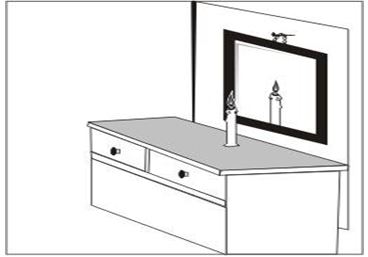
(a) Yes, the room will receive more light.
(b) No, since the source is one candle only.
(c) No, because of the extra shadows.
(d) It depends on the brightness of the candle.
Answer: A
Question. Which of the following would be appropriate units to measure wavelength?
(a) micron
(b) metre cubed
(c) litre
(d) metre per second
Answer: A
Question. An actress wears a yellow costume. The stage is lit with red light. What colour will her costume appear to be?
(a) Red
(b) Red
(c) Green
(d) Blue
Answer: B
Question. What kind of a mirror is this?

(a) plane mirror
(b) convex mirror
(c) concave mirror
(d) magnifying mirror
Answer: B
Question. Which of these ray diagrams correctly shows the functioning of a magnifying glass?

Answer: C
Question. Which of these settings should be used for clicking a photograph in bright sunshine?
(a) f32
(b) f8
(c) f5.6
(d) f1.4
Answer: B
Question. Apart from the aperture, which of these will ALWAYS affect the amount of light entering the camera?
The amount of light that enters a camera when a photograph is being taken depends on two factors. One of them is the aperture - the size of the opening through which light enters. The aperture of a camera is defined by an f number. The f number is shown for 3 different light conditions. Note the pattern between the f numbers and the aperture. The question is based on this:

(a) the make of the camera
(b) The photographer's skill
(c) the type of film
(d) the shutter speed
Answer: D
Question. Have you noticed that when you see an object through a layer of hot air, it appears distorted? The reason for this phenomenon is related to:

(a) density of air.
(b) refraction of light.
(c) temperature of air.
(d) temperature of air.
Answer: B
Question. A ray of white light is passed through two filters - a Cyan Filter and a Magenta Filter. (A cyan filter is one which allows only cyan coloured light to pass through).Which colour light will be seen by the observer?
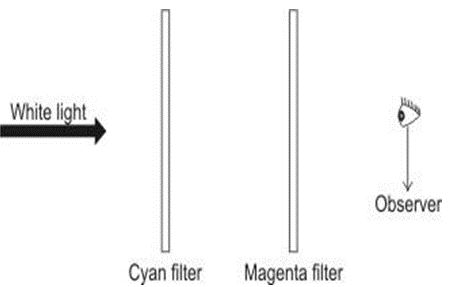
(a) green
(b) blue
(c) yellow
(d) black: no light is seen
Answer: B
Question. George is running towards the finish line in a race. The sun is casting his shadow as shown. In which direction is George running?

(a) definitely north-west
(b) either north-east or south-west
(c) definitely south-west
(d) it is not possible to tell from the given information
Answer: B
Question. The figure below shows the path taken by a ray of light as it reflects off a smooth surface. Which of these is true?
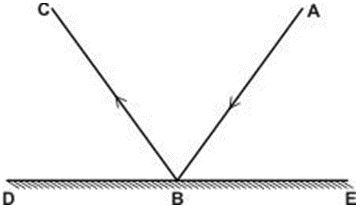
(a) Angle ABE = angle ABC
(b) The path A --> B --> C is the shortest path connecting A to C and touching DE.
(c) B will always be the mid point of DE.
(d) If DE (the mirror) is rotated around B, the ray would still reflect along BC.
Answer: B
Question. See this sculpture of a man's face. Depending on the direction from which light falls on it, the view changes. Given here is the view when the light falls on it from the front. From which direction is the light falling in the case shown below?

Answer: C
Question. If we drop a perfectly transparent piece of glass into perfectly clear water, will we be able to see the glass?
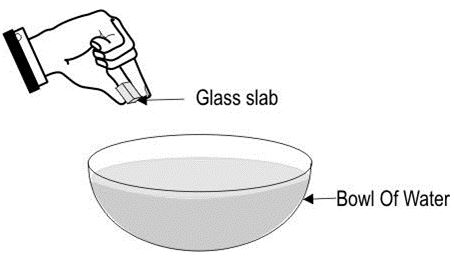
(a) Yes, because the refractive indices of glass and water are different.
(b) Yes, because no refraction takes place at the glass surface.
(c) No, because both the water and the glass slab are transparent.
(d) No, because light will be reflected away from the water surface itself.
Answer: A
Question. In a periscope, the reflecting mirrors will be :
(A) Perpendicular to each other
(B) Parallel to each other
(C) At an angle of 45°
(D) At an angle of 60°
Answer: B
Question. A series of fast moving still pictures can create an illusion of movement because :
(A) The eye can focus on very rapidly changing pictures
(B) Eye is quicker than the brain
(C) Eye can separate two image only when the interval of separation between them is one-tenth of a second
(D) The optical cortex can see through the rapidly moving images
Answer: C
Question. The 'pupil' in human eye can be dilated by :
(A) Retina
(B) Choroid
(C) Optic nerve
(D) Iris
Answer: D
Question. The presistance of the eye is only for :
(A) 1/10th of second
(B) 1/12th of second
(C) 1/16th of second
(D) 1/20th of second
Answer: C
Question. The outer layer of the eye is called :
(A) Cornea
(B) Sclerotic
(C) Choroid
(D) Retina
Answer: B
Question. When the distance between the object and the plane mirror increases :
(A) The image remains same
(B) The size of the image will become less than the size of the object
(C) The distance between the image and the plane mirror increases
(D) The distance between the image and the plane mirror decreases
Answer: C
Question. Night blindness occurs due to deficiency of which vitamin ?
(A) A,
(B) B,
(C) C,
(D) D,
Answer: A
Question. The part which protects the human eye is called :
(A) Cornea
(B) Choroid
(C) Retina
(D) Blind spot
Answer: A
Question. Which of the following statement about human eye is not true ?
(A) The iris gives a distinct colour to the eye
(B) The yellow spot is extermely sensitive to light
(C) The space between lens and cornea is filled with celiary muscles
(D) The optic nerves enters the eye near the blind spot
Answer: C
Question. Cataract is a condition of eye when :
(A) Eye sight becomes fogsy
(B) Eye lens becomes cloudy
(C) There is a loss of vision
(D) All of the above
Answer: D
Question. Plane mirrors are arranged at an angle to get a number of coloured images in :
(A) Periscope
(B) Kaleidoscope
(C) Telescope
(D) Thermoscope
Answer: B
Question. The nature of image formed on the retina of human eye is :
(A) Virtual and erect
(B) Virtual and inverted
(C) Real and erect
(D) Real and inverted
Answer: D
Question. The Braille code used by blind people use dot patterns for words. How many dot patterns or characters are used for this code ?
(A) 52,
(B) 63,
(C) 48,
(D) 26,
Answer: B
Question. In lateral inversion :
(A) Right of the object will be right side of the image
(B) Left side of the object will be left side of the image
(C) Upside of the object will be down side of the object
(D) Right side of the object will be left side of the image
Answer: D
Question. When a light ray is reflected repeatedly by a set of parallel plane mirrors, the intensity of light ray decreases after some reflections. This is because of :
(A) Poor reflection from mirrors
(B) Absorption of some amount of light by mirrors
(C) Dispersion of light when the rays travel through the atmosphere
(D) Scattering of light by the mirrors
Answer: B
Question. Nocturnal animals like owl & bat have :
(A) Large cornea
(B) Large pupil
(C) Retina with large number of rods
(D) All of the above
Answer: D
Question. Which of the following letters will be seen without any change in a plane mirror ?
(A) S
(B) T
(C) L
(D) P
Answer: B
Question. The perpendicular drawn at any point on a mirror is called :
(A) Incident ray
(B) Reflected ray
(C) Normal
(D) Image
Answer: C
Question. Which of the following statements is true ?
(A) The angle of incidence is twice the angle of reflection
(B) The incident ray, the reflected ray and the normal drawn at the point of incidence lie in the same plane
(C) Some types of virtual images can be obtained on of the screens
(D) A convex mirror forms real image
Answer: B
Question. An ideal mirror :
(A) Absorbs all the amount of light incident on it
(B) Refracts all the light
(C) Reflects all the light
(D) None of the above
Answer: C
Q1. Fill ups:
1) The image formed by a plane mirror shows the phenomenon of ___________ inversion.
2) Perpendicular at the point of incidence is_______________.
3) Splitting up of light into its color is known as ____________ of light.
4) Part of retina which is devoid of light sensitive cells______________.
5) During near vision, ciliary muscles ___________, while during distant vision, they expand.
6) ____________lens is present in the eyes.
7) __________ protect the inner structure of the eyes.
8) The day birds like Kite, Eagle have more __________ & fewer _______.
9) Reflection of light by a smooth polished surface is__________ reflection.
10) The ____________nerves connects the eyes to brain.
Q2. Choose the correct answer:
1. Braille System was developed in
a) 1891 c) 1791
b) 1888 d) 1821
2. The image formed by a plane mirror is
a) Always real c) Always virtual
b) Sometimes real & sometimes d) Real but diminished Virtual depending upon the distance of object from the mirror.
3. The no. of multiple images formed by two plane mirrors, if the angle between them is 72˚
a) 4 c) 5
b) 6 d) 7
4. A person is standing 5m away from a plane mirror. What will be the distance between him & the image?
a) 5m c) 0m
b) 10m d) 15m
Q3. Name the following:
a) The most popular resource for visually challenged person to read & write.______________
b) The ray which strikes any surface._____________
c) Light sensitive cells in the eye._____________
d) A smooth, shining surface, which rebounds the light back in the same or different direction._________________
Q3. Why do night birds have extraordinary night vision?
Q4. How the persistence of vision is helpful in making still pictures moving?
Q5. Describe the functions of (a) cornea (b) pupil (c) ciliary muscles (d) iris
Q6. Why are the multiple images seen when two plane mirrors are placed at an angle between them?
Q7. Why is Vitamin A essential for us?
Q8. What are the common eye defects? Give their causes and corrective measures.
Give one word for the following :
1. The invisible energy which causes in use the sensation of vision.
2. The ray of light which travels towards a mirror.
3. A line which is drawn at right angles to the mirror surface at the point of incidence.
4. Name one type of mirror which always form virtual image.
5. What type of image is formed on the cinema screen ?
6. Which cells on the retina respond to the intensity of light.
7. The part of the eye which preserves its shape and protects it from external injuries.
8. The phenomenon due to which we can judge depth.
9. The most sensitive part of the retina.
Fill in the blanks :
1. The point at which the incident ray falls on the mirror is called ___________________
2. If a ray of light is incident on a plane mirror at an angle of 300, its angle of reflection is _______________.
3. If a ray of light is incident normally on a mirror, i = __________ and r = ________________
4. The image of our face in a plane mirror is an example of ___________ image.
5. The distance of the image behind the plane mirror is _________ to the distance of the object in front of it.
6. The principle of ___________is made use of in motion picture projection in cinematography.
7. The presence of __________________ cells on the retina helps us to see in dim light.
8. The coned shaped cells of our retina respond to _____________
9. Due to the absence or insufficient number of ____________ cells a person becomes colour blind.
10. Owls and bats are able to see at night due to the presence of ______________ cells in their retina.
11. The thin, saline liquid that fills the anterior part of the eye is _________.
12. ___________ is the jelly like fluid found in the posterior part of the eye.
13. In a spectrum formed by a prism ______ colour deviates the least and ____________ colour deviates the most.
Multiple choice Questions :
1. The scientist who discovered that white light is composed of 7 colours. [ Louis Braille, Dalton, Issac Newton]
2. _____________________ can be donated after death, to enable a blind person see. [ optic nerve, cornea, iris]
3. The part of the retina which is insensitive to light. [ cornea, yellow spot, blind spot]
4. Focal length of the eye lens can be adjusted by the action of [ choroid, ciliary muscles, optic nerve]
5. Formation of multiple images in the eyes is avoided by the action of [iris, pupil, choroid]
6. The colour of a person‟s eye is determined by his [pupil, iris, retina]
7. Electric pulses from retina to brain is conveyed through [ciliary muscles, optic nerves, pupil]
Important Practice Resources for Class 8 Science
CBSE Science Class 8 Chapter 16 Light Worksheet
Students can use the practice questions and answers provided above for Chapter 16 Light to prepare for their upcoming school tests. This resource is designed by expert teachers as per the latest 2026 syllabus released by CBSE for Class 8. We suggest that Class 8 students solve these questions daily for a strong foundation in Science.
Chapter 16 Light Solutions & NCERT Alignment
Our expert teachers have referred to the latest NCERT book for Class 8 Science to create these exercises. After solving the questions you should compare your answers with our detailed solutions as they have been designed by expert teachers. You will understand the correct way to write answers for the CBSE exams. You can also see above MCQ questions for Science to cover every important topic in the chapter.
Class 8 Exam Preparation Strategy
Regular practice of this Class 8 Science study material helps you to be familiar with the most regularly asked exam topics. If you find any topic in Chapter 16 Light difficult then you can refer to our NCERT solutions for Class 8 Science. All revision sheets and printable assignments on studiestoday.com are free and updated to help students get better scores in their school examinations.
You can download the latest chapter-wise printable worksheets for Class 8 Science Chapter Chapter 16 Light for free from StudiesToday.com. These have been made as per the latest CBSE curriculum for this academic year.
Yes, Class 8 Science worksheets for Chapter Chapter 16 Light focus on activity-based learning and also competency-style questions. This helps students to apply theoretical knowledge to practical scenarios.
Yes, we have provided solved worksheets for Class 8 Science Chapter Chapter 16 Light to help students verify their answers instantly.
Yes, our Class 8 Science test sheets are mobile-friendly PDFs and can be printed by teachers for classroom.
For Chapter Chapter 16 Light, regular practice with our worksheets will improve question-handling speed and help students understand all technical terms and diagrams.