

Chapter-wise Worksheets for Class 4 Mathematics: Fractions And Time
Access comprehensive chapter-wise worksheets for Fractions And Time using the CBSE Class 4 Maths Fractions And Time Worksheet. Designed to align with the 2026-27 academic syllabus for Class 4 Mathematics, these printable practice sets help students reinforce key concepts and improve their overall exam readiness.
Practice Class 4 Mathematics Worksheets: Fractions And Time
Navigate directly to the solved Mathematics worksheets using the digital viewer below. Each practice set includes detailed step-by-step solutions, allowing students to instantly cross-check their work and identify areas requiring further revision.
Fill in the blanks:
Question 1. Fractions that have the same denominators are called ___________________________
Answer: like fractions
In simple words: Fractions with identical bottom numbers are like fractions.
Exam Tip: Always check the denominators to determine if fractions are like or unlike.
Question 2. Fractions that name the same part are called __________________________________
Answer: equivalent fractions
In simple words: Fractions that represent equal values are equivalent fractions.
Exam Tip: Multiply or divide the numerator and denominator by the same non-zero number to find equivalent fractions.
Question 3. In a leap year there are _______________________ days.
Answer: 366
In simple words: A leap year has one extra day in February, making 366 days in total.
Exam Tip: A normal year has 365 days, whereas a leap year occurs every 4 years and has 366 days.
Question 4. When we combine a whole number with a fraction , we get a _______________number.
Answer: mixed
In simple words: A combination of a whole number and a proper fraction forms a mixed number.
Exam Tip: Example of a mixed number is \(1 \frac{1}{2}\).
Question 5. 3 hours before midnight ________________.
Answer: 9:00 p.m.
In simple words: Midnight is 12:00 midnight. Counting 3 hours backward gives 9:00 p.m.
Exam Tip: Midnight marks the start of a new day at 12:00 a.m.
Question 6. 30 minutes after 6:00 p.m.__________________.
Answer: 6:30 p.m.
In simple words: Adding 30 minutes to 6:00 p.m. gives half past six.
Question 7. 1 hour after 11:00 a.m. __________________.
Answer: 12:00 noon
In simple words: Moving 1 hour forward from 11:00 a.m. reaches 12:00 noon.
Exam Tip: 12:00 noon marks the transition from a.m. to p.m.
Question 8. \(\frac{1}{3} = \frac{2}{6} = \frac{\Box}{12}\)
Answer: 4
Since \(\frac{1}{3} = \frac{1 \times 4}{3 \times 4} = \frac{4}{12}\), the missing numerator is 4.
In simple words: Multiply both numerator and denominator by 4 to get the denominator 12.
Exam Tip: Whatever you multiply the denominator by, you must multiply the numerator by the exact same number.
Write True or False:
Question 1. \(\frac{3}{5}, \frac{4}{5}, \frac{2}{5}\) are unlike fractions
Answer: False
In simple words: They all have the same denominator 5, so they are like fractions.
Exam Tip: Fractions with the same denominators are like fractions, not unlike.
Question 2. 5:00 a.m. is daylight
Answer: False
In simple words: 5:00 a.m. is early morning and usually before sunrise.
Exam Tip: Daylight hours generally start after sunrise around 6:00 a.m. or later depending on the season.
Question 3. The sun set at 6:00 p.m. yesterday
Answer: True
In simple words: Sunset typically occurs in the evening around 6:00 p.m.
Exam Tip: Sunset times vary throughout the year, but 6:00 p.m. is a standard general timeframe.
Question 4. \(\frac{15}{7}\) is a proper fraction.
Answer: False
In simple words: The numerator 15 is greater than the denominator 7, making it an improper fraction.
Exam Tip: A proper fraction always has a numerator smaller than its denominator.
Question 5. Amana ate dinner at 9:00 a.m.
Answer: False
In simple words: Dinner is eaten in the evening or night, which is p.m., not a.m.
Exam Tip: a.m. stands for morning hours and p.m. stands for afternoon and evening hours.
Question 6. \(\frac{4}{4}\) is a proper fraction.
Answer: False
In simple words: When the numerator is equal to or greater than the denominator, it is an improper fraction equal to 1.
Exam Tip: Proper fractions are strictly less than 1.
Convert the following into mixed numbers:
Question a) \(\frac{14}{9}\)
Answer: \(1\frac{5}{9}\)
Divide 14 by 9: \(14 \div 9 = 1\) quotient with a remainder of 5.
So, \(\frac{14}{9} = 1\frac{5}{9}\).
In simple words: Divide the top number by the bottom number to get the whole number and the remainder goes on top.
Exam Tip: The denominator of the fraction part remains the same as the original denominator.
Question b) \(\frac{13}{7}\)
Answer: \(1\frac{6}{7}\)
Divide 13 by 7: \(13 \div 7 = 1\) quotient with a remainder of 6.
So, \(\frac{13}{7} = 1\frac{6}{7}\).
In simple words: 13 divided by 7 gives 1 whole with 6 left over.
Exam Tip: Double check by converting back: \((1 \times 7) + 6 = 13\).
Question c) \(\frac{22}{10}\)
Answer: \(2\frac{2}{10}\) (or \(2\frac{1}{5}\))
Divide 22 by 10: \(22 \div 10 = 2\) quotient with a remainder of 2.
So, \(\frac{22}{10} = 2\frac{2}{10} = 2\frac{1}{5}\).
In simple words: 22 divided by 10 gives 2 whole parts and 2 parts remaining out of 10.
Exam Tip: Always reduce the fraction part to its simplest form if possible.
Convert these mixed numbers into improper fraction:
Question a) \(1\frac{3}{5}\)
Answer: \(\frac{8}{5}\)
\(= \frac{(1 \times 5) + 3}{5}\)
\(= \frac{5 + 3}{5} = \frac{8}{5}\)
In simple words: Multiply the whole number by the denominator and add the numerator.
Exam Tip: Keep the denominator unchanged in the resulting improper fraction.
Question b) \(7\frac{2}{3}\)
Answer: \(\frac{23}{3}\)
\(= \frac{(7 \times 3) + 2}{3}\)
\(= \frac{21 + 2}{3} = \frac{23}{3}\)
In simple words: Multiply 7 by 3 to get 21, then add 2 to get 23.
Exam Tip: Follow the formula: \(\frac{(\text{Whole} \times \text{Denominator}) + \text{Numerator}}{\text{Denominator}}\).
Question c) \(3\frac{3}{8}\)
Answer: \(\frac{27}{8}\)
\(= \frac{(3 \times 8) + 3}{8}\)
\(= \frac{24 + 3}{8} = \frac{27}{8}\)
In simple words: Multiply 3 by 8 and add 3.
Question a) \(\frac{3}{8} + \frac{1}{8}\)
Answer: \(\frac{4}{8}\) (or \(\frac{1}{2}\))
\(= \frac{3 + 1}{8} = \frac{4}{8} = \frac{1}{2}\)
In simple words: Since denominators are the same, add the numerators directly.
Exam Tip: Always reduce your final fraction to its simplest form.
Question b) \(\frac{4}{5} + \frac{3}{5}\)
Answer: \(\frac{7}{5}\) (or \(1\frac{2}{5}\))
\(= \frac{4 + 3}{5} = \frac{7}{5} = 1\frac{2}{5}\)
In simple words: Add the numerators 4 and 3 over the common denominator 5.
Exam Tip: Improper fraction answers can be left as improper fractions or converted to mixed numbers unless specified.
Question c) \(\frac{5}{6} + \frac{1}{6}\)
Answer: \(\frac{6}{6}\) (or \(1\))
\(= \frac{5 + 1}{6} = \frac{6}{6} = 1\)
In simple words: Any fraction with the same numerator and non-zero denominator equals 1.
Exam Tip: State \(\frac{6}{6} = 1\) to show complete simplification.
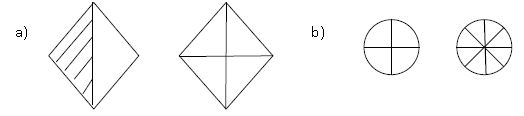
Colour to show equivalent fractions
Question a) Colour to show equivalent fractions
Answer: For shape (a), shade 2 out of 4 parts (or 4 out of 8 parts) to show equivalent fractions like \(\frac{1}{2} = \frac{2}{4}\).
In simple words: Shade the required proportional sections of the given geometric figure.
Exam Tip: Equivalent fractions represent the same shaded area of a whole shape.
Question b) Colour to show equivalent fractions
Answer: For circle (b), shade 4 parts out of 8 parts to represent \(\frac{1}{2}\) or equivalent fractions.
In simple words: Shade half of the sectors in the circle.
Exam Tip: Make sure equal portions are shaded relative to the total number of parts.
Find the fraction:
Question 1. \(\frac{1}{4}\) of a dozen
Answer: 3
1 dozen = 12
\(\frac{1}{4} \text{ of } 12 = \frac{12}{4} = 3\)
In simple words: Divide 12 by 4 since a dozen equals 12 items.
Exam Tip: Remember standard units: 1 dozen = 12 units, 1 litre = 1000 millilitres, 1 hour = 60 minutes, 1 day = 24 hours.
Question 2. \(\frac{1}{8}\) of 1 litre ( in millilitre)
Answer: 125 millilitres
1 litre = 1000 millilitres
\(\frac{1}{8} \text{ of } 1000 \text{ ml} = \frac{1000}{8} = 125 \text{ ml}\)
In simple words: Convert 1 litre to 1000 ml and divide by 8.
Question 3. \(\frac{1}{5}\) of an hour (in minutes)
Answer: 12 minutes
1 hour = 60 minutes
\(\frac{1}{5} \text{ of } 60 \text{ minutes} = \frac{60}{5} = 12 \text{ minutes}\)
In simple words: Divide 60 minutes by 5.
Exam Tip: 60 divided by 5 is a standard division fact equal to 12.
Question 4. \(\frac{1}{6}\) of a day (in hours)
Answer: 4 hours
1 day = 24 hours
\(\frac{1}{6} \text{ of } 24 \text{ hours} = \frac{24}{6} = 4 \text{ hours}\)
In simple words: Divide the 24 hours in a day by 6.
Exam Tip: 24 divided by 6 gives 4.
Solve the following:
Question 1. Sara’s mother made a Christmas cake. Sara ate \(\frac{5}{16}\) of the cake, and her brother ate \(\frac{8}{16}\) of the cake. Who ate more and how much?
Answer: Brother ate more by \(\frac{3}{16}\) of the cake.
Sara's share = \(\frac{5}{16}\)
Brother's share = \(\frac{8}{16}\)
Since \(8 > 5\), the brother ate more.
Difference = \(\frac{8}{16} - \frac{5}{16} = \frac{3}{16}\)
In simple words: Compare the numerators since denominators are equal, then subtract to find the difference.
Exam Tip: State clearly who ate more before showing the subtraction step.
Question 2. The Maths quiz was 2 hours 10 minutes long. It started at 8:05 a.m. At what time it got over?
Answer: 10:15 a.m.
Start time = 8:05 a.m.
Duration = 2 hours 10 minutes
Adding hours: 8:05 a.m. + 2 hours = 10:05 a.m.
Adding minutes: 10:05 a.m. + 10 minutes = 10:15 a.m.
In simple words: Add 2 hours to 8:05 to get 10:05, then add 10 minutes to get 10:15.
Exam Tip: Always add hours to hours and minutes to minutes separately.
Question 3. To make soup Hana took \(\frac{2}{8}\) of milk and \(\frac{5}{8}\) of water. How much quantity she used in all?
Answer: \(\frac{7}{8}\)
Milk used = \(\frac{2}{8}\)
Water used = \(\frac{5}{8}\)
Total quantity used = \(\frac{2}{8} + \frac{5}{8} = \frac{2 + 5}{8} = \frac{7}{8}\)
In simple words: Combine both fractions by adding their numerators because the denominators are the same.
Exam Phrase: "In all" or "altogether" indicates that you need to perform addition.
Fill in the blanks:
1. Fractions that have the same denominators are called ___________________________
2. Fractions that name the same part are called __________________________________
3. In a leap year there are _______________________ days.
4. When we combine a whole number with a fraction , we get a _______________number.
5. 3 hours before midnight ________________.
6. 30 minutes after 6:00 p.m.__________________.
7. 1 hour after 11:00 a.m. __________________.
8. 1/3 = 2/6 = /12
Write True or False:
1. 3/5, 4/5, 2/5 are unlike fractions ( )
2. 5:00 a.m. is daylight ( )
3. The sun set at 6:00 p.m. yesterday ( )
4. 15/7 is a proper fraction. ( )
5. Amana ate dinner at 9:00 a.m. ( )
6. 4/4 is a proper fraction. ( )
Convert the following into mixed numbers:
a) 14/9 =
b) 13/7 =
c) 22/10 =
Convert these mixed numbers into improper fraction:
a) 1(3/5) =
b) 7(2/8) =
c) 3(1/8) =
Solve the following:
a) 3/8+ 1/8 =
b) 4/5 + 3/5 =
c) 5/6 + 1/6 =
Colour to show equivalent fractions
Find the fraction:
1. 1/4 of a dozen
2. 1/8 of 1 litre ( in millilitre)
3 . 1/5 of an hour (in minutes)
4. 1/6 of a day (in hours)
Solve the following:
1. Sara’s mother made a Christmas cake. Sara ate 5/16 of the cake, and her brother ate 8/16 of the cake. Who ate more and how much?
2. The Maths quiz was 2 hours 10 minutes long. It started at 8:05 a.m. At what time it got over?
3. To make soup Hana took 2/8 of milk and 5/8 of water . How much quantity she used in all?
Free study material for Mathematics
Download Class 4 Mathematics Fractions And Time Practice Worksheets
Mastering Fractions And Time with Printable Worksheets
Explore reliable practice questions for Fractions And Time tailored for Class 4 Mathematics learners. Use these structured worksheets to evaluate exam preparedness and strengthen problem-solving skills throughout the 2026 academic session.
Verified Solutions and NCERT Alignment
Designed around the official curriculum for Class 4 Mathematics, these practice sheets guarantee standard compliance. Reviewing step-by-step solutions after completion sharpens your accuracy and clarifies complex sub-topics within Fractions And Time.
Additional Study Resources for Class 4 Mathematics
Follow up your worksheet practice by attempting the interactive online MCQ tests for Fractions And Time to evaluate your execution speed. All printable assignments and revision sheets on our platform are updated for the 2026 session and available free of charge.
FAQs
You can download the latest chapter-wise printable worksheets for Class 4 Mathematics Fractions And Time for free from StudiesToday.com. These have been made as per the latest CBSE curriculum for this academic year.
Yes, Class 4 Mathematics worksheets for Fractions And Time focus on activity-based learning and also competency-style questions. This helps students to apply theoretical knowledge to practical scenarios.
Yes, we have provided solved worksheets for Class 4 Mathematics Fractions And Time to help students verify their answers instantly.
Yes, our Class 4 Mathematics test sheets are mobile-friendly PDFs and can be printed by teachers for classroom.
For Fractions And Time, regular practice with our worksheets will improve question-handling speed and help students understand all technical terms and diagrams.