

Download Class 5 English Practice Worksheets
Review targeted academic worksheets with the CBSE Class 5 English Revision Worksheet Set 21. Built according to official educational standards for the 2026-27 term, these downloadable Class 5 English resources support effective daily practice and detailed self-evaluation for All Chapters.
Access All Chapters Practice Papers and Solutions
Navigate directly to the solved English worksheets using the digital viewer below. Each practice set includes detailed step-by-step solutions, allowing students to instantly cross-check their work and identify areas requiring further revision.
I. Fill in the blanks by choosing a correct word from blacket.
1. Riya ______________ when the phone rang.(painted/was painting)
2. The butterfly _________________ away when the boy came near .(fling / flew)
II. Correct the incorrect sentences
1. History is always repeating itself.
2. I am usually studying at 5 pm.
III. Join the sentence and begin with- “before” .
1. Sneha woke up. Mahi left for work.
2. They stopped the car. There is a In- orbit mall.
IV. Write answer using Present perfect tenses.
1. Have you been to Delhi?
2. How many books you have read in your library?
V. Match the synonyms
1. Churn to divide into 2 parts
2. Bisect praising
3. Puffing American deer
4. Moose to stir
VI. Rewrite using correct homophone
1. We went to ban concert.______________________________________________
2. I scent her a surprise gift!________________________________________________
VII. Make sentences with following homographs.
1. Well.______________________________________________________________
__________________________________________________________________________
2. Herd.________________________________________________________________
VIII. Fill in the blanks with appropriate conjunction.
Question 8.1. No sooner had I opened my eyes_____________________ I remember where I was.
Answer: than
In simple words: 'No sooner ... than' means two things happened one right after the other.
Exam Tip: Remember the pair 'No sooner ... than' and 'Hardly ... when'.
Question 8.2. It was not only raining_________________thundering.
Answer: but also
In simple words: 'not only ... but also' joins two facts that are both true.
Exam Tip: 'Not only' is always followed by 'but also'.
IX. Rewrite the following sentence.
Question 9.1. They will leave either today or they will go tomorrow.
Answer: They will either leave today or go tomorrow.
In simple words: Use 'either ... or' once, and then the verb is not repeated.
Exam Tip: Put 'either' just before the first option and 'or' before the second.
Question 9.2. The speech was not only very long but also boring.
Answer: Not only was the speech very long, but it was also boring.
In simple words: Start the sentence with 'Not only' and swap the verb with the subject.
Exam Tip: When 'not only' starts a sentence, the helping verb comes before the subject.
X. Make sentences using these transitional words.
Question 10.1. Without a doubt
Answer: Without a doubt, the Sun rises in the east.
In simple words: 'Without a doubt' shows that you are very sure of something.
Exam Tip: Put a comma after a transitional word at the start of a sentence.
Question 10.2. However
Answer: I wanted to play outside; however, it started to rain.
In simple words: 'However' shows a difference or a contrast.
Exam Tip: Use 'however' to show that the second idea is different from the first.
XI. Underline appositive phrase.
Question 11.1. President of India, one of the highest designation, rules for 5years.
Answer: President of India, one of the highest designation, rules for 5 years.
In simple words: An appositive phrase gives extra information about the noun just before it.
Exam Tip: An appositive phrase is set off by commas.
Question 11.2. Bio nutrition, Aditi's favourite subject, it is very interesting.
Answer: Bio nutrition, Aditi's favourite subject, it is very interesting.
In simple words: 'Aditi's favourite subject' tells us more about 'Bio nutrition'.
Exam Tip: Look for the phrase that renames the noun next to it.
XII. Circle the preposition and underline prepositional phrase.
Question 12.1. My pet dog likes to sit on the carpet.
Answer: My pet dog likes to sit (on) the carpet.
In simple words: 'on the carpet' tells where the dog sits.
Exam Tip: A preposition is followed by a noun or pronoun.
Question 12.2. Sameer ran down the stairs.
Answer: Sameer ran (down) the stairs.
In simple words: 'down the stairs' tells the direction of running.
Exam Tip: Words like down, up, in and out can be prepositions.
Question 12.3. Who is knocking at the door?
Answer: Who is knocking (at) the door?
In simple words: 'at the door' tells where the knocking is happening.
Exam Tip: 'At' often shows a place.
XIII. Edit the paragraph.
Question 13.1. james kathy and rex whent to the store! james bought two candy. kathy bought sum toffes,rex had to paye the bill for both.
Answer: James, Kathy and Rex went to the store. James bought two candies. Kathy bought some toffees, and Rex had to pay the bill for both.
In simple words: Capital letters start names and sentences, and spellings must be correct.
Exam Tip: Read the paragraph slowly and check each name, word and full stop.
XIII. Make sentences with the following reflexive pronouns.
Question 13.2. Myself.
Answer: I cut the cake myself.
In simple words: 'Myself' shows that I did the work alone.
Exam Tip: Use 'myself' with 'I'.
Question 13.3. Yourself.
Answer: You should believe in yourself.
In simple words: 'Yourself' is used with 'you'.
Exam Tip: Use 'yourself' for one person and 'yourselves' for more than one.
Question 13.4. Themself.
Answer: They painted the room themselves.
In simple words: The correct form is 'themselves' for more than one person.
Exam Tip: Use 'themselves', not 'themself'.
Question 13.5. Itself
Answer: The cat cleaned itself.
In simple words: 'Itself' is used for a thing or an animal.
Exam Tip: 'Itself' is used for things and animals.
XIV. Complete the poem using possessive pronoun.
Question 14. I have a toy, You have a book, The toy is for____, The book is for _________ The toy is _______. It is ________book, The book is __________.
Answer: I have a toy, You have a book,
The toy is for me, The book is for you.
The toy is mine. It is your book, The book is mine.
In simple words: 'Mine' and 'yours' take the place of a noun that has already been named.
Exam Tip: Use 'my' before a noun, and 'mine' when the noun is left out.
XV. Fill in the blanks using possessive adjectives.
Question 15.1. Susan and Jane's mother is in Paris. ____ Mother is in Paris.
Answer: Their Mother is in Paris.
In simple words: 'Their' shows that the mother belongs to two people.
Exam Tip: Use 'their' when there are two or more owners.
Question 15.2. My brother's bicycle is red. ____ bicycle is red.
Answer: My brother's bicycle is red. (Here 'His' bicycle is red.)
In simple words: 'His' shows that the bicycle belongs to a boy or man.
Exam Tip: Use 'his' for a male owner.
Question 15.3. I've got my sister's books. I've got ____ books.
Answer: I've got her books.
In simple words: 'Her' shows that the books belong to a girl.
Exam Tip: Use 'her' for a female owner.
Look at the picture and fill in the blanks:
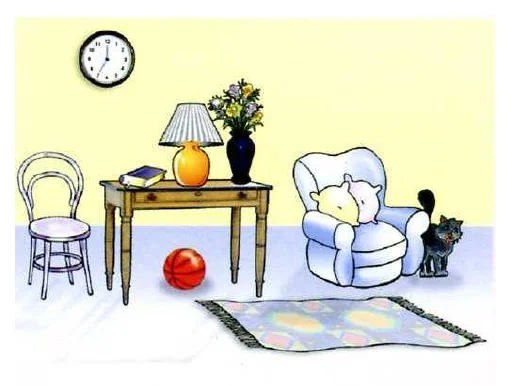
Question 15.4. 1) The clock is ____ the wall.
Answer: on
In simple words: The clock is hanging on the wall.
Exam Tip: Use 'on' for things touching a surface.
Question 15.5. 2) The ball is ____ the table.
Answer: under
In simple words: The ball is below the table.
Exam Tip: 'Under' means below something.
Question 15.6. 3) The cat is ____ the armchair.
Answer: next to
In simple words: The cat is beside the armchair.
Exam Tip: 'Next to' means beside.
Question 15.7. 4) The table is ____ the armchair.
Answer: next to
In simple words: The table stands beside the armchair.
Exam Tip: Use 'next to' for things that are side by side.
Question 15.8. 5) The carpet is ____ the floor.
Answer: on
In simple words: The carpet lies on the floor.
Exam Tip: Use 'on' for things resting on a surface.
Question 15.9. 6) The lamp is ____ the table.
Answer: on
In simple words: The lamp is standing on the table.
Exam Tip: Use 'on' when something rests on top.
Question 15.10. 7) The flowers are ____ the vase.
Answer: in
In simple words: The flowers are inside the vase.
Exam Tip: Use 'in' for things inside a container.
Question 15.11. 8) The table is ____ the chair and the armchair.
Answer: between
In simple words: The table is in the middle of the chair and the armchair.
Exam Tip: Use 'between' when there are two things on either side.
XVI. Describe the main characters in Aladin.
Question 16. Describe the main characters in Aladdin.
Answer: Sample outline: Aladdin is a poor, kind and brave young boy who finds a magic lamp. Other main characters are the Princess, whom Aladdin loves, and the magician, who wants the lamp and is the villain of the story. Write two or three sentences about each character in your own words.
In simple words: Say who the character is, what he or she does, and what kind of person he or she is.
Exam Tip: Use the character's actions to show what kind of person he or she is.
XVI. Look around in the playground and write five sentences in present continuous tense.
Question 17. Write five sentences in present continuous tense about what you see in the playground.
Answer: Sample sentences: 1. Some children are running around the field. 2. A boy is swinging on the swing. 3. Two girls are playing with a ball. 4. The teacher is blowing a whistle. 5. A dog is sitting near the gate.
In simple words: Use 'is' or 'are' with a verb ending in -ing to show an action happening now.
Exam Tip: Use 'is' with one person or thing and 'are' with more than one.
Worksheet 2
I. Answer the following questions.
Question 1. Do you think Zee's mother was finally happy with Zee? Give reason.
Answer: Answers should be based on the story. Look at how Zee's mother behaves at the end and support the answer with a reason from the story.
In simple words: Say yes or no, then give one clear reason from the story.
Exam Tip: Always support your answer with an event from the story.
Question 2. How did the honest trader react when he realised that the bowl was made of gold?
Answer: Answers should be based on the story. The honest trader's reaction should show what he felt and did when he found out the bowl was gold.
In simple words: Tell how he felt and what he did when he found the gold.
Exam Tip: Write the reaction in two or three sentences.
Question 3. Bowing to a hat is a silly idea, yet Tell said he would bow to the hat. Why?
Answer: Answers should be based on the story. Tell agreed to bow to the hat to keep himself and his son safe from Gessler's punishment, even though he did not respect the hat.
In simple words: He did it to protect his family, not because he wanted to.
Exam Tip: Give the reason in the story, not your own opinion.
Question 4. 'You will shoot the apple off your boy's head,' repeated Gessler in a slow and scornful voice. Reveal the character of Gessler.
Answer: Gessler is cruel, proud and enjoys making others suffer. He speaks in a slow and scornful voice, which shows that he looks down on others and likes to see them in danger.
In simple words: Gessler is a mean and cruel ruler.
Exam Tip: Use words like cruel, proud or harsh and support them with the voice or action in the line.
I. Read the lines below and answer the questions.
Whatever happens you mustn't sneeze
When they come prowling in.
And here they are whispering at the door;
You've never heard them sound so hushed before.
Don't breathe. Don't move. Stay dumb. Hide in your blindness.
Question 5.1. Why did the speaker in the poem say 'you mustn't move'?
Answer: The speaker says you must not move because something is prowling outside and may notice you if you make any sound or movement.
In simple words: Keep very still so that the creatures outside do not find you.
Exam Tip: Look for the words that show danger, such as prowling and whispering.
Question 5.2. What is the meaning of prowling?
Answer: Prowling means moving quietly and secretly, often looking for something to catch.
In simple words: Prowling is sneaking around quietly.
Exam Tip: Think of a cat creeping up on a mouse.
Question 5.3. Where is the speaker in the poem hiding?
Answer: The speaker is hiding in a dark or hidden place, shown by the words 'Hide in your blindness'.
In simple words: The speaker is hiding somewhere dark and quiet.
Exam Tip: Look for the words that describe the hiding place.
II. Read the poem and answer the questions.
Only one I in the whole wide world
And millions and millions of you,
But every you is an I to itself
And I am a you to you, too!
But if I am a you and you are an I
And the opposite also is true,
Question 6.1. Why has the poet used exclamation in line 4?
Answer: The poet uses an exclamation mark to show surprise and excitement at the idea that I am a 'you' to you.
In simple words: The poet is excited by a surprising idea.
Exam Tip: An exclamation mark shows strong feeling.
Question 6.2. How do I and You become the same?
Answer: Every person is 'I' to himself or herself, and 'you' to everyone else. So 'I' and 'you' change places and both mean the same kind of person.
In simple words: Everyone is 'I' to themselves and 'you' to others.
Exam Tip: Look at how the poet swaps the words 'I' and 'you' in the last two lines.
Question 6.3. Who is the poet of the poem 'You and I'?
Answer: The poet's name is not given in these lines. Check the name of the poet in your textbook.
In simple words: The poet's name is printed with the poem in your book.
Exam Tip: Check the title and the poet's name in your textbook.
II. Write a thanking letter to your friend who looked after you when you were sick for a long time.
Question 7. Thanking letter.
Answer: Sample outline: Start with the date and 'Dear (friend's name),'. Thank your friend for looking after you, mention one thing your friend did, say how much it helped, and close with 'Yours lovingly, (your name)'.
In simple words: Say thank you and tell your friend what you liked.
Exam Tip: Keep the letter polite and warm.
3. Write a diary account on 'how do you feel when people waste water'.
Question 8. Diary account on wasting water.
Answer: Sample outline: Write the date at the top. Describe what you saw, for example a tap left running. Say how you felt, such as sad or angry, and what you think people should do to save water.
In simple words: Write about what you saw and how it made you feel.
Exam Tip: Diary entries are written in the first person using 'I'.
III. Imagine you are a newspaper reporter who happened to witness how the trader in the colony was deceiving the public. Write a brief newspaper account.
Question 9. Newspaper account.
Answer: Sample outline: Give a headline, such as 'Trader Caught Cheating'. Write where and when it happened, who was involved, what the trader did to cheat the public, and how people reacted.
In simple words: A news report tells what happened, where, when and who was involved.
Exam Tip: Write in the third person and use facts only.
___________________________________________________________________________
Choose the correct options-
a. What is the plural form of the word ‘hair'?
(i) Hair (ii) Hairs (iii) Haires
b. The Verb is called the ......... word.
(i) naming (ii) describing (iii) doing
c. Words, which tell us something about the Noun or Pronoun are called ........
(i) Prepositions (ii) Articles (iii) Adjectives
d. Ishan attends his school regularly. The underlined word is a .......
(i) Pronoun (ii) Adverb (iii) Verb
e. Which kind of noun always begins with a capital letter?
(i) Collective Noun (ii) Proper Noun (iii) Abstract Noun
f. Solomon was known for his wisdom. The underlined word is
(i) Collective Noun (ii) Proper Noun (iii) Abstract Noun
g. Which of these nouns takes only –s to form its plural?
(i) Leaf (ii) Wolf (iii) Chief
h. Non-living objects are called the
(i) Neuter Gender (ii) Common Gender (iii) Masculine Gender
i. A word used instead of a Noun is called ......
(i) Pronoun (ii) Verb (iii) Adjective
j. Which pronoun is used for both singular and plural nouns?
(i) You (ii) we (iii) he
k. The describing or qualifying words are called .........
(i) Nouns (ii) Adjectives (iii) Adverbs
l. Shivani is the ........of three sisters.
(i) older (ii) elder (iii) eldest
m. The positive Degree of ‘better’ is .......
(i) bad (ii) worse (iii) good
n. All the verbs have ....... forms.
(i) one (ii) two (iii) four
o. She could not play because of her ......... forearm.
(i) break (ii) broke (iii) broken
Free study material for English
CBSE Class 5 English Worksheets for All Chapters
Download Chapter Worksheets: Class 5 English
Review targeted practice exercises for Class 5 English All Chapters. Curated to match official CBSE guidelines, these printable problem sets support daily revision and improve overall test readiness.
Concept Clarification for All Chapters
Built using official NCERT guidelines for Class 5 English, these practice sheets provide reliable academic support. Cross-reference your completed work with our detailed solutions to learn standard answer-writing formats for CBSE exams.
Effective Revision Strategies for School Exams
Follow up your worksheet practice by attempting the interactive online MCQ tests for All Chapters to evaluate your execution speed. All printable assignments and revision sheets on our platform are updated for the 2026 session and available free of charge.
FAQs
You can download the latest chapter-wise printable worksheets for Class 5 English All Chapters for free from StudiesToday.com. These have been made as per the latest CBSE curriculum for this academic year.
Yes, Class 5 English worksheets for All Chapters focus on activity-based learning and also competency-style questions. This helps students to apply theoretical knowledge to practical scenarios.
Yes, we have provided solved worksheets for Class 5 English All Chapters to help students verify their answers instantly.
Yes, our Class 5 English test sheets are mobile-friendly PDFs and can be printed by teachers for classroom.
For All Chapters, regular practice with our worksheets will improve question-handling speed and help students understand all technical terms and diagrams.