

Chapter-wise Worksheets for Class 5 English: Coconut Came To Myanmar
Explore structured practice materials through the CBSE Class 5 English Coconut Came To Myanmar Worksheet. Tailored for Class 5 learners, utilizing these English worksheets ensures thorough preparation and strengthens problem-solving accuracy before final school evaluations.
Practice Class 5 English Worksheets: Coconut Came To Myanmar
Navigate directly to the solved English worksheets using the digital viewer below. Each practice set includes detailed step-by-step solutions, allowing students to instantly cross-check their work and identify areas requiring further revision.
Read the story. How The Coconut Came To Myanmar Myanmar (then called Burma) is known as the golden land of gold dome pagodas and swaying coconut trees. Coconut trees were originally called 'gon-bin' in Myanmar language, which translated in English means the mischief-maker's tree. Why it is known by this most unusual name, is because once centuries ago, a raft carrying three people landed on the Burmese coast. The people on board this raft were taken to the king. On questioning them the king learnt that they had been banished from their own kingdom because of the crimes they had committed. One man was a thief who stole from other people; the next was a witch who used to cast wicked spells and frightened the people. While the third was a mischief-maker, who did nothing right and only harmed everyone by telling tales and lies. The king on hearing their story ordered his minister to give a thousand pieces of silver to the thief and allowed him to settle in Burma. For the witch too, he gave the same orders. But for the mischief-maker, he ordered him to be executed at once. To his astonished courtiers the king explained that the thief stole from others because he was poor and if he had enough to live on, he would make a good subject. The witch too cast spells because she was envious, poor and unhappy and if she had enough to live on, she too would make a good subject. But for the third, the king pointed out that "once a mischief-maker, always a mischief-maker". So the mischief-maker was taken to the seashore and beheaded. The next day when the king's officer passed the place of the mischief-maker's execution, he was surprised to see the head of the mischief-maker open its mouth and shout out aloud, "Tell your king to come and bow before me or else I will knock his head off." The frightened officer ran to the king to report the most unusual happening. The king did not believe him and felt he was making fun of him. "My Lord if you do not believe me, send someone with me and he will confirm what I just saw." So the king ordered another officer to accompany the first. When they reached the execution grounds the head lay silent. The second officer reported what he saw and in anger the King ordered the first officer to be executed for being a liar. The unfortunate officer was taken to the execution grounds and beheaded. On seeing this, the head of the mischief-maker laughed aloud saying, "Ha, ha! I can still make mischief even though I am dead." The officer went rushing back to the palace and reported to the king. The king was filled with grief and remorse. The king realised that the mischief-maker's head would create further problems, so he ordered the head to be buried in a deep pit. The next day a strange tree grew where the head was buried, bearing the most unusual fruit, which resembled the mischief-maker's head. This was the coconut tree which the Burmese call the 'gon-bin' tree. Over the years, it became "on-bin". If you take the "gon-thi" (a coconut fruit) and shake it, you can hear a gurgling sound - for it's still the mischief-maker wanting to tittle tattle and play a prank on you. 1a) Complete the informations, on the basis of the story.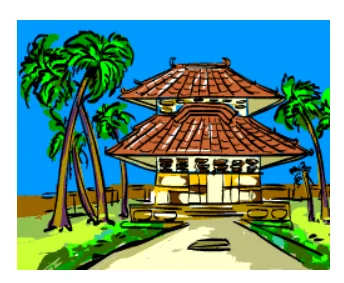
Answer:
i. The earlier name of Myanmar was Burma.
ii. Coconut trees are called gon-bin in English language. The story tells that, once three people reached by a raft.
iii. They were banished from their country because they have committed some crimes.
iv. The king ordered him for execution at once.
v. So the mischief maker was taken to the shore and beheaded.
vi. The head of the mischief-maker was buried deep in the ground.
vii. The next day a strange tree grew where the head was buried.
viii. The fruit of the tree was resembling the head of the mischief-maker.
ix. If you shake the coconut fruit, you can hear the gurgling sound.
In simple words: These sentences summarize key facts directly from the story about Myanmar, the coconut tree's origin name, and the three men who arrived on a raft.
Exam Tip: Read comprehension passages carefully to locate exact names, terms, and plot events.
1b) Read the underlined words. With the help of the dictionary find out the word meanings.
Answer:
| Word | Meaning | Word | Meaning |
|---|---|---|---|
| Banished | Sent away from a country as an official punishment | Envious | Feeling or showing jealousy of what someone else has |
| Executed | Put to death as a lawful punishment | Serenity | The state of being calm, peaceful, and untroubled |
| Astonished | Greatly surprised or impressed; amazed | Investment | The action or process of investing money or time for profit or benefit |
| Remorse | Deep regret or guilt for a wrong committed | Gurgling | Making a hollow bubbling sound |
In simple words: Vocabulary words from the text are matched with their standard dictionary meanings.
| Word | Meaning |
|---|---|
| Swaying | Moving gently from side to side |
| Beheaded | Killed by having the head cut off |
| Confirm | To show or prove that something is true |
| Execution | The act of putting a person to death as a punishment |
| Prank | A playful trick played on someone |
Exam Tip: Always use a dictionary to verify the contextual meanings of unfamiliar words.
1c) Choose five nouns, five verbs, five adjectives, five adverbs and five prepositions from the passage.
Answer:
| Noun | Verb | Adjective | Adverb | Preposition |
|---|---|---|---|---|
| Myanmar | Landed | Golden | Originally | On |
| King | Stole | Wicked | Aloud | In |
| Thief | Ordered | Astonished | Still | To |
| Seashore | Laughed | Silent | Once | From |
| Tree | Buried | Unusual | Always | By |
In simple words: Parts of speech are categorized based on their grammatical functions in sentences.
Exam Tip: Identify parts of speech by asking how a word functions within a sentence.
2. Learn the poem. You will be asked to recite it in the class
Answer:
The poem "Never Forget" encourages self-worth, resilience, optimism, and kindness. Students are required to memorize and recite it with proper rhythm and expression.
In simple words: Read the poem multiple times aloud to memorize the lines and practice proper intonation.
Your presence is a gift to the world,
You're unique and one of a kind.
Your life can be what you want it to be -
Take it one day at a time.
Count your blessings, not your troubles,
And you'll make it through what comes along.
Within you are so many answers,
Understand, have courage, be strong.
Don't put limits on yourself,
Your dreams are waiting to be realized.
Don't leave your important decisions to chance -
Reach for your peak, your goal, and your prize.
Nothing wastes more energy than worrying -
The longer a problem is carried, the heavier it gets.
Don't take things too seriously -
Live a life of serenity, not a life of regrets.
Remember that a little love goes a long way -
Remember that a lot goes forever.
Remember that friendship is a wise investment,
Life's treasures are people... together.
Have health and hope and happiness,
Take the time to wish on a star.
And don't ever forget for even a day...
How very special YOU are!
Exam Tip: Memorize poetry stanza by stanza for better retention during recitation tests.
3. Write 10 lines on "My friends and I"
Answer:
1. My friends and I play football in the school playground every evening.
2. My friends and I eat healthy snacks and fruits during our lunch break.
3. My friends and I go to the public library together on weekends to read storybooks.
4. My friends and I watch educational science shows and cartoons on television.
5. My friends and I like to share our art supplies and help each other with homework.
6. I like my friends because they are kind, honest, and always support me.
7. My friends and I fight about small things like who gets to bat first in cricket, but we make up quickly.
8. I am a good friend because I listen carefully when they speak and share my toys.
9. We celebrate our birthdays together with great joy and excitement.
10. True friendship makes our school days wonderful and memorable.
In simple words: This short essay describes daily activities shared with friends and qualities of a good friendship.
My Friends and I ..
Some clues are given to help you. My friends and I play ___, My friends and I eat ___, My friends and I go to ___, My friends and I watch ___, My friends and I like to ___, I like my friends because ___. My friends and I fight about ___. I am a good friend because ___.
Exam Tip: Use descriptive action verbs and complete sentences when writing short compositions.
4. You are going on a trip to a place where it is snowing. Write five things you will do there using these words: track suit, dark glasses, cap, gloves, boots, travel.
Answer:
1. I will travel to the snowy mountains by train with my family.
2. I will wear a warm woollen cap and comfortable gloves to protect myself from the freezing cold.
3. I will put on my sturdy snow boots so I can walk safely on slippery ice.
4. I will wear my cozy track suit while playing and building snowmen outdoors.
5. I will wear my dark glasses to protect my eyes from the bright glare of sunlight reflecting off the white snow.
In simple words: These sentences describe preparations and activities for a snowy vacation using all the required vocabulary words.
Exam Tip: Check that all mandatory words given in the prompt are successfully included and highlighted in your sentences.
Free study material for English
CBSE Class 5 English Worksheets for Coconut Came To Myanmar
Mastering Coconut Came To Myanmar with Printable Worksheets
Review targeted practice exercises for Class 5 English Coconut Came To Myanmar. Curated to match official CBSE guidelines, these printable problem sets support daily revision and improve overall test readiness.
Verified Solutions and NCERT Alignment
Each worksheet draws directly from authorized standard textbooks to maintain academic accuracy. Evaluating your finished exercises against expert-verified solutions helps master the formal presentation standards expected in school evaluations.
Additional Study Resources for Class 5 English
Wrap up your chapter revision by testing your knowledge against standard objective question formats. Explore our full library of free, up-to-date printable assignments to maximize your academic results in upcoming CBSE evaluations.
FAQs
You can download the latest chapter-wise printable worksheets for Class 5 English Coconut Came To Myanmar for free from StudiesToday.com. These have been made as per the latest CBSE curriculum for this academic year.
Yes, Class 5 English worksheets for Coconut Came To Myanmar focus on activity-based learning and also competency-style questions. This helps students to apply theoretical knowledge to practical scenarios.
Yes, we have provided solved worksheets for Class 5 English Coconut Came To Myanmar to help students verify their answers instantly.
Yes, our Class 5 English test sheets are mobile-friendly PDFs and can be printed by teachers for classroom.
For Coconut Came To Myanmar, regular practice with our worksheets will improve question-handling speed and help students understand all technical terms and diagrams.