

Official Class 5 English Worksheets: Prefixes And Suffixes
Explore structured practice materials through the CBSE Class 5 English Prefixes And Suffixes Worksheet. Tailored for Class 5 learners, utilizing these English worksheets ensures thorough preparation and strengthens problem-solving accuracy before final school evaluations.
Solved Practice Worksheets for English
View or download the dedicated CBSE Class 5 English Prefixes And Suffixes Worksheet resource below. Engaging with these practice papers under focused study conditions ensures continuous academic progress and mastery of the 2026-27 curriculum for Prefixes And Suffixes.
Prefixes Class 5 English Worksheets
Question. An …………………….. amount of money was spent on that project.
(a) inordinate
(b) unordinate
(c) non ordinate
Answer : A
Question. There are ……………………… stars in the sky.
(a) unnumerable
(b) innumerable
(c) disnumerable
Answer : B
Question. The accident ………………………… her.
(a) disfigured
(b) unfigured
(c) misfigured
Answer : A
Question. Gasoline has a strong but ………………………. odor.
(a) disoffensive
(b) unoffensive
(c) inoffensive
Answer : C
Question. He described the problem in a/a ……………….. way.
(a) dispassionate
(b) unpassionate
(c) inpassionate
Answer : A
Question. He has a/an ……………………. appetite.
(a) unsatiable
(b) insatiable
(c) non satiable
Answer : B
Question. His affairs brought ……………………….. to the family.
(a) mishonor
(b) dishonor
(c) unhonor
Answer : B
Question. Remove all …………………….. items from the list.
(a) dispensable
(b) inspensable
Answer : A
Question. You should never do business with ………………… people.
(a) unhonest
(b) dishonest
(c) inhonest
Answer : B
Question. The letter made him …………………….. withanger.
(a) insane
(b) unsane
(c) nonsane
Answer : A
Question. The newspaper led a campaign against social …………………….
(a) unjustice
(b) injustice
(c) non justice
Answer : B
Question. I am afraid I caught you at an ……………………… moment.
(a) unopportune
(b) inopportune
(c) disopportune
Answer : B
Dis, In, Un – Prefixes Class 5 English Worksheets
Question. His arguments were ..........................
(a) indistinct
(b) nondistinct
(c) undistinct
Answer : A
Question. Metaphysics is full of ......................... concepts.
(a) elusive
(b) delusive
(c) evasive
Answer : A
Question. My documents were ........................... by the children.
(a) disarranged
(b) misarranged
(c) unarranged
Answer : A
Question. Many ...................... people receive financial aid from the government.
(a) indigenous
(b) indigent
Answer : B
Question. His .......................... prevents him from walking.
(a) disability
(b) inability
Answer : A
Question. The invention of writing accelerated the ........................... of knowledge.
(a) effusion
(b) diffusion
(c) illusion
Answer : B
Question. One twin is .......................... from the other.
(a) undistinguishable
(b) indistinguishable
(c) Either could be used here
Answer : B
Question. He ................................ responsibility for the accident.
(a) unclaimed
(b) disclaimed
(c) misclaimed
Answer : B
Question. The performers were ......................... by the late comers.
(a) disconcerted
(b) Unconcerted
(c) Inconcerted
Answer : A
Question. The government should do something for the ................................. sections of the society.
(a) unadvantaged
(b) disadvantaged
(c) misadvantaged
Answer : B
Question. The weather has been ........................... all week.
(a) disagreeable
(b) unagreeable
Answer : A
Question. His stare was ...........................
(a) disconcerting
(b) disquieting
(c) discerning
Answer : B
Building Vocabulary Prefixes Class 5 English
A prefix is a word part that is added to the beginning of a word and changes its meaning. An understanding of prefixes and their meanings will help you learn new words.
The king was dethroned. (The prefix de- means “remove from” or “reduce”; therefore, the king was removed from his throne.)
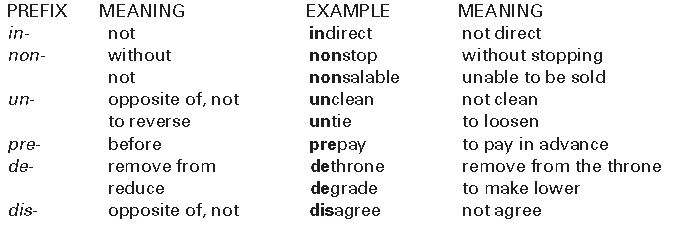
Exercise 1 Underline the prefix of each word. Using the meaning of the prefix, write in the blank the meaning of the word. Use a dictionary if you are uncertain of the meaning.
preselect to select in advance
1. devalue .....................
2. disassemble ......................
3. unfit
4. preview ......................
5. inactive ......................
6. nonverbal ......................
7. defrost ......................
8. unfold ......................
9. prewar ......................
10. disbud ......................
11. nonsense ......................
12. preheat ......................
13. deactivate ......................
14. undo ......................
15. discourage ......................
16. insensitive ......................
17. disadvantage ......................
18. nonskid ......................
19. involuntary ......................
20. prejudge ......................
Exercise 2 Write in the blank a word with a prefix that means the same as the words in parentheses.
Achim was chosen to preview the new movie. (view in advance)
1. His actions were very unkind . (not kind)
2. Mara’s homework was incomplete . (not complete)
3. When playing this card game, after each turn you must discard . (remove a card from your hand)
4. Harold completed the job in one nonstop session. (without stopping)
5. Does your mother always preapprove the books that you read? (approve in advance)
6. Juan helped Teresa defrost the refrigerator. (remove the frost)
7. Detectives often travel in unmarked cars. (no markings)
8. The man used indirect quotations in his speech. (not direct)
9. We agree to disagree . (not agree)
10. The sauce was made with nonfat milk. (fat removed)
11. Mr. Alvarez was very thin during his preteen years. (before teenage)
12. Passengers may deplane at gate forty-two. (remove themselves from the airplane)
13. The items at the bake sale were unpriced . (not priced)
14. The puppy was a victim of inhumane treatment. (not humane)
15. The chilly wind added to his discomfort . (lack of comfort).
Writing Link Write a paragraph about a relaxing Saturday afternoon. Use at least three words with prefixes and underline them.
Building Vocabulary Suffixes Class 5 English
A suffix is a word part that is added to the end of a word and changes its part ofspeech and its meaning. Adding the suffix -er to read (a verb) makes reader (a noun). Adding -less to face (a noun) makes faceless (an adjective).
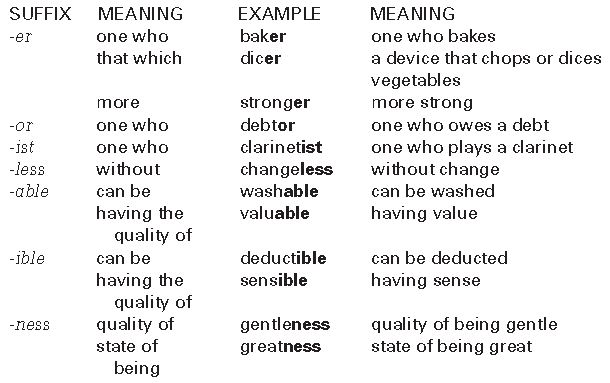
Exercise 1 Write the word that is formed by adding the given suffix to each word.
Then write a basic meaning of the new word. Be careful to check the spelling of the new word.
win + -er winner one who wins
1. fault + -less
2. advise + -or
3. make + -er
4. like + -able
5. piano + -ist
6. ready + -ness
7. kind + -ness
8. freeze + -er
9. depend + -able
10. terror + -ible
11. weak + -er
12. mow + -er
13. match + -less
14. admire + -able
15. good + -ness
16. resist + -ible
17. defense + -ible
18. aware + -ness
19. grant + -or
20. type + -ist
21. wrestle + -er
22. laugh + -able
23. sure + -er
24. calm + -ness
25. force + -ible
26. burn + -er
27. thin + -er
28. cycle + -ist
29. ill + -ness
30. honor + -able
31. write + -er
32. fast + -er
33. damp + -ness
34. sleep + -less
35. teach + -er
Prefixes
Make opposites by adding a prefix to the following words.
1. wrap - unwrap
2. use - misuse
3. agree - disagree
4. engage - disengage
5. behave - misbehave
6. understand - misunderstand
7. fold - unfold
8. spell - misspell
9. connect - disconnect
10. close - disclose
Suffixes
Add suffixes to the following words to form a new word.
1. comfort - comfortable
2. child - childish
3. satisfy - satisfaction
4. disaster - disastrous
5. bore - boredom
6. wise - wisdom
7. collect - collection
8. leader - leadership
9. present - presentation
10. friend - friendship
1. Prefixes And Suffixes
Q1. Fill in the blanks with words formed by adding prefixes to the words given in brackets.
Eg. He stood impatiently in the queue. (patiently)
1. Their team was unfortunate to lose the match. (fortunate)
2. The floods led to the misfortune of the farmers. (fortune)
3. He made his clothes untidy by playing in the mud. (tidy)
4. He was scolded for wearing improper uniform. (proper)
5. Indiscipline will not be tolerated in the school. (discipline)
6. It is impossible to keep your eyes opened when you sneeze. (possible)
Answer: Completed with correct prefixes (un-, mis-, im-, in-).
In simple words: Prefixes are added to the beginning of root words to change their meanings, often making them negative or opposite.
Exam Tip: Memorize common negative prefixes such as un-, in-, im-, and mis- to tackle prefix exercises easily.
Q2. Fill in the blanks with words formed by adding -er, -ful, -or, -less to the words given below.
1. We have a cordless phone. (cord)
2. Do not do careless mistakes. (care)
3. The professor is forgetful. (forget)
4. The teacher explained the lesson. (teach)
5. My friend is very helpful. (help)
6. We are hopeful of passing the exam. (hope)
7. The higher you go, the cooler you feel. (high, cool)
Answer: Filled with correct suffixes (-less, -ful, -er, -or) and comparative forms.
In simple words: Suffixes are word endings that change the word class or meaning, such as turning nouns into adjectives.
Exam Tip: Pay attention to spelling changes when adding suffixes, such as dropping silent 'e' or doubling consonants.
2. Reflexive Pronouns
Q1. Fill in the blanks using reflexive pronouns.
1. He fell down and hurt himself.
2. I completed all the work myself.
3. They enjoyed themselves in the park.
4. The bird cleaned itself.
5. We went to the school ourselves.
6. Boys, help yourselves.
7. Did you buy this for yourself?
Answer: Himself, myself, themselves, itself, ourselves, yourselves, yourself.
In simple words: Reflexive pronouns refer back to the subject of the sentence (e.g., I to myself, he to himself).
Exam Tip: Always match the reflexive pronoun to the person and number of the subject.
Q2. Fill in the blanks with reflexive pronouns.
An old man was sitting under a tree. He was talking to himself. A young man asked him, “Why are you talking to yourself? Don't you know that only mad people talk to themselves?” The old man replied, “I want to talk to a wise man. I want to listen to a wise man. That's why I am talking to myself.”
Answer: Himself, yourself, themselves, myself.
In simple words: Use 'himself' for the old man, 'yourself' when addressing him directly, 'themselves' for mad people plural, and 'myself' for the speaker.
Exam Tip: Read dialogue carefully to identify who is speaking to whom to select the correct pronoun.
3. Use Of Articles
Q. Fill in the blanks with 'a', 'an' or 'the' as required.
1. The sun rises in the east and sets in the west.
2. An apple a day, keeps the doctor away.
3. December is the last month of the year.
4. He was admired by the rich as well as the poor.
5. A man was walking on the road with an umbrella in his hand.
6. The Bay of Bengal is to the right of India.
7. The train will leave the station in half an hour.
8. A camel is a useful animal.
9. I ate an orange and a banana.
10. This is the end of the chapter.
Answer: Filled with appropriate articles (a, an, the).
In simple words: Use 'a' before consonant sounds, 'an' before vowel sounds, and 'the' for specific or unique things.
Exam Tip: Remember that phonetic sounds matter more than spelling (e.g., 'a useful' because 'useful' starts with a 'y' consonant sound).
4. Some More Adverbs
Q1. What are adverbs? Give some examples.
Answer: An adverb is a word that adds more information about a verb, an adjective, or another adverb. It tells us how, when, where, or how often an action happens. Examples: quickly, softly, yesterday, here, very.
In simple words: Adverbs describe verbs and tell us how or when things happen.
Exam Tip: Most adverbs of manner end in '-ly' (e.g., happily, slowly).
Q2. What are interrogative adverbs? Give some examples.
Answer: Interrogative adverbs are question words used to ask about time, place, manner, or reason. Examples: When, where, how, why.
In simple words: These are question words used at the beginning of sentences to ask for details.
Exam Tip: Always look for question marks at the end of sentences containing interrogative adverbs.
Q3. Fill in the blanks with suitable interrogative adverbs.
1. When will you go to India?
2. How many legs does a spider have?
3. Where do you live?
4. Why did you beat him?
5. Why do you look angry?
6. How many students passed?
7. When will the bus come?
Answer: When, How, Where, Why, Why, How, When.
In simple words: Choose the question word that fits the context of the answer expected.
Exam Tip: Use 'how many' for countable nouns and 'when' for time.
Comprehension Practice (Poem: Examinations)
Q1. What did the poet do the whole year?
Answer: The poet only played cricket the whole year and did not pay attention to her studies.
In simple words: She wasted her time playing cricket instead of studying.
Exam Tip: Reference specific lines from the poem to support your answer.
Q2. What is her very tough task?
Answer: Her very tough task is to study all day and night to get good marks in examinations.
In simple words: Catching up on all her missed studies is a hard task.
Exam Tip: Focus on keywords like 'tough task' in the poem text.
Q3. Why did she have to stop writing the poem?
Answer: She had to stop writing the poem so that she could start studying for her upcoming examinations.
In simple words: She needed to focus fully on her studies.
Exam Tip: Look at the final lines of the poem for the conclusion.
Q4. Write the four rhyming pairs of words from the poem.
Answer:
1. near - fear
2. cricket - wicket
3. night - tight
4. long - song
In simple words: Rhyming words have the same ending sounds.
Exam Tip: Check the ends of consecutive or alternating lines for rhyming patterns.
Q5. Give a suitable title to the poem.
Answer: The Exam Fear / Regrets of a Lazy Student.
In simple words: Choose a title that reflects the main theme of the poem.
Q. Write a Mothers' Day letter to your mother thanking her for what all she has done for you. You can also design a card to go with it.
Answer:
Dear Mom,
Happy Mothers' Day! Thank you so much for always taking care of me, helping me with my homework, and supporting me in everything I do. I am so lucky to have you as my mother. I love you the most!
Yours lovingly,
[Your Name]
In simple words: Express your gratitude and love clearly in a warm letter format.
Exam Tip: Always include a proper salutation, body, and closing sign-off in personal letters.
Nouns - Singular and Plural
Change the following nouns into plural (if they are countable) and use appropriate forms for the rest.
1. box - boxes
2. ox - oxen
3. housefly - houseflies
4. oil - oil (uncountable)
5. milk - milk (uncountable)
6. suitcase - suitcases
7. mango - mangoes
8. cheese - cheese (uncountable)
9. coal - coal (uncountable)
10. shirt - shirts
Answer: Countable nouns pluralized; uncountable nouns kept in base form.
In simple words: Uncountable nouns like oil and milk do not have plural forms.
Exam Tip: Watch out for spelling changes like 'y' to 'ies' in houseflies.
Q6. Use the clues and make sentences using 'had'.
1. Did you enjoy the trip to the zoo? (yes, great fun)
Yes, we had great fun on the trip to the zoo.
2. Did he go to the school yesterday? (no, holiday)
No, he did not go to school because we had a holiday yesterday.
3. Why didn't you come to play? (headache)
I didn't come to play because I had a headache.
4. Why did he go to the hospital? (fever)
He went to the hospital because he had a fever.
5. He was busy studying. (test)
He was busy studying because he had a test.
6. How did you solve the problem? (key)
I solved the problem because I had the answer key.
Answer: Sentences successfully constructed using 'had'.
In simple words: 'Had' is used to show possession or experience in the past tense.
Exam Tip: Ensure complete and grammatically correct sentences using the provided clues.
Q7. Underline the silent letters.
wrist - wrist
knew - knew
walk - wallk (or l)
answer - answer
comb - comb
resign - resign
would - would
honest - honest
Answer: Silent letters identified in each word.
In simple words: Silent letters are written in spelling but not pronounced when spoken.
Q8. Match the containers with their usual contents.
shelf - books
bottle - water
basket - vegetables
glass - water (or juice)
packet - chips (or pens)
pouch - pens (or chips)
Answer: Correctly matched containers to typical items.
In simple words: Match items with the places or containers they are normally stored in.
Exam Tip: Common sense pairings help secure full marks here.
Q9. Complete the following table and fill in the blanks with suitable words.
| Adjective | Noun | Verb |
|---|---|---|
| cracked | crack | crack |
| perfect | perfection | perfect |
| beautiful | beauty | beautify |
| accomplished | accomplishment | accomplish |
| decorative | decoration | decorate |
1. There is a crack in the cup.
2. I liked the decoration of the stage.
3. I have to accomplish a task.
4. No man is perfect.
5. This is a beautiful scenery.
Answer: Table completed and blanks filled correctly.
In simple words: Words change forms depending on whether they act as adjectives, nouns, or verbs.
Exam Tip: Practice word family derivations to master vocabulary questions.
Q10. Fill in the blanks with have / had.
1. Do you have P. Ed. period today?
No, we had it yesterday.
2. I had a pet dog before.
Now I have a pet cat.
3. I don't want to have lunch now.
I had a heavy breakfast.
Answer: Have, had, had, have, have, had.
In simple words: Use 'have' for present time and 'had' for past time.
Exam Tip: Look at time markers like 'yesterday' or 'before' to choose past tense 'had'.
5. Some More Adjectives
1. Write the following sentences in correct columns.
1. I have six friends. (Definite)
2. Many boys ran out. (Indefinite)
3. She ate two bananas. (Definite)
4. Several people were sick. (Indefinite)
5. Give me a few books. (Indefinite)
6. Forty students are in my class. (Definite)
7. Raju worked hard for many days. (Indefinite)
8. Two and two make four. (Definite)
Answer: Sentences correctly sorted into Definite and Indefinite Numeral Adjectives columns.
In simple words: Definite numerals give exact numbers, while indefinite numerals show an unspecific quantity.
Exam Tip: Look for exact numbers (six, two, forty) versus general amounts (many, several, few).
6. Contractions
I. Rewrite the following sentences replacing the underlined words with contractions:
1. Do not misbehave in the class.
Don't misbehave in the class.
2. My pen is not working.
My pen isn't working.
3. We should not bite nails.
We shouldn't bite nails.
4. What is your name?
What's your name?
5. I am not well.
I'm not well.
6. Who is your friend?
Who's your friend?
7. It is raining.
It's raining.
8. I will burn the books.
I'll burn the books.
9. They have gone to India.
They've gone to India.
10. We are going to school.
We're going to school.
Answer: Contractions correctly applied using apostrophes.
In simple words: Contractions shorten words by combining them and replacing omitted letters with an apostrophe.
Exam Tip: Place the apostrophe exactly where letters have been left out.
II. Rewrite the sentences without using contractions.
1. “Where's Raj going? I've some work with him”.
“Where is Raj going? I have some work with him.”
2. “We're tired now. They've given us a lot of work. It's not fair”.
“We are tired now. They have given us a lot of work. It is not fair.”
3. “Don't make noise. I'll write your name”.
“Do not make noise. I will write your name.”
4. “He didn't come to the party. Aren't I his friend? Let's call him”.
“He did not come to the party. Am I not his friend? Let us call him.”
Answer: Expanded forms of all contractions written out fully.
In simple words: Expand contracted forms back into their original two separate words.
Exam Tip: 'Aren't I' expands to 'Am I not', which is a common tricky exception.
Comprehension Practice (Poem: The Doctor)
1. What does the word "he" in the poem stands for?
Answer: The word "he" stands for the doctor.
In simple words: The poem describes a visit by a doctor to a sick child.
Exam Tip: Identify pronouns by checking context clues from previous lines.
2. With whom does the doctor come up the stairs?
Answer: The doctor comes up the stairs with the child's mother.
In simple words: The mother accompanies the doctor to the bedroom.
3. Fill in the blanks with words from given poem:
a. The doctor takes a chair and sits near the child's bed.
b. The doctor sees the child's tongue and throat.
Answer: Chair, bed, tongue, throat.
In simple words: Complete blanks using exact vocabulary from the stanza.
Exam Tip: Always cross-check blanks with the original poem text.
4. Write two rhyming words from the poem.
Answer: stairs - chair, throat - coat.
In simple words: Identify pairs of words with matching ending sounds.
5. Give a suitable title to the poem.
Answer: The Kind Doctor.
In simple words: A title capturing the doctor's visit and kind nature.
Exam Tip: Keep titles short and descriptive.
Comprehension Practice (Passage: Bridges)
1. How do we know that the first iron bridge is very strong?
Answer: We know the first iron bridge is very strong because cars and lorries still use it today, even though it was built about two hundred years ago.
In simple words: Heavy vehicles still drive across it today.
Exam Tip: Refer to details about heavy vehicles and age in the text.
2. How does the suspension bridge get its name?
Answer: The suspension bridge gets its name because "suspension" means "hanging", and the bridge hangs down from strong cables held up by towers.
In simple words: It hangs from cables supported by towers.
Exam Tip: Look for definitions given in quotation marks in passages.
3. What is the length of the Golden Gate Bridge?
Answer: The length of the Golden Gate Bridge is 2,725 meters.
In simple words: It is 2,725 meters long.
Exam Tip: Scan for numbers and measurements to answer factual questions quickly.
4. For what purpose is the Forth Bridge Used?
Answer: The Forth Bridge is used as a railway bridge in Scotland.
In simple words: It carries trains across.
Exam Tip: Pay attention to specific names like Forth railway bridge.
5. Name any two bridges that you know apart from those mentioned in the passage.
Answer: Howrah Bridge and Bandra-Worli Sea Link.
In simple words: Mention any well-known bridges outside the text.
Exam Tip: General knowledge questions allow for outside examples.
6. The Adjective - Kinds Of Adjectives
Q1. What is an adjective? Give some examples.
Answer: An adjective is a word that describes or modifies a noun or pronoun. Examples: tall, brave, sweet, red.
In simple words: Adjectives tell us more about nouns (people, places, or things).
Exam Tip: Adjectives can describe color, size, quality, or quantity.
Q2. Rewrite the following using the opposites of the Adjectives.
1. A fresh fruit - A stale fruit
2. A poor man - A rich man
3. A shallow lake - A deep lake
4. A dark shade - A bright/light shade
5. A smooth surface - A rough surface
Answer: Adjectives replaced with exact antonyms.
In simple words: Antonyms are words with opposite meanings.
Exam Tip: Check each adjective carefully before providing its opposite.
Q2 (Tick). Tick the correct Adjectives from the ones given in brackets.
1. In cold weather we like to wear thick clothes.
2. The tea was strong.
3. The smell of a rose is sweet.
4. A soldier is brave.
5. We should eat fresh food.
Answer: Thick, strong, sweet, brave, fresh.
In simple words: Select the adjective that makes logical and realistic sense with the noun.
Exam Tip: Eliminate adjectives that contradict common sense.
Q3. Fill in the blanks with suitable adjectives of quality for these animals and birds.
1. The cunning fox
2. The proud peacock
3. The ferocious / strong bull
4. The faithful dog
5. The gentle / innocent lamb
6. The swift / fast horse
7. The brave / fierce lion
8. The blind bat
Answer: Cunning, proud, ferocious, faithful, gentle, swift, fierce, blind.
In simple words: Use traditional adjectives commonly associated with these animals.
Exam Tip: Use standard descriptors taught in stories and fables.
7. The Adverb - Kinds Of Adverbs
Q1. Define an Adverb with some examples.
Answer: An adverb is a word that modifies a verb, adjective, or another adverb by expressing manner, place, time, or frequency. Examples: neatly, quickly, here, yesterday.
In simple words: Adverbs add details to actions.
Exam Tip: Include examples of different types of adverbs for full credit.
Q2. Fill in the blanks choosing suitable adverbs. (Noisily, silently, bitterly, slowly, neatly, early, politely)
1. He drew the diagram neatly.
2. We watched the programme silently.
3. He woke up early in the morning.
4. The child cried bitterly.
5. The boys played noisily.
6. We should talk politely.
7. The old man walked slowly.
Answer: Neatly, silently, early, bitterly, noisily, politely, slowly.
In simple words: Match the adverb to the action being performed.
Exam Tip: Ensure each adverb is used only once from the given list.
Q3. Fill in the blanks with the adverbs opposite in meaning to those given in the brackets.
1. Our team played well (badly).
2. He behaved wisely (foolishly).
3. He did his work correctly (wrongly).
4. We should not talk rudely (politely).
5. The children played happily (sadly).
Answer: Well, wisely, correctly, rudely, happily.
In simple words: Provide the direct antonym of the adverb in brackets.
Exam Tip: Watch for negative context (e.g., opposite of politely when talking about bad behavior).
Comprehension Practice (Poem: The Donkey)
Q1. What treat would the boy give to the donkey?
Answer: The boy would give a carrot as a treat to the donkey.
In simple words: He would reward him with a fresh carrot.
Exam Tip: Quote directly from the poem ("I'd buy him a carrot").
Q2. Why would the boy give the treat to the donkey?
Answer: The boy would give the treat to encourage the donkey to move and run up to the top of the hill.
In simple words: To entice him to run along.
Exam Tip: Understand the playful motivation behind the speaker's actions.
Q3. Where would the donkey catch the boy?
Answer: The donkey would catch the boy at the top of the hill.
In simple words: At the hill summit.
Exam Tip: Scan the final lines for location details.
Q4. Write the three pairs of rhyming words from the poem.
Answer:
1. go - no
2. this - miss
3. run - until (or run/hill)
In simple words: Pairs of words sharing similar ending sounds.
Exam Tip: Verify stanza endings for correct rhyme pairs.
Q5. Give a suitable title to the poem.
Answer: The Stubborn Donkey / A Friendly Race.
In simple words: A title representing the interaction between the boy and his donkey.
Exam Tip: Keep titles creative and concise.
Comprehension Practice (Passage: History of the Pencil)
Q1. The pencil's history dates back to
(a) 1664
(b) 1569
(c) 1564
Answer: (c) 1564
In simple words: The text states the history dates back to 1564.
Exam Tip: Locate exact dates mentioned in the opening sentence.
Q2. The farmers were using a substance to mark their sheep. It was called
(a) Clay
(b) graphite
(c) ink
Answer: (b) graphite
In simple words: Farmers used graphite to mark sheep because it wouldn't wash off.
Exam Tip: Follow the narrative of the discovery in Borrowdale.
Q3. Pencils are identified by the numbers 1, 2, and 3.
Answer: 1, 2, and 3.
In simple words: Pencils are graded using these numbers.
Exam Tip: Look for numerical lists in the passage.
Q4. A number 3 pencil is soft and makes a very dark mark without applying much pressure. (True / False)
Answer: False
In simple words: A number 1 pencil is soft and dark; a number 3 pencil is very hard and lighter.
Exam Tip: Read descriptive properties of pencil numbers carefully.
Q5. Which pencils do the teachers recommend for the students? Why?
Answer: Teachers recommend number 2 pencils because they are medium-soft and ideal for regular student use.
In simple words: They have medium softness suitable for writing.
Exam Tip: Highlight recommendations given by teachers in the text.
Letter Writing
Q. Write a letter to your father on the occasion of Fathers' Day and thank him for whatever he has done for you.
Answer:
Dear Dad,
Happy Fathers' Day! Thank you for always working so hard for our family, guiding me through tough times, and playing games with me. You are my hero. I love you very much!
Yours affectionately,
[Your Name]
In simple words: Express love and appreciation for your father.
Exam Tip: Maintain a respectful and affectionate tone throughout.
10. The Conjunction
Q1. What is a conjunction? Give some examples.
Answer: A conjunction is a joining word used to connect words, phrases, or clauses together. Examples: and, but, because, or.
In simple words: Conjunctions act as bridges between sentences or ideas.
Exam Tip: Memorize coordinating and subordinating conjunctions.
Q2. Join each pair of sentences by using the conjunctions given below: (but, because, so, although, till, or, if, and)
1. He went by a taxi. He missed the bus.
Although he went by a taxi, he missed the bus.
2. She is hardworking. Her sister is lazy.
She is hardworking, but her sister is lazy.
3. He is rich. He is unhappy.
He is rich, but he is unhappy.
4. She fought with me. I am not talking to her.
She fought with me, so I am not talking to her.
5. Study well. You will not pass.
Study well, otherwise / or you will not pass.
6. Work hard. You will pass.
Work hard, and you will pass.
7. I waited. My friend came.
I waited till my friend came.
8. Raju is smart. Shanker is smart.
Raju and Shanker are smart.
Answer: Sentences joined accurately using appropriate conjunctions.
In simple words: Choose conjunctions that correctly show the relationship between clauses.
Exam Tip: Check punctuation when combining sentences with conjunctions like 'but' and 'so'.
Sam Manekshaw Exercises
Q1. Match the years with the events in Sam Manekshaw's life.
1. 1914 - born
2. 1934 - passed out of the Military Academy
3. 1969 - became Army Chief
4. 1972 - awarded Padma Vibhushan
Answer: Correctly mapped historical milestones to respective years.
In simple words: Match important life events with correct dates.
Exam Tip: Memorize key dates from biographical chapters.
Q2. Who said this to/about Sam Manekshaw?
a) “The very best staff officer I ever had.”
General Sir Gerald Templer
b) “A dead person cannot be awarded a Military Cross.”
The doctor / Major General D.T. Cowan
Answer: Sir Gerald Templer / Major General D.T. Cowan.
In simple words: Identify the speakers of famous quotes from the text.
Exam Tip: Review chapter quotes and attributed speakers.
Q3. Match the words with their meanings:
a) cavalry - soldiers who fight on horses
b) infantry - soldiers who fight on foot
c) ambition - strong desire to achieve
d) vacancy - available job or position
e) superior - a person of higher rank
Answer: Vocabulary correctly matched to definitions.
In simple words: Match military and descriptive terms to their correct meanings.
Q4. Choose the adjectives from the given words and write their comparative and superlative forms: (courageous, proud, cadet, smart, army, barracks)
| Adjective | Comparative | Superlative |
|---|---|---|
| courageous | more courageous | most courageous |
| proud | prouder | proudest |
| smart | smarter | smartest |
Answer: Adjectives filtered from word bank and inflected correctly.
In simple words: Filter out nouns (cadet, army, barracks) and inflect adjectives.
Exam Tip: Use 'more' and 'most' for adjectives with three or more syllables.
Q5. Match the opposites of the given words and fill in the blanks with the suitable words.
1. United we stand, divided we fall.
2. An unkind man trapped the deer in a net. A kind man freed it.
3. Mother Teresa wore ordinary cotton sarees, not special sarees.
4. Wake up early in the morning or you will be late to the school.
Answer: United/divided, unkind/kind, ordinary/special, early/late.
In simple words: Fill blanks using pairs of antonyms.
Exam Tip: Check sentence context to place antonyms correctly in pairs.
Poetry Comprehension (Childhood)
Q1. True or false.
a) The poet is missing his childhood. ( True )
b) The poet knows the places where the childhood has faded away to. ( False )
Answer: (a) True, (b) False.
In simple words: The poem reflects on nostalgic memories of an unknown destination for childhood.
Exam Tip: Read lines about "places unknown to us" carefully.
Q2. Fill in the blanks.
Days of play,
Going our way,
Having fun, no care
For another day.
Answer: Play, way, fun, day.
In simple words: Fill missing stanza lines accurately from memory or text.
Exam Tip: Memorize stanza structures for poetry questions.
Q3. Match the following.
a) Time for us - stood still
b) Summer time - was fine
c) When friends - were kind
d) Our hearts - were thrilled
Answer: Correct line pairings matched.
In simple words: Match subjects with their predicate phrases from the poem.
Exam Tip: Cross-verify with poem text lines.
Q4. Write the rhyming words for:
Play - day
Still - hill
Filled - thrilled
Away - day
Answer: Day, hill, thrilled, day.
In simple words: Provide words that rhyme with the given prompts.
Exam Tip: Pick rhyming endings directly from stanza lines.
Q5. Give a suitable title to the poem.
Answer: Memories of Childhood.
In simple words: A title capturing nostalgic childhood recollections.
Exam Tip: Keep titles relevant and apt.
Section - B & C (Letter, Essay & Grammar Review)
B1. Write a letter to the Principal of your school requesting him for a field trip.
Answer:
To,
The Principal,
[School Name],
[City].
Subject: Request for a school field trip.
Respected Sir/Madam,
I am writing on behalf of the students of Class 5 to request a educational field trip to the national museum this month. This trip will help us learn history and science practically. We promise to maintain discipline throughout.
Thanking you,
Yours obediently,
[Your Name]
In simple words: Formal letter requesting permission for an educational trip.
Exam Tip: Follow strict formal letter formatting with subject, salutation, and polite closing.
B2. Imagine that you are a Digital Camera / a Play Station 3. Talk about the way you see yourself...
Answer:
I am a sleek black Digital Camera, manufactured in a high-tech factory in Japan two years ago. My master is a young photography enthusiast named Rahul who takes me everywhere to capture sunsets and smiling faces. The happiest moments in my life are when the flash goes off and I preserve a beautiful memory forever. People handle me with great care using a soft strap. My message to everyone is: "Capture the little moments of life, because they become timeless treasures!"
In simple words: Creative paragraph written from the perspective of an inanimate object.
C4. Join each pair of sentences using the conjunctions given below: (and, but, because, otherwise, although, till, since, so, unless, if)
1. Vijay is tall. Vijay is strong.
Vijay is tall and strong.
2. He is intelligent. He is lazy.
He is intelligent, but he is lazy.
3. He failed. He did not study.
He failed because he did not study.
4. Work hard. You will not pass.
Work hard, otherwise you will not pass.
5. He is old. He is active.
Although he is old, he is active.
6. Don't go. I tell you.
Don't go till I tell you.
7. She is weak. She cannot do hard work.
Since she is weak, she cannot do hard work.
8. He did not run fast. He lost the race.
He did not run fast, so he lost the race.
9. You study. You will not pass.
Unless you study, you will not pass.
10. You talk. I will write your name.
If you talk, I will write your name.
Answer: Sentences joined correctly using conjunction options.
In simple words: Connect two sentences smoothly using appropriate conjunction words.
Exam Tip: Pay attention to conditional conjunctions like 'unless' and 'if'.
C5. What is a pronoun? Give some examples.
Answer: A pronoun is a word used in place of a noun to avoid repetition. Examples: he, she, it, they, we, I.
In simple words: Pronouns substitute nouns in sentences.
Exam Tip: Provide clear examples of personal pronouns.
C6. Fill in the blanks with suitable personal pronouns.
1. I am tired. I cannot work anymore.
2. Tell the boys that they should wait.
3. Priya was crying because she fell down. She took her to the medical room.
4. This book is mine. Give it to me.
5. Ravi and Raj are friends. They are good boys. They all like sports.
Answer: I, I, they, she, she, her, mine, me, they, they, it.
In simple words: Select pronouns matching gender and number.
Exam Tip: Check subject-verb agreement when filling pronouns.
C8. Rewrite the following sentences changing the verb to show that the action is going on at the present moment. (Present Continuous Tense)
1. Farmers plough their fields.
Farmers are ploughing their fields.
2. We write the answers.
We are writing the answers.
3. The boys run in the ground.
The boys are running in the ground.
4. The children play cricket.
The children are playing cricket.
5. Raju goes to school.
Raju is going to school.
Answer: Converted into present continuous tense using 'is/are + verb-ing'.
In simple words: Present continuous tense shows actions happening right now.
Exam Tip: Remember helper verbs ('is', 'am', 'are') before adding '-ing'.
C9. Rewrite the following sentences changing the verbs to the past tense.
1. She sings and dances.
She sang and danced.
2. We fight and win.
We fought and won.
3. He slips and falls.
He slipped and fell.
Answer: Verbs changed to past tense forms (sang, danced, fought, won, slipped, fell).
In simple words: Past tense indicates actions that already happened.
C9 (Verbs). Fill in the blanks with the Past tense or Past Participle of the verbs given in brackets. (fly, begin, drink, bring, lie)
1. The bird has flown away. The bird flew over the roof of the house.
2. He began to read. He has not begun to write.
3. She has drunk the juice. The girls also drank the juice.
4. We have brought our books. We brought our pens also.
5. She lay on the bed and slept. The baby has also lain on the bed.
6. He lied to me about the marks. He has also lied before.
Answer: Flown/flew, began/begun, drunk/drank, brought/brought, lay/lain, lied/lied.
In simple words: Use past tense with simple past and past participle with 'has/have'.
Exam Tip: Distinguish between past simple and past participle forms.
C10. Underline the verb and circle the adverb in these sentences.
1. He stopped and listened (carefully).
2. She wrote (neatly).
3. They shouted (loudly).
4. He quickly jumped off the tree.
Answer: Verbs underlined and adverbs circled.
In simple words: Verbs show action; adverbs describe how the action is done.
Exam Tip: Adverbs often answer the question 'how?'.
C11. Rewrite the incorrect sentences correctly. Tick (√) the correct ones.
1. He sipped the hot tea careful. ( )
He sipped the hot tea carefully.
2. He drives slow. ( )
He drives slowly.
3. He walked home fastly. ( )
He walked home fast.
4. That boy beat me very hardly. ( )
That boy beat me very hard.
5. My father talks politely. ( √ )
Answer: Corrected adverb forms used; correct sentence ticked.
In simple words: Use adverb forms (-ly) to modify verbs instead of adjectives.
Exam Tip: 'Fast' and 'hard' act as both adjectives and adverbs without adding '-ly'.
C12. Complete the sentences using the comparative forms of the adverbs.
1. Preeti sings sweetly, but Pinky sings more sweetly.
2. Your performance in Science is bad, but in Maths it is worse.
3. Sam behaved foolishly, but Jim behaved more foolishly.
4. Pre finals are difficult, but finals are more difficult.
Answer: More sweetly, worse, more foolishly, more difficult.
In simple words: Comparative adverbs compare how two actions are performed.
Exam Tip: Use 'more' for adverbs ending in '-ly'.
C13. Change the countable nouns into plurals and write the appropriate forms for the rest.
1. Butterfly - butterflies
2. Cotton - cotton (uncountable)
3. Cloth - cloths / clothes
4. News - news (uncountable)
5. Water - water (uncountable)
6. Oil - oil (uncountable)
7. Pin - pins
8. Fox - foxes
9. Potato - potatoes
10. Furniture - furniture (uncountable)
Answer: Plurals formed for countable nouns; uncountable nouns kept intact.
In simple words: Only countable nouns have plural forms.
Exam Tip: Identify mass/uncountable nouns like news and furniture.
C14. Answer the following using 'had' and the clues in brackets.
1. Did you enjoy the trip to the Dolphins Park? (yes - great fun)
Yes, we had great fun on the trip to the Dolphins Park.
2. Did he go to school yesterday? (no - holiday)
No, he didn't go to school because we had a holiday.
3. Why didn't you come to play? (headache)
I didn't come to play because I had a headache.
4. He was busy studying. (exams)
He was busy studying because he had exams.
Answer: Complete sentences constructed using 'had'.
In simple words: Form past possession statements using 'had'.
Exam Tip: Ensure grammatical accuracy incorporating clues.
C15. Underline the odd word.
1. river sea lake land
2. ludo carom cricket chess
3. gone cone bone tone
Answer: Land, cricket, gone.
In simple words: Find the word that does not belong to the same category or rhyme scheme.
Exam Tip: Analyze categories (water bodies, indoor games, rhyming sounds).
C16. Fill in the blanks with since or for.
1. We have been studying for two hours.
2. She has been waiting since 5.00 pm.
3. Ali has been fasting since Tuesday.
4. It has been raining for three days.
5. They have been living in Riyadh since 2005.
Answer: For, since, since, for, since.
In simple words: Use 'for' for duration of time and 'since' for a specific starting point.
Exam Tip: 'For' specifies length (hours, days); 'since' specifies point in time (years, o'clock).
C17. Cross out the incorrect words.
1. Lata is/has been playing since/for morning.
2. Ravi has/have been learning to drive for/since a month.
3. Sita and Gita are/have been working in the company since/for May. (Wait: working since May is correct, so cross out 'for').
Answer: Incorrect helper verbs and prepositions crossed out.
In simple words: Choose the correct grammar rules for present tense structures.
Exam Tip: Match subject numbers (singular/plural) with correct auxiliary verbs.
C18. Fill in the blanks with singular or plural of the words in brackets.
As the beauty of a flower lies in its petals, similarly the real beauty of a family is in its family members and the love and care they give to each other. So, love your family. And the best way to show your love is by obeying all the elders of the family and loving the younger ones.
Answer: Flower, petals, members, they, way, elders, ones.
In simple words: Use correct singular or plural forms based on context.
Exam Tip: Read surrounding words to determine if singular or plural is required.
C19. Complete the following table and fill in the blanks with suitable words.
| Adjective | Noun | Verb |
|---|---|---|
| cracked | crack | crack |
| perfect | perfection | perfect |
| beautiful | beauty | beautify |
| accomplished | accomplishment | accomplish |
1. There is a crack in the cup.
2. I have to accomplish a task.
3. This is a beautiful scenery.
4. No man is perfect.
Answer: Table completed and sentences filled correctly.
In simple words: Use correct grammatical word forms in blanks.
Exam Tip: Practice word forms across parts of speech.
SECTION D
D1. Word meanings:
1. cocked - tilted or turned to one side
2. fidgeted - made small nervous movements
3. very angrily - furiously
4. dump - a place where waste is left
5. sorting - arranging in groups according to type
6. the answer to a problem - solution
7. shone brightly - gleamed / glowed
8. left without finishing - abandoned / deserted
9. graciousness - courtesy and kindness
10. vista - a pleasing view
Answer: Accurate definitions provided for each vocabulary word.
In simple words: Definitions explain the exact meanings of terms.
Exam Tip: Memorize glossary meanings from textbook units.
D2. Make sentences with the given words.
1. rarely - We rarely see tigers in this forest.
2. reputation - The school has a good reputation for discipline.
3. disturbed - Loud noises disturbed my sleep.
4. frowned - Teacher frowned when she saw the messy work.
5. admired - Everyone admired her beautiful painting.
6. chiming - We heard the clock chiming at midnight.
7. attitude - She has a positive attitude towards learning.
8. forbidden - Park entry is forbidden after sunset.
9. provided - The school provided free books to students.
10. located - Our school is located near the central park.
Answer: Meaningful sentences constructed for each word.
In simple words: Write clear, simple sentences showing the meaning of each word.
D3. Who said to whom?
1. “Who did all the work and received all the stings?”
The honey guide said this (referring to how it helped the badger).
2. “And there's an art competition.”
Ani's friend said this to Ani.
3. “You've got the hands and the heart of an artist.”
The art teacher said this to Ani.
Answer: Characters identified correctly for each dialogue quote.
In simple words: Identify the speakers and listeners of key story quotes.
Exam Tip: Review story plots and character dialogues.
D4. Write the missing lines of the poem Gold.
Gold! Gold! Gold! Gold!
Bright and yellow, hard and cold,
Molten, graven, hammered, rolled,
Hard to get and heavy to hold.
Bought or borrowed, sold or stole,
Wealth makes heap in city mole,
Gold! Gold! Gold! Gold!
Poet: Thomas Hood
Answer: Missing stanzas of Thomas Hood's poem completed.
In simple words: Fill in standard textbook poetry verses.
Exam Tip: Memorize popular poems and poet names from the syllabus.
D5. Answer the following questions.
Q1. Why was the honey guide furious?
Answer: The honey guide was furious because the lazy badger ate all the honey and left none for the bird as a reward.
In simple words: The badger cheated the bird out of its share of honey.
Exam Tip: Explain the conflict clearly based on the story.
Q2. What did the leopard do when Gingile disturbed her sleep?
Answer: When Gingile disturbed her sleep, the leopard growled fiercely and sprang up angrily.
In simple words: She woke up angry and growled.
Exam Tip: Mention the leopard's reaction accurately.
Q3. Why was Ani worried about the art competition?
Answer: Ani was worried about the art competition because she wasn't sure if her artwork was good enough compared to others.
In simple words: She lacked confidence in winning.
Exam Tip: Focus on character emotions and plot challenges.
Q4. How were the walls and tables decorated in the auditorium? Where was the butterfly that Ani had made?
Answer: The walls and tables were decorated with colorful paper flowers and ribbons. The butterfly Ani made was resting proudly on the main display board.
In simple words: Decorated with festive items; her butterfly was on display.
Q5. Why did the waitresses show graciousness toward Jackson?
Answer: The waitresses showed graciousness toward Jackson because of his polite manners and kind appreciation.
In simple words: They were touched by his polite behavior.
Exam Tip: Highlight themes of kindness and respect.
Q6. Why was the lunch counter most attractive at the drugstore?
Answer: The lunch counter was most attractive because it had delicious snacks, ice creams, and colorful drinks.
In simple words: It served tasty treats and snacks.
Exam Tip: Describe sensory details mentioned in the text.
Q7. Find lines in the poem that tell us what people do with gold?
Answer: "Bought or borrowed, sold or stole, / Wealth makes heap in city mole".
In simple words: People buy, borrow, sell, or steal gold.
Exam Tip: Quote exact lines from the poem text.
13. Prepositions
Q1. What is a preposition? Give some examples.
Answer: A preposition is a word placed before a noun or pronoun to show its relation to another word in the sentence, indicating time, place, or direction. Examples: in, on, under, behind, with.
In simple words: Prepositions show positions and directions.
Exam Tip: Give examples covering different types of prepositions (place, time).
Q2. Fill in the blanks with suitable prepositions.
1. I am waiting for my friend.
2. Give this book to Ravi.
3. He took out the books from the bag and kept them on the table.
4. In spite of warning him, he shouted at the top of his voice.
5. There is a park right in front of my house.
6. I sat beside my friend.
7. We played during the recess.
Answer: For, to, from, on, In spite of, at, right in front of, beside, during.
In simple words: Select prepositions that fit standard phrasing.
Exam Tip: Memorize common prepositional phrases like "at the top of his voice".
15. Nouns: Possessive Case
Q1. Write down the possessive forms of the following:
1. The bats of these players - These players' bats
2. The books of those students - Those students' books
3. The caps of those boys - Those boys' caps
4. The chain of this girl - This girl's chain
5. The friend of my cousin - My cousin's friend
Answer: Possessive apostrophe forms correctly written.
In simple words: Use 's for singular possessives and s' for plural possessives ending in s.
Exam Tip: Place the apostrophe after the 's' for plural nouns.
Q2. Turn the following possessives into plurals:
1. The farmer's field - The farmers' fields
2. The girl's school - The girls' schools
3. The man's hat - The men's hats
4. The thief's knife - The thieves' knives
5. This hero's film - These heroes' films
Answer: Singular possessive phrases converted to plural possessive forms.
In simple words: Change both nouns and possessives into plural forms.
Exam Tip: Watch irregular plurals like man-men, thief-thieves.
Q3. Write the following in a shorter form:
1. The shirt belonging to my friend - My friend's shirt
2. The cat belonging to my neighbour - My neighbour's cat
3. The village of these people - These people's village
Answer: Condensed into possessive noun phrases.
In simple words: Use apostrophe 's to express ownership concisely.
Exam Tip: Short forms use fewer words while retaining exact meaning.
Q4. Rewrite these sentences putting in the possessive form of the words underlined:
1. The mother of this child is a teacher.
This child's mother is a teacher.
2. The doctors of this hospital are experienced.
This hospital's doctors are experienced.
3. The name of the cat belonging to Neha is Pussy.
Neha's cat's name is Pussy.
4. The shops of this person are famous.
This person's shops are famous.
5. The eyes of my sister are blue.
My sister's eyes are blue.
Answer: Sentences rewritten using possessive apostrophes.
In simple words: Replace underlined phrases with possessive nouns.
Exam Tip: Retain the rest of the sentence structure unchanged.
19. Conjunctions
Q1. What is a conjunction? Give some examples.
Answer: A conjunction is a word used to connect clauses, sentences, or words together. Examples: and, but, because, although.
In simple words: Conjunctions link words and sentences together.
Exam Tip: Provide clear definitions and standard examples.
Q2. Join each set of sentences with the conjunction given within the brackets.
1. He is tall. His brother is short. (but)
He is tall, but his brother is short.
2. I ate bread. I ate butter. (and)
I ate bread and butter.
3. He failed. He did not study. (because)
He failed because he did not study.
4. He is clever. He is lazy. (but)
He is clever, but he is lazy.
5. I shall sleep. I feel sleepy. (when)
I shall sleep when I feel sleepy.
6. Don't go. I tell you. (till)
Don't go till I tell you.
7. He is weak. He cannot do hard work. (since)
Since he is weak, he cannot do hard work.
Answer: Sentences correctly joined using specified conjunctions.
In simple words: Combine sentences using the exact conjunction provided in brackets.
Exam Tip: Always double check that the correct conjunction from brackets was used.
Please refer to attached file for CBSE Class 5 English Revision Worksheet - Prefixes And Suffixes
Free CBSE Practice Worksheets: Class 5 English Prefixes And Suffixes
Download Chapter Worksheets: Class 5 English
Review targeted practice exercises for Class 5 English Prefixes And Suffixes. Curated to match official CBSE guidelines, these printable problem sets support daily revision and improve overall test readiness.
Concept Clarification for Prefixes And Suffixes
Built using official NCERT guidelines for Class 5 English, these practice sheets provide reliable academic support. Cross-reference your completed work with our detailed solutions to learn standard answer-writing formats for CBSE exams.
Effective Revision Strategies for School Exams
Follow up your worksheet practice by attempting the interactive online MCQ tests for Prefixes And Suffixes to evaluate your execution speed. All printable assignments and revision sheets on our platform are updated for the 2026 session and available free of charge.
FAQs
You can download the latest chapter-wise printable worksheets for Class 5 English Prefixes And Suffixes for free from StudiesToday.com. These have been made as per the latest CBSE curriculum for this academic year.
Yes, Class 5 English worksheets for Prefixes And Suffixes focus on activity-based learning and also competency-style questions. This helps students to apply theoretical knowledge to practical scenarios.
Yes, we have provided solved worksheets for Class 5 English Prefixes And Suffixes to help students verify their answers instantly.
Yes, our Class 5 English test sheets are mobile-friendly PDFs and can be printed by teachers for classroom.
For Prefixes And Suffixes, regular practice with our worksheets will improve question-handling speed and help students understand all technical terms and diagrams.