

Official Class 7 Science Worksheets: Chapter 13 Motion and Time
Review targeted practice sets for Class 7 Science Chapter 13 Motion and Time. Built according to official educational guidelines for the 2026-27 academic year, these downloadable worksheets support daily revision and core concept reinforcement.
Chapter-wise Practice Material: Chapter 13 Motion and Time
View or download the dedicated Chapter 13 Motion and Time practice resource below. Engaging with these objective and subjective questions daily ensures continuous academic progress and mastery of the 2026-27 curriculum.
Question. There are four basic types of motion in mechanical systems: ROTARY MOTION is turning round in a circle; LINEAR MOTION is moving in a straight line; RECIPROCATING MOTION is moving backwards and forwards in a straight line;<br> OSCILLATING MOTION is swinging from side to side Many mechanical devices convert motion from one type to another. What is the input and output motion for the equipment given alongside? (See the arrows showing the direction and type of the input motion.)
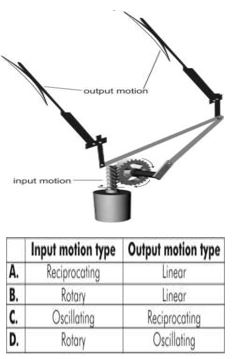
(a) A
(b) B
(c) C
(d) D
Answer : D
Question. Assume that a cycle and a car reach speed breaker P at the same time. What can we say about the distance between the two vehicles at T, compared to if the speed breakers had NOT been there?
(a) The vehicles will cross T at the SAME TIME whether or not there are speed breakers.
(b) The distance between the vehicles will be MORE when there are speed breakers.
(c) The distance between the vehicles will be LESS when there are speed breakers.
(d) The distance between the vehicles will be LESS, but the cycle will be ahead of the car.
Answer : C
Question. See this figure of an hour glass (or sand clock) which is used to measure time. One of the important factors that determines the ability of the hour glass to measure time accurately is the fineness of the sand in it. Coarse sand will wear away the glass, making the measurement inaccurate. In what way will the time measured by an hour glass having coarse sand be inaccurate (assuming no other defect in the hour glass)?
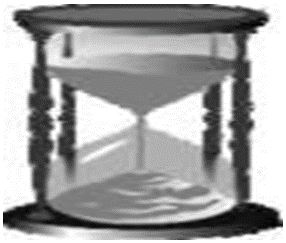
(a) The time taken for the sand to drain completely will be less than what it should be.
(b) The time taken for the sand to drain completely will be more than what it should be.
(c) The hour glass will not function at all due to the effect of the coarse sand.
(d) (The hour glass will continue to be accurate and it will not be affected by coarse sand.)
Answer : A
Question. A roller coaster track has to be designed with P as the starting point - that is, the coaster has to start from rest at point P, and travel along the track up to a point Q. Which of these tracks would make that possible?

Answer : A
Question. A torch uses three different forms of energy. Which of these shows the energy changes in the correct order?
(a) Mechanical----> Heat-------> Chemical
(b) Heat-----> Chemical------> Light
(c) Electrical------> Mechanical----> Chemical
(d) Chemical------> Electrical-----> Light
Answer : D
Question. The table given below classifies a few substances as good or bad conductors of electricity. Which substance has been put under the wrong heading?
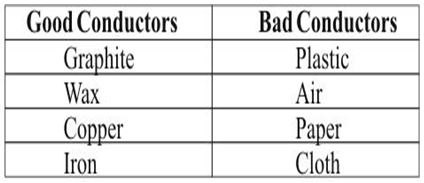
(a) Graphite
(b) Air
(c) Wax
(d) Cloth
Answer : C
Question. See the circuit shown below in figure P. If the battery is connected the other way (as shown in figure Q), what will happen?
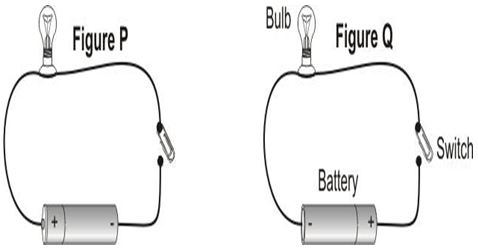
(a) The bulb will glow in exactly the same way.
(b) The bulb will glow but less brightly.
(c) The bulb will blow or fuse out.
(d) The bulb will not glow, but not get damaged.
Answer : A
Question. Study this electrical circuit. It consists of a powerful battery, a bulb, an electromagnet and a movable connection. The connection is designed in such a way that it closes (that is, it allows electric current to pass) when the electromagnet is not magnetised; but opens when the electromagnet is magnetised. If the electromagnet takes 5 seconds to get magnetised, what will be status of the electric bulb?
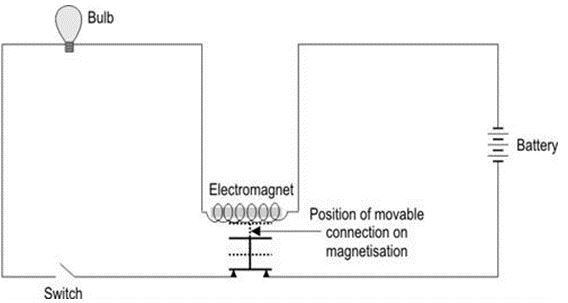
(a) It will remain OFF - it will not glow at all.
(b) It will alternate between ON and OFF states.
(c) It will come ON after some seconds and keep glowing.
(d) It will stay ON for a few seconds and then go OFF.
Answer : B
Question. Rita wants to send a written message and a picture to her friend. Which of the following should she use?
(a) A pager
(b) A telephone
(c) A fax machine
(d) A television
Answer : C
Question. The figure shows an electric iron - it uses a wire that can be detached from the main iron. In which of these cases will electricity be consumed?
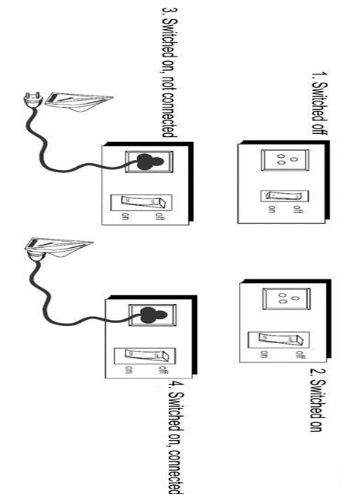
(a) Only 4
(b) Only 3 and 4
(c) Only 2, 3 and 4
(d) All the cases.
Answer : A
Question. The diagram shows a flashlight battery and a bulb connected by wires to various substances. Which of the bulbs will light?
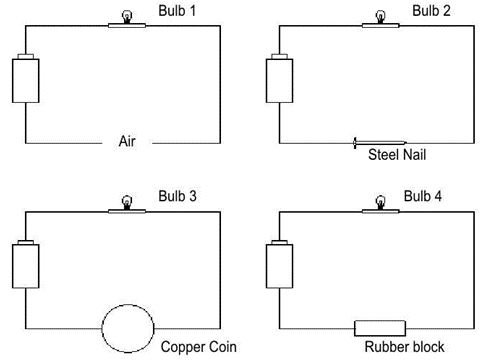
(a) 1 and 2 only
(b) 2 and 3 only
(c) 3 and 4 only
(d) 1, 2 and 3 only
Answer : B
Question. Many electrical devices like televisions and electric irons have plugs which have 3 pins. However, other devices sometimes work with only 2 pins. Why is the third pin necessary?
(a) It is not necessary; it is only to provide a better grip.
(b) Since the sockets often have three holes, the third pin fits into the third hole.
(c) It is provided for safety in case electricity leaks onto the body of the appliance.
(d) It allows the electric device to draw more power than it could with only 2 pins.
Answer : C
Question. When a plastic spoon is rubbed on a woollen cloth and held above a mixture of salt and pepper, pepper jumps to the spoon. Choose the best reason for this:
(a) Air pushes the pepper towards the spoon.
(b) The spoon temporarily gets magnetised.
(c) The spoon temporarily gets charged with static electricity.
(d) Gravitational attraction pulls the pepper to the spoon.
Answer : C
Question. See Circuit 1. Bulbs X and Y are glowing. If a second cell is added to the circuit as shown in Circuit 2, with switch P closed and switch Q open, what would happen to bulbs X, Y and Z?.
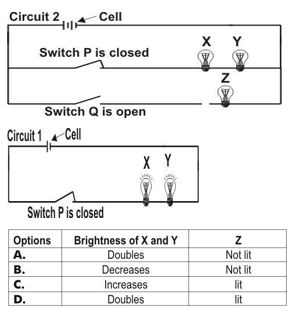
(a) A
(b) B
(c) C
(d) D
Answer : A
Question. When connected as shown, the bulb glows, but dimly. Which of these CAN be the explanation for this:
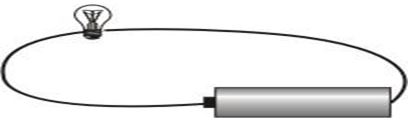
(a) The wires are not touching the battery or bulb.
(b) The bulb is fused (that is, its filament is broken.)
(c) The battery is weak and not producing enough electricity.
(d) The battery is connected the wrong way around.
Answer : C
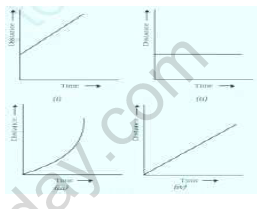
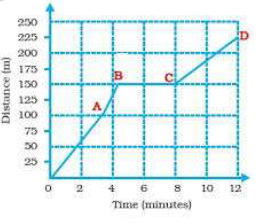
Please click on below link to download CBSE Class 7 Science motion And Time Worksheet Set C
Free study material for Science
Exam Preparation Worksheet for Class 7 Science Chapter 13 Motion and Time
Chapter Practice Questions for Class 7 Science
Access structured practice worksheets for Chapter 13 Motion and Time designed in alignment with the latest CBSE curriculum for Class 7 Science. These printable problem sets help students build accuracy and prepare effectively for school tests.
Expert Practice Material for Class 7 Science
Each worksheet is structured around standard CBSE textbooks, allowing students to check their working steps and correct mistakes early in their revision.
Complete Your Chapter Revision
Wrap up your chapter revision by testing your knowledge against standard question formats. Everything on our platform is provided free of charge.
FAQs
You can download the teacher-verified PDF for CBSE Class 7 Science motion And Time Worksheet Set 03 from StudiesToday.com. These practice sheets for Class 7 Science are designed as per the latest CBSE academic session.
Yes, our CBSE Class 7 Science motion And Time Worksheet Set 03 includes a variety of questions like Case-based studies, Assertion-Reasoning, and MCQs as per the 50% competency-based weightage in the latest curriculum for Class 7.
Yes, we have provided detailed solutions for CBSE Class 7 Science motion And Time Worksheet Set 03 to help Class 7 and follow the official CBSE marking scheme.
Daily practice with these Science worksheets helps in identifying understanding gaps. It also improves question solving speed and ensures that Class 7 students get more marks in CBSE exams.
All our Class 7 Science practice test papers and worksheets are available for free download in mobile-friendly PDF format. You can access CBSE Class 7 Science motion And Time Worksheet Set 03 without any registration.