

Practice Worksheets for Class 7 Science: Chapter 06 Physical and Chemical Changes
Review targeted practice sets for Class 7 Science Chapter 06 Physical and Chemical Changes. Built according to official educational guidelines for the 2026-27 academic year, these downloadable worksheets support daily revision and core concept reinforcement.
Practice Chapter 06 Physical and Chemical Changes Worksheets for Class 7 Science
Navigate directly to the printable exercises for Chapter 06 Physical and Chemical Changes using the digital viewer below. Each practice set allows students to isolate specific topics for thorough review and uninterrupted practice alongside standard textbooks.
Question. Using the density column and the data table, predict which of these will FLOAT on the oil?
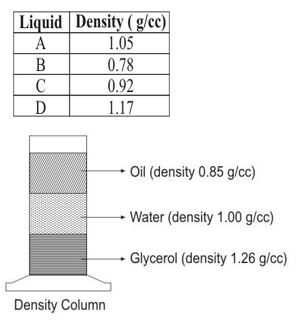
a) Sample A
b) Sample B
c) Sample C
d) Sample D
Answer : B
Question. Two identical spring scales are arranged as shown. If a weight is suspended as shown in the figure what will happen?
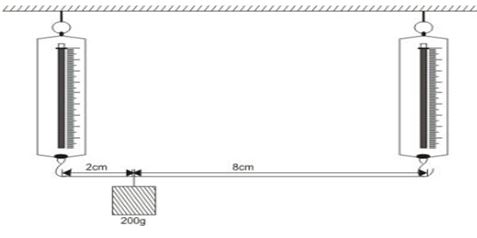
a) Spring on the left will stretch more.
b) Spring on the right will stretch more.
c) Both springs will stretch the same distance.
d) One cannot tell which spring will stretch more.
Answer : A
Question. Which of the following is NOT a cyclic change?
a) formation of a rainbow
b) ocean tides
c) the phases of the moon
d) the seasons of the year
Answer : A
Question. Which of the following is a chemical change?
a) Grinding of rice
b) Breaking of a window pane
c) A bud changing into a flower
d) Powdering of sugar crystals
Answer : C
Question. Distilled water is called pure because_____________.
a) it contains dissolved salts
b) it boils at exactly 100degree C and freezes at exactly 0degreeC
c) it contains dissolved oxygen
d) it can be produced only in a laboratory
Answer : B
Question. The flow chart gives the method of separation of four substances P, Q, R and S of which one is water. What are P, Q, R and S?

a) A
b) B
c) C
d) D
Answer : C
Question. In the arrangement shown, which of the following materials will make lime water turn milky when kept for a few days?

a) Damp boiled rice
b) Dry wood pieces
c) Roasted peanuts
d) Charcoal
Answer : A
Question. In the figure below, P, Q and R represent three different physical states of a substance. A direct change from the state represented by R to that represented by P would be _________.
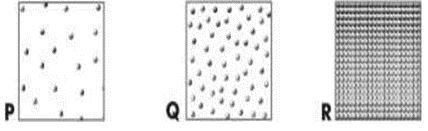
a) evaporation
b) condensation
c) melting
d) sublimation
Answer : D
Which of the following can be classified as a chemical change?
a) lighting of a matchstick
b) melting of ice
c) condensation of water
d) separation of salt from water
Answer : A
Question. Students in a laboratory are told not to taste any chemicals (even common salt) in the laboratory. What is the MAIN reason?
a) The chemicals bought for the laboratory are not pure.
b) Chemicals may have got mixed or wrongly labelled.
c) Chemicals are very expensive and should not be wasted.
d) The chemicals may get spoilt if they are touched.
Answer : B
Question. Which of these is a chemical change?
a) mixing sand in water
b) magnetizing a piece of iron
c) a copper container getting tarnished
d) evaporation of water
Answer : B
Question. The period of development in the mother's womb before birth is called the gestation period. Study the gestation periods and life spans of some animals and answer the question
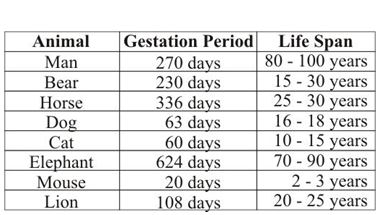
a) there is no relation whatsoever between gestation period and life span.
b) the longer the gestation period, the shorter the life span with some exceptions.
c) the longer the gestation period, the longer the life span with some exceptions.
d) animals with the shortest and longest gestation periods have longer life spans.
Answer : A
Question. A metallic circular disc having a hole as shown, is heated. What would it look like when it expands after heating (shown by the dotted lines)?
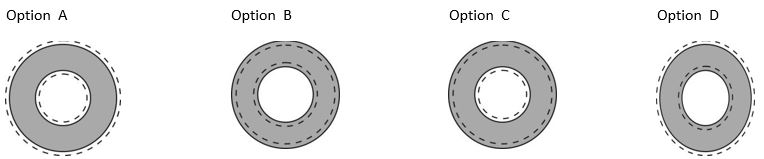
Answer : D
Question. In which part of the atmosphere is the ozone layer?
The earth’s atmosphere is divided into different layers - the stratosphere, mesosphere and ionosphere as shown here. Study the figure and answer the question.

a) below the stratosphere
b) in the stratosphere
c) in the mesosphere
d) in the ionosphere
Answer : B
Question. Among the animals in the table, which have gestation periods more than 6 months?
The period of development in the mother's womb before birth is called the gestation period. Study the gestation periods and life spans of some animals and answer the question

a) Only elephants
b) Only horses and elephants
c) Only horses, elephants, men and bears
d) Only horses, elephants, men, lions and bears
Answer : C
Questions
Very Short Answer
Q1) Define galvanisation?
Q2) How stainless steel is made?
Q3) What happens when carbon dioxide passed through lime water?
Q4) What is rust?
Q5) Name the two types of changes?
Short Answer
Q6) Why explosion of a fireworks is a chemical change?
Q7) What do you understand by the rusting of iron?
Q8) Why is protecting the ozone layer important?
Q9) What do you mean by the term chemical reaction?
Q10) Why does not stainless steel rust?
Long Answer
Q11) Write short note on crystallization?
Q12) Distinguish between physical and chemical change?
Q13) Difference between rusting and corrosion?
Q14) What are the steps taken when the new product may accompany a chemical change?
Q15) Explain about the chemical reaction and its concepts?
Please click on below link to download CBSE Class 7 Science Physical and Chemical Changes Worksheet Set A
Free study material for Science
Download CBSE Practice Material: Class 7 Science Chapter 06 Physical and Chemical Changes
Download Practice Sheet: Chapter 06 Physical and Chemical Changes (Class 7 Science)
Explore reliable practice questions for Chapter 06 Physical and Chemical Changes tailored for Class 7 Science learners. Use these structured worksheets to evaluate preparedness and strengthen problem-solving skills.
Concept Clarification for Chapter 06 Physical and Chemical Changes
Cross-reference your completed exercises with comprehensive NCERT solutions for Class 7 Science to ensure absolute clarity across all sub-topics in this chapter.
Additional Study Resources for Class 7 Science
Explore our broader library of printable assignments, chapter notes, and mock tests designed to support continuous revision and secure higher marks in CBSE assessments.
FAQs
You can download the teacher-verified PDF for CBSE Class 7 Science Physical and Chemical Changes Worksheet Set 01 from StudiesToday.com. These practice sheets for Class 7 Science are designed as per the latest CBSE academic session.
Yes, our CBSE Class 7 Science Physical and Chemical Changes Worksheet Set 01 includes a variety of questions like Case-based studies, Assertion-Reasoning, and MCQs as per the 50% competency-based weightage in the latest curriculum for Class 7.
Yes, we have provided detailed solutions for CBSE Class 7 Science Physical and Chemical Changes Worksheet Set 01 to help Class 7 and follow the official CBSE marking scheme.
Daily practice with these Science worksheets helps in identifying understanding gaps. It also improves question solving speed and ensures that Class 7 students get more marks in CBSE exams.
All our Class 7 Science practice test papers and worksheets are available for free download in mobile-friendly PDF format. You can access CBSE Class 7 Science Physical and Chemical Changes Worksheet Set 01 without any registration.