CBSE Class 7 Science Fibre to Fabric Worksheet Set A

Access the latest CBSE Class 7 Science Fibre to Fabric Worksheet Set A. We have provided free printable Class 7 Science worksheets in PDF format, specifically designed for Chapter 3 Fibre to Fabric. These practice sets are prepared by expert teachers following the 2025-26 syllabus and exam patterns issued by CBSE, NCERT, and KVS.

Chapter 3 Fibre to Fabric Science Practice Worksheet for Class 7

Students should use these Class 7 Science chapter-wise worksheets for daily practice to improve their conceptual understanding. This detailed test papers include important questions and solutions for Chapter 3 Fibre to Fabric, to help you prepare for school tests and final examination. Regular practice of these Class 7 Science questions will help improve your problem-solving speed and exam accuracy for the 2026 session.

Download Class 7 Science Chapter 3 Fibre to Fabric Worksheet PDF


Fibre to Fabric
 
ACTIVITY- 3.1 : To know about the hairs of some animals
 
Question 1- Name any two natural fibres obtained from plants.
Answer- Cotton and jute.
 
Question 2- Name any two natural fibres obtained from animals.
Answer- Wool and silk.
 
Question 3- Name any three animals which provide us wool.
Answer- Sheep, goat, camel and yak.
 
Question 4- Why do some animals have a thick coat of hairs?
Answer- Hairs trap a lot of air. Air is a poor conductor of heat, so it does not allow the body heat to escape and keep the body warm.
 
ACTIVITY- 3.4 : Burn test for Natural and Synthetic fibres
 
Question 1- What difference in smell you notice on burning silk thread, artificial silk thread and wool?
Answer- Smell of burning thread of artificial thread is like burning of paper. But smell of burning of thread of
silk and wool is like burning of hairs.
 
Question 2- What type of ash is formed in the above activity?
Answer- Artificial silk is converted into soft black ash on burning, while silk and wool is converted into dark brittle and easily crushable bead.
 
Question 3- Does the smell of burning of silk thread is same as the smell of burning woolen thread?
Answer- Yes.
 
EXERCISE
 
Question 1- Fill In The Blanks.
 
(i). Wool is obtained from the fleece (hair) of sheep, goat and yak
(ii). Long hair on the body protect animals from winter.
(ii). Removal of fleece from the skin of animal is called Shearing.
(iv). Rearing of silkworm is called Sericulture.
(v). The process of unwinding the filaments from the boiled cocoons, is called Reeling.
 
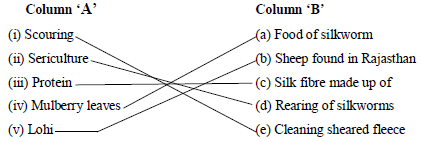
Question 2- Match The Following :
7th.sci.eng.july.aug.new 1
 
Question 3. Choose The Correct Answer.
 
(i). The fibre which is not produced by animals :
a) Angora Wool     b) Wool    c) Jute (✓)    d) Silk
 
(ii). Wool is commonly obtained from :
a) Sheep    b) Goat    c) Yak    d) All of the above (✓)
 
(iii). Washing of sheared hair is called :
a) Scouring (✓)    b) Sorting    c) Shearing    d) Dyeing
 
(iv). Wool is chemically :
a) Fat b) Protein (✓)    c) Carbohydrate    d) None of these
 
(v). The animal that does not yield wool is :
a) Alpaca    b) Woolly dog (✓)    c) Camel    d) Goat
 
Question 4- Write True Or False.
 
(i) Air is bad conductor of heat. (True)
(ii) Air trapped in long hair does not allow body heat to escape from body. (True)
(iii) In Tibet and Ladakh, wool is obtained from yak. (True)
(iv) Rearing of silk moths is called apiculture. (False)
(v) The cover around the body of caterpillar is called cocoon. (True)
(vi) Tassar silk and moonga silk are produced by silk moth who have been feeding on non-mulberry trees. (True)
 
Question 5- Very Short Answer Type Questions.
 
(i) Name any two plant fibres and animal fibres.
Answer- Plant fibres- Cotton, jute.
Animal fibres- Wool and silk.
 
(ii) What is sericulture?
Answer- Rearing of silkworms for production of silk is known as sericulture.
 
(iii) Name the common animals who yield fleece.
Answer- Sheep, goat, yak and camel.
 
Question 6- Short Answer Type Questions.
 
(i) What you understand by Angora and Kashmere wool?
Answer- Angora wool is obtained from Angora goats found in hilly regions such as Jammu and Kashmir,while Kashmiri wool is obtained from Kashmiri goat.
 
(ii) Write the states where the following breeds of sheep are found:-
Lohi, Bakharwal, Nali and Marwari.
Answer-
Lohi- Rajasthan, Punjab.
Bakharwal- Jammu and Kashmir.
Nali- Rajasthan, Hariana, Punjab.
Marwari- Gujarat.
 
(iii) Write all the steps involved in processing of fibres into wool.
Answer- (1) Shearing, (2) Scouring, (3) Sorting, (4) Combing, (5) Dyeing, (6) Spinning.
 
(iv) Why do some animals have a thick coat of hair.
Answer- Hairs trap a lot of air. Air is a poor conductor of heat, so it does not allow the body heat to escape and keep the body warm.
 
(v) How is silk moth reared?
Answer- Eggs of silk moth are stored carefully on strips of cloth or paper and sold to silkworm farmers. The farmers keep eggs under hygienic conditions, under suitable temperature and humidity. The eggs are warmed to a suitable temperature for the larvae to hatch from eggs when mulberry trees bear a fresh crop. The worms are kept in bamboo trays along with mulberry leaves. By eating leaves larvae change into caterpillar, then caterpillar into cocoons. The farmers get silk fibres from cocoon.
 
Question 7- Long Answer Type Questions.
 
(i) Write all the steps in processing silk from cocoons.
Answer-
(1) Boiling- The cocoons are boiled in hot water to kill larvae and to soften the silk gum.
(2) Reeling- The process of taking out threads from the cocoon for use as silk is called reeling the silk. This is done with special machines.
(3) Throwing- In this process the raw silk is twisted to produce thrown silk.
(4) Dyeing- In the end silk is dyed for making colorful fabrics.
 
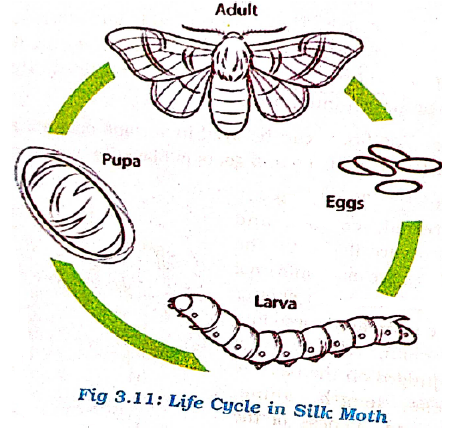
(ii) Draw a well labeled diagram and explain the life cycle of silk moth.
Answer- (1) The female silk moth lay eggs on the leaves of mulberry trees.
(2) The eggs hatch larvae in two weeks to form worm like structures which are called caterpillars or silkworms. They eat leaves and grows to become pupa.
(3) To protect itself pupa secretes fibre made of protein and rotates its mouth in the shape of 8. Hence a cocoon made of silk fibre is constructed around the moth.
7th.sci.eng.july.aug.new 2
 

Questions

            Very Short Answer

Q1)      Define sericulture?

Q2)      Which is the most common silk moth?

Q3)      What is reeling the silk?

Q4)      From where silk fibres come?

Q5)      What are occupational hazards?


            Short Answer

Q6)      What do you mean by the term silk route?

Q7)      What do you understand by the sorter’s disease?

Q8)      What is artificial silk made of?

Q9)      What do you mean by the natural silk?

Q10)    Why artificial silk is much cheaper than natural silk?


            Long Answer

Q11)    What are the steps of processing fibres into wool?

Q12)    State the difference between wool and silk?

Q13)    Explain the life history of silk moth?

Q14)    Explain the processing of cocoon to silk?

Q15)    State the difference between scouring and souring?


Please click on below link to download CBSE Class 7 Science Fibre to Fabric Worksheet Set A

Revision Worksheets for Class 7 Science
CBSE Class 7 Science Revision Worksheet
~ Class 7 Science (Old Chapters)
CBSE Class 7 Science Acid Bases and Salts Worksheet Set A
CBSE Class 7 Science Acid Bases And Salts Worksheet Set B
CBSE Class 7 Science Acid Bases And Salts Worksheet Set C
CBSE Class 7 Science Acid Bases And Salts Worksheet Set D
CBSE Class 7 Science Electric Current and Its Effects Worksheet Set A
CBSE Class 7 Science Electric Current And Its Effects Worksheet Set B
CBSE Class 7 Science Electric Current And Its Effects Worksheet Set C
CBSE Class 7 Science Fibre to fabric Set B
CBSE Class 7 Science Fibre to fabric Set C
CBSE Class 7 Science Fibre to Fabric Worksheet Set A
CBSE Class 7 Science Forests Our Lifeline Worksheet Set A
CBSE Class 7 Science Heat Worksheet Set A
CBSE Class 7 Science Heat Worksheet Set B
CBSE Class 7 Science Heat Worksheet Set C
CBSE Class 7 Science Heat Worksheet Set D
CBSE Class 7 Science Light Worksheet Set A
CBSE Class 7 Science Light Worksheet Set B
CBSE Class 7 Science Light Worksheet Set C
CBSE Class 7 Science Light Worksheet Set D
CBSE Class 7 Science Motion and Time Worksheet Set A
CBSE Class 7 Science motion And Time Worksheet Set B
CBSE Class 7 Science motion And Time Worksheet Set C
CBSE Class 7 Science Nutrition in Animals Worksheet Set A
CBSE Class 7 Science Nutrition in Animals Worksheet Set B
CBSE Class 7 Science Nutrition in Animals Worksheet Set C
CBSE Class 7 Science Nutrition in Animals Worksheet Set D
CBSE Class 7 Science Nutrition in Plants Worksheet Set A
CBSE Class 7 Science Nutrition in Plants Worksheet Set B
CBSE Class 7 Science Nutrition in plants Worksheet Set C
CBSE Class 7 Science Nutrition in plants Worksheet Set D
CBSE Class 7 Science Nutrition in Plants Worksheet Set E
CBSE Class 7 Science Physical And Chemical Change Worksheet Set B
CBSE Class 7 Science Physical And Chemical Change Worksheet Set C
CBSE Class 7 Science Physical and Chemical Changes Worksheet Set A
CBSE Class 7 Science Reproduction in Plants Worksheet Set A
CBSE Class 7 Science Reproduction in plants Worksheet Set B
CBSE Class 7 Science Reproduction in plants Worksheet Set C
CBSE Class 7 Science Respiration in Organisms Worksheet Set A
CBSE Class 7 Science Soil Worksheet Set A
CBSE Class 7 Science Transportation in Animals and Plants Worksheet Set A
CBSE Class 7 Science Transportation in Animals and Plants Worksheet Set B
CBSE Class 7 Science Transportation In Animals And Plants Worksheet Set C
CBSE Class 7 Science Transportation In Animals And Plants Worksheet Set D
CBSE Class 7 Science Waste water Set B
CBSE Class 7 Science Wastewater Story Worksheet Set A
CBSE Class 7 Science Water A Precious Resource Worksheet
CBSE Class 7 Science Water Worksheet Set A
CBSE Class 7 Science Weather Climate and Adaptions of Animals to Climate Worksheet Set A
CBSE Class 7 Science Winds Storms and Cyclones Worksheet Set A
CBSE Class 7 Science Winds Storms And Cyclones Worksheet Set B

Chapter 3 Fibre to Fabric CBSE Class 7 Science Worksheet

Students can use the Chapter 3 Fibre to Fabric practice sheet provided above to prepare for their upcoming school tests. This solved questions and answers follow the latest CBSE syllabus for Class 7 Science. You can easily download the PDF format and solve these questions every day to improve your marks. Our expert teachers have made these from the most important topics that are always asked in your exams to help you get more marks in exams.

NCERT Based Questions and Solutions for Chapter 3 Fibre to Fabric

Our expert team has used the official NCERT book for Class 7 Science to create this practice material for students. After solving the questions our teachers have also suggested to study the NCERT solutions  which will help you to understand the best way to solve problems in Science. You can get all this study material for free on studiestoday.com.

Extra Practice for Science

To get the best results in Class 7, students should try the Science MCQ Test for this chapter. We have also provided printable assignments for Class 7 Science on our website. Regular practice will help you feel more confident and get higher marks in CBSE examinations.

Where can I download the latest PDF for CBSE Class 7 Science Fibre to Fabric Worksheet Set A?

You can download the teacher-verified PDF for CBSE Class 7 Science Fibre to Fabric Worksheet Set A from StudiesToday.com. These practice sheets for Class 7 Science are designed as per the latest CBSE academic session.

Are these Science Class 7 worksheets based on the 2026 competency-based pattern?

Yes, our CBSE Class 7 Science Fibre to Fabric Worksheet Set A includes a variety of questions like Case-based studies, Assertion-Reasoning, and MCQs as per the 50% competency-based weightage in the latest curriculum for Class 7.

Do you provide solved answers for CBSE Class 7 Science Fibre to Fabric Worksheet Set A?

Yes, we have provided detailed solutions for CBSE Class 7 Science Fibre to Fabric Worksheet Set A to help Class 7 and follow the official CBSE marking scheme.

How does solving CBSE Class 7 Science Fibre to Fabric Worksheet Set A help in exam preparation?

Daily practice with these Science worksheets helps in identifying understanding gaps. It also improves question solving speed and ensures that Class 7 students get more marks in CBSE exams.

Is there any charge for the Class 7 Science practice test papers?

All our Class 7 Science practice test papers and worksheets are available for free download in mobile-friendly PDF format. You can access CBSE Class 7 Science Fibre to Fabric Worksheet Set A without any registration.