

Practice Worksheets for Class 7 Science: Chapter 17 Forests: Our Lifeline
Explore reliable practice materials for Chapter 17 Forests: Our Lifeline tailored for Class 7 learners. Utilizing these Science worksheets ensures thorough preparation and strengthens problem-solving speed for upcoming school assessments.
Practice Chapter 17 Forests: Our Lifeline Worksheets for Class 7 Science
Navigate directly to the printable exercises for Chapter 17 Forests: Our Lifeline using the digital viewer below. Each practice set allows students to isolate specific topics for thorough review and uninterrupted practice alongside standard textbooks.
Question. Ahmed's grandfather plants trees all along the edge of their farm in the hills along the boundary fence. What is likely to be the best reason for this?
(a) To reduce the rainfall.
(b) To keep away goats.
(c) To conserve the soil.
(d) To demarcate the boundary.
Answer : C
Question. Zaheeda put some items into a big polythene bag. After two months, she took each of them out and made a table to put them under heads as & lsquo; Decomposed' and & lsquo; Not decomposed' as shown. Which item(s) have been put under incorrect headings?
| Decomposed | Not decomposed |
| Grass | Key chain |
| Bread | Plastic spoon |
| Orange peel | Cucumber |
| Tin can | Stainless steel vessel |
(a) only the stainless steel vessel
(b) only grass
(c) the tin can and the cucumber
(d) the key chain and the bread
Answer : C
Question. The table below classifies threatened species into vertebrates, invertebrates and plants. Which pie chart represents this data most accurately?
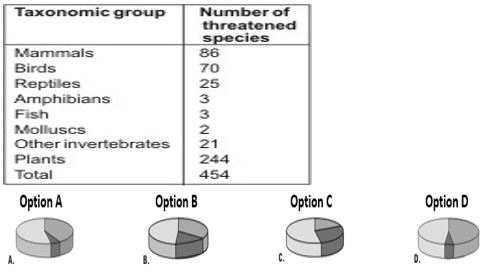
Answer : A
Question. Study this food chain.
What is likely to be an immediate effect if the cat population INCREASES a lot?

(a) The food chain will not be affected.
(b) The bird population will decrease.
(c) The snake population will decrease.
(d) The caterpillar population will decrease.
Answer : B
Question. Choose the best pair of words to fill in the blanks:
The average temperature has -------due to -------------- levels of carbon dioxide and methane in the atmosphere.
(a) increased, decreasing
(b) decreased, increasing
(c) increased, increasing
(d) decreased, decreasing
Answer : C
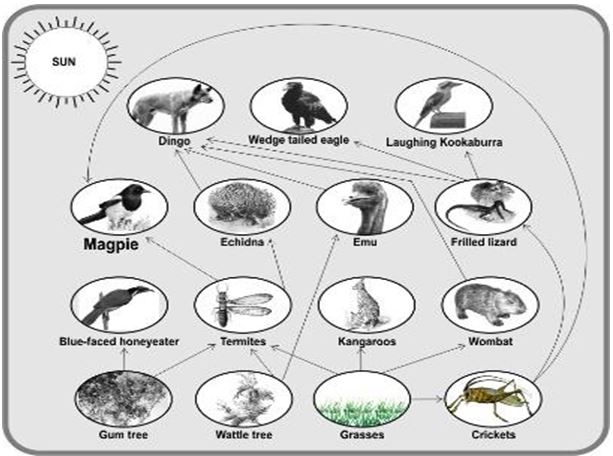
Question. If an organism eats seeds, fruits and insects", in which list would you put it?"
The question is based on the food web shown below
Top level carnivores: Organisms that only eat other animals and are rarely killed by other carnivores Carnivores/ Omnivores: Organisms that eat both plants and animals
Herbivores : Organisms that mainly feed on plant material
Producers: Organisms that use the sun’s energy to make food through photosynthesis
Predators - Animals that eats other animals for food.
Prey - Animals hunted or caught for food.
(a) Top level carnivore
(b) Omnivore
(c) Herbivore
(d) Producer
Answer : B
Question. Which of the following food chains would be from the food web given above?
The question is based on the food web shown below
Top level carnivores: Organisms that only eat other animals and are rarely killed by other carnivores Carnivores/ Omnivores: Organisms that eat both plants and animals
Herbivores : Organisms that mainly feed on plant material
Producers: Organisms that use the sun’s energy to make food through photosynthesis
Predators - Animals that eats other animals for food.
Prey - Animals hunted or caught for food.
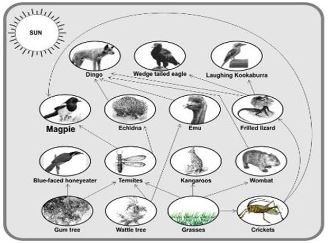
(a) grasses ---> magpie ---> wedge-tailed eagle ---> laughing kookaburra
(b) gum tree ---> blue- faced honey eater ---> crickets ---> kangaroo
(c) wattle tree ---> termites ---> echidna ---> dingo
(d) grasses ---> wombat ---> emu ---> wedge- tailed eagle
Answer : C
Question. In the food web given, which of the following would list all the predators of the frilled lizard?
The question is based on the food web shown below
Top level carnivores: Organisms that only eat other animals and are rarely killed by other carnivores Carnivores/ Omnivores: Organisms that eat both plants and animals
Herbivores : Organisms that mainly feed on plant material
Producers: Organisms that use the sun’s energy to make food through photosynthesis
Predators - Animals that eats other animals for food.
Prey - Animals hunted or caught for food.

(a) Dingo, wedge-tailed eagle, laughing kookaburra
(b) Crickets
(c) Dingo, wombat, echidna
(d) Crickets, laughing kookaburra, wombat
Answer : A
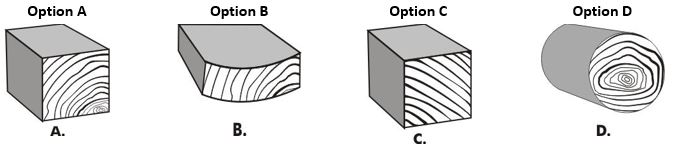
Question. The wooden blocks shown here were cut from the same tree trunk. Which of them was cut from the outermost part of the trunk?
Answer : C
Question. Study this flowchart. Which of these could alphabet P be ?
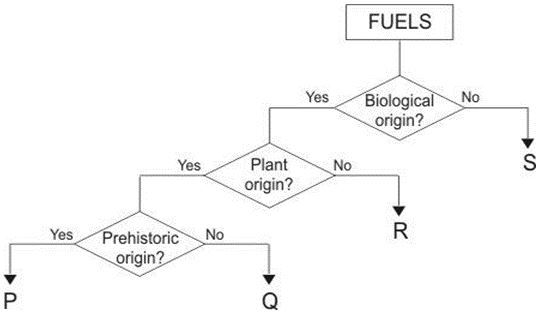
(a) Wood
(b) wind energy
(c) coal
(d) Petrol
Answer : C
Question. Four students of a school, Mohan, Suraj, Birju and Sonali visited a bird sanctuary to observe migratory birds. They counted the number of sightings of different birds and recorded the data as shown in the table below. Each of them tried to represent the data collected in graphical form as shown below. Who has represented the data correctly?

Answer : C
Question. This food web shows the interdependence of various plants and animals living on a farm. Use it to answer the given question-
What is the assumption you can make about plants from the above picture?
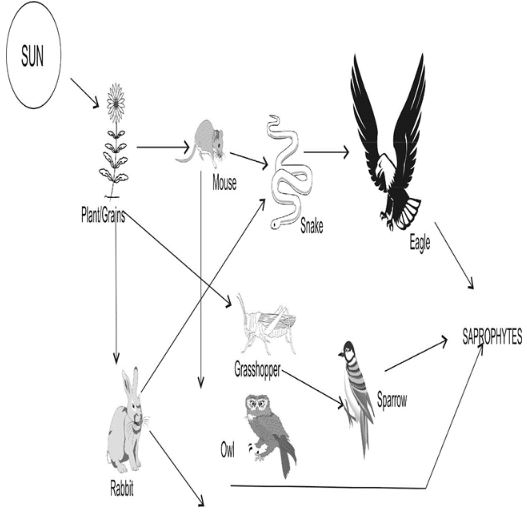
(a) Plants depend on other species for their energy.
(b) Plants grow the best among the various species.
(c) Plants provide food for snakes directly.
(d) Plants are the only species that make their own food.
Answer : D
Question. This food web shows the interdependence of various plants and animals living on a farm. Use it to answer the given question –
In the above food web, the species which compete for rabbits are-
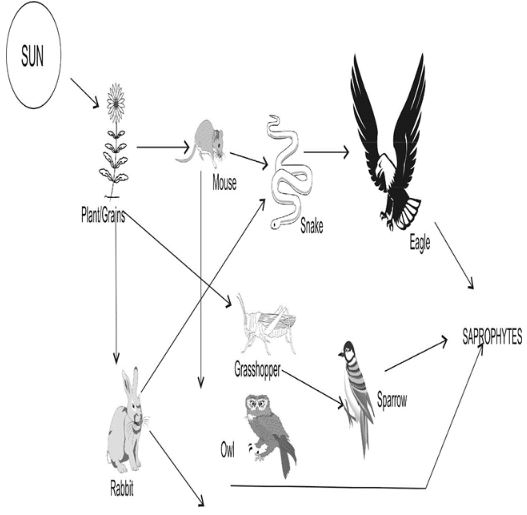
(a) snakes and eagles
(b) mice and owls
(c) snakes and mice
(d) Snakes and owls.
Answer : D
Question. This food web shows the interdependence of various plants and animals living on a farm. Use it to answer the following question-
Due to fear of certain diseases caused by mice, the people in the farm start killing mice in large numbers. What is likely to be the effect of this on the population of rabbits, and why?
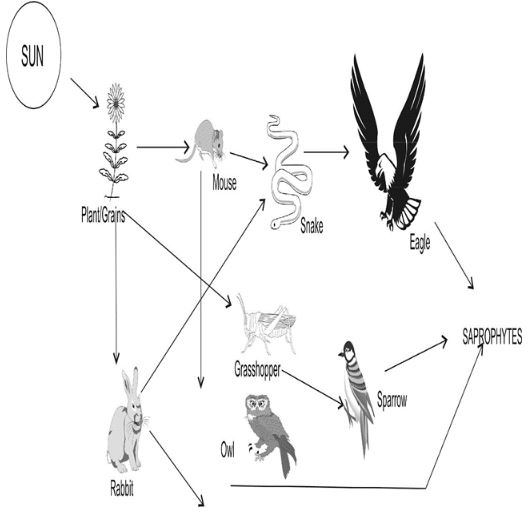
(a) No effect because neither rabbits nor mice eat the other.
(b) It will increase because there will be more plants/grain for the rabbits to eat.
(c) It will increase because snakes will die as there will be less mice for them to eat.
(d) It will decrease because snakes and owls will eat rabbits in the absence of mice.
Answer : D
Question. Which of these items of daily use does NOT come from living things?
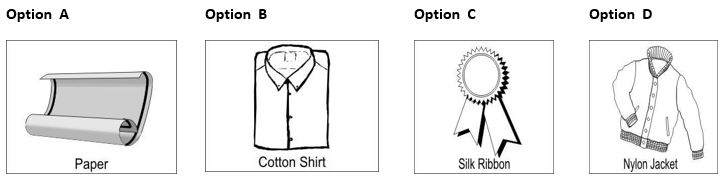
Answer : D
Questions
Very Short Answer
Q1) What is forest?
Q2) Define crown of the tree?
Q3) What is canopy?
Q4) What are decomposers?
Q5) How soil helps the forests?
Short Answer
Q6) What will happen if forests disappear?
Q7) What do you mean by seed dispersal?
Q8) Why forests are called the lungs of the earth?
Q9) What do you mean by humus?
Q10) What is understory?
Long Answer
Q11) Explain what are the effects of deforestation?
Q12) Explain why forests are important?
Q13) Explain how forests prevent floods?
Q14) Explain why preventing and stopping soil erosion is so important?
Q15) Explain what kind of role plays by the decomposers?
Please click on below link to download CBSE Class 7 Science Forests Our Lifeline Worksheet Set A
Free study material for Science
Chapter 17 Forests: Our Lifeline Practice Sheet and Solutions for Class 7 Science
Download Practice Sheet: Chapter 17 Forests: Our Lifeline (Class 7 Science)
Review targeted practice exercises for Class 7 Science Chapter 17 Forests: Our Lifeline. Curated to match official CBSE guidelines, these downloadable PDF sheets support daily revision and core concept reinforcement.
Concept Clarification for Chapter 17 Forests: Our Lifeline
Each worksheet is structured around standard CBSE textbooks, allowing students to check their working steps and correct mistakes early in their revision.
Additional Study Resources for Class 7 Science
Follow up your worksheet practice by attempting the interactive online Science MCQ test for this chapter to evaluate your execution speed. All platform resources are free to access.
FAQs
You can download the teacher-verified PDF for CBSE Class 7 Science Forests Our Lifeline Worksheet Set 01 from StudiesToday.com. These practice sheets for Class 7 Science are designed as per the latest CBSE academic session.
Yes, our CBSE Class 7 Science Forests Our Lifeline Worksheet Set 01 includes a variety of questions like Case-based studies, Assertion-Reasoning, and MCQs as per the 50% competency-based weightage in the latest curriculum for Class 7.
Yes, we have provided detailed solutions for CBSE Class 7 Science Forests Our Lifeline Worksheet Set 01 to help Class 7 and follow the official CBSE marking scheme.
Daily practice with these Science worksheets helps in identifying understanding gaps. It also improves question solving speed and ensures that Class 7 students get more marks in CBSE exams.
All our Class 7 Science practice test papers and worksheets are available for free download in mobile-friendly PDF format. You can access CBSE Class 7 Science Forests Our Lifeline Worksheet Set 01 without any registration.