

Official NCERT Solutions for Class 9 Mathematics: Chapter 09 Areas of Parallelograms and Triangles
Review structured textbook solutions for Class 9 Mathematics Chapter 09 Areas of Parallelograms and Triangles. Built according to NCERT guidelines for the 2026-27 academic year, these downloadable answers support daily revision and problem-solving accuracy.
Chapter-wise Solutions for Mathematics: Chapter 09 Areas of Parallelograms and Triangles
Navigate directly to the solved Mathematics textbook exercises using the digital viewer below. Each solution includes detailed step-by-step explanations, allowing students to instantly cross-check their work and identify areas requiring further revision.
Exercise 9.1
Q.1) Which of the following figures lie on the same base and between the same parallels? In such a case, write the common base and the two parallels.
Sol.1) (i) Trapezium ABCD and 𝛥𝑃𝐷𝐶 lie on the same DC and between the same parallel lines AB and DC.
(ii) Parallelogram PQRS and trapezium 𝑆𝑀𝑁𝑅 lie on the same base SR but not between the same parallel lines.
(iii) Parallelogram 𝑃𝑄𝑅𝑆 and 𝛥𝑅𝑇𝑄 lie on the same base QR and between the same parallel lines QR and PS.
(iv) Parallelogram ABCD and 𝛥𝑃𝑄𝑅 do not lie on the same base but between the same parallel lines BC and AD.
(v) Quadrilateral ABQD and trapezium APCD lie on the same base AD and between the same parallel lines AD and BQ.
(vi) Parallelogram 𝑃𝑄𝑅𝑆 and parallelogram ABCD do not lie on the same base SR but between the same parallel lines SR and PQ.
Exercise 9.2
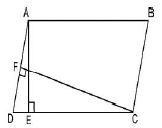
Q.1) In the figure, ABCD is a parallelogram, 𝐴𝐸 ⊥ 𝐷𝐶 and 𝐶𝐹 ⊥ 𝐴𝐷. If 𝐴𝐵 = 16 𝑐𝑚, 𝐴𝐸 = 8 𝑐𝑚 and 𝐶𝐹 = 10 𝑐𝑚, find 𝐴𝐷.
Sol.1) Area of parallelogram ABCD
= 𝐴𝐵 × 𝐴𝐸
= 16 × 8 𝑐𝑚2 = 128 𝑐𝑚2
Also, area of parallelogram ABCD
= 𝐴𝐷 × 𝐹𝐶 = (𝐴𝐷 × 10)𝑐𝑚2
∴ 𝐴𝐷 × 10 = 128
⇒ 𝐴𝐷 = 128/10 = 12.8 𝑐𝑚
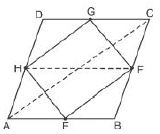
Q.2) If E, F, G, and H are respectively the mid-points of the sides of a parallelogram ABCD, show that 𝑎𝑟 (𝐸𝐹𝐺𝐻) = 1/2 𝑎𝑟 (𝐴𝐵𝐶𝐷).
Sol.2) Given : A parallelogram ABCD · E, F, G, H are mid-points of sides AB, BC, CD, DA respectively.
To Prove : 𝑎𝑟 (𝐸𝐹𝐺𝐻) = 1/2 𝑎𝑟 (𝐴𝐵𝐶𝐷)
Construction : Join AC and HF.
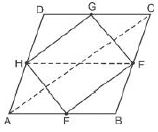
Proof : In ΔABC, E is the mid-point of AB.
F is the mid-point of BC.
⇒ 𝐸𝐹 is parallel to AC and 𝐸𝐹 = 1/2
𝐴𝐶 ... (i)
Similarly, in Δ𝐴𝐷𝐶, we can show that
𝐻𝐺 || 𝐴𝐶 and 𝐻𝐺 = 1/2
𝐴𝐶 ... (ii)
From (i) and (ii)
𝐸𝐹 || 𝐻𝐺 and 𝐸𝐹 = 𝐻𝐺
∴ 𝐸𝐹𝐺𝐻 is a parallelogram. [One pour of opposite sides is equal and parallel]
In quadrilateral ABFH, we have
𝐻𝐴 = 𝐹𝐵 𝑎𝑛𝑑 𝐻𝐴 || 𝐹𝐵 [𝐴𝐷 = 𝐵𝐶 ⇒ 1/2
𝐴𝐷 = 1/2
𝐵𝐶 ⇒ 𝐻𝐴 = 𝐹𝐵]
∴ 𝐴𝐵𝐹𝐻 is a parallelogram. [One pair of opposite sides is equal and parallel]
Now, triangle HEF and parallelogram 𝐻𝐴𝐵𝐹 are on the same base HF and between the same parallels HF and AB.
∴ Area of Δ𝐻𝐸𝐹 = ½ area of HABF ... (iii)
Similarly, area of Δ𝐻𝐺𝐹 = ½ area of HFCD ... (iv)
Adding (iii) and (iv),
Area of Δ𝐻𝐸𝐹 + area of Δ𝐻𝐺𝐹 = 1/2
(area of HABF + area of HFCD)
⇒ 𝑎𝑟 (𝐸𝐹𝐺𝐻) = 1/2
𝑎𝑟 (𝐴𝐵𝐶𝐷) Proved.
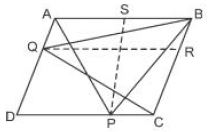
Q.3) P and Q are any two points lying on the sides DC and AD respectively of a parallelogram 𝐴𝐵𝐶𝐷. Show that 𝑎𝑟 (𝐴𝑃𝐵) = 𝑎𝑟 (𝐵𝑄𝐶).
Sol.3) Given : A parallelogram ABCD. P and Q are any points on DC and AD respectively.
To prove : 𝑎𝑟 (𝐴𝑃𝐵) = 𝑎𝑟 (𝐵𝑄𝐶)
Construction : Draw 𝑃𝑆 || 𝐴𝐷 and 𝑄𝑅 || 𝐴𝐵.
Proof : In parallelogram 𝐴𝐵𝑅𝑄, 𝐵𝑄 is the diagonal.
∴ area of Δ𝐵𝑄𝑅 = 1/2 area of 𝐴𝐵𝑅𝑄 ... (i)
In parallelogram CDQR, CQ is a diagonal.
∴ area of Δ𝑅𝑄𝐶 = 1/2 area of 𝐶𝐷𝑄𝑅 ... (ii)
Adding (i) and (ii), we have
area of Δ𝐵𝑄𝑅 + area of Δ𝑅𝑄𝐶
= 1/2 [area of 𝐴𝐵𝑅𝑄 + area of CDQR]
⇒ area of Δ𝐵𝑄𝐶 = 1/2 area of 𝐴𝐵𝐶𝐷 ... (iii)
Again, in parallelogram 𝐷𝑃𝑆𝐴, 𝐴𝑃 is a diagonal.
∴ area of Δ𝐴𝑆𝑃 = 1/2 area of 𝐷𝑃𝑆𝐴 ... (iv)
In parallelogram BCPS, PB is a diagonal.
∴ area of Δ𝐵𝑃𝑆 = 1/2 area of 𝐵𝐶𝑃𝑆 ... (v)
Adding (iv) and (v)
area of Δ𝐴𝑆𝑃 + area of Δ𝐵𝑃𝑆 = 1/2 (area of DPSA + area of BCPS)
⇒ area of Δ𝐴𝑃𝐵 = 1/2 (area of ABCD) ... (vi)
From (iii) and (vi), we have
area of Δ𝐴𝑃𝐵 = area of Δ𝐵𝑄𝐶. Proved.
Q.4) In the figure, P is a point in the interior of a parallelogram ABCD. Show that
(i) 𝑎𝑟 (𝐴𝑃𝐵) + 𝑎𝑟 (𝑃𝐶𝐷) = 1/2 𝑎𝑟 (𝐴𝐵𝐶𝐷)
(ii) 𝑎𝑟 (𝐴𝑃𝐷) + 𝑎𝑟 (𝑃𝐵𝐶) = 𝑎𝑟(𝐴𝑃𝐵) + 𝑎𝑟 (𝑃𝐶𝐷)
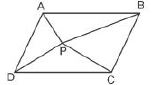
Sol.4) Given : A parallelogram ABCD. P is a point inside it.
To prove : (i) 𝑎𝑟 (𝐴𝑃𝐵) + 𝑎𝑟(𝑃𝐶𝐷) = 1/2 𝑎𝑟 (𝐴𝐵𝐶𝐷)
(ii) 𝑎𝑟 (𝐴𝑃𝐷) + 𝑎𝑟 (𝑃𝐵𝐶) = 𝑎𝑟 (𝐴𝑃𝐵) + 𝑎𝑟 (𝑃𝐶𝐷)
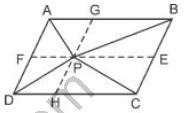
Construction : Draw EF through P parallel to AB, and GH through P parallel to AD.
Proof : In parallelogram FPGA, AP is a diagonal,
∴ area of Δ𝐴𝑃𝐺 = area of Δ𝐴𝑃𝐹 ... (i)
In parallelogram BGPE, PB is a diagonal,
∴ area of Δ𝐵𝑃𝐺 = area of Δ𝐸𝑃𝐵 ... (ii)
In parallelogram DHPF, DP is a diagonal,
∴ area of Δ𝐷𝑃𝐻 = area of ΔDPF ... (iii)
In parallelogram HCEP, CP is a diagonal,
∴ area of Δ𝐶𝑃𝐻 = area of Δ𝐶𝑃𝐸 ... (iv)
Adding (i), (ii), (iii) and (iv)
area of Δ𝐴𝑃𝐺 + area of Δ𝐵𝑃𝐺 + area of Δ𝐷𝑃𝐻 + area of Δ𝐶𝑃𝐻
= area of Δ𝐴𝑃𝐹 + area of Δ𝐸𝑃𝐵 + area of Δ𝐷𝑃𝐹 + area Δ𝐶𝑃𝐸
⇒ [area of Δ𝐴𝑃𝐺 + area of Δ𝐵𝑃𝐺] + [area of Δ𝐷𝑃𝐻 + area of Δ𝐶𝑃𝐻]
= [area of Δ𝐴𝑃𝐹 + area of Δ𝐷𝑃𝐹] + [area of ΔEPB + area of Δ𝐶𝑃𝐸]
⇒ area of Δ𝐴𝑃𝐵 + area of Δ𝐶𝑃𝐷 = area of Δ𝐴𝑃𝐷 + area of Δ𝐵𝑃𝐶 ... (v)
But area of parallelogram ABCD
= area of Δ𝐴𝑃𝐵 + area of Δ𝐶𝑃𝐷 + area of Δ𝐴𝑃𝐷 + area of Δ𝐵𝑃𝐶 ... (vi)
From (v) and (vi)
area of Δ𝐴𝑃𝐵 + area of Δ𝑃𝐶𝐷 = 1/2 area of ABCD
or, 𝑎𝑟 (𝐴𝑃𝐵) + 𝑎𝑟 (𝑃𝐶𝐷) = 1/2 𝑎𝑟 (𝐴𝐵𝐶𝐷) Proved.
(ii) From (v),
⇒ 𝑎𝑟 (𝐴𝑃𝐷) + 𝑎𝑟 (𝑃𝐵𝐶) = 𝑎𝑟 (𝐴𝑃𝐵) + 𝑎𝑟 (𝐶𝑃𝐷) Proved.
Q.5) In the figure, PQRS and ABRS are parallelograms and X is any point on side BR. Show that
(i) 𝑎𝑟 (𝑃𝑄𝑅𝑆) = 𝑎𝑟 (𝐴𝐵𝑅𝑆)
(ii) 𝑎𝑟 (𝐴𝑋𝑆) = 1/2 𝑎𝑟 (𝑃𝑄𝑅𝑆)
Sol.5) Given : PQRS and ABRS are parallelograms and X is any point on side BR.
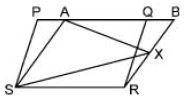
To prove : (i) 𝑎𝑟 (𝑃𝑄𝑅𝑆) = 𝑎𝑟 (𝐴𝐵𝑅𝑆)
(ii) 𝑎𝑟 (𝐴𝑋𝑆) = 1/2 𝑎𝑟 (𝑃𝑄𝑅𝑆)
Proof : (i) In Δ𝐴𝑆𝑃 and BRQ, we have
∠𝑆𝑃𝐴 = ∠𝑅𝑄𝐵 [Corresponding angles] ...(1)
∠𝑃𝐴𝑆 = ∠𝑄𝐵𝑅 [Corresponding angles] ...(2)
∴ ∠𝑃𝑆𝐴 = ∠𝑄𝑅𝐵 [Angle sum property of a triangle] ...(3)
Also, 𝑃𝑆 = 𝑄𝑅 [Opposite sides of the parallelogram PQRS] ...(4)
So, Δ𝐴𝑆𝑃 ≅ Δ𝐵𝑅𝑄 [ASA axiom, using (1), (3) and (4)]
Therefore, area of Δ𝑃𝑆𝐴 = area of Δ𝑄𝑅𝐵 [Congruent figures have equal areas] ...(5)
Now, 𝑎𝑟 (𝑃𝑄𝑅𝑆) = 𝑎𝑟 (𝑃𝑆𝐴) + 𝑎𝑟 (𝐴𝑆𝑅𝑄]
= 𝑎𝑟 (𝑄𝑅𝐵) + 𝑎𝑟 (𝐴𝑆𝑅𝑄]
= 𝑎𝑟 (𝐴𝐵𝑅𝑆)
So, 𝑎𝑟 (𝑃𝑄𝑅𝑆) = 𝑎𝑟 (𝐴𝐵𝑅𝑆) Proved.
(ii) Now, Δ𝐴𝑋𝑆 and ||𝑔𝑚 𝐴𝐵𝑅𝑆 are on the same base AS and between same parallels AS and BR
∴ area of Δ𝐴𝑋𝑆 = 1/2
area of ABRS
⇒ area of Δ𝐴𝑋𝑆 = 1/2
area of 𝑃𝑄𝑅𝑆 [ 𝑎𝑟 (𝑃𝑄𝑅𝑆) = 𝑎𝑟 (𝐴𝐵𝑅𝑆]
⇒ ar of (𝐴𝑋𝑆) = 1/2
ar of (𝑃𝑄𝑅𝑆) Proved.
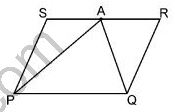
Q.6) A farmer was having a field in the form of a parallelogram PQRS. She took any point A on RS and joined it to points P and Q. In how many parts the fields is divided? What are the shapes of these parts? The farmer wants to sow wheat and pulses in equal portions of the field separately. How should she do it?
Sol.6) The field is divided in three triangles.
Since triangle APQ and parallelogram PQRS are on the same base PQ and between the same parallels PQ and RS.
∴ 𝑎𝑟 (𝐴𝑃𝑄) = 1/2 𝑎𝑟 (𝑃𝑄𝑅𝑆)
⇒ 2𝑎𝑟 (𝐴𝑃𝑄) = 𝑎𝑟 (𝑃𝑄𝑅𝑆)
But 𝑎𝑟 (𝑃𝑄𝑅𝑆) = 𝑎𝑟(𝐴𝑃𝑄) + 𝑎𝑟 (𝑃𝑆𝐴) + 𝑎𝑟 (𝐴𝑅𝑄)
⇒ 2 𝑎𝑟 (𝐴𝑃𝑄) = 𝑎𝑟(𝐴𝑃𝑄) + 𝑎𝑟(𝑃𝑆𝐴) + 𝑎𝑟 (𝐴𝑅𝑄)
⇒ 𝑎𝑟 (𝐴𝑃𝑄) = 𝑎𝑟(𝑃𝑆𝐴) + 𝑎𝑟(𝐴𝑅𝑄)
Hence, area of Δ𝐴𝑃𝑄 = area of Δ𝑃𝑆𝐴 + area of Δ𝐴𝑅𝑄.
To sow wheat and pulses in equal portions of the field separately, farmer sow wheat in Δ𝐴𝑃𝑄 and pulses in other two triangles or pulses in Δ𝐴𝑃𝑄 and wheat in other two triangles.
Free study material for Mathematics
Free NCERT Textbook Explanations: Class 9 Mathematics Chapter 09 Areas of Parallelograms and Triangles
Textbook Solutions for Class 9 Mathematics Chapter 09 Areas of Parallelograms and Triangles
Review comprehensive exercise answers for Class 9 Mathematics Chapter 09 Areas of Parallelograms and Triangles. Fully updated to match current NCERT syllabus guidelines, these textbook solutions help students verify their work and maintain accurate study notes.
Mastering Theoretical and Practical Questions
Clear, methodical explanations accompany every challenging problem within the Class 9 Mathematics text. Engaging with these detailed answers lays a solid foundation for advanced learning and improves foundational clarity for upcoming assessments.
Effective Self-Study and Homework Assistance
These resources act as an effective roadmap for daily homework tasks and independent study. Supplement your review of Chapter 09 Areas of Parallelograms and Triangles with official sample papers and interactive practice tests available on our platform free of charge.
FAQs
The complete and updated NCERT Solutions Class 9 Mathematics Chapter 9 Areas of Parallelograms and Triangles is available for free on StudiesToday.com. These solutions for Class 9 Mathematics are as per latest NCERT curriculum.
Yes, our experts have revised the NCERT Solutions Class 9 Mathematics Chapter 9 Areas of Parallelograms and Triangles as per 2026 exam pattern. All textbook exercises have been solved and have added explanation about how the Mathematics concepts are applied in case-study and assertion-reasoning questions.
Toppers recommend using NCERT language because NCERT marking schemes are strictly based on textbook definitions. Our NCERT Solutions Class 9 Mathematics Chapter 9 Areas of Parallelograms and Triangles will help students to get full marks in the theory paper.
Yes, we provide bilingual support for Class 9 Mathematics. You can access NCERT Solutions Class 9 Mathematics Chapter 9 Areas of Parallelograms and Triangles in both English and Hindi medium.
Yes, you can download the entire NCERT Solutions Class 9 Mathematics Chapter 9 Areas of Parallelograms and Triangles in printable PDF format for offline study on any device.