

NCERT Solutions for Class 9 Mathematics: Chapter 07 Triangles
Explore reliable textbook solutions for Chapter 07 Triangles tailored for Class 9 learners. Utilizing these Mathematics answers ensures thorough preparation and strengthens foundational knowledge before final NCERT evaluations.
Practice Class 9 Mathematics Solutions: Chapter 07 Triangles
Navigate directly to the solved Mathematics textbook exercises using the digital viewer below. Each solution includes detailed step-by-step explanations, allowing students to instantly cross-check their work and identify areas requiring further revision.
Exercise 7.1
Q.1) In quadrilateral 𝐴𝐶𝐵𝐷, 𝐴𝐶 = 𝐴𝐷 and AB bisects ∠A (see Fig.). Show that 𝛥𝐴𝐵𝐶 ≅ 𝛥𝐴𝐵𝐷. What can you say about BC and BD?
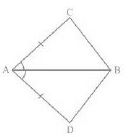
Sol.1) Given,
AC = AD and AB bisects ∠𝐴
To prove,
𝛥𝐴𝐵𝐶 ≅ 𝛥𝐴𝐵𝐷
Proof,
In 𝛥𝐴𝐵𝐶 and 𝛥𝐴𝐵𝐷,
AB = AB (Common)
AC = AD (Given)
∠𝐶𝐴𝐵 = ∠𝐷𝐴𝐵 (AB is bisector)
Therefore, 𝛥𝐴𝐵𝐶 ≅ 𝛥𝐴𝐵𝐷 by SAS congruence condition.
BC and BD are of equal length.
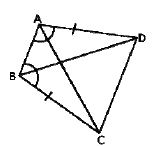
Q.2) ABCD is a quadrilateral in which AD = BC and ∠𝐷𝐴𝐵 = ∠𝐶𝐵𝐴 (see Fig.). Prove that
(i) 𝛥𝐴𝐵𝐷 ≅ 𝛥𝐵𝐴𝐶
(ii) 𝐵𝐷 = 𝐴𝐶
(iii) ∠𝐴𝐵𝐷 = ∠𝐵𝐴𝐶.
Sol.2) Given,
AD = BC and ∠DAB = ∠CBA
(i) In 𝛥𝐴𝐵𝐷 and 𝛥𝐵𝐴𝐶,
𝐴𝐵 = 𝐵𝐴 (Common)
∠𝐷𝐴𝐵 = ∠𝐶𝐵𝐴 (Given)
𝐴𝐷 = 𝐵𝐶 (Given)
Therefore, 𝛥𝐴𝐵𝐷 ≅ 𝛥𝐵𝐴𝐶 by SAS congruence condition.
(ii) Since, 𝛥𝐴𝐵𝐷 ≅ 𝛥𝐵𝐴𝐶
Therefore 𝐵𝐷 = 𝐴𝐶 by CPCT
(iii) Since, 𝛥𝐴𝐵𝐷 ≅ 𝛥𝐵𝐴𝐶
Therefore ∠𝐴𝐵𝐷 = ∠𝐵𝐴𝐶 by CPCT
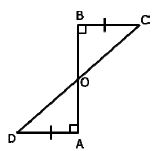
Q.3) AD and BC are equal perpendiculars to a line segment AB (see Fig. ). Show that CD bisects AB.
Sol.3) Given,
AD and BC are equal perpendiculars to AB.
To prove,
CD bisects AB
Proof,
In 𝛥𝐴𝑂𝐷 and 𝛥𝐵𝑂𝐶,
∠𝐴 = ∠𝐵 (Perpendicular)
∠𝐴𝑂𝐷 = ∠𝐵𝑂𝐶 (Vertically opposite angles)
AD = BC (Given)
Therefore, 𝛥𝐴𝑂𝐷 ≅ 𝛥𝐵𝑂𝐶 by AAS congruence condition.
Now,
AO = OB (CPCT). CD bisects AB.
Q.4) 𝑙 and 𝑚 are two parallel lines intersected by another pair of parallel lines 𝑝 and 𝑞 (see Fig). Show that 𝛥𝐴𝐵𝐶 ≅ 𝛥𝐶𝐷𝐴.
Sol.4) Given,
𝑙 || 𝑚 and 𝑝 || 𝑞
To prove,
𝛥𝐴𝐵𝐶 ≅ 𝛥𝐶𝐷𝐴
Proof,
In 𝛥𝐴𝐵𝐶 and 𝛥𝐶𝐷𝐴,
∠𝐵𝐶𝐴 = ∠𝐷𝐴𝐶 (Alternate interior angles)
𝐴𝐶 = 𝐶𝐴 (Common)
∠𝐵𝐴𝐶 = ∠𝐷𝐶𝐴 (Alternate interior angles)
Therefore, 𝛥𝐴𝐵𝐶 ≅ 𝛥𝐶𝐷𝐴 by ASA congruence condition.

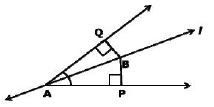
Q.5) Line 𝑙 is the bisector of an angle ∠𝐴 and B is any point on 𝑙. BP and BQ are perpendiculars from B to the arms of ∠𝐴 (see Fig.). Show that:
(i) 𝛥𝐴𝑃𝐵 ≅ 𝛥𝐴𝑄𝐵
(ii) 𝐵𝑃 = 𝐵𝑄 or B is equidistant from the arms of ∠𝐴.
Sol.5) Given,
l is the bisector of an angle ∠𝐴.
BP and BQ are perpendiculars.
(i) In 𝛥𝐴𝑃𝐵 and 𝛥𝐴𝑄𝐵,
∠𝑃 = ∠𝑄 (Right angles)
∠𝐵𝐴𝑃 = ∠𝐵𝐴𝑄 (𝑙 is bisector)
𝐴𝐵 = 𝐴𝐵 (Common)
Therefore, 𝛥𝐴𝑃𝐵 ≅ 𝛥𝐴𝑄𝐵 by AAS congruence condition.
(ii) BP = BQ by CPCT. Therefore, B is equidistant from the arms of ∠𝐴.
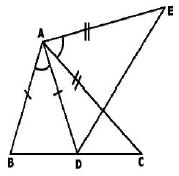
Q.6) In Fig., 𝐴𝐶 = 𝐴𝐸, 𝐴𝐵 = 𝐴𝐷 and ∠𝐵𝐴𝐷 = ∠𝐸𝐴𝐶. Show that 𝐵𝐶 = 𝐷𝐸.
Sol.6) Given,
𝐴𝐶 = 𝐴𝐸, 𝐴𝐵 = 𝐴𝐷 and ∠𝐵𝐴𝐷 = ∠𝐸𝐴𝐶
To show,
𝐵𝐶 = 𝐷𝐸
Proof,
∠𝐵𝐴𝐷 = ∠𝐸𝐴𝐶 (Adding ∠𝐷𝐴𝐶 both sides)
∠𝐵𝐴𝐷 + ∠𝐷𝐴𝐶 = ∠𝐸𝐴𝐶 + ∠𝐷𝐴𝐶
⇒ ∠𝐵𝐴𝐶 = ∠𝐸𝐴𝐷
In 𝛥𝐴𝐵𝐶 and 𝛥𝐴𝐷𝐸,
𝐴𝐶 = 𝐴𝐸 (Given)
∠𝐵𝐴𝐶 = ∠𝐸𝐴𝐷
𝐴𝐵 = 𝐴𝐷 (Given)
Therefore, 𝛥𝐴𝐵𝐶 ≅ 𝛥𝐴𝐷𝐸 by SAS congruence condition.
𝐵𝐶 = 𝐷𝐸 by CPCT.
Q.7) AB is a line segment and P is its mid-point. D and E are points on the same side of AB such that ∠𝐵𝐴𝐷 = ∠𝐴𝐵𝐸 and ∠𝐸𝑃𝐴 = ∠𝐷𝑃𝐵 (see Fig.). Show that
(i) 𝛥𝐷𝐴𝑃 ≅ 𝛥𝐸𝐵𝑃
(ii) 𝐴𝐷 = 𝐵𝐸
Sol.7) Given,
P is mid-point of AB.
∠𝐵𝐴𝐷 = ∠𝐴𝐵𝐸 and ∠𝐸𝑃𝐴 = ∠𝐷𝑃𝐵

(i) ∠𝐸𝑃𝐴 = ∠𝐷𝑃𝐵 (Adding ∠𝐷𝑃𝐸 both sides)
∠𝐸𝑃𝐴 + ∠𝐷𝑃𝐸 = ∠𝐷𝑃𝐵 + ∠𝐷𝑃𝐸
⇒ ∠𝐷𝑃𝐴 = ∠𝐸𝑃𝐵
In 𝛥𝐷𝐴𝑃 ≅ 𝛥𝐸𝐵𝑃,
∠𝐷𝑃𝐴 = ∠𝐸𝑃𝐵
AP = BP (P is mid-point of AB)
∠𝐵𝐴𝐷 = ∠𝐴𝐵𝐸 (Given)
Therefore, 𝛥𝐷𝐴𝑃 ≅ 𝛥𝐸𝐵𝑃 by ASA congruence condition.
(ii) 𝐴𝐷 = 𝐵𝐸 by CPCT.
Q.8) In right triangle ABC, right angled at C, M is the mid-point of hypotenuse AB. C is joined to M and produced to a point D such that 𝐷𝑀 = 𝐶𝑀. Point D is joined to point B (see Fig.).
Show that:
(i) 𝛥𝐴𝑀𝐶 ≅ 𝛥𝐵𝑀𝐷
(ii) ∠𝐷𝐵𝐶 is a right angle.
(iii) 𝛥𝐷𝐵𝐶 ≅ 𝛥𝐴𝐶𝐵
(iv) 𝐶𝑀 = (1/2)𝐴𝐵
Sol.8) Given,
∠𝐶 = 90°, 𝑀 is the mid-point of AB and 𝐷𝑀 = 𝐶𝑀
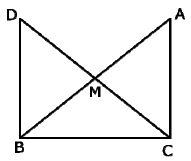
(i) In 𝛥𝐴𝑀𝐶 and 𝛥𝐵𝑀𝐷,
𝐴𝑀 = 𝐵𝑀 (M is the mid-point)
∠𝐶𝑀𝐴 = ∠𝐷𝑀𝐵 (Vertically opposite angles)
CM = DM (Given)
Therefore, 𝛥𝐴𝑀𝐶 ≅ 𝛥𝐵𝑀𝐷 by SAS congruence condition.
(ii) ∠𝐴𝐶𝑀 = ∠𝐵𝐷𝑀 (by CPCT)
Therefore, 𝐴𝐶 || 𝐵𝐷 as alternate interior angles are equal.
Now,
∠𝐴𝐶𝐵 + ∠𝐷𝐵𝐶 = 180° (co-interiors angles)
⇒ 90° + ∠𝐵 = 180°
⇒ ∠𝐷𝐵𝐶 = 90°
(iii) In 𝛥𝐷𝐵𝐶 and 𝛥𝐴𝐶𝐵,
𝐵𝐶 = 𝐶𝐵 (Common)
∠𝐴𝐶𝐵 = ∠𝐷𝐵𝐶 (Right angles)
𝐷𝐵 = 𝐴𝐶 (byy CPCT, already proved)
Therefore, 𝛥𝐷𝐵𝐶 ≅ 𝛥𝐴𝐶𝐵 by SAS congruence condition.
(iv) 𝐷𝐶 = 𝐴𝐵 (𝛥𝐷𝐵𝐶 ≅ 𝛥𝐴𝐶𝐵)
⇒ 𝐷𝑀 + 𝐶𝑀 = 𝐴𝑀 + 𝐵𝑀
⇒ 𝐶𝑀 + 𝐶𝑀 = 𝐴𝐵
⇒ 𝐶𝑀 = (1/2)𝐴𝐵
Exercise 7.2
Q.1) In an isosceles triangle ABC, with 𝐴𝐵 = 𝐴𝐶, the bisectors of ∠𝐵 and ∠𝐶 intersect each other at O. Join A to O. Show that :
(i) 𝑂𝐵 = 𝑂𝐶 (ii) AO bisects ∠𝐴
Sol.1) Given,
AB = AC, the bisectors of ∠B and ∠C intersect each other at O
(i) Since ABC is an isosceles with AB = AC,
∴ ∠𝐵 = ∠𝐶
⇒ 1/2 ∠𝐵 = 1/2 ∠𝐶
⇒ ∠𝑂𝐵𝐶 = ∠𝑂𝐶𝐵 (Angle bisectors.)
⇒ 𝑂𝐵 = 𝑂𝐶 (Side opposite to the equal angles are equal.)
(ii) In 𝛥𝐴𝑂𝐵 and 𝛥𝐴𝑂𝐶,
𝐴𝐵 = 𝐴𝐶 (Given)
𝐴𝑂 = 𝐴𝑂 (Common)
𝑂𝐵 = 𝑂𝐶 (Proved above)
Therefore, 𝛥𝐴𝑂𝐵 ≅ 𝛥𝐴𝑂𝐶 by SSS congruence condition.
∠𝐵𝐴𝑂 = ∠𝐶𝐴𝑂 (by CPCT)
Thus, AO bisects ∠𝐴.
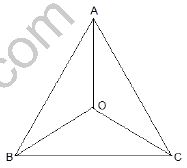
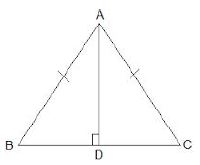
Q.2) In 𝛥𝐴𝐵𝐶, 𝐴𝐷 is the perpendicular bisector of BC (see Fig. ). Show that 𝛥𝐴𝐵𝐶 is an isosceles triangle in which 𝐴𝐵 = 𝐴𝐶.
Sol.2) Given,
AD is the perpendicular bisector of BC
To show,
AB = AC
Proof,
In 𝛥𝐴𝐷𝐵 and ΔADC,
AD = AD (Common)
∠𝐴𝐷𝐵 = ∠𝐴𝐷𝐶
𝐵𝐷 = 𝐶𝐷 (AD is the perpendicular bisector)
Therefore, 𝛥𝐴𝐷𝐵 ≅ 𝛥𝐴𝐷𝐶 by SAS congruence condition.
AB = AC (by CPCT)
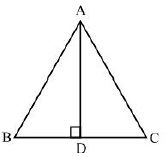
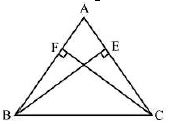
Q,3) ABC is an isosceles triangle in which altitudes BE and CF are drawn to equal sides AC and AB respectively (see Fig.). Show that these altitudes are equal.
Sol.3) Given,
BE and CF are altitudes.
AC = AB
To show,
BE = CF
Proof,
In 𝛥𝐴𝐸𝐵 and 𝛥𝐴𝐹𝐶,
∠𝐴 = ∠𝐴 (Common)
∠𝐴𝐸𝐵 = ∠𝐴𝐹𝐶 (Right angles)
𝐴𝐵 = 𝐴𝐶 (Given)
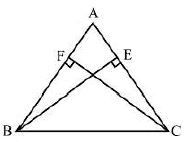
Therefore, 𝛥𝐴𝐸𝐵 ≅ 𝛥𝐴𝐹𝐶 by AAS congruence condition.
Thus, 𝐵𝐸 = 𝐶𝐹 by CPCT.
Q.4) ABC is a triangle in which altitudes BE and CF to sides AC and AB are equal (see Fig.).
Show that
(i) 𝛥𝐴𝐵𝐸 ≅ 𝛥𝐴𝐶𝐹
(ii) AB = AC, i.e., ABC is an isosceles triangle.
Sol.4) Given,
BE = CF
(i) In 𝛥𝐴𝐵𝐸 and 𝛥𝐴𝐶𝐹,
∠𝐴 = ∠𝐴 (Common)
∠𝐴𝐸𝐵 = ∠𝐴𝐹𝐶 (Right angles)
BE = CF (Given)
Therefore, 𝛥𝐴𝐵𝐸 ≅ 𝛥𝐴𝐶𝐹 by AAS congruence condition.
(ii) Thus, AB = AC by CPCT and therefore ABC is an isosceles triangle.

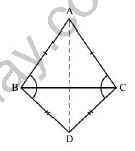
Q.5) ABC and DBC are two isosceles triangles on the same base BC (see Fig.). Show that ∠𝐴𝐵𝐷 = ∠𝐴𝐶𝐷.
Sol.5) Given,
𝐴𝐵𝐶 and 𝐷𝐵𝐶 are two isosceles triangles.
To show,
∠𝐴𝐵𝐷 = ∠𝐴𝐶𝐷
Proof,
In 𝛥𝐴𝐵𝐷 and 𝛥𝐴𝐶𝐷,
𝐴𝐷 = 𝐴𝐷 (Common)
𝐴𝐵 = 𝐴𝐶 (ABC is an isosceles triangle.)
𝐵𝐷 = 𝐶𝐷 (BCD is an isosceles triangle.)
Therefore, 𝛥𝐴𝐵𝐷 ≅ 𝛥𝐴𝐶𝐷 by SSS congruence condition. Thus, ∠𝐴𝐵𝐷 = ∠𝐴𝐶𝐷 by CPCT.
Q.6) 𝛥𝐴𝐵𝐶 is an isosceles triangle in which 𝐴𝐵 = 𝐴𝐶. Side BA is produced to D such that 𝐴𝐷 = 𝐴𝐵 (see Fig.). Show that ∠𝐵𝐶𝐷 is a right angle.
Sol.6) Given,
𝐴𝐵 = 𝐴𝐶 and 𝐴𝐷 = 𝐴𝐵
To show,
∠𝐵𝐶𝐷 is a right angle.
Proof,
In 𝛥𝐴𝐵𝐶,
𝐴𝐵 = 𝐴𝐶 (Given)
⇒ ∠𝐴𝐶𝐵 = ∠𝐴𝐵𝐶 (Angles opposite to the equal sides are equal.)
In 𝛥𝐴𝐶𝐷,
𝐴𝐷 = 𝐴𝐵
⇒ ∠𝐴𝐷𝐶 = ∠𝐴𝐶𝐷 (Angles opposite to the equal sides are equal.)
Now,
In 𝛥𝐴𝐵𝐶,
∠𝐶𝐴𝐵 + ∠𝐴𝐶𝐵 + ∠𝐴𝐵𝐶 = 180°
⇒ ∠𝐶𝐴𝐵 + 2∠𝐴𝐶𝐵 = 180°
⇒ ∠𝐶𝐴𝐵 = 180° – 2∠𝐴𝐶𝐵 ….. (i)
Similarly in 𝛥𝐴𝐷𝐶,
∠𝐶𝐴𝐷 = 180°° – 2∠𝐴𝐶𝐷 …. (ii)
also,
∠𝐶𝐴𝐵 + ∠𝐶𝐴𝐷 = 180° (BD is a straight line.)
Adding (i) and (ii)

∠𝐶𝐴𝐵 + ∠𝐶𝐴𝐷 = 180°– 2∠𝐴𝐶𝐵 + 180°– 2∠𝐴𝐶𝐷
⇒ 180° = 360° – 2∠𝐴𝐶𝐵 – 2∠𝐴𝐶𝐷
⇒ 2(∠𝐴𝐶𝐵 + ∠𝐴𝐶𝐷) = 180°
⇒ ∠𝐵𝐶𝐷 = 90°
Q.7) ABC is a right angled triangle in which ∠𝐴 = 90° and 𝐴𝐵 = 𝐴𝐶. Find ∠𝐵 and ∠𝐶.
Sol.7) Given,
∠𝐴 = 90° and 𝐴𝐵 = 𝐴𝐶
A/q,
𝐴𝐵 = 𝐴𝐶
⇒ ∠𝐵 = ∠𝐶 (Angles opposite to the equal sides are equal.)
Now,
∠𝐴 + ∠𝐵 + ∠𝐶 = 180° (Sum of the interior angles of the triangle.)
⇒ 90° + 2∠𝐵 = 180°
⇒ 2∠𝐵 = 90°
⇒ ∠𝐵 = 45°
Thus, ∠𝐵 = ∠𝐶 = 45°
Q.8) Show that the angles of an equilateral triangle are 60° each.
Sol.8) Let ABC be an equilateral triangle.
𝐵𝐶 = 𝐴𝐶 = 𝐴𝐵 (Length of all sides is same)
⇒ ∠𝐴 = ∠𝐵 = ∠𝐶 (Sides opposite to the equal angles are equal.)
Also,
∠𝐴 + ∠𝐵 + ∠𝐶 = 180°
⇒ 3∠𝐴 = 180°
⇒ ∠𝐴 = 60°
Therefore, ∠𝐴 = ∠𝐵 = ∠𝐶 = 60°
Thus, the angles of an equilateral triangle are 60°each.
Exercise 7.3
Q.1) 𝛥𝐴𝐵𝐶 and 𝛥𝐷𝐵𝐶 are two isosceles triangles on the same base BC and vertices A and D are on the same side of BC (see Fig.). If AD is extended to intersect BC at P, show that
(i) 𝛥𝐴𝐵𝐷 ≅ 𝛥𝐴𝐶𝐷
(ii) 𝛥𝐴𝐵𝑃 ≅ 𝛥𝐴𝐶𝑃
(iii) AP bisects ∠𝐴 as well as ∠𝐷.
(iv) AP is the perpendicular bisector of BC.
Sol.1) Given,
𝛥𝐴𝐵𝐶 and 𝛥𝐷𝐵𝐶 are two isosceles triangles.
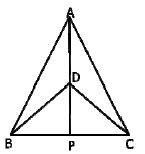
(i) In 𝛥𝐴𝐵𝐷 and 𝛥𝐴𝐶𝐷,
𝐴𝐷 = 𝐴𝐷 (Common)
𝐴𝐵 = 𝐴𝐶 (𝛥𝐴𝐵𝐶 is isosceles)
𝐵𝐷 = 𝐶𝐷 (𝛥𝐷𝐵𝐶 is isosceles)
Therefore, 𝛥𝐴𝐵𝐷 ≅ 𝛥𝐴𝐶𝐷 by SSS congruence condition.
(ii) In 𝛥𝐴𝐵𝑃 and 𝛥𝐴𝐶𝑃,
𝐴𝑃 = 𝐴𝑃 (Common)
∠𝑃𝐴𝐵 = ∠𝑃𝐴𝐶 (𝛥𝐴𝐵𝐷 ≅ 𝛥𝐴𝐶𝐷 so by CPCT)
𝐴𝐵 = 𝐴𝐶 (𝛥𝐴𝐵𝐶 is isosceles)
Therefore, 𝛥𝐴𝐵𝑃 ≅ 𝛥𝐴𝐶𝑃 by SAS congruence condition.
(iii) ∠𝑃𝐴𝐵 = ∠𝑃𝐴𝐶 by CPCT as 𝛥𝐴𝐵𝐷 ≅ 𝛥𝐴𝐶𝐷.
AP bisects ∠𝐴. ….(i)
also,
In 𝛥𝐵𝑃𝐷 and 𝛥𝐶𝑃𝐷,
𝑃𝐷 = 𝑃𝐷 (Common)
𝐵𝐷 = 𝐶𝐷 (𝛥𝐷𝐵𝐶 is isosceles.)
𝐵𝑃 = 𝐶𝑃 (𝛥𝐴𝐵𝑃 ≅ 𝛥𝐴𝐶𝑃 so by CPCT.)
Therefore, 𝛥𝐵𝑃𝐷 ≅ 𝛥𝐶𝑃𝐷 by SSS congruence condition.
Thus, ∠𝐵𝐷𝑃 = ∠𝐶𝐷𝑃 by CPCT. ….. (ii)
By (i) and (ii) we can say that AP bisects ∠A as well as ∠𝐷.
(iv) ∠𝐵𝑃𝐷 = ∠𝐶𝑃𝐷 (by CPCT as 𝛥𝐵𝑃𝐷 ≅ 𝛥𝐶𝑃𝐷)
and 𝐵𝑃 = 𝐶𝑃 ….. (i)
also,
∠𝐵𝑃𝐷 + ∠𝐶𝑃𝐷 = 180° (BC is a straight line.)
⇒ 2∠𝐵𝑃𝐷 = 180°
⇒ ∠𝐵𝑃𝐷 = 90° ……(ii)
From (i) and (ii),
AP is the perpendicular bisector of BC.
Q.2) AD is an altitude of an isosceles triangle 𝐴𝐵𝐶 in which 𝐴𝐵 = 𝐴𝐶. Show that
(i) AD bisects BC (ii) AD bisects ∠𝐴.
Sol.2) Given,
AD is an altitude and AB = AC
(i) In 𝛥𝐴𝐵𝐷 and 𝛥𝐴𝐶𝐷,
∠𝐴𝐷𝐵 = ∠𝐴𝐷𝐶 = 90°
𝐴𝐵 = 𝐴𝐶 (Given)
𝐴𝐷 = 𝐴𝐷 (Common)
Therefore, 𝛥𝐴𝐵𝐷 ≅ 𝛥𝐴𝐶𝐷 by RHS congruence condition.
Now,
𝐵𝐷 = 𝐶𝐷 (by CPCT)
Thus, 𝐴𝐷 bisects BC
(ii) ∠𝐵𝐴𝐷 = ∠𝐶𝐴𝐷 (by CPCT)
Thus, AD bisects ∠𝐴.
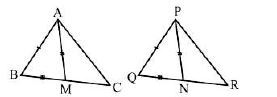
Q.3) Two sides AB and BC and median AM of one triangle ABC are respectively equal to sides PQ and QR and median PN of 𝛥𝑃𝑄𝑅 (see Fig.). Show that:
(i) 𝛥𝐴𝐵𝑀 ≅ 𝛥𝑃𝑄𝑁
(ii) 𝛥𝐴𝐵𝐶 ≅ 𝛥𝑃𝑄𝑅
Sol.3) Given,
𝐴𝐵 = 𝑃𝑄, 𝐵𝐶 = 𝑄𝑅 and 𝐴𝑀 = 𝑃𝑁
(i) 1/2
𝐵𝐶 = 𝐵𝑀 and 1/2
𝑄𝑅 = 𝑄𝑁 (𝐴𝑀 and 𝑃𝑁 are medians)
also,
⇒ 𝐵𝑀 = 𝑄𝑁
In 𝛥𝐴𝐵𝑀 and 𝛥𝑃𝑄𝑁,
𝐴𝑀 = 𝑃𝑁 (Given)
𝐴𝐵 = 𝑃𝑄 (Given)
𝐵𝑀 = 𝑄𝑁 (Proved above)
Therefore, 𝛥𝐴𝐵𝑀 ≅ 𝛥𝑃𝑄𝑁 by SSS congruence condition.
(ii) In 𝛥𝐴𝐵𝐶 and 𝛥𝑃𝑄𝑅,
𝐴𝐵 = 𝑃𝑄 (Given)
∠𝐴𝐵𝐶 = ∠𝑃𝑄𝑅 (by CPCT)
𝐵𝐶 = 𝑄𝑅 (Given)
Therefore, 𝛥𝐴𝐵𝐶 ≅ 𝛥𝑃𝑄𝑅 by SAS congruence condition.
Q.4) 𝐵𝐸 and 𝐶𝐹 are two equal altitudes of a triangle ABC. Using RHS congruence rule, prove that the triangle 𝐴𝐵𝐶 is isosceles.
Sol.4) Given,
BE and CF are two equal altitudes.
In 𝛥𝐵𝐸𝐶 and 𝛥𝐶𝐹𝐵,
∠𝐵𝐸𝐶 = ∠𝐶𝐹𝐵 = 90° (Altitudes)
𝐵𝐶 = 𝐶𝐵 (Common)
𝐵𝐸 = 𝐶𝐹 (Common)
Therefore, 𝛥𝐵𝐸𝐶 ≅ 𝛥𝐶𝐹𝐵 by RHS congruence condition.
Now,
∠𝐶 = ∠𝐵 (by CPCT)
Thus, 𝐴𝐵 = 𝐴𝐶 as sides opposite to the equal angles are equal.
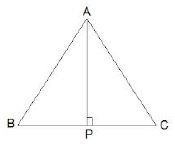
Q.5) ABC is an isosceles triangle with 𝐴𝐵 = 𝐴𝐶. Draw 𝐴𝑃 ⊥ 𝐵𝐶 to show that ∠𝐵 = ∠𝐶.
Sol.5) Given,
AB = AC
In 𝛥𝐴𝐵𝑃 and 𝛥𝐴𝐶𝑃,
∠𝐴𝑃𝐵 = ∠𝐴𝑃𝐶 = 90° (AP is altitude)
𝐴𝐵 = 𝐴𝐶 (Given)
𝐴𝑃 = 𝐴𝑃 (Common)
Therefore, 𝛥𝐴𝐵𝑃 ≅ 𝛥𝐴𝐶𝑃 by RHS congruence condition.
Thus, ∠𝐵 = ∠𝐶 (by CPCT)
Exercise 7.4
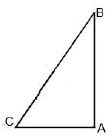
Q.1) Show that in a right angled triangle, the hypotenuse is the longest side.
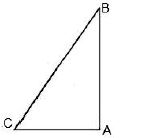
Sol.1) ABC is a triangle right angled at B.
Now,
∠𝐴 + ∠𝐵 + ∠𝐶 = 180°
⇒ ∠𝐴 + ∠𝐶 = 90° and ∠𝐵 is 90°.
Since, B is the largest angle of the triangle, the side opposite to it must be the largest.
So, BC is the hypotenuse which is the largest side of the right angled triangle ABC.
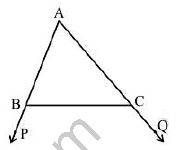
Q.2) In Fig., sides AB and AC of 𝛥𝐴𝐵𝐶 are extended to points P and Q respectively. Also, ∠𝑃𝐵𝐶 < ∠𝑄𝐶𝐵. Show that 𝐴𝐶 > 𝐴𝐵.
Sol.2) Given,
∠𝑃𝐵𝐶 < ∠𝑄𝐶𝐵
Now,
∠𝐴𝐵𝐶 + ∠𝑃𝐵𝐶 = 180°
⇒ ∠𝐴𝐵𝐶 = 180° – ∠𝑃𝐵𝐶
also,
∠𝐴𝐶𝐵 + ∠𝑄𝐶𝐵 = 180°
⇒ ∠𝐴𝐶𝐵 = 180° – ∠𝑄𝐶𝐵
Since,
∠𝑃𝐵𝐶 < ∠𝑄𝐶𝐵 therefore, ∠𝐴𝐵𝐶 > ∠𝐴𝐶𝐵
Thus, 𝐴𝐶 > 𝐴𝐵 as sides opposite to the larger angle is larger.
Q.3) In Fig., ∠𝐵 < ∠𝐴 and ∠𝐶 < ∠𝐷. Show that 𝐴𝐷 < 𝐵𝐶.
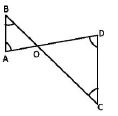
Sol.3) Given,
∠𝐵 < ∠𝐴 and ∠𝐶 < ∠𝐷
Now,
𝐴𝑂 < 𝐵𝑂 …… (i) (Side opposite to the smaller angle is smaller)
𝑂𝐷 < 𝑂𝐶 ….(ii) (Side opposite to the smaller angle is smaller)
Adding (i) and (ii)
𝐴𝑂 + 𝑂𝐷 < 𝐵𝑂 + 𝑂𝐶
⇒ 𝐴𝐷 < 𝐵𝐶
Q.4) AB and CD are respectively the smallest and longest sides of a quadrilateral ABCD (see Fig.). Show that ∠𝐴 > ∠𝐶 and ∠𝐵 > ∠𝐷.
Sol.4) In 𝛥𝐴𝐵𝐷,
𝐴𝐵 < 𝐴𝐷 < 𝐵𝐷
∴ ∠𝐴𝐷𝐵 < ∠𝐴𝐵𝐷 ….. (i) (Angle opposite to longer side is larger.)
Now,
In 𝛥𝐵𝐶𝐷,
𝐵𝐶 < 𝐷𝐶 < 𝐵𝐷
∴ ∠𝐵𝐷𝐶 < ∠𝐶𝐵𝐷 …… (ii)
Adding (i) and (ii) we get,
∠𝐴𝐷𝐵 + ∠𝐵𝐷𝐶 < ∠𝐴𝐵𝐷 + ∠𝐶𝐵𝐷
⇒ ∠𝐴𝐷𝐶 < ∠𝐴𝐵𝐶
⇒ ∠𝐵 > ∠𝐷
Similarly,
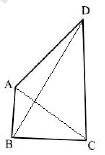
In 𝛥𝐴𝐵𝐶,
∠𝐴𝐶𝐵 < ∠𝐵𝐴𝐶 …… (iii) (Angle opposite to longer side is larger.)
Now,
In 𝛥𝐴𝐷𝐶,
∠𝐷𝐶𝐴 < ∠𝐷𝐴𝐶 …. (iv)
Adding (iii) and (iv) we get,
∠𝐴𝐶𝐵 + ∠𝐷𝐶𝐴 < ∠𝐵𝐴𝐶 + ∠𝐷𝐴𝐶
⇒ ∠𝐵𝐶𝐷 < ∠𝐵𝐴𝐷
⇒ ∠𝐴 > ∠𝐶
Q.5) In Fig., 𝑃𝑅 > 𝑃𝑄 and PS bisects ∠𝑄𝑃𝑅. Prove that ∠𝑃𝑆𝑅 > ∠𝑃𝑆𝑄.
Sol.5) Given,
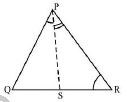
PR > PQ and PS bisects ∠QPR
To prove,
∠𝑃𝑆𝑅 > ∠𝑃𝑆𝑄
Proof,
∠𝑃𝑄𝑅 > ∠𝑃𝑅𝑄 ….(i) (𝑃𝑅 > 𝑃𝑄 as angle opposite to larger side is larger.)
∠𝑄𝑃𝑆 = ∠𝑅𝑃𝑆 …… (ii) (PS bisects ∠𝑄𝑃𝑅)
∠𝑃𝑆𝑅 = ∠𝑃𝑄𝑅 + ∠𝑄𝑃𝑆 …… (iii) (exterior angle of a triangle equals to the sum of
opposite interior angles)
∠𝑃𝑆𝑄 = ∠𝑃𝑅𝑄 + ∠𝑅𝑃𝑆 ….. (iv) (exterior angle of a triangle equals to the sum of
opposite interior angles)
Adding (i) and (ii)
∠𝑃𝑄𝑅 + ∠𝑄𝑃𝑆 > ∠𝑃𝑅𝑄 + ∠𝑅𝑃𝑆
⇒ ∠𝑃𝑆𝑅 > ∠𝑃𝑆𝑄 [from (i), (ii), (iii) and (iv)]
Q.6) Show that of all line segments drawn from a given point not on it, the perpendicular line segment is the shortest.
Sol.6) Let l is a line segment and B is a point lying o it. We drew a line AB perpendicular to l. Let
C be any other point on l.
To prove,
𝐴𝐵 < 𝐴𝐶
Proof,
In 𝛥𝐴𝐵𝐶,
∠𝐵 = 90°.
Now,
∠𝐴 + ∠𝐵 + ∠𝐶 = 180°.
⇒ ∠𝐴 + ∠𝐶 = 90°.
∴ ∠𝐶 must be acute angle. or ∠𝐶 < ∠𝐵
⇒ 𝐴𝐵 < 𝐴𝐶 (Side opposite to the larger angle is larger.)
Exercise 7.5 (Optional)
Q.1) ABC is a triangle. Locate a point in the interior of Δ𝐴𝐵𝐶 which is equidistant from all the vertices of Δ𝐴𝐵𝐶.
Sol.1) Draw perpendicular bisectors PQ and RS of sides AB and BC respectively of triangle ABC.
Let PQ bisects AB at M and RS bisects BC at point N.
Let PQ and RS intersect at point O.
Join 𝑂𝐴, 𝑂𝐵 and 𝑂𝐶.
Now in Δ𝐴𝑂𝑀 and Δ𝐵𝑂𝑀 ,
𝐴𝑀 = 𝑀𝐵 [By construction]
Δ𝐴𝑀𝑂 = Δ𝐵𝑀𝑂 = 90° [By construction]
𝑂𝑀 = 𝑂𝑀 [Common]
∴ 𝛥𝐴𝑂𝑀 ≅ 𝐵𝑂𝑀 [By SAS congruency]
𝑂𝐴 = 𝑂𝐵 [By C.P.C.T.] …..(i)
Similarly, 𝛥𝐵𝑂𝑁 ≅ 𝛥𝐶𝑂𝑁
𝑂𝐵 = 𝑂𝐶 [By C.P.C.T.] …..(ii)
From eq. (i) and (ii),
𝑂𝐴 = 𝑂𝐵 = 𝑂𝐶
Hence O, the point of intersection of perpendicular bisectors of any two sides of ABC equidistant from its vertices

Q.2) In a triangle locate a point in its interior which is equidistant from all the sides of the triangle.
Sol.2) Let ABC be a triangle.
Draw bisectors of ∠𝐵 and ∠𝐶
Let these angle bisectors intersect each other at point 𝐼.
Draw 𝐼𝐾 ⊥ 𝐵𝐶
Also draw 𝐼𝐽 ⊥ 𝐴𝐵 and 𝐼𝐿 ⊥ 𝐴𝐶.
Join 𝐴𝐼.
In Δ𝐵𝐼𝐾 and Δ𝐵𝐼𝐽,
∠𝐼𝐾𝐵 = ∠ 𝐼𝐽𝐵 = 90° [By construction]
∠𝐼𝐵𝐾 = ∠𝐼𝐵𝐽 [ 𝐵𝐼 is the bisector of ∠𝐵 (By construction)]
𝐵𝐼 = 𝐵𝐼 [Common]
∴ Δ𝐵𝐼𝐾 ≅ Δ𝐵𝐼𝐽 [ASA criteria of congruency]
∴ 𝐼𝐾 = 𝐼𝐽 [By C.P.C.T.] ……….(i)
Similarly, 𝛥𝐶𝐼𝐾 ≅ 𝛥𝐶𝐼𝐿
∴ 𝐼𝐾 = 𝐼𝐿 [By C.P.C.T.] ……….(ii)
From eq (i) and (ii),
𝐼𝐾 = 𝐼𝐽 = 𝐼𝐿
Hence, 𝐼 is the point of intersection of angle bisectors of any two angles of Δ𝐴𝐵𝐶 equidistant from its sides.

Q.3) In a huge park, people are concentrated at three points (See figure).
A: where there are different slides and swings for children.
B: near which a man-made lake is situated.
C: which is near to a large parking and exit.
Where should an ice cream parlour be set up so that maximum number of persons can approach it?
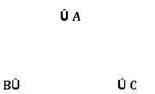
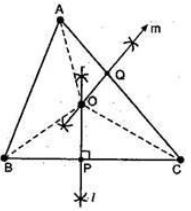
Sol.3) The parlour should be equidistant from A, B and C.
For this let we draw perpendicular bisector say 𝑙 of line joining points B and C also draw perpendicular bisector say 𝑚 of line joining points A and C.
Let 𝑙 and 𝑚 intersect each other at point O.
Now point O is equidistant from points A, B and C.
Join OA, OB and OC.
Proof: In Δ𝐵𝑂𝑃 and Δ𝐶𝑂𝑃,
𝑂𝑃 = 𝑂𝑃 [Common]
∠ OPB = ∠ OPC =
BP = PC [P is the mid-point of BC]
∴ Δ𝐵𝑂𝑃 ≅ Δ𝐶𝑂𝑃 [By SAS congruency]
𝑂𝐵 = 𝑂𝐶 [By C.P.C.T.] …..(i)
Similarly, Δ𝐴𝑂𝑄 ≅ Δ𝐶𝑂𝑄
𝑂𝐴 = 𝑂𝐶 [By C.P.C.T.] …..(ii)
From eq. (i) and (ii),
𝑂𝐴 = 𝑂𝐵 = 𝑂𝐶
Therefore, ice cream parlour should be set up at point O, the point of intersection of perpendicular bisectors of any two sides out of three formed by joining these points.
Q.4) Complete the hexagonal rangoli and the star rangolies (See figure) but filling them with as many equilateral triangles of side 1 cm as you can. Count the number of triangles in each case. Which has more triangles?
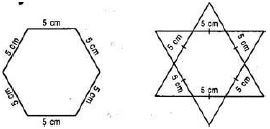
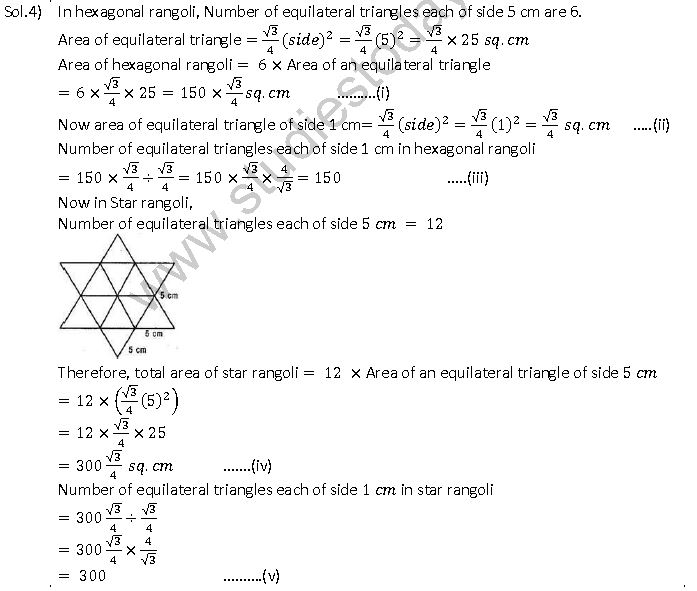
From eq. (iii) and (v), we observe that star rangoli has more equilateral triangles each of side 1 𝑐𝑚.
Free study material for Mathematics
Free NCERT Textbook Explanations: Class 9 Mathematics Chapter 07 Triangles
Official NCERT Solutions for Chapter 07 Triangles
Explore reliable textbook solutions for Chapter 07 Triangles tailored for Class 9 learners. Utilizing these complete exercise answers ensures your preparation aligns exactly with official NCERT standards for Mathematics.
Step-by-Step Explanations for Chapter 07 Triangles
Beyond providing final answers, these guides offer step-by-step breakdowns for complex queries in the Class 9 Mathematics module. This approach helps students balance theoretical depth with practical problem-solving skills required for NCERT exams.
Next Steps in Your Mathematics Revision
Frequent review of these structured answers builds strong analytical capabilities and response efficiency. Maximize your academic readiness by combining these textbook solutions with our curated study materials and mock evaluations for Class 9 Mathematics.
FAQs
The complete and updated NCERT Solutions Class 9 Mathematics Chapter 7 Triangles is available for free on StudiesToday.com. These solutions for Class 9 Mathematics are as per latest NCERT curriculum.
Yes, our experts have revised the NCERT Solutions Class 9 Mathematics Chapter 7 Triangles as per 2026 exam pattern. All textbook exercises have been solved and have added explanation about how the Mathematics concepts are applied in case-study and assertion-reasoning questions.
Toppers recommend using NCERT language because NCERT marking schemes are strictly based on textbook definitions. Our NCERT Solutions Class 9 Mathematics Chapter 7 Triangles will help students to get full marks in the theory paper.
Yes, we provide bilingual support for Class 9 Mathematics. You can access NCERT Solutions Class 9 Mathematics Chapter 7 Triangles in both English and Hindi medium.
Yes, you can download the entire NCERT Solutions Class 9 Mathematics Chapter 7 Triangles in printable PDF format for offline study on any device.