

Download NCERT Solutions for Class 9 Mathematics Chapter 06 Lines and Angles Variables
Review structured textbook solutions for Class 9 Mathematics Chapter 06 Lines and Angles Variables. Built according to NCERT guidelines for the 2026-27 academic year, these downloadable answers support daily revision and problem-solving accuracy.
Access NCERT Solutions and Answers
Access the complete solution PDF for Class 9 Mathematics below. Regular practice with these targeted textbook answers builds familiarity with standard question patterns and helps secure higher marks in final school evaluations.
Exercise 6.1
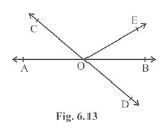
Q.1) In Fig. 6.13, lines AB and CD intersect at O. If ∠𝐴𝑂𝐶 + ∠𝐵𝑂𝐸 = 70° and ∠𝐵𝑂𝐷 = 40°, find ∠𝐵𝑂𝐸 and reflex ∠𝐶𝑂𝐸.
Sol.1) Given,
∠𝐴𝑂𝐶 + ∠𝐵𝑂𝐸 = 70° and ∠𝐵𝑂𝐷 = 40°
A/q,
∠𝐴𝑂𝐶 + ∠𝐵𝑂𝐸 + ∠𝐶𝑂𝐸 = 180° (Forms a straight line)
⇒ 70° + ∠𝐶𝑂𝐸 = 180°
⇒ ∠𝐶𝑂𝐸 = 110°
also,
∠𝐶𝑂𝐸 + ∠𝐵𝑂𝐷 + ∠𝐵𝑂𝐸 = 180° (Forms a straight line)
⇒ 110° + 40° + ∠𝐵𝑂𝐸 = 180°
⇒ 150° + ∠𝐵𝑂𝐸 = 180°
⇒ ∠𝐵𝑂𝐸 = 30°
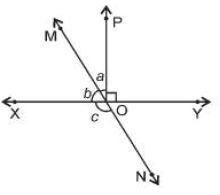
Q.2) In Fig., lines XY and MN intersect at O. If ∠𝑃𝑂𝑌 = 90° and 𝑎 ∶ 𝑏 = 2 ∶ 3, find 𝑐.
Sol.2) Given,
∠𝑃𝑂𝑌 = 90° and 𝑎 ∶ 𝑏 = 2 ∶ 3
A/q,
∠𝑃𝑂𝑌 + 𝑎 + 𝑏 = 180°
⇒ 90° + 𝑎 + 𝑏 = 180°
⇒ 𝑎 + 𝑏 = 90°
Let 𝑎 be 2𝑥 then will be 3𝑥
2𝑥 + 3𝑥 = 90°
⇒ 5𝑥 = 90°
⇒ 𝑥 = 18°
∴ 𝑎 = 2 × 18° = 36°
and 𝑏 = 3 × 18° = 54°
also,
𝑏 + 𝑐 = 180° (Linear Pair)
⇒ 54° + 𝑐 = 180°
⇒ 𝑐 = 126°
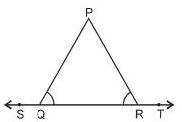
Q.3) In Fig., ∠𝑃𝑄𝑅 = ∠𝑃𝑅𝑄, then prove that ∠𝑃𝑄𝑆 = ∠𝑃𝑅𝑇.
Sol.3) Given,
∠𝑃𝑄𝑅 = ∠𝑃𝑅𝑄
To prove,
∠𝑃𝑄𝑆 = ∠𝑃𝑅𝑇
A/q,
∠𝑃𝑄𝑅 + ∠𝑃𝑄𝑆 = 180° (Linear Pair)
⇒ ∠𝑃𝑄𝑆 = 180° – ∠𝑃𝑄𝑅 ……..(i)
also,
∠𝑃𝑅𝑄 + ∠𝑃𝑅𝑇 = 180° (Linear Pair)
⇒ ∠𝑃𝑅𝑇 = 180° – ∠𝑃𝑅𝑄
⇒ ∠𝑃𝑅𝑄 = 180° – ∠𝑃𝑄𝑅 ……….(ii) (∠𝑃𝑄𝑅 = ∠𝑃𝑅𝑄)
From (i) and (ii)
∠𝑃𝑄𝑆 = ∠𝑃𝑅𝑇 = 180° – ∠𝑃𝑄𝑅
Therefore, ∠𝑃𝑄𝑆 = ∠𝑃𝑅𝑇
Hence, proved.
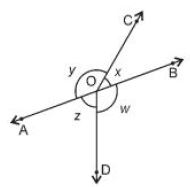
Q.4) In the figure, if 𝑥 + 𝑦 = 𝑤 + 𝑧, then prove that 𝐴𝑂𝐵 is a line.
Sol.4) Given,
𝑥 + 𝑦 = 𝑤 + 𝑧
To Prove,
𝐴𝑂𝐵 is a line or 𝑥 + 𝑦 = 180° (linear pair.)
A/q,
𝑥 + 𝑦 + 𝑤 + 𝑧 = 360° (Angles around a point.)
⇒ (𝑥 + 𝑦) + (𝑤 + 𝑧) = 360°
⇒ (𝑥 + 𝑦) + (𝑥 + 𝑦) = 360° (Given 𝑥 + 𝑦 = 𝑤 + 𝑧)
⇒ 2(𝑥 + 𝑦) = 360°
⇒ (𝑥 + 𝑦) = 180°
Hence, 𝑥 + 𝑦 makes a linear pair. Therefore, 𝐴𝑂𝐵 is a straight line.
Q.5) In the figure, POQ is a line. Ray OR is perpendicular to line PQ. OS is another ray lying between rays OP and OR. Prove that ∠𝑅𝑂𝑆 = 1/2 (∠𝑄𝑂𝑆 – ∠𝑃𝑂𝑆).
Sol.5) Given,
OR is perpendicular to line PQ
To prove,
∠𝑅𝑂𝑆 = 1/2
(∠𝑄𝑂𝑆 – ∠𝑃𝑂𝑆)
A/q,
∠𝑃𝑂𝑅 = ∠𝑅𝑂𝑄 = 90° (Perpendicular)
∠𝑄𝑂𝑆 = ∠𝑅𝑂𝑄 + ∠𝑅𝑂𝑆 = 90° + ∠𝑅𝑂𝑄 ………….. (i)
∠𝑃𝑂𝑆 = ∠𝑃𝑂𝑅 – ∠𝑅𝑂𝑆 = 90° – ∠𝑅𝑂𝑄 …………..(ii)
Subtracting (ii) from (i)
∠𝑄𝑂𝑆 – ∠𝑃𝑂𝑆 = 90° + ∠𝑅𝑂𝑄 – (90° – ∠𝑅𝑂𝑄)
⇒ ∠𝑄𝑂𝑆 – ∠𝑃𝑂𝑆 = 90° + ∠𝑅𝑂𝑄 – 90° + ∠𝑅𝑂𝑄
⇒ ∠𝑄𝑂𝑆 – ∠𝑃𝑂𝑆 = 2∠𝑅𝑂𝑄
⇒ ∠𝑅𝑂𝑆 = 1/2
(∠𝑄𝑂𝑆 – ∠𝑃𝑂𝑆)

Hence, Proved.
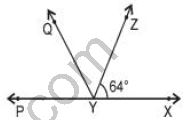
Q.6) It is given that ∠𝑋𝑌𝑍 = 64° and 𝑋𝑌 is produced to point P. Draw a figure from the given information. If ray 𝑌𝑄 bisects ∠ 𝑍𝑌𝑃, find ∠ 𝑋𝑌𝑄 and reflex ∠𝑄𝑌𝑃.
Sol.6) Given,
∠𝑋𝑌𝑍 = 64°
YQ bisects ∠𝑍𝑌𝑃
∠𝑋𝑌𝑍 + ∠𝑍𝑌𝑃 = 180° (Linear Pair)
⇒ 64° + ∠𝑍𝑌𝑃 = 180°
⇒ ∠𝑍𝑌𝑃 = 116°
also, ∠𝑍𝑌𝑃 = ∠𝑍𝑌𝑄 + ∠𝑄𝑌𝑃
∠𝑍𝑌𝑄 = ∠𝑄𝑌𝑃 (YQ bisects ∠ZYP)
⇒ ∠𝑍𝑌𝑃 = 2∠𝑍𝑌𝑄
⇒ 2∠𝑍𝑌𝑄 = 116°
⇒ ∠𝑍𝑌𝑄 = 58° = ∠𝑄𝑌𝑃
Now,
∠𝑋𝑌𝑄 = ∠𝑋𝑌𝑍 + ∠𝑍𝑌𝑄
⇒ ∠𝑋𝑌𝑄 = 64° + 58°
⇒ ∠𝑋𝑌𝑄 = 122°
also,
reflex ∠𝑄𝑌𝑃 = 180° + ∠𝑋𝑌𝑄
∠𝑄𝑌𝑃 = 180° + 122°
⇒ ∠𝑄𝑌𝑃 = 302°
Exercise 6.2
Q.1) In Fig., find the values of 𝑥 and 𝑦 and then show that 𝐴𝐵 || 𝐶𝐷.
Sol.1) In the given figure, a transversal intersects two lines AB and CD such that
𝑥 + 50° = 180° (Linear pair axiom)
⇒ 𝑥 = 180° – 50°
= 130°
𝑦 = 130° (Vertically opposite angles)
Therefore, ∠𝑥 = ∠𝑦 = 130° (Alternate angles)
∴ 𝐴𝐵 || 𝐶𝐷 (Converse of alternate angles axiom)

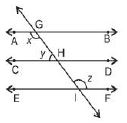
Q.2) In the figure, if 𝐴𝐵 || 𝐶𝐷, 𝐶𝐷 || 𝐸𝐹 and 𝑦 ∶ 𝑧 = 3 ∶ 7, find 𝑥.
Sol.2) In the given figure, 𝐴𝐵 || 𝐶𝐷, 𝐶𝐷 || 𝐸𝐹
and 𝑦 ∶ 𝑧 = 3 ∶ 7.
Let 𝑦 = 3𝑎 and 𝑧 = 7𝑎
∠𝐷𝐻𝐼 = 𝑦 (vertically opposite angles)
∠𝐷𝐻𝐼 + ∠𝐹𝐼𝐻 = 180° (Interior angles on the same side of the transversal)
⇒ 𝑦 + 𝑧 = 180°
⇒ 3𝑎 + 7𝑎 = 180°
⇒ 10𝑎 = 180° ⇒ 𝑎 = 18°
∴ 𝑦 = 3 × 18° = 54° and 𝑧 = 18° × 7 = 126°
Also, 𝑥 + 𝑦 = 180°
⇒ 𝑥 + 54° = 180°
∴ 𝑥 = 180° – 54° = 126°
Hence, 𝑥 = 126° Ans.
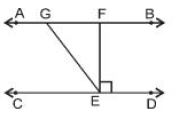
Q.3) In the figure, if 𝐴𝐵 || 𝐶𝐷, 𝐸𝐹 ⊥ 𝐶𝐷 and ∠𝐺𝐸𝐷 = 126°. Find ∠ 𝐴𝐺𝐸, ∠𝐺𝐸𝐹 and ∠𝐹𝐺𝐸.
Sol.3) In the given figure, 𝐴𝐵 || 𝐶𝐷, 𝐸𝐹 ⊥ 𝐶𝐷
and ∠𝐺𝐸𝐷 = 126°
∠𝐴𝐺𝐸 = ∠𝐿𝐺𝐸 (Alternate angle)
∴ ∠𝐴𝐺𝐸 = 126°
Now, ∠𝐺𝐸𝐹 = ∠𝐺𝐸𝐷 – ∠𝐷𝐸𝐹
= 126° – 90° = 36° (∵ ∠𝐷𝐸𝐹 = 90°)
Also, ∠𝐴𝐺𝐸 + ∠𝐹𝐺𝐸 = 180° (Linear pair axiom)
⇒126° + 𝐹𝐺𝐸 = 180°
⇒ ∠𝐹𝐺𝐸 = 180° – 126° = 54°
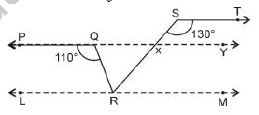
Q.4) In the figure, if 𝑃𝑄 || 𝑆𝑇, ∠𝑃𝑄𝑅 = 110° and ∠ 𝑅𝑆𝑇 = 130°, find ∠𝑄𝑅𝑆.
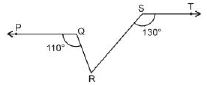
Sol.4) Extend PQ to Y and draw 𝐿𝑀 || 𝑆𝑇 through 𝑅.
∠𝑇𝑆𝑋 = ∠𝑄𝑋𝑆 [Alternate angles]
⇒ ∠𝑄𝑋𝑆 = 130°
∠𝑄𝑋𝑆 + ∠𝑅𝑋𝑄 = 180° [Linear pair axiom]
⇒ ∠𝑅𝑋𝑄 = 180° – 130° = 50° .. . (1)
∠𝑃𝑄𝑅 = ∠𝑄𝑅𝑀 [Alternate angles]
⇒ ∠𝑄𝑅𝑀 = 110° .. . (2)
∠𝑅𝑋𝑄 = ∠𝑋𝑅𝑀 [Alternate angles]
⇒ ∠𝑋𝑅𝑀 = 50° [By (1)]
∠𝑄𝑅𝑆 = ∠𝑄𝑅𝑀 – ∠𝑋𝑅𝑀
= 110° – 50° = 60° Ans.
Q.5) In the figure, if 𝐴𝐵 || 𝐶𝐷, ∠𝐴𝑃𝑄 = 50° and ∠𝑃𝑅𝐷 = 127°, find 𝑥 and 𝑦.
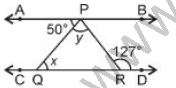
Sol.5) In the given figure, 𝐴𝐵 || 𝐶𝐷, ∠𝐴𝑃𝑄 = 50°
and ∠𝑃𝑅𝐷 = 127°
∠𝐴𝑃𝑄 + ∠𝑃𝑄𝐶 = 180° [Pair of consecutive interior angles are supplementary]
⇒ 50° + ∠𝑃𝑄𝐶 = 180°
⇒ ∠𝑃𝑄𝐶 = 180° – 50° = 130°
Now, ∠𝑃𝑄𝐶 + ∠𝑃𝑄𝑅 = 180° [Linear pair axiom]
⇒ 130° + 𝑥 = 180°
⇒ 𝑥 = 180° – 130° = 50°
Also, 𝑥 + 𝑦 = 127° [Exterior angle of a triangle is equal to the sum of the two interior opposite angles]
⇒ 50° + 𝑦 = 127°
⇒ 𝑦 = 127° – 50° = 77°
Hence, 𝑥 = 50° and 𝑦 = 77° Ans.
Q.6) In the figure, PQ and RS are two mirrors placed parallel to each other. An incident ray AB strikes the mirror PQ at B, the reflected ray moves along the path BC and strikes the mirror RS at C and again reflects back along CD. Prove that AB || CD.
Sol.6) At point B, draw 𝐵𝐸 ⊥ 𝑃𝑄 and at point C, draw
𝐶𝐹 ⊥ 𝑅𝑆
∠1 = ∠2 ...(i) (Angle of incidence is equal to angle of reflection)
∠3 = ∠4 ...(ii) [Same reason]
Also, ∠2 = ∠3 ... (iii) [Alternate angles]
⇒ ∠1 = ∠4 [From (i), (ii), and (iii)]
⇒ 2∠1 = 2∠4
⇒ ∠1 + ∠1 = ∠4 + ∠4
⇒ ∠1 + ∠2 = ∠3 + ∠4 [From (i) and (ii)]
⇒ ∠𝐵𝐶𝐷 = ∠𝐴𝐵𝐶
Hence, 𝐴𝐵 || 𝐶𝐷. [Alternate angles are equal] Proved.
Exercise 6.3
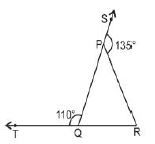
Q.1) In the figure, sides 𝑄𝑃 and 𝑅𝑄 of Δ 𝑃𝑄𝑅 are produced to points S and T respectively. If ∠𝑆𝑃𝑅 = 135° and ∠𝑃𝑄𝑇 = 110°, find ∠𝑃𝑅𝑄.
Sol.1) In the given figure, ∠𝑆𝑃𝑅 = 135° and ∠𝑃𝑄𝑇 = 110°.
∠𝑃𝑄𝑇 + ∠𝑃𝑄𝑅 = 180° [Linear pair axiom]
⇒ 110° + ∠𝑃𝑄𝑅 = 180°
⇒ ∠𝑃𝑄𝑅 = 180° – 110° = 70°
Also, ∠𝑆𝑃𝑅 + ∠𝑄𝑃𝑅 = 180° [Linear pair axiom]
⇒ 135° + ∠𝑄𝑃𝑅 = 180°
⇒ ∠𝑄𝑃𝑆 = 180° – 135° = 45°
Now, in the triangle 𝑃𝑄𝑅
∠𝑃𝑄𝑅 + ∠𝑃𝑅𝑄 + ∠𝑄𝑃𝑅 = 180° [Angle sum property of a triangle]
⇒ 70° + ∠𝑃𝑅𝑄 + 45° = 180°
⇒ ∠𝑃𝑅𝑄 + 115° = 180°
⇒ ∠𝑃𝑅𝑄 = 180° – 115° = 65°
Hence, ∠ 𝑃𝑅𝑄 = 65° Ans.
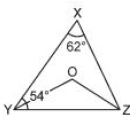
Q.2) In the figure, ∠ 𝑋 = 62°, ∠ 𝑋𝑌𝑍 = 54°. If YO and ZO are the bisectors of ∠ 𝑋𝑌𝑍 and ∠ 𝑋𝑍𝑌 respectively of Δ 𝑋𝑌𝑍, find ∠𝑂𝑍𝑌 and ∠𝑌𝑂𝑍.
Sol.2) In the given figure,
∠𝑋 = 62° and ∠𝑋𝑌𝑍 = 54°.
∠𝑋𝑌𝑍 + ∠𝑋𝑍𝑌 + ∠𝑌𝑋𝑍 = 180° ...(i) [Angle sum property of a triangle]
⇒ 54° + ∠𝑋𝑍𝑌 + 62° = 180°
⇒ ∠𝑋𝑍𝑌 + 116° = 180°
⇒ ∠𝑋𝑍𝑌 = 180° – 116° = 64°
Now, ∠𝑂𝑍𝑌 = 1/2 × ∠𝑋𝑍𝑌 [ZO is bisector of ∠𝑋𝑍𝑌]
= 1/2 × 64° = 32°
Similarly, ∠𝑂𝑌𝑍 = 1/2
× 54° = 27°
Now, in Δ𝑂𝑌𝑍, we have
∠𝑂𝑌𝑍 + ∠𝑂𝑍𝑌 + ∠𝑌𝑂𝑍 = 180° [Angle sum property of a triangle]
⇒ 27° + 32° + ∠𝑌𝑂𝑍 = 180°
⇒ ∠𝑌𝑂𝑍 = 180° – 59° = 121°
Hence, ∠𝑂𝑍𝑌 = 32° and ∠𝑌𝑂𝑍 = 121° Ans.
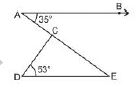
Q.3) In the figure, if 𝐴𝐵 || 𝐷𝐸, ∠ 𝐵𝐴𝐶 = 35° and ∠𝐶𝐷𝐸 = 53°, find ∠ 𝐷𝐶𝐸.
Sol.3) In the given figure
∠𝐵𝐴𝐶 = ∠𝐶𝐸𝐷 [Alternate angles]
⇒ ∠𝐶𝐸𝐷 = 35°
In Δ𝐶𝐷𝐸,
∠𝐶𝐷𝐸 + ∠𝐷𝐶𝐸 + ∠𝐶𝐸𝐷 = 180° [Angle sum property of a triangle]
⇒ 53° + ∠𝐷𝐶𝐸 + 35° = 180°
⇒ ∠𝐷𝐶𝐸 + 88° = 180°
⇒ ∠𝐷𝐶𝐸 = 180° – 88° = 92°
Hence, ∠𝐷𝐶𝐸 = 92° Ans.
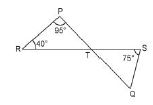
Q.4) In the figure, if lines PQ and RS intersect at point T, such that ∠ 𝑃𝑅𝑇 = 40°, ∠ 𝑅𝑃𝑇 = 95° and ∠𝑇𝑆𝑄 = 75°, find ∠𝑆𝑄𝑇.
Sol.4) In the given figure, lines PQ and RS intersect at point T, such that ∠𝑃𝑅𝑇 = 40°,
∠𝑅𝑃𝑇 = 95° and ∠𝑇𝑆𝑄 = 75°.
In Δ𝑃𝑅𝑇,
∠𝑃𝑅𝑇 + ∠𝑅𝑃𝑇 + ∠𝑃𝑇𝑅 = 180° [Angle sum property of a triangle]
⇒ 40° + 95° + ∠𝑃𝑇𝑅 = 180°
⇒ 135° + ∠𝑃𝑇𝑅 = 180°
⇒ ∠𝑃𝑇𝑅 = 180° – 135° = 45°
Also, ∠𝑃𝑇𝑅 = ∠𝑆𝑇𝑄 [Vertical opposite angles]
∴ ∠𝑆𝑇𝑄 = 45°
Now, in Δ𝑆𝑇𝑄,
∠𝑆𝑇𝑄 + ∠𝑇𝑆𝑄 + ∠𝑆𝑄𝑇 = 180° [Angle sum property of a triangle]
⇒ 45° + 75° + ∠𝑆𝑄𝑇 = 180°
⇒ 120° + ∠𝑆𝑄𝑇 = 180°
⇒ ∠𝑆𝑄𝑇 = 180° – 120° = 60°
Hence, ∠𝑆𝑄𝑇 = 60° Ans.
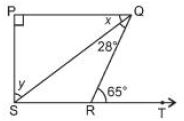
Q.5) In the figure, if 𝑃𝑇 ⊥ 𝑃𝑆, 𝑃𝑄 || 𝑆𝑅, ∠𝑆𝑄𝑅 = 28° and ∠𝑄𝑅𝑇 = 65°, then find the values of 𝑥 and 𝑦.
Sol.5) In the given figure,
lines 𝑃𝑄 ⊥ 𝑃𝑆, 𝑃𝑄||𝑆𝑅, ∠𝑆𝑄𝑅 = 28° and ∠𝑄𝑅𝑇 = 65°
∠𝑃𝑄𝑅 = ∠𝑄𝑅𝑇 [Alternate angles]
⇒ 𝑥 + 28° = 65°
⇒ 𝑥 = 65° – 28° = 37°
In Δ𝑃𝑄𝑆,
∠𝑆𝑃𝑄 + ∠𝑃𝑄𝑆 + ∠𝑄𝑆𝑃 = 180° [Angle sum property of a triangle]
⇒ 90° + 37° + 𝑦 = 180° [∵PQ ⊥ PS, ∠PQS = x = 37° and ∠QSP = y)
⇒ 127° + 𝑦 = 180°
⇒ 𝑦 = 180° – 127° = 53°
Hence, 𝑥 = 37° and 𝑦 = 53° Ans.
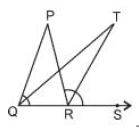
Q.6) In the figure, the side QR of Δ𝑃𝑄𝑅 is produced to a point S. If the bisectors of ∠ 𝑃𝑄𝑅 and ∠ 𝑃𝑅𝑆 meet at point T, then prove that ∠𝑄𝑇𝑅 = 1/2
∠𝑄𝑃𝑅.
Sol.6) Exterior ∠PRS = ∠PQR + ∠QPR [Exterior angle property]
Therefore, 1/2 ∠𝑃𝑅𝑆 = 1/2 ∠𝑃𝑄𝑅 + 1/2 ∠𝑄𝑃𝑅
⇒ ∠𝑇𝑅𝑆 = ∠𝑇𝑄𝑅 + (1/2) ∠𝑄𝑃𝑅
But in Δ𝑄𝑇𝑅,
Exterior ∠𝑇𝑅𝑆 = ∠𝑇𝑄𝑅 + ∠𝑄𝑇𝑅 ...(ii) [Exterior angles property]
Therefore, from (i) and (ii)
∠𝑇𝑄𝑅 + ∠𝑄𝑇𝑅 = ∠𝑇𝑄𝑅 + 1/2, ∠𝑄𝑃𝑅
⇒ ∠𝑄𝑇𝑅 = 1/2 ∠𝑄𝑃𝑅 proved.
Free study material for Mathematics
Free NCERT Textbook Explanations: Class 9 Mathematics Chapter 06 Lines and Angles Variables
Accessing Chapter 06 Lines and Angles Variables Solutions
Explore reliable textbook solutions for Chapter 06 Lines and Angles Variables tailored for Class 9 learners. Utilizing these complete exercise answers ensures your preparation aligns exactly with official NCERT standards for Mathematics.
Concept-Driven Answers for Class 9 Mathematics
Beyond providing final answers, these guides offer step-by-step breakdowns for complex queries in the Class 9 Mathematics module. This approach helps students balance theoretical depth with practical problem-solving skills required for NCERT exams.
Maximizing Study Efficiency
These resources act as an effective roadmap for daily homework tasks and independent study. Supplement your review of Chapter 06 Lines and Angles Variables with official sample papers and interactive practice tests available on our platform free of charge.
FAQs
The complete and updated NCERT Solutions Class 9 Mathematics Chapter 6 Lines and Angles Variables is available for free on StudiesToday.com. These solutions for Class 9 Mathematics are as per latest NCERT curriculum.
Yes, our experts have revised the NCERT Solutions Class 9 Mathematics Chapter 6 Lines and Angles Variables as per 2026 exam pattern. All textbook exercises have been solved and have added explanation about how the Mathematics concepts are applied in case-study and assertion-reasoning questions.
Toppers recommend using NCERT language because NCERT marking schemes are strictly based on textbook definitions. Our NCERT Solutions Class 9 Mathematics Chapter 6 Lines and Angles Variables will help students to get full marks in the theory paper.
Yes, we provide bilingual support for Class 9 Mathematics. You can access NCERT Solutions Class 9 Mathematics Chapter 6 Lines and Angles Variables in both English and Hindi medium.
Yes, you can download the entire NCERT Solutions Class 9 Mathematics Chapter 6 Lines and Angles Variables in printable PDF format for offline study on any device.