

NCERT Solutions for Class 9 Mathematics: Chapter 15 Probability
Access comprehensive textbook solutions for Chapter 15 Probability using the official curriculum guides for Class 9 Mathematics. Designed to align with the 2026-27 NCERT standards, these detailed answers help students reinforce core academic concepts.
Practice Class 9 Mathematics Solutions: Chapter 15 Probability
View or download the dedicated Chapter 15 Probability solution resource below. Engaging with these textbook answers under focused study conditions ensures continuous academic progress and mastery of the 2026-27 curriculum for Mathematics.
Exercise 15.1
Q.1) In a cricket match, a batswoman hits a boundary 6 times out of 30 balls she plays. Find the probability that she did not hit a boundary.
Sol.1) Let 𝐸 be the event of hitting the boundary
Then 𝑃(𝐸) = 𝑁𝑢𝑚𝑏𝑒𝑟 𝑜𝑓 𝑡ℎ𝑒 𝑡𝑖𝑚𝑒𝑠 𝑏𝑎𝑡𝑤𝑜𝑚𝑎𝑛 ℎ𝑖𝑡𝑠 𝑡ℎ𝑒 𝑏𝑜𝑢𝑛𝑑𝑎𝑟𝑦/𝑇𝑜𝑡𝑎𝑙 𝑛𝑜.𝑜𝑓 𝑏𝑎𝑙𝑙𝑠 𝑠ℎ𝑒 𝑝𝑙𝑎𝑦𝑠
= 6/30 = 1/5 = 0.2
∴ probability of not hitting the boundary = 1 −probablity of hitting the boundary
= 1 − 0.2 = 0.8
Q.2) 1500 families with 2 children were selected randomly, and the following data were recorded:

Compute the probability of a family, chosen at random, having
(i) 2 girls (ii) 1 girl (iii) No girl
Also check whether the sum of these probabilities is 1.
Sol.2) Total numbers of families = 1500
(i) Numbers of families having 2 girls = 475
Probability = Numbers of families having 2 girls/Total numbers of families
= 475/1500
= 19/60
(ii) Numbers of families having 1 girls = 814
Probability = Numbers of families having 1 girls/Total numbers of families
= 814/1500
= 407/750
(iii) Numbers of families having 2 girls = 211
Probability = Numbers of families having 0 girls/Total numbers of families
= 211/1500
Sum of the probability = 19/60 + 407/750 + 211/1500
= 475 + 814 + 211/1500 = 1500/1500 = 1
Yes, the sum of these probabilities is 1.
Q.3) Refer to Example 5, Section 14.4, Chapter 14. Find the probability that a student of the class was born in August.
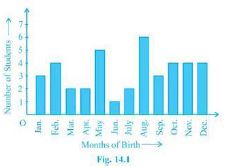
Sol.3) Total numbers of students = 40
Numbers of students = 6
Required probability = 6/40 = 3/20
Q.4) Three coins are tossed simultaneously 200 times with the following frequencies of different outcomes:

If the three coins are simultaneously tossed again, compute the probability of 2 heads coming up.
Sol.4) Number of times 2 heads come up = 72
Total number of times the coins were tossed = 200
Required probability = 72/200 = 9/25
Q.5) An organization selected 2400 families at random and surveyed them to determine a relationship between income level and the number of vehicles in a family. The information gathered is listed in the table below:
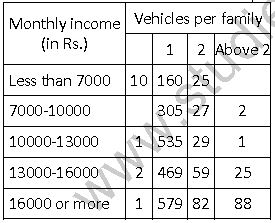
Suppose a family is chosen. Find the probability that the family chosen is
(i) earning Rs.10000 – 13000 per month and owning exactly 2 vehicles.
(ii) earning Rs.16000 or more per month and owning exactly 1 vehicle.
(iii) earning less than Rs.7000 per month and does not own any vehicle.
(iv) earning Rs.13000 – 16000 per month and owning more than 2 vehicles.
(v) owning not more than 1 vehicle.
Sol.5) Total numbers of families = 2400
(i) Numbers of families earning 𝑅𝑠. 10000 – 13000 per month and owning exactly 2 vehicles = 29
Required probability = 29/2400
(ii) Number of families earning Rs.16000 or more per month and owning exactly 1 vehicle = 579
Required probability = 579/2400
(iii) Number of families earning less than Rs.7000 per month and does not own any vehicle = 10
Required probability = 10/2400 = 1/240
(iv) Number of families earning Rs.13000-16000 per month and owning more than 2 vehicles = 25
Required probability = 25/2400 = 1/96
(v) Number of families owning not more than 1 vehicle = 10 + 160 + 0 + 305 + 1 + 535 +
2 + 469 + 1 + 579 = 2062
Required probability = 2062/2400 = 1031/1200
Q.6) Following table shows the performance of two sections of students in mathematics test of 100 marks.

(i) Find the probability that a student obtained less than 20% in the mathematics test.
(ii) Find the probability that a student obtained marks 60 or above.
Sol.6) Total numbers of students = 90
(i) Numbers of students obtained less than 20% in the mathematics test = 7
Required probability = 7/90
(ii) Numbers of student obtained marks 60 or above = 15 + 8 = 23
Required probability = 23/90
Q.7) To know the opinion of the students about the subject statistics, a survey of 200 students was conducted. The data is recorded in the following table.
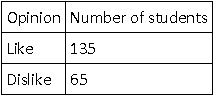
Find the probability that a student chosen at random
(i) likes statistics, (ii) does not like it.
Sol.7) Total numbers of students = 135 + 65 = 200
(i) Numbers of students who like statistics = 135
Required probability = 135/200 = 27/40
(ii) Numbers of students who does not like statistics = 65
Required probability = 65/200 = 13/40
Q.8) The distance (in km) of 40 engineers from their residence to their place of work were found as follows :
5 3 10 2 25 11 13 7 12 31
19 10 12 17 18 11 32 17 16 2
7 9 7 8 3 5 12 15 18 3
12 14 2 9 6 15 15 7 6 12
What is the empirical probability that an engineer lives:
(i) less than 7 km from her place of work?
(ii) more than or equal to 7 km from her place of work?
(iii) within 1/2 km from her place of work?
Sol.8) Total numbers of engineers = 40
(i) Numbers of engineers living less than 7 km from her place of work = 9
Required probability = 9/40
(ii) Numbers of engineers living less than 7 km from her place of work = 40 – 9 = 31
Required probability = 31/40
(iii) Numbers of engineers living less than 7 km from her place of work = 0
Required probability = 0/40 = 0
Q.11) Eleven bags of wheat flour, each marked 5 kg, actually contained the following weights of flour (in kg) :
4.97 5.05 5.08 5.03 5.00 5.06 5.08 4.98 5.04 5.07 5.00
Find the probability that any of these bags chosen at random contains more than 5 kg of flour.
Sol.11) Total no. of bags examined = 11
P (a bag weighing more than 5 kg) = No. of bags which weigh more than 5 kg/Total no. of bags
= 7/11
Q.12) A study was conducted to find out the concentration of sulphur dioxide in the air parts per million (ppm) of a certain city. The data obtained for 30 days is as follows :
0.03 0.08 0.08 0.09 0.04 0.17
0.16 0.05 0.02 0.06 0.18 0.20
0.11 0.08 0.12 0.13 0.22 0.07
0.08 0.01 0.10 0.06 0.09 0.18
0.11 0.07 0.05 0.07 0.01 0.04
Using this table, find the probability of the concentration of sulphur dioxide in the interval
0.12-0.16 on any of these days.
Sol.12) Total numbers of days data recorded = 30 days
Numbers of days in which sulphur dioxide in the interval 0.12 − 0.16 = 2
Required probability = 2/30 = 1/15
Q.13) The blood groups of 30 students of class VIII are recorded as follows:
A, B, O, O, AB, O, A, O, B, A, O, B, A, O, O, A, AB, O, A, A, O, O, AB, B, A, O, B, A, B, O
Use this table to determine the probability that a student of this class, selected at random, has blood group AB.
Sol.13) Total numbers of students = 30
Numbers of students having blood group AB = 3
Required probability = 3/30 = 1/10
Free study material for Mathematics
NCERT Solutions for Class 9 Mathematics Chapter 15 Probability
Accessing Chapter 15 Probability Solutions
Review comprehensive exercise answers for Class 9 Mathematics Chapter 15 Probability. Fully updated to match current NCERT syllabus guidelines, these textbook solutions help students verify their work and maintain accurate study notes.
Concept-Driven Answers for Class 9 Mathematics
Clear, methodical explanations accompany every challenging problem within the Class 9 Mathematics text. Engaging with these detailed answers lays a solid foundation for advanced learning and improves foundational clarity for upcoming assessments.
Maximizing Study Efficiency
These resources act as an effective roadmap for daily homework tasks and independent study. Supplement your review of Chapter 15 Probability with official sample papers and interactive practice tests available on our platform free of charge.
FAQs
The complete and updated NCERT Solutions Class 9 Mathematics Chapter 15 Probability is available for free on StudiesToday.com. These solutions for Class 9 Mathematics are as per latest NCERT curriculum.
Yes, our experts have revised the NCERT Solutions Class 9 Mathematics Chapter 15 Probability as per 2026 exam pattern. All textbook exercises have been solved and have added explanation about how the Mathematics concepts are applied in case-study and assertion-reasoning questions.
Toppers recommend using NCERT language because NCERT marking schemes are strictly based on textbook definitions. Our NCERT Solutions Class 9 Mathematics Chapter 15 Probability will help students to get full marks in the theory paper.
Yes, we provide bilingual support for Class 9 Mathematics. You can access NCERT Solutions Class 9 Mathematics Chapter 15 Probability in both English and Hindi medium.
Yes, you can download the entire NCERT Solutions Class 9 Mathematics Chapter 15 Probability in printable PDF format for offline study on any device.