

Official NCERT Solutions for Class 9 Mathematics: Chapter 04 Linear Equations In Two Variables
Review structured textbook solutions for Class 9 Mathematics Chapter 04 Linear Equations In Two Variables. Built according to NCERT guidelines for the 2026-27 academic year, these downloadable answers support daily revision and problem-solving accuracy.
Chapter-wise Solutions for Mathematics: Chapter 04 Linear Equations In Two Variables
Navigate directly to the solved Mathematics textbook exercises using the digital viewer below. Each solution includes detailed step-by-step explanations, allowing students to instantly cross-check their work and identify areas requiring further revision.
Exercise 4.1
Q.1) The cost of a notebook is twice the cost of a pen. Write a linear equation in two variables to represent this statement.
Sol.1) Cost of a notebook = 𝑥
Cost of a pen = 𝑦
Then according to the given statement
𝑥 = 2𝑦 or 𝑥 − 2𝑦 = 0
Q.2) Express the following linear equations in the form 𝑎𝑥 + 𝑏𝑦 + 𝑐 = 0 and indicate the values of 𝑎, 𝑏 and 𝑐 in each case :
(i) 2𝑥 + 3𝑦 = 9.35̅
(ii) 𝑥 −(𝑦/5)− 10 = 0 (iii) −2𝑥 + 3𝑦 = 6 (iv) 𝑥 = 3𝑦
(v) 2𝑥 = −5𝑦 (vi) 3x + 2 = 0 (vii) 𝑦 − 2 = 0 (viii) 5 = 2𝑥
Sol.2) (i) 2𝑥 + 3𝑦 = 9.35̅
⇒ 2𝑥 + 3𝑦 − 9.35̅ = 0
On comparing this equation with 𝑎𝑥 + 𝑏𝑦 + 𝑐 = 0, we get
𝑎 = 2𝑥, 𝑏 = 3 and 𝑐 = −9.35̅
(ii) 𝑥 − 𝑦/5 − 10 = 0
On comparing this equation with 𝑎𝑥 + 𝑏𝑦 + 𝑐 = 0, we get
𝑎 = 1, 𝑏 = − 1/5 and 𝑐 = −10
(iii) −2𝑥 + 3𝑦 = 6
⇒ −2𝑥 + 3𝑦 − 6 = 0
On comparing this equation with 𝑎𝑥 + 𝑏𝑦 + 𝑐 = 0, we get
𝑎 = −2, 𝑏 = 3 and 𝑐 = −6
(iv) 𝑥 = 3𝑦 ⇒ 𝑥 − 3𝑦 = 0
On comparing this equation with 𝑎𝑥 + 𝑏𝑦 + 𝑐 = 0, we get
𝑎 = 1, 𝑏 = −3 and 𝑐 = 0
(v) 2𝑥 = −5𝑦
⇒ 2𝑥 + 5𝑦 = 0
On comparing this equation with 𝑎𝑥 + 𝑏𝑦 + 𝑐 = 0, we get
𝑎 = 2, 𝑏 = 5 and 𝑐 = 0
(vi) 3𝑥 + 2 = 0 ⇒ 3𝑥 + 0𝑦 + 2 = 0
On comparing this equation with 𝑎𝑥 + 𝑏𝑦 + 𝑐 = 0, we get
𝑎 = 3, 𝑏 = 0 and 𝑐 = 2
(vii) 𝑦 − 2 = 0 ⇒ 0𝑥 + 𝑦 − 2 = 0
On comparing this equation with 𝑎𝑥 + 𝑏𝑦 + 𝑐 = 0, we get
𝑎 = 0, 𝑏 = 1 and 𝑐 = −2
(viii) 5 = 2𝑥 ⇒ −2𝑥 + 0𝑦 + 5 = 0
On comparing this equation with 𝑎𝑥 + 𝑏𝑦 + 𝑐 = 0, we get
𝑎 = −2, 𝑏 = 0 and 𝑐 = 5
Exercise 4.2
Q.1) Which one of the following options is true, and why? 𝑦 = 3𝑥 + 5 has
(i) a unique solution,
(ii) only two solutions,
(iii) infinitely many solutions
Sol.1) We need to the number of solutions of the linear equation 𝑦 = 3𝑥 + 5.
We know that any linear equation has infinitely many solutions.
Justification:
If 𝑥 = 0 then 𝑦 = 3 × 0 + 5 = 5
If 𝑥 = 1 then 𝑦 = 3 × 1 + 5 = 8
If 𝑥 = −2 then 𝑦 = 3 × (−2) + 5 = −1
Similarly, we can find infinite many solutions by putting the values of 𝑥.
Q.2) Write four solutions for each of the following equations:
(i) 2𝑥 + 𝑦 = 7
(ii) 𝜋𝑥 + 𝑦 = 9
(iii) 𝑥 = 4𝑦
Sol.2) We know that any linear equation has infinitely many solutions.
Let us put 𝑥 = 0 in the linear equation 2𝑥 + 𝑦 = 7, to get
2(0) + 𝑦 = 7 ⇒ 𝑦 = 7
Thus, we get first pair of solution as (0,7).
Let us put 𝑥 = 2 in the linear equation 2𝑥 + 𝑦 = 7, , to get
2(2) + 𝑦 = 7 ⇒ 𝑦 + 4 = 7 ⇒ 𝑦 = 3
Thus, we get second pair of solution as (2,3) .
Let us put 𝑥 = 4, in the linear equation 2𝑥 + 𝑦 = 7, to get
2(4) + 𝑦 = 7 ⇒ 𝑦 + 8 = 7 ⇒ 𝑦 = −1
Thus, we get third pair of solution as (4, -1).
Let us put 𝑥 = 6 in the linear equation 2𝑥 + 𝑦 = 7 , to get
2(6) + 𝑦 = 7 ⇒ 𝑦 + 12 = 7 ⇒ 𝑦 = −5
Thus, we get fourth pair of solution as (6, −5).
Therefore, we can conclude that four solutions for the linear equation 2𝑥 + 𝑦 = 7 are
(0,7) , (2,3), (4, -1) & (6, -5).
(ii) 𝜋𝑥 + 𝑦 = 9
We know that any linear equation has infinitely many solutions.
Let us put 𝑥 = 0in the linear equation 𝜋𝑥 + 𝑦 = 9, to get
𝜋(0) + 𝑦 = 9 ⇒ 𝑦 = 9
Thus, we get first pair of solution as (0,9)
Let us put 𝑦 = 0 in the linear equation 𝜋𝑥 + 𝑦 = 9, to get
𝜋𝑥 + (0) = 9 ⇒ 𝑥 = 9/𝜋
Thus, we get second pair of solution as (9/𝜋, 0).
Let us put 𝑥 = 1 in the linear equation 𝜋𝑥 + 𝑦 = 9, to get
𝜋𝑥 + (1) = 9 ⇒ 𝑦 = 9/𝜋
Thus, we get third pair of solution as (1, 9/𝜋).
Let us put 𝑦 = 2 in the linear equation 𝜋𝑥 + 𝑦 = 9, to get
𝜋𝑥 + (2) = 9 ⇒ 𝜋𝑥 = 7 ⇒ 7/𝜋
Thus, we get fourth pair of solution as (7/𝜋, 2).
Therefore, we can conclude that four solutions for the linear equation 𝜋𝑥 + 𝑦 = 9 are
(0, 9), (9/𝜋, 0) , (1,9/𝜋) & (7/𝜋, 2).
(iii) 𝑥 = 4𝑦
We know that any linear equation has infinitely many solutions.
Let us put 𝑦 = 0 in the linear equation 𝑥 = 4𝑦 , to get
𝑥 = 4(0) ⇒ 𝑥 = 0
Thus, we get first pair of solution as (0,0).
Let us put 𝑦 = 2 in the linear equation 𝑥 = 4𝑦 , to get
𝑥 = 4(2) ⇒ 𝑥 = 8
Thus, we get second pair of solution as(8,2).
Let us put 𝑦 = 4 in the linear equation 𝑥 = 4𝑦 , to get
𝑥 = 4(4) ⇒ 𝑥 = 16
Thus, we get third pair of solution as (16,4).
Let us put 𝑦 = 6 n the linear equation 𝑥 = 4𝑦, to get
𝑥 = 4(6) ⇒ 𝑥 = 24
Thus, we get fourth pair of solution as(24,6).
Therefore, we can conclude that four solutions for the linear equation 𝑥 = 4𝑦 are
(0,0), (8,2), (16,4) & (24,6).
Q.3) Check which of the following are solutions of the equation 𝑥 − 2𝑦 = 4 and which are not:
(i) (0, 2) (ii) (2, 0) (iii) (4, 0) (iv) (√2, 4√2) (v) (1, 1)
Sol.3) (i) Put 𝑥 = 0 and 𝑦 = 2 in the equation
𝑥 − 2𝑦 = 4. 0 − 2 × 2 = 4
⇒ −4 ≠ 4
∴ (0, 2) is not a solution of the given equation.
(ii) Put 𝑥 = 2 and 𝑦 = 0 in the equation
𝑥 − 2𝑦 = 4. 2 − 2 × 0 = 4
⇒ 2 ≠ 4
∴ (2, 0) is not a solution of the given equation.
(iii) Put 𝑥 = 4 and 𝑦 = 0 in the equation
𝑥 − 2𝑦 = 4. 4 − 2 × 0 = 4
⇒ 4 = 4
∴ (4, 0) is a solution of the given equation.
(iv) Put 𝑥 = √2 and 𝑦 = 4√2 in the equation
𝑥 − 2𝑦 = 4. √2 − 2 × 4√2 = 4
⇒ √2 − 8√2 = 4
⇒ √2(1 − 8) = 4
⇒ −7√2 ≠ 4
∴ (√2, 4√2) is not a solution of the given equation.
(v) Put 𝑥 = 1 and 𝑦 = 1 in the equation
𝑥 − 2𝑦 = 4.
1 − 2 × 1 = 4 ⇒ −1 ≠ 4
∴ (1, 1) is not a solution of the given equation
Q.4) Find the value of 𝑘, if 𝑥 = 2, 𝑦 = 1 is a solution of the equation 2𝑥 + 3𝑦 = 𝑘.
Sol.4) Given equation = 2𝑥 + 3𝑦 = 𝑘 𝑥 = 2,
𝑦 = 1 is the solution of the given equation.
A/q,
Putting the value of x and y in the equation, we get
2 × 2 + 3 × 1 = 𝑘
⇒ 𝑘 = 4 + 3 ⇒ 𝑘 = 7
Exercise 4.3
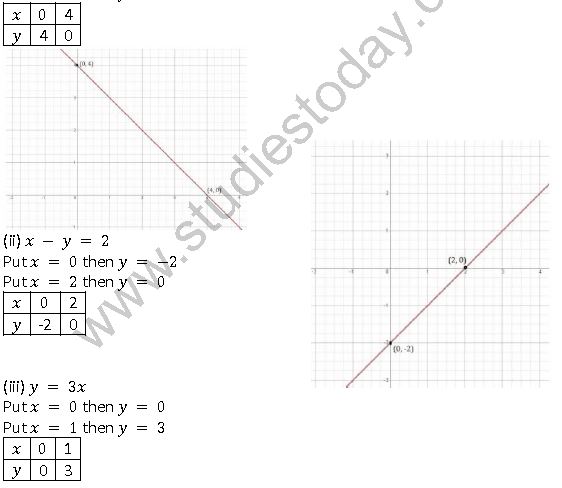
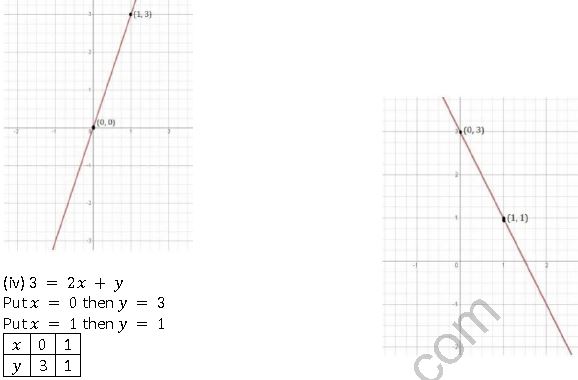
Q.1) Draw the graph of each of the following linear equations in two variables:
(i) 𝑥 + 𝑦 = 4 (ii) 𝑥 – 𝑦 = 2 (iii) 𝑦 = 3𝑥 (iv) 3 = 2𝑥 + 𝑦
Sol.1) (i) 𝑥 + 𝑦 = 4
Put 𝑥 = 0 then 𝑦 = 4
Put 𝑥 = 4 then 𝑦 = 0
Q.2) Give the equations of two lines passing through (2, 14). How many more such lines are there, and why?
Sol.2) Here, 𝑥 = 2 and 𝑦 = 14.
Thus, 𝑥 + 𝑦 = 1 also,
𝑦 = 7𝑥 ⇒ 𝑦 − 7𝑥 = 0
∴ The equations of two lines passing through (2, 14) are 𝑥 + 𝑦 = 1 and 𝑦 − 7𝑥 = 0.
There will be infinite such lines because infinite number of lines can pass through a given point.
Q.3) If the point (3, 4) lies on the graph of the equation 3𝑦 = 𝑎𝑥 + 7, find the value of 𝑎.
Sol.3) The point (3, 4) lies on the graph of the equation.
∴ Putting 𝑥 = 3 and 𝑦 = 4 in the equation 3𝑦 = 𝑎𝑥 + 7, we get
3 × 4 = 𝑎 × 3 + 7
⇒ 12 = 3𝑎 + 7
⇒ 3𝑎 = 12 − 7
⇒ 𝑎 = 5/3
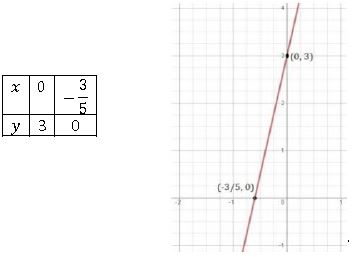
Q.4) The taxi fare in a city is as follows: For the first kilometre, the fare is Rs 8 and for the subsequent distance it is Rs 5 per km. Taking the distance covered as 𝑥 𝑘𝑚 and total fare as 𝑅𝑠 𝑦, write a linear equation for this information, and draw its graph.
Sol.4) Total fare = 𝑦
Total distance covered = 𝑥
Fair for the subsequent distance after 1st kilometre = 𝑅𝑠 5
Fair for 1st kilometre = Rs 8
A/q
𝑦 = 8 + 5(𝑥 − 1)
⇒ 𝑦 = 8 + 5𝑥 − 5
⇒ 𝑦 = 5𝑥 + 3
Q.5) From the choices given below, choose the equation whose graphs are given in Fig. 4.6 and
Fig. 4.7.
For Fig. 4. 6 For Fig. 4.7
(i) 𝑦 = 𝑥 (i) 𝑦 = 𝑥 + 2
(ii) 𝑥 + 𝑦 = 0 (ii) 𝑦 = 𝑥 – 2
(iii) 𝑦 = – 𝑥 + 2 (iii) 𝑦 = 2𝑥
(iv) 2 + 3𝑦 = 7𝑥 (iv) 𝑥 + 2𝑦 = 6
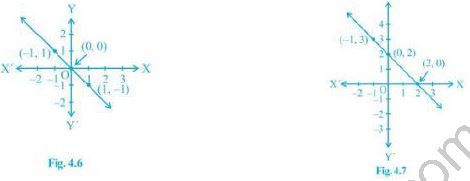
Sol.5) In fig. 4.6, Points are (0, 0), (-1, 1) and (1, -1).
∴ Equation (ii) 𝑥 + 𝑦 = 0 is correct as it satisfies all the value of the points.
In fig. 4.7, Points are (-1, 3), (0, 2) and (2, 0).
∴ Equation (iii) 𝑦 = – 𝑥 + 2 is correct as it satisfies all the value of the points
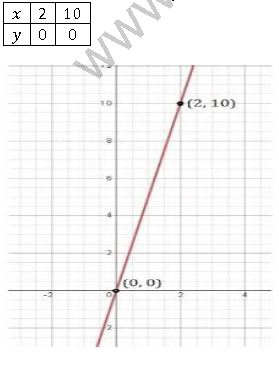
Q.6) If the work done by a body on application of a constant force is directly proportional to the distance travelled by the body, express this in the form of an equation in two variables and draw the graph of the same by taking the constant force as 5 units. Also read from the graph the work done when the distance travelled by the body is (i) 2 units (ii) 0 unit
Sol.6) Let the distance travelled by the body be 𝑥 and 𝑦 be the work done by the force.
𝑦 ∝ 𝑥 (Given)
⇒ 𝑦 = 5𝑥 (To equate the proportional, we need a constant. Here, it was given 5)
A/q,
(i) When x = 2 units then 𝑦 = 10 𝑢𝑛𝑖𝑡𝑠
(ii) When x = 0 unit then 𝑦 = 0 𝑢𝑛𝑖𝑡
Q.7) Yamini and Fatima, two students of Class IX of a school, together contributed 𝑅𝑠 100 towards the Prime Minister’s Relief Fund to help the earthquake victims. Write a linear equation which satisfies this data. (You may take their contributions as 𝑅𝑠 𝑥 and 𝑅𝑠 𝑦.) Draw the graph of the same
Sol.7) Let the contribution amount by Yamini be 𝑥 and contribution amount by Fatima be 𝑦.
A/q,
𝑥 + 𝑦 = 100
When 𝑥 = 0 then 𝑦 = 100
When 𝑥 = 50 then 𝑦 = 50
When 𝑥 = 100 then 𝑦 = 0

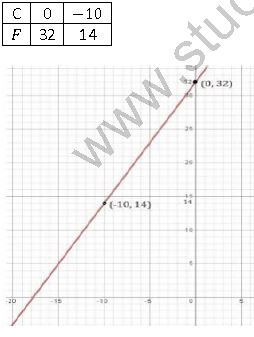
Q.8) In countries like USA and Canada, temperature is measured in Fahrenheit, whereas in countries like India, it is measured in Celsius. Here is a linear equation that converts
Fahrenheit to Celsius: 𝐹 = (9/5) 𝐶 + 32
(i) Draw the graph of the linear equation above using Celsius for x-axis and Fahrenheit for y-axis.
(ii) If the temperature is 30°C, what is the temperature in Fahrenheit?
(iii) If the temperature is 95°F, what is the temperature in Celsius?
(iv) If the temperature is 0°C, what is the temperature in Fahrenheit and if the temperature is 0°F, what is the temperature in Celsius?
(v) Is there a temperature which is numerically the same in both Fahrenheit and Celsius? If yes, find it.
Sol.8) (i) 𝐹 = (9/5) 𝐶 + 32 When 𝐶 = 0 then 𝐹 = 32
also, when 𝐶 = −10 then 𝐹 = 14
(ii) Putting the value of 𝐶 = 30 in 𝐹 = (9/5) 𝐶 + 32, we get
𝐹 = (9/5) × 30 + 32
⇒ 𝐹 = 54 + 32
⇒ 𝐹 = 86
(iii) Putting the value of 𝐹 = 95 in 𝐹 = (9/5/) 𝐶 + 32, we get
95 = (9/5) 𝐶 + 32
⇒ (9/5) 𝐶 = 95 − 32
⇒ 𝐶 = 63 × 5/9
⇒ 𝐶 = 35
(iv) Putting the value of F = 0 in 𝐹 = (9/5) 𝐶 + 32, we get
0 = (9/5) 𝐶 + 32
⇒ (9/5) 𝐶 = −32
⇒ 𝐶 = −32 × 5/9
⇒ 𝐶 = − 160/9
Putting the value of C = 0 in 𝐹 = (9/5) 𝐶 + 32, we get
𝐹 = (9/5) × 0 + 32
⇒ 𝐹 = 32
(v) Here, we have to find when F = C.
Therefore, Putting F = C in 𝐹 = (9/5) 𝐶 + 32, we get
𝐹 = (9/5) 𝐹 + 32
⇒ 𝐹 − 9/5 𝐹 = 32
⇒ − 4/5 𝐹 = 32
⇒ 𝐹 = −40
Therefore at -40, both Fahrenheit and Celsius numerically the same
Exercise 4.4
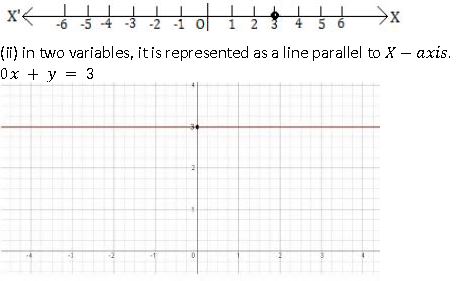
Q.1) Give the geometric representations of 𝑦 = 3 as an equation (i) in one variable (ii) in two variables
Sol.1) (i) in one variable, it is represented as 𝑦 = 3
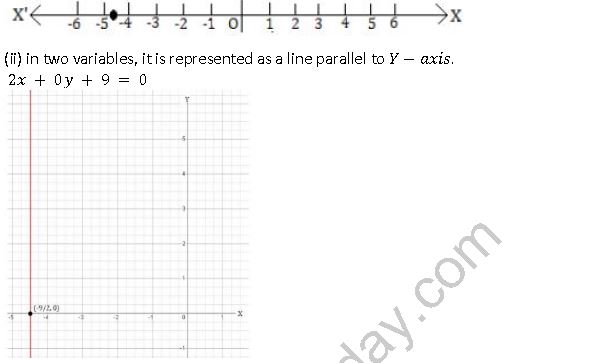
Q.2) Give the geometric representations of 2𝑥 + 9 = 0 as an equation (i) in one variable (ii) in two variables
Sol.2) (i) in one variable, it is represented as 𝑥 = −(9/2)
Free study material for Mathematics
Mathematics Class 9 Curriculum Solutions: Chapter 04 Linear Equations In Two Variables
Accessing Chapter 04 Linear Equations In Two Variables Solutions
Access structured NCERT textbook solutions for Chapter 04 Linear Equations In Two Variables. Designed in alignment with the latest academic curriculum for Class 9 Mathematics, these answers cover all end-of-chapter exercises to support daily learning and homework completion.
Concept-Driven Answers for Class 9 Mathematics
Beyond providing final answers, these guides offer step-by-step breakdowns for complex queries in the Class 9 Mathematics module. This approach helps students balance theoretical depth with practical problem-solving skills required for NCERT exams.
Maximizing Study Efficiency
Frequent review of these structured answers builds strong analytical capabilities and response efficiency. Maximize your academic readiness by combining these textbook solutions with our curated study materials and mock evaluations for Class 9 Mathematics.
FAQs
The complete and updated NCERT Solutions Class 9 Mathematics Chapter 4 Linear Equations In Two Variables is available for free on StudiesToday.com. These solutions for Class 9 Mathematics are as per latest NCERT curriculum.
Yes, our experts have revised the NCERT Solutions Class 9 Mathematics Chapter 4 Linear Equations In Two Variables as per 2026 exam pattern. All textbook exercises have been solved and have added explanation about how the Mathematics concepts are applied in case-study and assertion-reasoning questions.
Toppers recommend using NCERT language because NCERT marking schemes are strictly based on textbook definitions. Our NCERT Solutions Class 9 Mathematics Chapter 4 Linear Equations In Two Variables will help students to get full marks in the theory paper.
Yes, we provide bilingual support for Class 9 Mathematics. You can access NCERT Solutions Class 9 Mathematics Chapter 4 Linear Equations In Two Variables in both English and Hindi medium.
Yes, you can download the entire NCERT Solutions Class 9 Mathematics Chapter 4 Linear Equations In Two Variables in printable PDF format for offline study on any device.