

Download NCERT Solutions for Class 9 Mathematics Chapter 02 Polynomials
Access comprehensive textbook solutions for Chapter 02 Polynomials using the official curriculum guides for Class 9 Mathematics. Designed to align with the 2026-27 NCERT standards, these detailed answers help students reinforce core academic concepts.
Access NCERT Solutions and Answers
Navigate directly to the solved Mathematics textbook exercises using the digital viewer below. Each solution includes detailed step-by-step explanations, allowing students to instantly cross-check their work and identify areas requiring further revision.
Exercise 2.1
Question. Which of the following expressions are polynomials in one variable and which are not? State reasons for your answer.
(i) 4x2 - 3x + 7
(ii) y2 + √2
(iii) 3√t + t√2
(iv) y + 2/y
(v) x10 + y3 + t50
Answer : (i) 4x2 - 3x + 7
There is only one variable x with whole number power so this polynomial in one variable.
(ii) y2 + √2
There is only one variable y with whole number power so this polynomial in one variable.
(iii) 3√2 + t√2
There is only one variable t but in 3√t power of t is 1/2 which is not a whole number so 3√t + t√2 is not a polynomial.
(iv) y + 2/y
There is only one variable y but 2/y = 2y-1 so the power is not a whole number so y + 2/y is not a polynomial.
(v) x10 + y3 + t50
There are three variable x, y and t and there powers are whole number so this polynomial in three variable.
Question. Write the coefficients of x2 in each of the following:
(i) 2 + x2 + x
(ii) 2 - x2 + x3
(iii) (π/2)x2 + x
(iv) √2x - 1
Answer : (i) coefficients of x2 = 1
(ii) coefficients of x2 = -1
(iii) coefficients of x2 = π/2
(iv) coefficients of x2 = 0
Question. Give one example each of a binomial of degree 35, and of a monomial of degree 100.
Answer : x35 +,5 is a binomial of degree 35.
2y100 is a monomial of degree 100.
Question. Write the degree of each of the following polynomials:
(i) 5x3 + 4x2 + 7x
(ii) 4 – y2
(iii) 5t – √7
(iv) 3
Answer : (i) 5x3 has highest power in the given polynomial which power is 3. Therefore, degree of polynomial is 3.
(ii) – y2 has highest power in the given polynomial which power is 2. Therefore, degree of polynomial is 2.
(iii) 5t has highest power in the given polynomial which power is 1. Therefore, degree of polynomial is 1.
(iv) There is no variable in the given polynomial. Therefore, degree of polynomial is 0.
Question. Classify the following as linear, quadratic and cubic polynomial:
(i) x2 + x
(ii) x - x3
(iii) y + y2 +4
(iv) 1 + x
(v) 3t
(vi) r2
(vii) 7x3
Answer : (i) x2 + x
Quadratic Polynomial
(ii) x - x3
Cubic Polynomial
(iii) y + y2 +4
Quadratic Polynomial
(iv) 1 + x
Linear Polynomial
(v) 3t
Linear Polynomial
(vi) r2
Quadratic Polynomial
(vii) 7x3
Cubic Polynomial
Exercise 2.2
Question. Find the value of the polynomial 5x – 4x2 + 3 at
(i) x = 0
(ii) x = – 1
(iii) x = 2
Answer : Let p(x) = 5x – 4x2 + 3
(i) p(0) = 5(0) – 4(0)2 + 3 = 0 – 0 + 3 = 3
Thus, the value of 5x – 4x2 + 3 at x = 0 is 3.
(ii) p(-1) = 5(-1) – 4(-1)2 + 3
= – 5x – 4x2 + 3 = -9 + 3 = -6
Thus, the value of 5x – 4x2 + 3 at x = -1 is -6.
(iii) p(2) = 5(2) – 4(2)2 + 3 = 10 – 4(4) + 3
= 10 – 16 + 3 = -3
Thus, the value of 5x – 4x2 + 3 at x = 2 is – 3.
Question. Find p (0), p (1) and p (2) for each of the following polynomials.
(i) p(y) = y2 – y +1
(ii) p (t) = 2 +1 + 2t2 -t3
(iii) P (x) = x3
(iv) p (x) = (x-1) (x+1)
Answer : (i) Given that p(y) = y2 – y + 1.
∴ P(0) = (0)2 – 0 + 1 = 0 – 0 + 1 = 1
p(1) = (1)2 – 1 + 1 = 1 – 1 + 1 = 1
p(2) = (2)2 – 2 + 1 = 4 – 2 + 1 = 3
(ii) Given that p(t) = 2 + t + 2t2 – t3
∴p(0) = 2 + 0 + 2(0)2 – (0)3
= 2 + 0 + 0 – 0=2
P(1) = 2 + 1 + 2(1)2 – (1)3
= 2 + 1 + 2 – 1 = 4
p( 2) = 2 + 2 + 2(2)2 – (2)3
= 2 + 2 + 8 – 8 = 4
(iii) Given that p(x) = x3
∴ p(0) = (0)3 = 0, p(1) = (1)3 = 1
p(2) = (2)3 = 8
(iv) Given that p(x) = (x – 1)(x + 1)
∴ p(0) = (0 – 1)(0 + 1) = (-1)(1) = -1
p(1) = (1 – 1)(1 +1) = (0)(2) = 0
P(2) = (2 – 1)(2 + 1) = (1)(3) = 3
Question. Verify whether the following are zeroes of the polynomial, indicated against them.
(i) p(x) = 3x + 1, x = -1/3
(ii) p(x) = 5x - π, x = 4/5
(iii) p(x) = x2 - 1, x = 1, -1
(iv) p(x) = (x + 1) (x - 2), x = -1, 2
(v) p(x) = x2 , x = 0
(vi) p (x) = 1x + m, x = – m/1
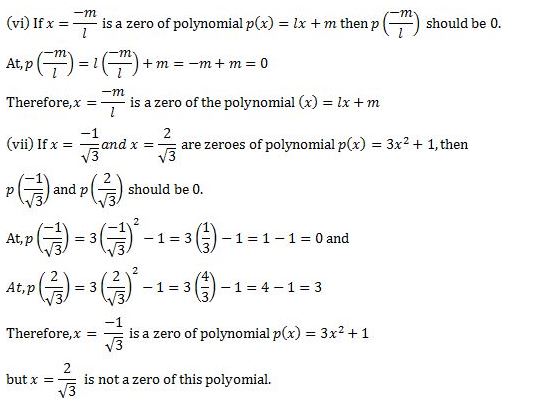
(vii) P (x) = 3x2 – 1, x = – 1/√3, 2/√3
(viii) p (x) = 2x + 1, x = 1/2
Answer : (i) If x = -1/3 is a zero of polynomial p(x) = 3x + 1 then p(-1/3) should be 0.
At, p(-1/3) = 3(-1/3) + 1 = -1 + 1 = 0
Therefore, x = -1/3 is a zero of polynomial p(x) = 3x + 1.
(ii) If x = 4/5 is a zero of polynomial p(x) = 5x - π then p(4/5) should be 0.
At, p(4/5) = 5(4/5) - π = 4 - π
Therefore, x = 4/5 is not a zero of given polynomial p(x) = 5x - π.
(iii) If x = 1 and x = -1 are zeroes of polynomial p(x) = x2 - 1, then p(1) and p(-1) should be 0.
At, p(1) = (1)2 - 1 = 0 and
At, p(-1) = (-1)2 - 1 = 0
Hence, x = 1 and -1 are zeroes of the polynomial p(x) = x2 - 1.
(iv) If x = -1 and x = 2 are zeroes of polynomial p(x) = (x +1) (x - 2), then p( - 1) and (2)should be 0.
At, p(-1) = (-1 + 1) (-1 - 2) = 0 (-3) = 0, and
At, p(2) = (2 + 1) (2 - 2) = 3 (0) = 0
Therefore, x = -1 and x = 2 are zeroes of the polynomial p(x) = (x +1) (x - 2).
(v) If x = 0 is a zero of polynomial p(x) = x2, then p(0) should be zero.
Here, p(0) = (0)2 = 0
Hence, x = 0 is a zero of the polynomial p(x) = x2.
Question. Find the zero of the polynomial in each of the following cases:
(i) p(x) = x + 5
(ii) p(x) = x - 5
(iii) p(x) = 2x + 5
(iv) p(x) = 3x - 2
(v) p(x) = 3x
(vi) p(x) = ax, a ≠ 0
(vii) p(x) = cx + d, c ≠ 0, c, are real numbers.
Answer : (i) p(x) = x + 5
p(x) = 0
x + 5 = 0
x = -5
Therefore, x = -5 is a zero of polynomial p(x) = x + 5 .
(ii) p(x) = x - 5
p(x) = 0
x - 5 = 0
x = 5
Therefore, x = 5 is a zero of polynomial p(x) = x - 5.
(iii) p(x) = 2x + 5
p(x) = 0
2x + 5 = 0
2x = -5
x = -5/2
Therefore, x = -5/2 is a zero of polynomial p(x) = 2x + 5.
(iv) p(x) = 3x - 2
p(x) = 0
3x - 2 = 0
x = 2/3
Therefore, x = 2/3 is a zero of polynomial p(x) = 3x - 2.
(v) p(x) = 3x
p(x) = 0
3x = 0
x = 0
Therefore, x = 0 is a zero of polynomial p(x) = 3x.
(vi) p(x) = ax
p(x) = 0
ax = 0
x = 0
Therefore, x = 0 is a zero of polynomial p(x) = ax.
(vii) p(x) = cx + d
p(x) = 0
cx + d = 0
x = -d/c
Therefore, x = -d/c is a zero of polynomial p(x) = cx + d.
Exercises 2.3
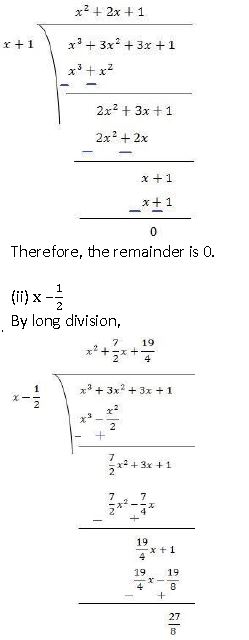
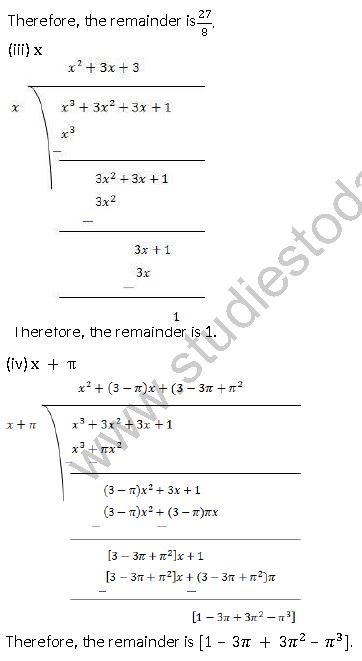
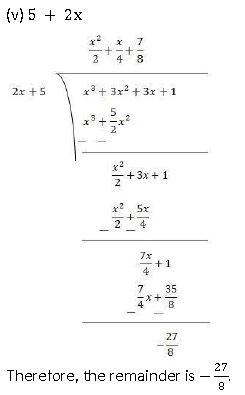
Question. Find the remainder when x3 + 3x2 + 3x + 1 is divided by
(i) x + 1
(ii) x - 1/2
(iii) x
(iv) x + π
(v) 5 + 2x
Answer : (i) x + 1
By long division,
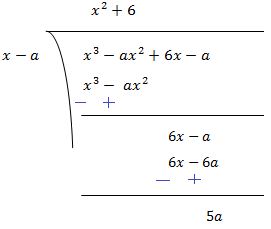
Question. Find the remainder when x3 - ax2 + 6x - a is divided by x - a.
Answer : By Long Division,
Question. Check whether 7 + 3x is a factor of 3x3 + 7x.
Answer : We have to divide 3x3 + 7x by 7 + 3x. If remainder comes out to be 0 then 7 + 3x will be a factor of 3x3 + 7x.
By Long Division,
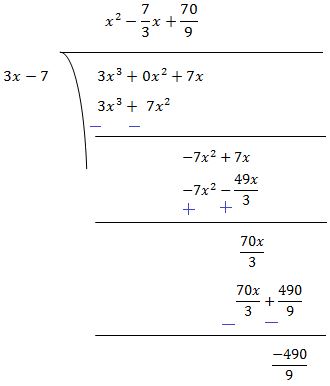
As remainder is not zero so 7 + 3x is not a factor of 3x3 + 7x.
Exercise 2.4
Question. Determine which of the following polynomials has (x + 1) a factor:
(i) x3 + x2 + x + 1
(ii) x4 + x3 + x2 + x + 1
(iii) x4 + 3x3 + 3x2 + x + 1
(iv) x3 - x2 - (2 + √2)x + √2
Answer : (i) If (x + 1) is a factor of p(x) = x3 + x2 + x + 1, p(-1) must be zero.
Here, p(x) = x3 + x2 + x + 1
p(-1) = (-1)3 + (-1)2 + (-1) + 1
= -1 + 1 - 1 + 1 = 0
Therefore, x + 1 is a factor of this polynomial
(ii) If (x + 1) is a factor of p(x) = x4 + x3 + x2 + x + 1, p(-1) must be zero.
Here, p(x) = x4 + x3 + x2 + x + 1
p(-1) = (-1)4 + (-1)3 + (-1)2 + (-1) + 1
= 1 - 1 + 1 - 1 + 1 = 1
As, p(-1) ≠ 0
Therefore, x + 1 is not a factor of this polynomial
(iii) If (x + 1) is a factor of polynomial p(x) = x4 + 3x3 + 3x2 + x + 1, p(- 1) must be 0.
p(-1) = (-1)4 + 3(-1)3 + 3(-1)2 + (-1) + 1
= 1 - 3 + 3 - 1 + 1 = 1
As, p(-1) ≠ 0
Therefore, x + 1 is not a factor of this polynomial.
(iv) If (x + 1) is a factor of polynomial
p(x) = x3 - x2 - (2 + √2)x + √2, p(- 1) must be 0.
p(-1) = (-1)3 - (-1)2 - (2 + √2) (-1) + √2
= -1 - 1 + 2 + √2 + √2
=2√2
As, p(-1) ≠ 0
Therefore,, x + 1 is not a factor of this polynomial.
Question. Use the Factor Theorem to determine whether g(x) is a factor of p(x) in each of the following cases:
(i) p(x) = 2x3 + x2 - 2x - 1, g(x) = x + 1
(ii) p(x) = x3 + 3x2 + 3x + 1, g(x) = x + 2
(iii) p(x) = x3 - 4 x2 + x + 6, g(x) = x - 3
Answer : (i) If g(x) = x + 1 is a factor of given polynomial p(x), p(- 1) must be zero.
p(x) = 2x3 + x2 - 2x - 1
p(- 1) = 2(-1)3 + (-1)2 - 2(-1) - 1
= 2(- 1) + 1 + 2 - 1 = 0
Hence, g(x) = x + 1 is a factor of given polynomial.
(ii) If g(x) = x + 2 is a factor of given polynomial p(x), p(- 2) must be 0.
p(x) = x3 +3x2 + 3x + 1
p(-2) = (-2)3 + 3(- 2)2 + 3(- 2) + 1
= -8 + 12 - 6 + 1
= -1
As, p(-2) ≠ 0
Hence g(x) = x + 2 is not a factor of given polynomial.
(iii) If g(x) = x - 3 is a factor of given polynomial p(x), p(3) must be 0.
p(x) = x3 - 4x2 + x + 6
p(3) = (3)3 - 4(3)2 + 3 + 6
= 27 - 36 + 9 = 0
Therefore,, g(x) = x - 3 is a factor of given polynomial.
Question. Find the value of k, if x - 1 is a factor of p(x) in each of the following cases:(i) p(x) = x2 + x + k
(ii) p(x) = 2x2 + kx + √2
(iii) p(x) = kx2 - √2x + 1
(iv) p(x) = kx2 - 3x + k
Answer : (i) If x - 1 is a factor of polynomial p(x) = x2 + x + k, then
p(1) = 0
⇒ (1)2 + 1 + k = 0
⇒ 2 + k = 0
⇒ k = - 2
Therefore, value of k is -2.
(ii) If x - 1 is a factor of polynomial p(x) = 2x2 + kx + √2, then
p(1) = 0
⇒ 2(1)2 + k(1) + √2 = 0
⇒ 2 + k + √2 = 0
⇒ k = -2 - √2 = -(2 + √2)
Therefore, value of k is -(2 + √2).
(iii) If x - 1 is a factor of polynomial p(x) = kx2 - √2x + 1, then
p(1) = 0
⇒ k(1)2 - √2(1) + 1 = 0
⇒ k - √2 + 1 = 0
⇒ k = √2 - 1
Therefore, value of k is √2 - 1.
(iv) If x - 1 is a factor of polynomial p(x) = kx2 - 3x + k, then
p(1) = 0
⇒ k(1)2 + 3(1) + k = 0
⇒ k - 3 + k = 0
⇒ 2k - 3 = 0
⇒ k = 3/2
Therefore, value of k is 3/2.
Question. Factorise:
(i) 12x2 + 7x + 1
(ii) 2x2 + 7x + 3
(iii) 6x2 + 5x - 6
(iv) 3x2 - x - 4
Answer : (i) 12x2 + 7x + 1
= 12x2 - 4x - 3x+ 1
= 4x (3x - 1) - 1 (3x - 1)
= (3x - 1) (4x - 1)
(ii) 2x2 + 7x + 3
= 2x2 + 6x + x + 3
= 2x (x + 3) + 1 (x + 3)
= (x + 3) (2x + 1)
(iii) 6x2 + 5x - 6
= 6x2 + 9x - 4x - 6
= 3x (2x + 3) - 2 (2x + 3)
= (2x + 3) (3x - 2)
(iv) 3x2 - x - 4
= 3x2 - 4x + 3x - 4
= x (3x - 4) + 1 (3x - 4)
= (3x - 4) (x + 1)
Question. Factorise:
(i) x3 - 2x2 - x + 2
(ii) x3 - 3x2 - 9x - 5
(iii) x3 + 13x2 + 32x + 20
(iv) 2y3 + y2 - 2y - 1
Answer : (i) Let p(x) = x3 - 2x2 - x + 2
Factors of 2 are ±1 and ± 2
By trial method, we find that
p(1) = 0
So, (x+1) is factor of p(x)
Now,
p(x) = x3 - 2x2 - x + 2
p(-1) = (-1)3 - 2(-1)2 - (-1) + 2 = -1 -2 + 1 + 2 = 0
Therefore, (x+1) is the factor of p(x)
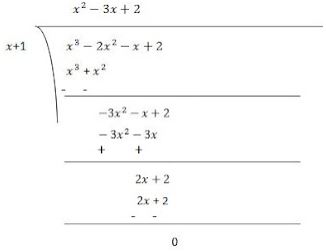
Now, Dividend = Divisor × Quotient + Remainder
(x+1) (x2 - 3x + 2)
= (x+1) (x2 - x - 2x + 2)
= (x+1) {x(x-1) -2(x-1)}
= (x+1) (x-1) (x+2)
(ii) Let p(x) = x3 - 3x2 - 9x - 5
Factors of 5 are ±1 and ±5
By trial method, we find that
p(5) = 0
So, (x-5) is factor of p(x)
Now,
p(x) = x3 - 2x2 - x + 2
p(5) = (5)3 - 3(5)2 - 9(5) - 5 = 125 - 75 - 45 - 5 = 0
Therefore, (x-5) is the factor of p(x)
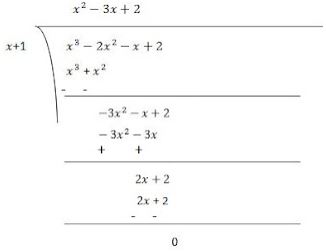
Now, Dividend = Divisor × Quotient + Remainder
(x-5) (x2 + 2x + 1)
= (x-5) (x2 + x + x + 1)
= (x-5) {x(x+1) +1(x+1)}
= (x-5) (x+1) (x+1)
(iii) Let p(x) = x3 + 13x2 + 32x + 20
Factors of 20 are ±1, ±2, ±4, ±5, ±10 and ±20
By trial method, we find that
p(-1) = 0
So, (x+1) is factor of p(x)
Now,
p(x) = x3 + 13x2 + 32x + 20
p(-1) = (-1)3 + 13(-1)2 + 32(-1) + 20 = -1 + 13 - 32 + 20 = 0
Therefore, (x+1) is the factor of p(x)
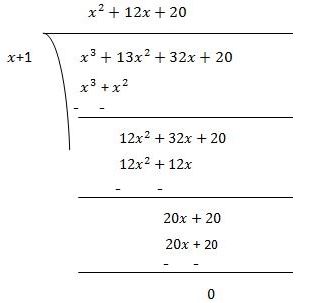
Now, Dividend = Divisor × Quotient + Remainder
(x+1) (x2 + 12x + 20)
= (x+1) (x2 + 2x + 10x + 20)
= (x-5) {x(x+2) +10(x+2)}
= (x-5) (x+2) (x+10)
(iv) Let p(y) = 2y3 + y2 - 2y - 1
Factors of ab = 2× (-1) = -2 are ±1 and ±2
By trial method, we find that
p(1) = 0
So, (y-1) is factor of p(y)
Now,
p(y) = 2y3 + y2 - 2y - 1
p(1) = 2(1)3 + (1)2 - 2(1) - 1 = 2 +1 - 2 - 1 = 0
Therefore, (y-1) is the factor of p(y)
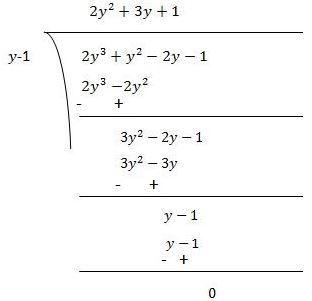
Now, Dividend = Divisor × Quotient + Remainder
(y-1) (2y2 + 3y + 1)
= (y-1) (2y2 + 2y + y + 1)
= (y-1) {2y(y+1) +1(y+1)}
= (y-1) (2y+1) (y+1)
Exercise 2.5
Question. Use suitable identities to find the following products:
(i) (x + 4) (x + 10)
(ii) (x + 8) (x – 10)
(iii) (3x + 4) (3x – 5)
(iv) (y2 + 3/2) (y2 - 3/2)
(v) (3 - 2x) (3 + 2x)
Answer : (i) Using identity, (x + a) (x + b) = x2 + (a + b) x + ab
In (x + 4) (x + 10), a = 4 and b = 10
Now,
(x + 4) (x + 10) = x2 + (4 + 10)x + (4 × 10)
= x2 + 14x + 40
(ii) (x + 8) (x – 10)
Using identity, (x + a) (x + b) = x2 + (a + b) x + ab
Here, a = 8 and b = –10
(x + 8) (x – 10) = x2 + {8 +(– 10)}x + {8×(– 10)}
= x2 + (8 – 10)x – 80
= x2 – 2x – 80
(iii) (3x + 4) (3x – 5)
Using identity, (x + a) (x + b) = x2 + (a + b) x + ab
Here, x = 3x , a = 4 and b = -5
(3x + 4) (3x – 5) = (3x) 2 + {4 + (-5)}3x + {4×(-5)}
= 9x2 + 3x(4 - 5) - 20
= 9x2 - 3x - 20
(iv) (y2 + 3/2) (y2 - 3/2)
Using identity, (x + y) (x -y) = x2 - y2
Here, x = y2 and y = 3/2
(y2 + 3/2) (y2 - 3/2) = (y2)2 - (3/2)2
= y4 - 9/4
(v) (3 - 2x) (3 + 2x)
Using identity, (x + y) (x -y) = x2 - y2
Here, x = 3 and y = 2x
(3 - 2x) (3 + 2x) = 32 - (2x)2
= 9 - 4x2
Question. Evaluate the following products without multiplying directly:
(i) 103 × 107
(ii) 95 × 96
(iii) 104 × 96
Answer : (i) 103 × 107 = (100 + 3) (100 + 7)
Using identity, (x + a) (x + b) = x2 + (a + b) x + ab
Here, x = 100, a = 3 and b = 7
103 × 107 = (100 + 3) (100 + 7) = (100)2 + (3 + 7)10 + (3 × 7)
= 10000 + 100 + 21
= 10121
(ii) 95 × 96 = (90 + 5) (90 + 4)
Using identity, (x + a) (x + b) = x2 + (a + b) x + ab
Here, x = 90, a = 5 and b = 4
95 × 96 = (90 + 5) (90 + 4) = 902 + 90(5 + 6) + (5 × 6)
= 8100 + (11 × 90) + 30
= 8100 + 990 + 30 = 9120
(iii) 104 × 96 = (100 + 4) (100 - 4)
Using identity, (x + y) (x -y) = x2 - y2
Here, x = 100 and y = 4
104 × 96 = (100 + 4) (100 - 4) = (100)2 - (4)2 = 10000 - 16 = 9984
Question. Factorise the following using appropriate identities:
(i) 9x2 + 6xy + y2
(ii) 4y2 - 4y + 1
(iii) x2 - y2/100
Answer : (i) 9x2 + 6xy + y2 = (3x) 2 + (2×3x×y) + y2
Using identity, (a + b)2 = a2 + 2ab + b2
Here, a = 3x and b = y
9x2 + 6xy + y2 = (3x) 2 + (2×3x×y) + y2 = (3x + y)2 = (3x + y) (3x + y)
(ii) 4y2 - 4y + 1 = (2y)2 - (2×2y×1) + 12
Using identity, (a - b)2 = a2 - 2ab + b2
Here, a = 2y and b = 1
4y2 - 4y + 1 = (2y)2 - (2×2y×1) + 12 = (2y - 1)2 = (2y - 1) (2y - 1)
(iii) x2 - y2/100 = x2 - (y/10)2
Using identity, a2 - b2 = (a + b) (a - b)
Here, a = x and b = (y/10)
x2 - y2/100 = x2 - (y/10)2 = (x - y/10) (x + y/10)
Question. Expand each of the following, using suitable identities:
(i) (x + 2y + 4z)2
(ii) (2x – y + z)2
(iii) (–2x + 3y + 2z)2
(iv) (3a – 7b – c)2
(v) (–2x + 5y – 3z)2
(vi) [1/4 a - 1/2 b + 1]2
Answer : (i) (x + 2y + 4z)2
Using identity, (a + b + c)2 = a2 + b2 + c2 + 2ab + 2bc + 2ca
Here, a = x, b = 2y and c = 4z
(x + 2y + 4z)2 = x2 + (2y)2 + (4z)2 + (2×x×2y) + (2×2y×4z) + (2×4z×x)
= x2 + 4y2 + 16z2 + 4xy + 16yz + 8xz
(ii) (2x – y + z)2
Using identity, (a + b + c)2 = a2 + b2 + c2 + 2ab + 2bc + 2ca
Here, a = 2x, b = -y and c = z
(2x – y + z)2 = (2x)2 + (-y)2 + z2 + (2×2x×-y) + (2×-y×z) + (2×z×2x)
= 4x2 + y2 + z2 - 4xy - 2yz + 4xz
(iii) (–2x + 3y + 2z)2
Using identity, (a + b + c)2 = a2 + b2 + c2 + 2ab + 2bc + 2ca
Here, a = -2x, b = 3y and c = 2z
(–2x + 3y + 2z)2 = (-2x)2 + (3y)2 + (2z)2 + (2×-2x×3y) + (2×3y×2z) + (2×2z×-2x)
= 4x2 + 9y2 + 4z2 - 12xy + 12yz - 8xz
(iv) (3a – 7b – c)2
Using identity, (a + b + c)2 = a2 + b2 + c2 + 2ab + 2bc + 2ca
Here, a = 3a, b = -7b and c = -c
(3a – 7b – c)2 = (3a)2 + (-7b)2 + (-c)2 + (2×3a×-7b) + (2×-7b×-c) + (2×-c×3a)
= 9a2 + 49b2 + c2 - 42ab + 14bc - 6ac
(v) (–2x + 5y – 3z)2
Using identity, (a + b + c)2 = a2 + b2 + c2 + 2ab + 2bc + 2ca
Here, a = -2x, b = 5y and c = -3z
(–2x + 5y – 3z)2 = (-2x)2 + (5y)2 + (-3z)2 + (2×-2x×5y) + (2×5y×-3z) + (2×-3z×-2x)
= 4x2 + 25y2 + 9z2 - 20xy - 30yz + 12xz
(vi) [1/4 a - 1/2 b + 1]2
Using identity, (a + b + c)2 = a2 + b2 + c2 + 2ab + 2bc + 2ca
Here, a = 1/4 a, b = -1/2 b and c = 1
[1/4 a - 1/2 b + 1]2 = (1/4 a)2 + (-1/2 b)2 + 12 + (2×1/4 a×-1/2 b) + (2×-1/2 b×1) + (2×1×1/4 a)
= 1/16 a2 + 1/4 b2 + 1 - 1/4 ab - b + 1/2 a
Question. Factorise: (i) 4x2 + 9y2 + 16z2 + 12xy - 24yz - 16xz
(ii) 2x2 + y2 + 8z2 - 2√2 xy + 4√2 yz - 8xz
Answer : (i) 4x2 + 9y2 + 16z2 + 12xy - 24yz - 16xz
Using identity, (a + b + c)2 = a2 + b2 + c2 + 2ab + 2bc + 2ca
4x2 + 9y2 + 16z2 + 12xy - 24yz - 16xz
= (2x)2 + (3y)2 + (-4z)2 + (2×2x×3y) + (2×3y×-4z) + (2×-4z×2x)
= (2x + 3y - 4z)2
= (2x + 3y - 4z) (2x + 3y - 4z)
(ii) 2x2 + y2 + 8z2 - 2√2 xy + 4√2 yz - 8xz
Using identity, (a + b + c)2 = a2 + b2 + c2 + 2ab + 2bc + 2ca
2x2 + y2 + 8z2 - 2√2 xy + 4√2 yz - 8xz
= (-√2x)2 + (y)2 + (2√2z)2 + (2×-√2x×y) + (2×y×2√2z) + (2×2√2z×-√2x)
= (-√2x + y + 2√2z)2
= (-√2x + y + 2√2z) (-√2x + y + 2√2z)
Question. Write the following cubes in expanded form:
(i) (2x + 1)3
(ii) (2a – 3b)3
(iii) [3/2 x + 1]3
(iv) [x - 2/3 y]3
Answer : (i) (2x + 1)3
Using identity, (a + b)3 = a3 + b3 + 3ab(a + b)
(2x + 1)3 = (2x)3 + 13 + (3×2x×1)(2x + 1)
= 8x3 + 1 + 6x(2x + 1)
= 8x3 + 12x2 + 6x + 1
(ii) (2a – 3b)3
Using identity, (a - b)3 = a3 - b3 - 3ab(a - b)
(2a – 3b)3 = (2a)3 - (3b)3 - (3×2a×3b)(2a - 3b)
= 8a3 - 27b3 - 18ab(2a - 3b)
= 8a3 - 27b3 - 36a2b + 54ab2
(iii) [3/2 x + 1]3
Using identity, (a + b)3 = a3 + b3 + 3ab(a + b)
[3/2 x + 1]3 = (3/2 x)3 + 13 + (3×3/2 x×1)(3/2 x + 1)
= 27/8 x3 + 1 + 9/2 x(3/2 x + 1)
= 27/8 x3 + 1 + 27/4 x2 + 9/2 x
= 27/8 x3 + 27/4 x2 + 9/2 x + 1
(iv) [x - 2/3 y]3
Using identity, (a - b)3 = a3 - b3 - 3ab(a - b)
[x - 2/3 y]3 = (x)3 - (2/3 y)3 - (3×x×2/3 y)(x - 2/3 y)
= x3 - 8/27y3 - 2xy(x - 2/3 y)
= x3 - 8/27y3 - 2x2y + 4/3xy2
Question. Evaluate the following using suitable identities:
(i) (99)3
(ii) (102)3
(iii) (998)3
Answer : (i) (99)3 = (100 - 1)3
Using identity, (a - b)3 = a3 - b3 - 3ab(a - b)
(100 - 1)3 = (100)3 - 13 - (3×100×1)(100 - 1)
= 1000000 - 1 - 300(100 - 1)
= 1000000 - 1 - 30000 + 300
= 970299
(ii) (102)3 = (100 + 2)3
Using identity, (a + b)3 = a3 + b3 + 3ab(a + b)
(100 + 2)3 = (100)3 + 23 + (3×100×2)(100 + 2)
= 1000000 + 8 + 600(100 + 2)
= 1000000 + 8 + 60000 + 1200
= 1061208
(iii) (998)3
Using identity, (a - b)3 = a3 - b3 - 3ab(a - b)
(1000 - 2)3 = (1000)3 - 23 - (3×1000×2)(1000 - 2)
= 100000000 - 8 - 6000(1000 - 2)
= 100000000 - 8- 600000 + 12000
= 994011992
Question. Factorise each of the following:
(i) 8a3 + b3 + 12a2b + 6ab2
(ii) 8a3 - b3 - 12a2b + 6ab2
(iii) 27 - 125a3 - 135a + 225a2
(iv) 64a3 - 27b3 - 144a2b + 108ab2
(v) 27p3 - 1/216 - 9/2 p2 + 1/4 p
Answer : (i) 8a3 + b3 + 12a2b + 6ab2
Using identity, (a + b)3 = a3 + b3 + 3a2b + 3ab2
8a3 + b3 + 12a2b + 6ab2
= (2a)3 + b3 + 3(2a)2b + 3(2a)(b)2
= (2a + b)3
= (2a + b)(2a + b)(2a + b)
(ii) 8a3 - b3 - 12a2b + 6ab2
Using identity, (a - b)3 = a3 - b3 - 3a2b + 3ab2
8a3 - b3 - 12a2b + 6ab2= (2a)3 - b3 - 3(2a)2b + 3(2a)(b)2
= (2a - b)3
= (2a - b)(2a - b)(2a - b)
(iii) 27 - 125a3 - 135a + 225a2
Using identity, (a - b)3 = a3 - b3 - 3a2b + 3ab2
27 - 125a3 - 135a + 225a2= 33 - (5a)3 - 3(3)2(5a) + 3(3)(5a)2
= (3 - 5a)3
= (3 - 5a)(3 - 5a)(3 - 5a)
(iv) 64a3 - 27b3 - 144a2b + 108ab2
Using identity, (a - b)3 = a3 - b3 - 3a2b + 3ab2
64a3 - 27b3 - 144a2b + 108ab2= (4a)3 - (3b)3 - 3(4a)2(3b) + 3(4a)(3b)2
= (4a - 3b)3
= (4a - 3b)(4a - 3b)(4a - 3b)
(v) 27p3 - 1/216 - 9/2 p2 + 1/4 p
Using identity, (a - b)3 = a3 - b3 - 3a2b + 3ab2
27p3 - 1/216 - 9/2 p2 + 1/4 p
= (3p)3 - (1/6)3 - 3(3p)2(1/6) + 3(3p)(1/6)2
= (3p - 1/6)3
= (3p - 1/6)(3p - 1/6)(3p - 1/6)
Question. Verify : (i) x3 + y3 = (x + y) (x2 - xy + y2) (ii) x3 - y3 = (x - y) (x2 + xy + y2)
Answer : (i) x3 + y3 = (x + y) (x2 - xy + y2)
We know that,
(x + y)3 = x3 + y3 + 3xy(x + y)
⇒ x3 + y3 = (x + y)3 - 3xy(x + y)
⇒ x3 + y3 = (x + y)[(x + y)2 - 3xy] {Taking (x+y) common}
⇒ x3 + y3 = (x + y)[(x2 + y2 + 2xy) - 3xy]
⇒ x3 + y3 = (x + y)(x2 + y2 - xy)
(ii) x3 - y3 = (x - y) (x2 + xy + y2 )
We know that,
(x - y)3 = x3 - y3 - 3xy(x - y)
⇒ x3 - y3 = (x - y)3 + 3xy(x - y)
⇒ x3 + y3 = (x - y)[(x - y)2 + 3xy] {Taking (x-y) common}
⇒ x3 + y3 = (x - y)[(x2 + y2 - 2xy) + 3xy]
⇒ x3 + y3 = (x + y)(x2 + y2 + xy)
Question. Factorise each of the following:
(i) 27y3 + 125z3
(ii) 64m3 - 343n3
Answer : (i) 27y3 + 125z3
Using identity, x3 + y3 = (x + y) (x2 - xy + y2)
27y3 + 125z3 = (3y)3 + (5z)3
= (3y + 5z) {(3y)2 - (3y)(5z) + (5z)2}
= (3y + 5z) (9y2 - 15yz + 25z)2
(ii) 64m3 - 343n3
Using identity, x3 - y3 = (x - y) (x2 + xy + y2 )
64m3 - 343n3 = (4m)3 - (7n)3
= (4m + 7n) {(4m)2 + (4m)(7n) + (7n)2}
= (4m + 7n) (16m2 + 28mn + 49n)2
Question. Factorise : 27x3 + y3 + z3 - 9xyz
Answer : 27x3 + y3 + z3 - 9xyz = (3x)3 + y3 + z3 - 3×3xyz
Using identity, x3 + y3 + z3 - 3xyz = (x + y + z)(x2 + y2 + z2 - xy - yz - xz)
27x3 + y3 + z3 - 9xyz
= (3x + y + z) {(3x)2 + y2 + z2 - 3xy - yz - 3xz}
= (3x + y + z) (9x2 + y2 + z2 - 3xy - yz - 3xz)
Question. Verify that: x3 + y3 + z3 - 3xyz = 1/2(x + y + z) [(x - y)2 + (y - z)2 + (z - x)2]
Answer : We know that,
x3 + y3 + z3 - 3xyz = (x + y + z)(x2 + y2 + z2 - xy - yz - xz)
⇒ x3 + y3 + z3 - 3xyz = 1/2×(x + y + z) 2(x2 + y2 + z2 - xy - yz - xz)
= 1/2(x + y + z) (2x2 + 2y2 + 2z2 - 2xy - 2yz - 2xz)
= 1/2(x + y + z) [(x2 + y2 -2xy) + (y2 + z2 - 2yz) + (x2 + z2 - 2xz)]
= 1/2(x + y + z) [(x - y)2 + (y - z)2 + (z - x)2]
Question. If x + y + z = 0, show that x3 + y3 + z3 = 3xyz.
Answer : We know that,
x3 + y3 + z3 - 3xyz = (x + y + z)(x2 + y2 + z2 - xy - yz - xz)
Now put (x + y + z) = 0,
x3 + y3 + z3 - 3xyz = (0)(x2 + y2 + z2 - xy - yz - xz)
⇒ x3 + y3 + z3 - 3xyz = 0
Question. Without actually calculating the cubes, find the value of each of the following:
(i) (-12)3 + (7)3 + (5)3
(ii) (28)3 + (–15)3 + (-13)3
Answer : (i) (-12)3 + (7)3 + (5)3
Let x = -12, y = 7 and z = 5
We observed that, x + y + z = -12 + 7 + 5 = 0
We know that if,
x + y + z = 0, then x3 + y3 + z3 = 3xyz
(-12)3 + (7)3 + (5)3 = 3(-12)(7)(5) = -1260
(ii) (28)3 + (–15)3 + (-13)3
Let x = 28, y = -15 and z = -13
We observed that, x + y + z = 28 - 15 - 13 = 0
We know that if,
x + y + z = 0, then x3 + y3 + z3 = 3xyz
(28)3 + (–15)3 + (-13)3 = 3(28)(-15)(-13) = 16380
Question. Give possible expressions for the length and breadth of each of the following rectangles, in which their areas are given:
(i) Area : 25a2 - 35a + 12
(ii) Area : 35 y2 + 13y - 12
Answer : (i) Area : 25a2 - 35a + 12
Since, area is product of length and breadth therefore by factorizing the given area, we can know the length and breadth of rectangle.
25a2 - 35a + 12
= 25a2 - 15a -20a + 12
= 5a(5a - 3) - 4(5a - 3)
= (5a - 4)(5a - 3)
Possible expression for length = 5a - 4
Possible expression for breadth = 5a - 3
(ii) Area : 35 y2 + 13y - 12
35 y2 + 13y - 12
= 35y2 - 15y + 28y - 12
= 5y(7y - 3) + 4(7y - 3)
= (5y + 4)(7y - 3)
Possible expression for length = (5y + 4)
Possible expression for breadth = (7y - 3)
Question. Give possible expressions for the length and breadth of each of the following rectangles, in which their areas are given:
(i) Area : 25a2 - 35a + 12
(ii) Area : 35 y2 + 13y - 12
Answer : (i) Area : 25a2 - 35a + 12
Since, area is product of length and breadth therefore by factorizing the given area, we can know the length and breadth of rectangle.
25a2 - 35a + 12
= 25a2 - 15a -20a + 12
= 5a(5a - 3) - 4(5a - 3)
= (5a - 4)(5a - 3)
Possible expression for length = 5a - 4
Possible expression for breadth = 5a - 3
(ii) Area : 35 y2 + 13y - 12
35 y2 + 13y - 12
= 35y2 - 15y + 28y - 12
= 5y(7y - 3) + 4(7y - 3)
= (5y + 4)(7y - 3)
Possible expression for length = (5y + 4)
Possible expression for breadth = (7y - 3)
Question. What are the possible expressions for the dimensions of the cuboids whose volumes are given below?
(i) Volume : 3x2 - 12x
(ii) Volume : 12ky2 + 8ky - 20k
Answer : (i) Volume : 3x2 - 12x
Since, volume is product of length, breadth and height therefore by factorizing the given volume, we can know the length, breadth and height of the cuboid.
3x2 - 12x
= 3x(x - 4)
Possible expression for length = 3
Possible expression for breadth = x
Possible expression for height = (x - 4)
(ii) Volume : 12ky2 + 8ky - 20k
Since, volume is product of length, breadth and height therefore by factorizing the given volume, we can know the length, breadth and height of the cuboid.
12ky2 + 8ky - 20k
= 4k(3y2 + 2y - 5)
= 4k(3y2 +5y - 3y - 5)
= 4k[y(3y +5) - 1(3y + 5)]
= 4k (3y +5) (y - 1)
Possible expression for length = 4k
Possible expression for breadth = (3y +5)
Possible expression for height = (y - 1)
Free study material for Mathematics
Step-by-Step Textbook Answers: Class 9 Mathematics Chapter 02 Polynomials
Accessing Chapter 02 Polynomials Solutions
Explore reliable textbook solutions for Chapter 02 Polynomials tailored for Class 9 learners. Utilizing these complete exercise answers ensures your preparation aligns exactly with official NCERT standards for Mathematics.
Concept-Driven Answers for Class 9 Mathematics
Each solution includes detailed reasoning to foster genuine comprehension of Chapter 02 Polynomials concepts. Reviewing these step-by-step breakdowns allows learners to master both analytical and descriptive questions expected in school evaluations.
Maximizing Study Efficiency
These resources act as an effective roadmap for daily homework tasks and independent study. Supplement your review of Chapter 02 Polynomials with official sample papers and interactive practice tests available on our platform free of charge.
FAQs
The complete and updated NCERT Solutions Class 9 Mathematics Chapter 2 Polynomials is available for free on StudiesToday.com. These solutions for Class 9 Mathematics are as per latest NCERT curriculum.
Yes, our experts have revised the NCERT Solutions Class 9 Mathematics Chapter 2 Polynomials as per 2026 exam pattern. All textbook exercises have been solved and have added explanation about how the Mathematics concepts are applied in case-study and assertion-reasoning questions.
Toppers recommend using NCERT language because NCERT marking schemes are strictly based on textbook definitions. Our NCERT Solutions Class 9 Mathematics Chapter 2 Polynomials will help students to get full marks in the theory paper.
Yes, we provide bilingual support for Class 9 Mathematics. You can access NCERT Solutions Class 9 Mathematics Chapter 2 Polynomials in both English and Hindi medium.
Yes, you can download the entire NCERT Solutions Class 9 Mathematics Chapter 2 Polynomials in printable PDF format for offline study on any device.