

Step-by-Step Textbook Solutions for Class 9 Mathematics Chapter 01 Number Systems
Access comprehensive textbook solutions for Chapter 01 Number Systems using the official curriculum guides for Class 9 Mathematics. Designed to align with the 2026-27 NCERT standards, these detailed answers help students reinforce core academic concepts.
Download Chapter 01 Number Systems Textbook Solutions PDF
Access the complete solution PDF for Class 9 Mathematics below. Regular practice with these targeted textbook answers builds familiarity with standard question patterns and helps secure higher marks in final school evaluations.
Exercise 1.1
Q.1) Is zero a rational number? Can you write it in the form 𝑝/𝑞, where p and q are integers and 𝑞 ≠ 0 ?
Sol.1) Yes 0 is a rational number because it can be written in form of 0/1, 0/2.......... 𝑎/0 and so on And according to definition of rational number which can be expressed in term form of 𝑝/𝑞 when q is non zero integer and p is a integer . And here 0 is an integer and 1,2 .. are nonzero integers.
Hence, 0 is a rational number
Q.2) Find six rational numbers between 3 and 4.
Sol.2) There are infinite rational numbers in between 3 and 4. 3 and 4 can be represented as
24/8 and 32/8 respectively. Therefore, six rational numbers between 3 and 4 are 25/8, 26/8, 27/8, 28/8, 29/8, 30/8
Q.3) Find five rational numbers between 3/5 and 4/5.
Sol.3) There are infinite rational numbers in between 3/5 and 4/5
3/5 = 3×6/5×6 = 18/30
4/5 = 4×6/5×6 = 24/30
Therefore, five rational numbers between
3/5 and 4/5 are 19/30, 20/30, 21/30, 22/30, 23/30
Q.4) State whether the following statements are true or false. Give reasons for your answers.
(i) Every natural number is a whole number.
(ii) Every integer is a whole number.
(iii) Every rational number is a whole number.
Sol.4) (i) Every natural number is a whole number.
True, since the collection of whole numbers contains all natural numbers & in addition zero.
(ii) Every integer is a whole number.
False, negative integers are not whole number.
(iii) Every rational number is a whole number.
False, numbers such as 2/3, 3/4, −3/5 etc., are rational numbers but not whole numbers.
Exercise 1.2
Q.1) State whether the following statements are true or false. Justify your answers
(i) Every irrational number is a real number.
(ii) Every point on the number line is of the form √𝑚, where 𝑚 is a natural number.
(iii) Every real number is an irrational number
Sol.1) (i) True,
since the collection of real numbers is made up of rational and irrational numbers.
(ii) False,
since positive number cannot be expressed as square roots.
(iii) False,
as real numbers include both rational and
Q.2) Are the square roots of all positive integers irrational? If not, give an example of the square root of a number that is a rational number
Sol.2) No, the square roots of all positive integers are not irrational. For example √4 = 2 which is a rational number.
Q.3) Show how √5 can be represented on the number line.
Sol.3) Step 1: Let AB be a line of length 2 unit on number line.
Step 2: At B, draw a perpendicular line BC of length 1 unit. Join CA.
Step 3: Now, ABC is a right angled triangle.
Applying Pythagoras theorem,
𝐴𝐵2 + 𝐵𝐶2 = 𝐶𝐴2
⇒ 22 + 12 = 𝐶𝐴2
⇒ 𝐶𝐴2 = 5
⇒ 𝐶𝐴2 = √5
Thus, 𝐶𝐴 is a line of length √5 unit.
Step 4: Taking CA as a radius and A as a centre draw an arc touching the number line.
The point at which number line get intersected by arc is at √5 distance from 0 because it is a radius of the circle whose centre was A.
Thus, √5 is represented on the number line as shown in the figure:

Exercise 1.3
Q.1) Write the following in decimal form and say what kind of decimal expansion each has:
i) 36/100
ii) 1/11
iii) 4(1/8)
iv) 3/13
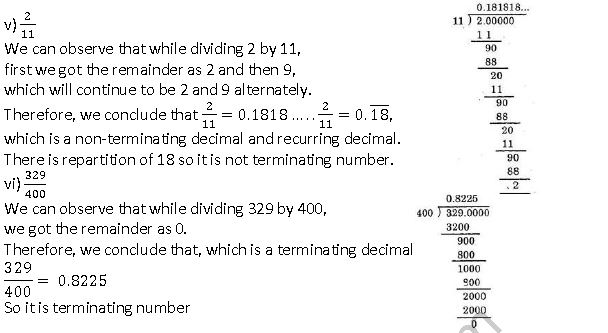
v) 2/11
vi) 329/400


Q.3) Express the following in the form 𝑝/𝑞, where p and q are integers and 𝑞 ≠ 0.

Sol.3) (i) 0.6 = 0.666...
Let 𝑥 = 0.666. . .
10𝑥 = 6.666. . .
10𝑥 = 6 + 𝑥
9𝑥 = 6
𝑥 = 2/3
(ii) 0.47 = 0.4777. . .
= 4/10 + 0.777/10
𝐿𝑒𝑡 𝑥 = 0.777 …
10𝑥 = 7.777 …
10𝑥 = 7 + 𝑥
𝑥 = 7/9
4/10 + 0.777/10
= 4/10 + 7/90
= 36/90 + 7/90
= 43/90
(iii) 0.001 = 0.001001. ..
Let 𝑥 = 0.001001 …
1000𝑥 = 1.001001 …
1000𝑥 = 1 + 𝑥
999𝑥 = 1
𝑥 = 1/999
Q.4) Express 0.99999…in the form p/q. Are you surprised by your answer? With your teacher and classmates discuss why the answer makes sense.
Sol.4) Let x = 0.9999 …
10x = 9.9999 …
10x = 9 + x
9x = 9
x = 1
The difference between 1 and 0.999999 is 0.000001 which is negligible. Thus, 0.999 is too much near 1, Therefore, the 1 as answer can be justified.
Q.5) What can the maximum number of digits be in the repeating block of digits in the decimal expansion of 1/17 ? Perform the division to check your answer.
Sol.5) 1/17 = 0.0588235294117647
There are 16 digits in the repeating block of the decimal expansion of 1/17.
Division Check:
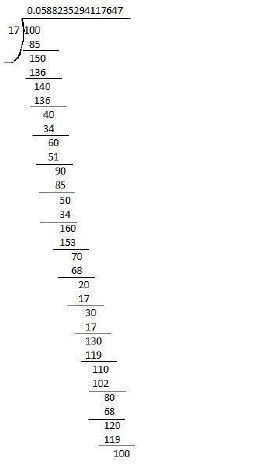
= 0.0588235294117647
Q.6) Look at several examples of rational numbers in the form p/q (q ≠ 0) where p and q are integers with no common factors other than 1 and having terminating decimal representations (expansions). Can you guess what property q must satisfy?
Sol.6) We observe that when 𝑞 is 2, 4, 5, 8, 10 … then the decimal expansion is terminating. For
example:
1/2 = 0.5, denominator q = 21
7/8 = 0.875, denominator q = 23
4/5 = 0.8, denominator q = 51
We can observed that terminating decimal may be obtained in the situation where prime factorisation of the denominator of the given fractions has the power of 2 only or 5 only or both.
Q.7) Write three numbers whose decimal expansions are non-terminating non-recurring
Sol.7) Three numbers whose decimal expansions are non-terminating non-recurring are:
0.303003000300003 …
0.505005000500005 …
0.7207200720007200007200000 …
Q.8) Find three different irrational numbers between the rational numbers 5/7 and 9/11.
Sol.8) 5/7 = 0.714285
9/11 = 0.81
Three different irrational numbers are:
0.73073007300073000073 …
0.75075007300075000075 …
0.76076007600076000076 …
Q.9) Classify the following numbers as rational or irrational:
(i) √23 (ii) √225 (iii) 0.3796 (iv) 7.478478
(v) 1.101001000100001 …
Sol.9) (i) √23 = 4.79583152331 …
Since the number is non-terminating non-recurring therefore, it is an irrational number.
(ii) √225 = 15 = 15/1
Since the number is rational number as it can represented in p/q form.
(iii) 0.3796
Since the number is terminating therefore, it is a rational number.
(iv) 7.478478 = 7.478
Since this number is non-terminating recurring, therefore, it is a rational number.
(v) 1.101001000100001 …
Since the number is non-terminating non-repeating, therefore, it is an irrational number.
Exercise 1.4
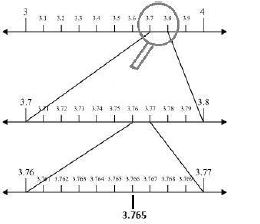
Q.1) Visualise 3.765 on the number line using successive magnification.
Sol.1) We know that the number 3.765 will lie between 3.764 and 3.766.
We know that the numbers 3.764 and 3.766 will lie between 3.76 and 3.77.
We know that the numbers 3.76 and 3.77 will lie between 3.7 and 3.8.
We know that the numbers 3.7 and 3.8 will lie between 3 and 4.
Therefore, we can conclude that we need to use the successive magnification, after locating numbers 3 and 4 on the number line.
Q.2) Visualise 4.26 on the number line, up to 4 decimal places.
Sol.2) We know that the number 4. ̅2̅6̅̅ can also be written as 4.262.
We know that the number will lie between 4.261 and 4.263.
We know that the numbers 4.261 and 4.263 will lie between 4.26 and 4.27.
We know that the numbers 4.26 and 4.27 will lie between 4.2 and 4.3.
We know that the numbers 4.2 and 4.3 will lie between 4 and 5.
Therefore, we can conclude that we need to use the successive magnification, after locating numbers 4 and 5 on the number line.
4.26 = 4.2626

Exercise 1.5
Q.1) Classify the following numbers as rational or irrational:
(i) 2 – √5 (ii) (3 + √23)– √23 (iii) 2√7/7√7
(iv) 1/√2 (v) 2𝜋
Sol.1) (i) 2 – √5 = 2 – 2.2360679 … = – 0.2360679 …
Since the number is non-terminating non-recurring therefore, it is an irrational number.
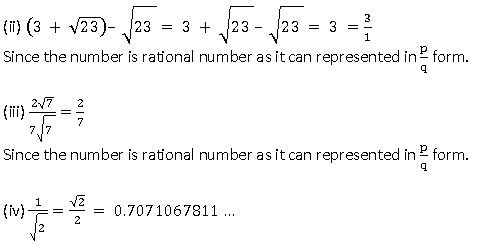
Since the number is rational number as it can represented in p/q form.
(iv) 1/√2 = √2/2 = 0.7071067811 …
Since the number is is non-terminating non-recurring therefore, it is an irrational number.
(v) 2𝜋 = 2 × 3.1415 … = 6.2830 …
Since the number is is non-terminating non-recurring therefore, it is an irrational number.
Q.2) Simplify each of the following expressions:
(i) (3 + √3)(2 + √2) (ii) (3 + √3)(3 – √3) (iii) (√5 + √2)2
(iv) (√5 – √2) (√5 + √2)
Sol.2) (i) (3 + √3) (2 + √2)
⇒ 3 × 2 + 2 + √3 + 3√2 + √3 × √2
⇒ 6 + 2√3 + 3√2 + √6
(ii) (3 + √3) (3 – √3) [∵ (a + b) (a – b) = a2– b2]]
⇒ 32 – (√3)2
⇒ 9 – 3
⇒ 6
(iii) (√5 + √2)2
[∵ (a + b)2
= a2 + b2 + 2ab]
⇒ (√5)2
+ (√2)2
+ 2 × √5 × √2
⇒ 5 + 2 + 2 × √5 × 2
⇒ 7 + 2√10
(iv) (√5 – √2) (√5 + √2) [∵ (a + b) (a – b) = a2 − b2]
⇒ (√5)2
− (√2)2
⇒ 5 – 2
⇒ 3
Q.3) Recall, 𝜋 is defined as the ratio of the circumference (say c) of a circle to its diameter (say d). That is, 𝜋 = 𝑐/𝑑. This seems to contradict the fact that 𝜋 is irrational. How will you resolve this contradiction?
Sol.3) There is no contradiction. When we measure a value with a scale, we only obtain an approximate value. We never obtain an exact value. Therefore, we may not realise that either c or d is irrational. The value of π is almost equal to 22/7 or 3.142857 …
Q.4) Represent √9.3 on the number line.
Sol.4) Step 1: Draw a line segment of unit 9.3. Extend it to C so that BC is of 1 𝑢𝑛𝑖𝑡.
Step 2: Now, 𝐴𝐶 = 10.3 𝑢𝑛𝑖𝑡𝑠. Find the centre of AC and name it as O.
Step 3: Draw a semi-circle with radius OC and centre O.
Step 4: Draw a perpendicular line BD to AC at point B which intersect the semicircle at D.
Also, Join OD.
Step 5: Now, OBD is a right angled triangle.
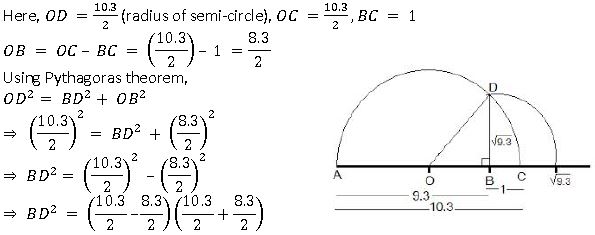
⇒ 𝐵𝐷2 = 9.3
⇒ 𝐵𝐷2 = √9.3
Thus, the length of BD is √9.3.
Step 6: Taking BD as radius and B as centre draw an arc which touches the line segment.
The point where it touches the line segment is at a distance of √9.3 from O as shown in the figure.
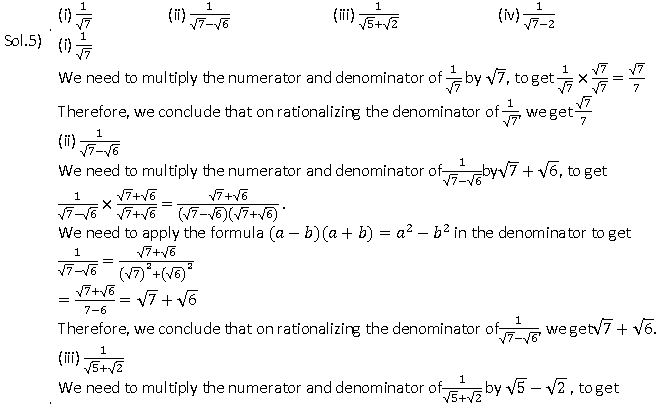
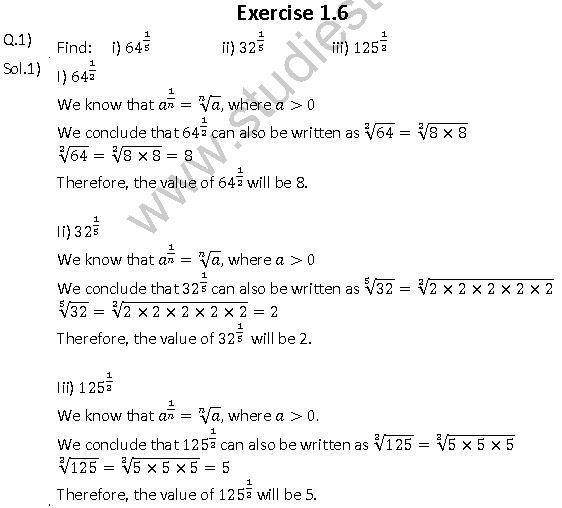
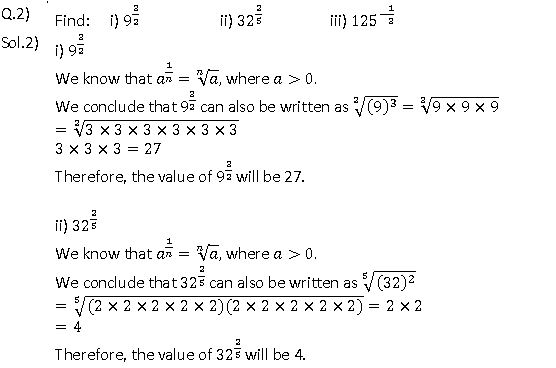
Q.5) Rationalise the denominators of the following:


Free study material for Mathematics
Free NCERT Textbook Explanations: Class 9 Mathematics Chapter 01 Number Systems
Accessing Chapter 01 Number Systems Solutions
Review comprehensive exercise answers for Class 9 Mathematics Chapter 01 Number Systems. Fully updated to match current NCERT syllabus guidelines, these textbook solutions help students verify their work and maintain accurate study notes.
Concept-Driven Answers for Class 9 Mathematics
Clear, methodical explanations accompany every challenging problem within the Class 9 Mathematics text. Engaging with these detailed answers lays a solid foundation for advanced learning and improves foundational clarity for upcoming assessments.
Maximizing Study Efficiency
These resources act as an effective roadmap for daily homework tasks and independent study. Supplement your review of Chapter 01 Number Systems with official sample papers and interactive practice tests available on our platform free of charge.
FAQs
The complete and updated NCERT Solutions Class 9 Mathematics Chapter 1 Number Systems is available for free on StudiesToday.com. These solutions for Class 9 Mathematics are as per latest NCERT curriculum.
Yes, our experts have revised the NCERT Solutions Class 9 Mathematics Chapter 1 Number Systems as per 2026 exam pattern. All textbook exercises have been solved and have added explanation about how the Mathematics concepts are applied in case-study and assertion-reasoning questions.
Toppers recommend using NCERT language because NCERT marking schemes are strictly based on textbook definitions. Our NCERT Solutions Class 9 Mathematics Chapter 1 Number Systems will help students to get full marks in the theory paper.
Yes, we provide bilingual support for Class 9 Mathematics. You can access NCERT Solutions Class 9 Mathematics Chapter 1 Number Systems in both English and Hindi medium.
Yes, you can download the entire NCERT Solutions Class 9 Mathematics Chapter 1 Number Systems in printable PDF format for offline study on any device.