

NCERT Solutions for Class 9 Mathematics: Chapter 11 Construction
Access comprehensive textbook solutions for Chapter 11 Construction using the official curriculum guides for Class 9 Mathematics. Designed to align with the 2026-27 NCERT standards, these detailed answers help students reinforce core academic concepts.
Practice Class 9 Mathematics Solutions: Chapter 11 Construction
Navigate directly to the solved Mathematics textbook exercises using the digital viewer below. Each solution includes detailed step-by-step explanations, allowing students to instantly cross-check their work and identify areas requiring further revision.
Exercise 11.1
Q.1) Construct an angle of 90° at the initial point of a given ray and justify the construction.
Sol.1) Steps of construction:
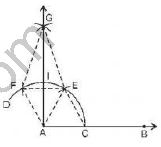
i) Let us take a ray AB with initial point A.
ii) Taking A as a centre & some radius, draw an arc of a circle, which intersects AB at C.
iii) With C as centre & the same radius as before, draw an arc, intersecting the previous arc at E.
iv) With E as a centre as a same radius, as before, draw an arc, which intersects the arc drawn in step (ii) at F.
v) With E as a centre & some radius draw an arc.
vi) With F as centre & the same radius as before, draw another arc, intersecting the previous arc at G.
vii) Draw the ray AG. Then ∠BAG is the required angle of 90°.
Justification:
Join 𝐴𝐸, 𝐶𝐸, 𝐸𝐹, 𝐹𝐺 AND 𝐺𝐸.
𝐴𝐶 = 𝐶𝐸 = 𝐴𝐸 (By construction)
⇒ ΔACE is an equilateral triangle.
⇒ ∠CAE = 60° (i)
Similarly, ∠AEF = 60° (ii)
From (i) & (ii), 𝐹𝐸||AC (iii) (Alternate angles are equal)
Also, 𝐹𝐺 = 𝐸𝐺 (By construction)
⇒ G lies on a perpendicular bisector of EF.
⇒ ∠GIE = 90° (iv)
∴ ∠GAB = ∠GIE = 90° (corresponding angles)
𝐺𝐹 = 𝐺𝐸 (arcs of equal radii)
Q.2) Construct an angle of 45°at the initial point of a given ray and justify the construction.
Sol.2) Steps of construction:
1. Draw a ray OA.
2. With O as centre and any suitable radius draw an arc cutting OA at B.
3. With B as centre and same radius cut the previous drawn arc at C and then with C as centre and same radius cut the arc at D.
4. With C as centre and radius more than half CD draw an arc.
5. With D as centre and same radius draw another arc to cut the previous arc at E.
6. Join OE. Then ∠AOE = 90°
7. Draw the bisector 𝑂𝐹 of ∠AOE. Then ∠AOF = 45°

Justification :
By construction ∠AOE = 90° and OF is the bisector of ∠AOE.
Therefore, ∠AOF = ∠AOE = 1/2 × 90° = 45°.
Q.3) Construct the angles of the following measurements:
i) 30° (ii) 22(1/2°)
(iii) 15°
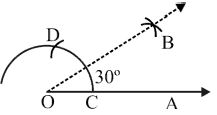
Sol.3) (i) Steps of construction:
1. Draw a ray OA.
2. With its initial point O as centre and any radius, draw an arc, cutting OA at C.
3. With centre C and Same radius (as in step 2). Draw an arc, cutting the arc of step 2 in D.
4. With C and D as centers, and any convenient radius
(more than 1/2 𝐶𝐷), draw two arcs intersecting at B.
5. Join OB. Then ∠AOB = 30°.
(ii) Steps of Construction :
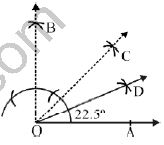
1. Draw an angle 𝐴𝑂𝐵 = 90°
2. Draw the bisector OC of ∠AOB, then ∠AOC = 45°.
3. Bisect ∠AOD, such that ∠AOD = ∠COD = 22.5°.
Thus ∠AOD = 22.5°.
(iii) Steps of Construction :
1. Construct an ∠AOB = 60°.
2. Bisect ∠AOB so that ∠AOC = ∠BOC = 30°.
3. Bisect ∠AOD, so that ∠AOD = ∠COD = 15°.
Thus ∠AOD = 15°.

Q.4) Construct the following angles and verify by measuring them by a protractor :
(i) 75° (ii) 105° (iii) 135°
Sol.4) i) 75°
Steps of constructions:
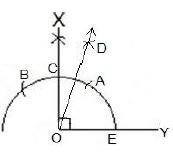
Step 1: A ray OY is drawn.
Step 2: An arc BAE is drawn with O as a center.
Step 3: With E as a center, two arcs are A and C are made on the arc BAE.
Step 4: With A and B as center, arcs are made to intersect at
X and ∠XOY = 90° is made.
Step 5: With A and C as center, arcs are made to intersect at D
Step 6: OD is joined and ∠DOY = 75° is constructed.
Thus, ∠DOY is the required angle making 75° with OY.
ii) 105°
Steps of constructions:
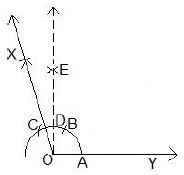
Step 1: A ray OY is drawn.
Step 2: An arc ABC is drawn with O as a center.
Step 3: With A as a center, two arcs are B and C
are made on the arc ABC.
Step 4: With B and C as center, arcs are made to
intersect at E and ∠𝐸𝑂𝑌 = 90° is made.
Step 5: With B and C as center, arcs are made to intersect at X
Step 6: OX is joined and ∠𝑋𝑂𝑌 = 105° is constructed.
Thus, ∠XOY is the required angle making 105° with OY.
iii) 135°
Steps of constructions:
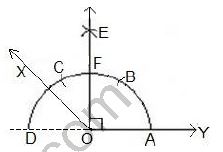
Step 1: A ray DY is drawn.
Step 2: An arc ACD is drawn with O as a center.
Step 3: With A as a center, two arcs are B and C
are made on the arc ACD.
Step 4: With B and C as center, arcs are made to
intersect at E and ∠𝐸𝑂𝑌 = 90° is made.
Step 5: With F and D as center, arcs are made to intersect at X or bisector of ∠𝐸𝑂𝐷 is constructed.
Step 6: OX is joined and ∠𝑋𝑂𝑌 = 135° is constructed.
Thus, ∠𝑋𝑂𝑌 is the required angle making 135° with DY
Q.5) Construct an equilateral triangle, given its side and justify the construction.
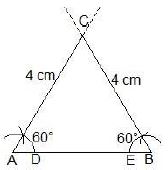
Sol.5) Steps of constructions:
Step 1: A line segment 𝐴𝐵 = 4 𝑐𝑚 is drawn.
Step 2: With A and B as centres, two arcs are made.
Step 4: With D and E as centres, arcs are made to cut the previous arc respectively and forming angle of 60° each.
Step 5: Lines from A and B are extended to meet each other at C.
Thus, ABC is the required triangle formed.
Justification:
By construction,
𝐴𝐵 = 4 𝑐𝑚, ∠𝐴 = 60° and ∠𝐵 = 60°
We know that,
∠𝐴 + ∠𝐵 + ∠𝐶 = 180° (Sum of the angles of a triangle)
⇒ 60° + 60° + ∠𝐶 = 180°
⇒ 120° + ∠𝐶 = 180°
⇒ ∠𝐶 = 60°
𝐵𝐶 = 𝐶𝐴 = 4 𝑐𝑚 (Sides opposite to equal angles are equal)
𝐴𝐵 = 𝐵𝐶 = 𝐶𝐴 = 4 𝑐𝑚
∠𝐴 = ∠𝐵 = ∠𝐶 = 60°
Exercise 11.2
Q.1) Construct a triangle ABC in which 𝐵𝐶 = 7𝑐𝑚, ∠𝐵 = 75° and 𝐴𝐵 + 𝐴𝐶 = 13 𝑐𝑚.
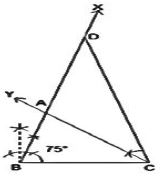
Sol.1) Steps of Construction:
Step 1: A line segment BC of 7 cm is drawn.
Step 2: At point B, an angle ∠𝑋𝐵𝐶 is constructed
such that it is equal to 75°.
Step 3: A line segment 𝐵𝐷 = 13 𝑐𝑚
is cut on BX (which is equal to AB+AC).
Step 3: DC is joined and ∠𝐷𝐶𝑌 = ∠𝐵𝐷𝐶 is made.
Step 4: Let CY intersect BX at A.
Thus, 𝛥𝐴𝐵𝐶 is the required triangle.
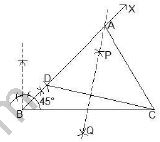
Q.2) Construct a triangle ABC in which 𝐵𝐶 = 8𝑐𝑚, ∠𝐵 = 45° and 𝐴𝐵 – 𝐴𝐶 = 3.5 𝑐𝑚.
Sol.2) Steps of Construction:
Step 1: A line segment 𝐵𝐶 = 8 𝑐𝑚 is drawn and at point B,
make an angle of 45° i.e. ∠𝑋𝐵𝐶.
Step 2: Cut the line segment 𝐵𝐷 = 3.5 𝑐𝑚
(equal to AB – AC) on ray BX.
Step 3: Join DC and draw the perpendicular bisector PQ of DC.
Step 4: Let it intersect BX at point A. Join AC.
Thus, 𝛥𝐴𝐵𝐶 is the required triangle.
Q.3) Construct a triangle PQR in which 𝑄𝑅 = 6𝑐𝑚, ∠𝑄 = 60° and 𝑃𝑅 – 𝑃𝑄 = 2𝑐𝑚.
Sol.3) Steps of Construction:
Step 1: A ray 𝑄𝑋 is drawn and cut off a line
segment 𝑄𝑅 = 6 𝑐𝑚 from it.
Step 2:. A ray QY is constructed making an angle
of 60° with QR and YQ is produced to form a line 𝑌𝑄𝑌’
Step 3: Cut off a line segment 𝑄𝑆 = 2𝑐𝑚
from 𝑄𝑌’. 𝑅𝑆 is joined.
Step 5: Draw perpendicular bisector of RS intersecting
QY at a point 𝑃. 𝑃𝑅 is joined.
Thus, 𝛥𝑃𝑄𝑅 is the required triangle.

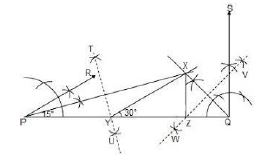
Q.4) Construct a triangle 𝑋𝑌𝑍 in which ∠𝑌 = 30°, ∠𝑍 = 90° and 𝑋𝑌 + 𝑌𝑍 + 𝑍𝑋 = 11 𝑐𝑚.
Sol.4) Steps of Construction:
Step 1: A line segment 𝑃𝑄 = 11 𝑐𝑚 is
drawn. (𝑋𝑌 + 𝑌𝑍 + 𝑍𝑋 = 11 𝑐𝑚)
Step 2: An angle, ∠𝑅𝑃𝑄 = 30° is constructed at point A
and an angle ∠𝑆𝑄𝑃 = 90° at point B.
Step 3: ∠𝑅𝑃𝑄 and ∠𝑆𝑄𝑃 are bisected . The bisectors of these
angles intersect each other at point 𝑋.
Step 4: Perpendicular bisectors TU of 𝑃𝑋 and WV of 𝑄𝑋 are constructed.
Step 5: Let TU intersect PQ at Y and 𝑊𝑉 intersect PQ at Z.
Step 6: XY and XZ are joined.
Thus, 𝛥𝑋𝑌𝑍 is the required triangle.
Q.5) Construct a right triangle whose base is 12𝑐𝑚 and sum of its hypotenuse and other side is 18 cm
Sol.5) Steps of Construction:
Step 1: A ray 𝐵𝑋 is drawn and a cut off a line segment 𝐵𝐶 = 12 𝑐𝑚 is made on it.
Step 2: ∠𝑋𝐵𝑌 = 90° is constructed.
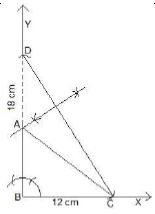
Step 3: Cut off a line segment 𝐵𝐷 = 18 𝑐𝑚 is made on 𝐵𝑌. 𝐶𝐷 is joined.
Step 4: Perpendicular bisector of CD is constructed intersecting BD at 𝐴.
Step 5: 𝐴𝐶 is joined.
Thus, 𝛥𝐴𝐵𝐶 is the required triangle.
Free study material for Mathematics
Mathematics Class 9 Curriculum Solutions: Chapter 11 Construction
Accessing Chapter 11 Construction Solutions
Access structured NCERT textbook solutions for Chapter 11 Construction. Designed in alignment with the latest academic curriculum for Class 9 Mathematics, these answers cover all end-of-chapter exercises to support daily learning and homework completion.
Concept-Driven Answers for Class 9 Mathematics
Each solution includes detailed reasoning to foster genuine comprehension of Chapter 11 Construction concepts. Reviewing these step-by-step breakdowns allows learners to master both analytical and descriptive questions expected in school evaluations.
Maximizing Study Efficiency
Frequent review of these structured answers builds strong analytical capabilities and response efficiency. Maximize your academic readiness by combining these textbook solutions with our curated study materials and mock evaluations for Class 9 Mathematics.
FAQs
The complete and updated NCERT Solutions Class 9 Mathematics Chapter 11 Construction is available for free on StudiesToday.com. These solutions for Class 9 Mathematics are as per latest NCERT curriculum.
Yes, our experts have revised the NCERT Solutions Class 9 Mathematics Chapter 11 Construction as per 2026 exam pattern. All textbook exercises have been solved and have added explanation about how the Mathematics concepts are applied in case-study and assertion-reasoning questions.
Toppers recommend using NCERT language because NCERT marking schemes are strictly based on textbook definitions. Our NCERT Solutions Class 9 Mathematics Chapter 11 Construction will help students to get full marks in the theory paper.
Yes, we provide bilingual support for Class 9 Mathematics. You can access NCERT Solutions Class 9 Mathematics Chapter 11 Construction in both English and Hindi medium.
Yes, you can download the entire NCERT Solutions Class 9 Mathematics Chapter 11 Construction in printable PDF format for offline study on any device.