

Step-by-Step Textbook Solutions for Class 9 Mathematics Chapter 05 Introduction to Euclids Geometry
Access comprehensive textbook solutions for Chapter 05 Introduction to Euclids Geometry using the official curriculum guides for Class 9 Mathematics. Designed to align with the 2026-27 NCERT standards, these detailed answers help students reinforce core academic concepts.
Download Chapter 05 Introduction to Euclids Geometry Textbook Solutions PDF
Navigate directly to the solved Mathematics textbook exercises using the digital viewer below. Each solution includes detailed step-by-step explanations, allowing students to instantly cross-check their work and identify areas requiring further revision.
Exercise 5.1
Q.1) Which of the following statements are true and which are false? Give reasons for your answers.
(i) Only one line can pass through a single point.
(ii) There are an infinite number of lines which pass through two distinct points.
(iii) A terminated line can be produced indefinitely on both the sides.
(iv) If two circles are equal, then their radii are equal.
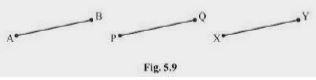
(v) In the Fig.5.9, if AB = PQ and PQ = XY, then AB = XY.
Sol.1) (i) False. Infinitely many lines can pass through a point in different directions.
(ii) False. Through two distinct points only one line can pass.
(iii) True. A terminated line or line segment can be produced indefinitely on both sides to give a line.
(iv) True. Two circles of equal area (i.e., equal circles) will have the same radius from the relation area = 𝜋𝑟2
(v) True. From the axiom that if two things are, separately, equal to a third thing, then, they are equal to each other.
Q.2) Give a definition for each of the following terms. Are there other terms that need to be defined first? What are they, and how might you define them?
(i) parallel lines (ii) perpendicular lines (iii) line segment
(iv) radius of a circle (v) square
Sol.2) (i) Parallel lines : Two straight lines which have no point in common are said to be parallel to each other.
‘Point’ and ‘straight line’ will have to be defined first. ‘Point’ and ‘straight line’ as defined in
Euclid’s text are :
A point is that which has no part.
A line is breadthless length and a straight line is a line which lies evenly with the points on itself.
(ii) Perpendicular lines : If one among two parallel lines is turned by 90°, the two lines become perpendicular to each other. Parallel lines has been defined before, ‘rotation through 90° needs further defining. Rotation may be assumed as an intuition therefore, cannot be used.
(iii) Line segment : A line with two end points is a line segment. ‘Line’ and ‘point’ have been defined before.
(iv) Radius of a circle : The line segment with one end point at the centre and the other at any point on the circle.
‘Centre’ may be defined (assuming inside) as a point inside the circle which is at the same
distance from all points on the circle.
(v) Square : A quadrilateral with all sides equal and all angles right angles is a square.
A quadrilateral is a figure with four sides. ‘Figure’, ‘side’ and ‘angle’ may be assumed known.
Q.3) Consider two ‘postulates’ given below :
(i) Given any two distinct points A and B, there exists a third point C which is in between A and B.
(ii) There exist at least three points that are not on the same line.
Do these postulates contain any undefined terms? Are these postulates consistent? Do they follow from Euclid’s postulates? Explain.
Sol.3) In postulate
(i) ‘in between A and B’ remains an undefined term which appeals to our geometric intuition.
The postulates are consistent. They do not contradict each other. Both of these postulates do not follow from Euclid’s postulates However, they follow from the axiom given below.
Given two distinct points, there is a unique line that passes through them.
(i) Let A B be a straight line.
There are an infinite number of points composing this line. Choose any except the two endpoints
A and B. This point lies between A and B.
(ii) If there are only two points, they can always be connected by a straight line (From Euclid’s postulate). Therefore, there have to be at least three points for one of them not to fall on the straight line between the other two.
Q.4) If a point C lies between two points A and B such that AC = BC, then prove that 𝐴𝐶 = 1/2 𝐴𝐵.
Explain by drawing the figure.
Sol.4)

Here, AC = BC
Now, adding AC both sides.
AC + AC = BC + AC
also, BC +AC = AB (as it coincides with line segment AB)
∴ 2 𝐴𝐶 = 𝐴𝐵 (If equals are added to equals, the wholes are equal.)
⇒ 𝐴𝐶 = 1/2 𝐴𝐵.
Q.5) In Question 4, point C is called a mid-point of line segment AB. Prove that every line segment has one and only one mid-point.
Sol.5) Let A and B be the line segment and points P and Q be two different mid points of AB.
Now,
∴ P and Q are midpoints of AB.
Therefore AP=PB and also AQ = QB.
also, PB + AP = AB (as it coincides with line segment AB)
Similarly, QB + AQ = AB.
Now,
AP + AP = PB + AP (If equals are added to equals, the wholes are equal.)
⇒ 2 AP = AB — (i)
Similarly,
2 AQ = AB — (ii)
From (i) and (ii)
2 AP = 2 AQ (Things which are equal to the same thing are equal to one another.)
⇒ AP = AQ (Things which are double of the same things are equal to one another.)
Thus, P and Q are the same points. This contradicts the fact that P and Q are two different mid
points of AB. Thus, it is proved that every line segment has one and only one mid-point.
Q.6) In Fig., if AC = BD, then prove that AB = CD.

Sol.6) Given, AC = BD
From the figure,
AC = AB + BC
BD = BC + CD
⇒ AB + BC = BC + CD
According to Euclid’s axiom, when equals are subtracted from equals, remainders are also equal.
Subtracting BC both sides,
AB + BC – BC = BC + CD – BC
AB = CD
Q.7) Why is Axiom 5, in the list of Euclid’s axioms, considered a ‘universal truth’? (Note that the question is not about the fifth postulate.)
Sol.7) Axiom 5 : ‘Whole is always greater than its part.’
This is a ‘universal truth’ because part is included in the whole and therefore can never be greater than the whole in magnitude.
Exercise 5.2
Q.1) How would you rewrite Euclid’s fifth postulate so that it would be easier to understand?
Sol.1) The fifth postulate is about parallel lines.
When two or more never intersect each other in a plane and perpendicular distance between
them is always constant then they are said to be parallel lines.
Two facts of the postulates:
(i) If P doesn’t lie on l then we can draw a line through P which will be parallel to the line 𝑙.
(ii) There will be only one line can be drawn through P which is parallel to the line 𝑙.
Q.2) Does Euclid’s fifth postulate imply the existence of parallel lines? Explain.
Sol.2) Yes, Euclid’s fifth postulate implies the existence of parallel lines.
If the sum of the interior angles will be equal to sum of the two right angles then two lines will not meet each other on either sides and therefore they will be parallel to each other.
𝑚 and 𝑛 will be parallel if
∠1 + ∠3 = 180°
Or ∠3 + ∠4 = 180°
Free study material for Mathematics
Step-by-Step Textbook Answers: Class 9 Mathematics Chapter 05 Introduction to Euclids Geometry
Accessing Chapter 05 Introduction to Euclids Geometry Solutions
Explore reliable textbook solutions for Chapter 05 Introduction to Euclids Geometry tailored for Class 9 learners. Utilizing these complete exercise answers ensures your preparation aligns exactly with official NCERT standards for Mathematics.
Concept-Driven Answers for Class 9 Mathematics
Beyond providing final answers, these guides offer step-by-step breakdowns for complex queries in the Class 9 Mathematics module. This approach helps students balance theoretical depth with practical problem-solving skills required for NCERT exams.
Maximizing Study Efficiency
These resources act as an effective roadmap for daily homework tasks and independent study. Supplement your review of Chapter 05 Introduction to Euclids Geometry with official sample papers and interactive practice tests available on our platform free of charge.
FAQs
The complete and updated NCERT Solutions Class 9 Mathematics Chapter 5 Introduction to Euclid's Geometry is available for free on StudiesToday.com. These solutions for Class 9 Mathematics are as per latest NCERT curriculum.
Yes, our experts have revised the NCERT Solutions Class 9 Mathematics Chapter 5 Introduction to Euclid's Geometry as per 2026 exam pattern. All textbook exercises have been solved and have added explanation about how the Mathematics concepts are applied in case-study and assertion-reasoning questions.
Toppers recommend using NCERT language because NCERT marking schemes are strictly based on textbook definitions. Our NCERT Solutions Class 9 Mathematics Chapter 5 Introduction to Euclid's Geometry will help students to get full marks in the theory paper.
Yes, we provide bilingual support for Class 9 Mathematics. You can access NCERT Solutions Class 9 Mathematics Chapter 5 Introduction to Euclid's Geometry in both English and Hindi medium.
Yes, you can download the entire NCERT Solutions Class 9 Mathematics Chapter 5 Introduction to Euclid's Geometry in printable PDF format for offline study on any device.