

Download NEET MCQs for NEET Physics: Work Energy
Access targeted multiple-choice questions for Work Energy designed to align with the latest NEET academic syllabus for NEET Physics. These objective practice sets help students evaluate their conceptual understanding and improve exam readiness.
Chapter-wise Objective Questions: Work Energy
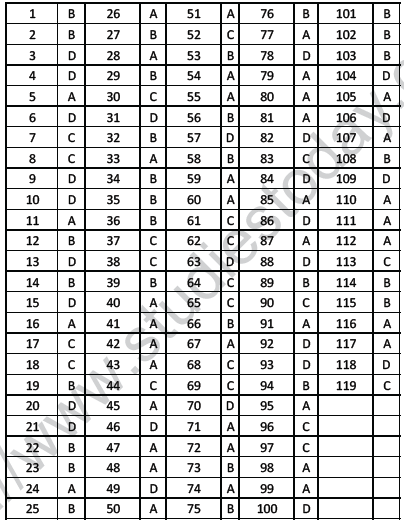
Navigate directly to the 50 objective questions for Work Energy using the digital viewer below. Each practice set includes verified answer keys, allowing students to instantly cross-check their work and identify areas requiring further revision.
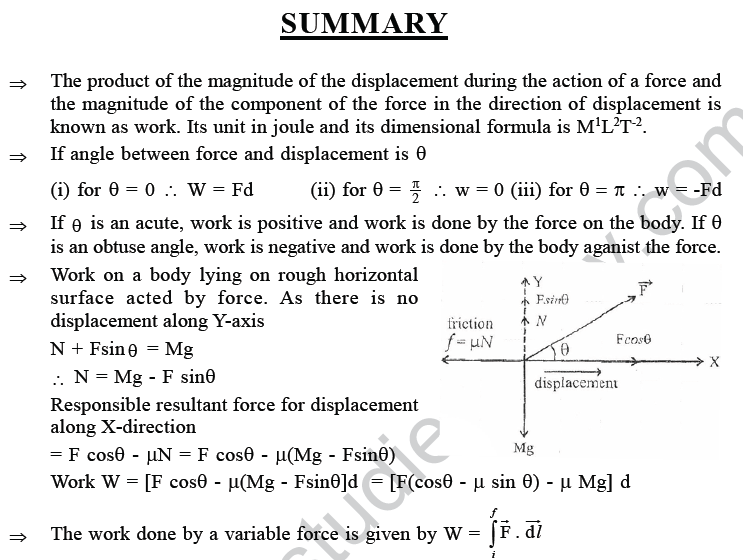
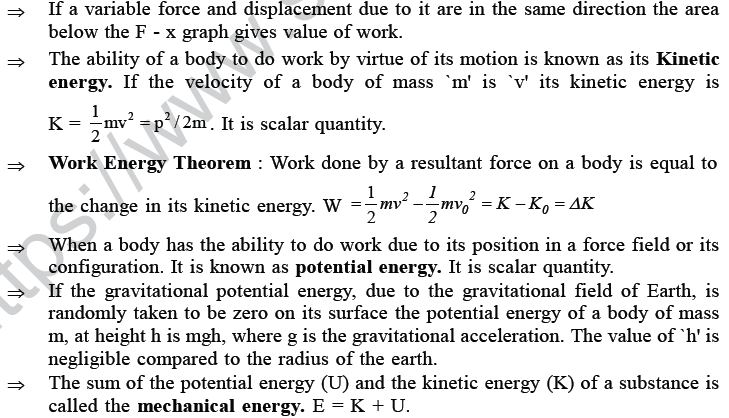
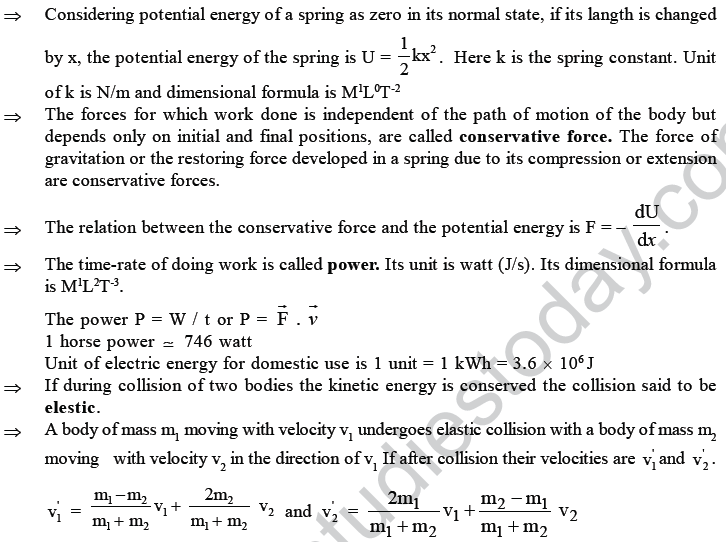
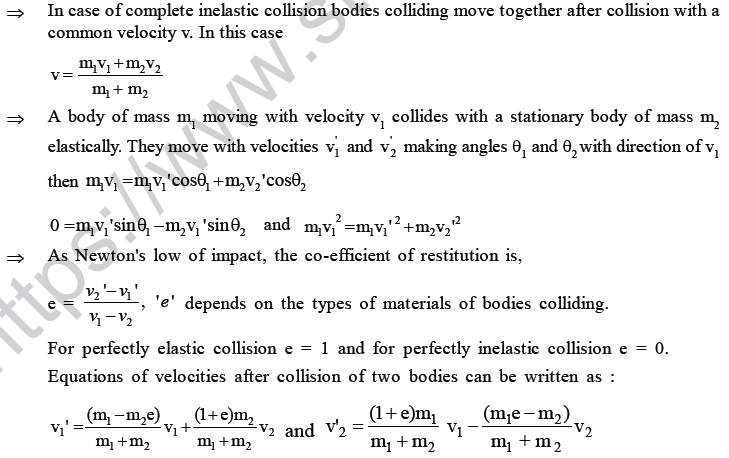
For the answer of the following questions choose the correct alternative from among the given ones.
1. How much is the work done in pulling up a block of wood weighing 2KN for a length of 10m on a smooth plane inclined at an angle of 30o with the horizontal ?
(A) 1.732 KJ (B) 17.32 KJ (C) 10 KJ (D) 100 KJ
2. A force of 7N, making an angle θ with the horizontal, acting on an object displaces it by 0.5m along the horizontal direction. If the object gains K.E. of 2J, what is the horizontal component of the force ?
(A) 2N (B) 4 N (C) 1 N (D) 14 N
3. A 60 kg JATAN with 10 kg load on his head climbs 25 steps of 0.20m height each. what is the work done in climbing ? (g = 10 m/s2)
(A) 5 J (B) 350 J (C) 100J (D) 3500J
4. A ball of mass 5 kg is stiding on a plane with intial velocity of 10 m/s. If coefficient of friction between surface and ball is 1/2 , then before stopping it will describe...... (g = 10 m/s2)
(A) 12.5 m (B) 5 m (C) 7.5 m (D) 10 m
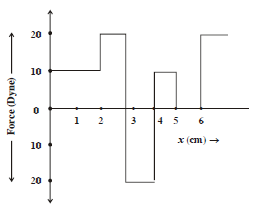
5. The relationship between force and position is shown in the figure given (in one dimensional case) calculate the work done by the force in displacing a body from x = 0 cm to x = 5 cm
(A) 30 ergs (B) 70 ergs (C) 20 ergs (D) 60 ergs
6. The force constant of a wire is K and that of the another wire is 3k when both thewires are stretched through same distance, if work done are W1 and W2, then...
(A) w2 = 3w12 (B) W2 = 0.33W1 (C) W2 = W1 (D) W2 = 3W1
7. A ball is released from the top of a tower. what is the ratio of work done by force of gravity in first, second and third second of the motion of the ball ? [hn α (2n – 1)]
(A) 1 : 2 : 3 (B) 1 : 4 : 9 (C) 1 : 3 : 5 (D) 1: 5 : 3
8. A spring of spring constant 103 N/m is stretched initially 4cm from the unstretched position. How much the work required to stretched it further by another 5 cm ?
(A) 6.5 NM (B) 2.5 NM (C) 3.25 NM (D) 6.75 NM
9. The mass of a car is 1000 kg. How much work is required to be done on it to make it move with a speed of 36 km/h ?
(A) 2.5×10⁴ J (B) 5×10³ J (C) 500 J (D) 5×10⁴ J
10. A body of mass 6 kg is under a force, which causes a displacement in it given by S = 2t3 /3 (in m). Find the work done by the force in first one seconds.
(A) 2 J (B) 3.8 J (C) 5.2 J (D) 24 J
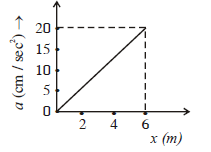
11. A 8 kg mass moves along x - axis. Its accelerations as a function of its position is shown in the figure. What is the total work done on the mass by the force as the mass moves from x = 0 to x = 6cm ?
(A) 48×10-3 J (B) 98× 10-3 J (C) 4.8×10⁻³ J (D) 9.8×10⁻³ J
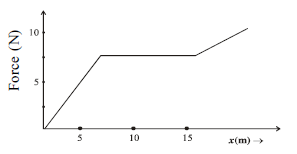
12. The work done by a force acting on a body is as shown in the graph.what is the total work done in covering an intial distance of 15m ?
(A) 50 J (B) 75 J (C) 100 J (D) 25 J
13. A spring gun of spring constant 90×102N /M is compressed 4cm by a ball of mass 16g. If the trigger is pulled, calculate the velocity of the ball.
(A) 60 m/s (B) 3 m/s (C) 90 m/s (D) 30 m/s
14. A uniform chain of length 2m is kept on a table such that a length of 50cm hangs freely from the edge of the table. The total mass of the chain is 5kg. What is the work done in pulling the entire chain on the table. (g = 10 m\s2)
(A) 7.2 J (B) 3 J (C) 4.6 J (D) 120 J
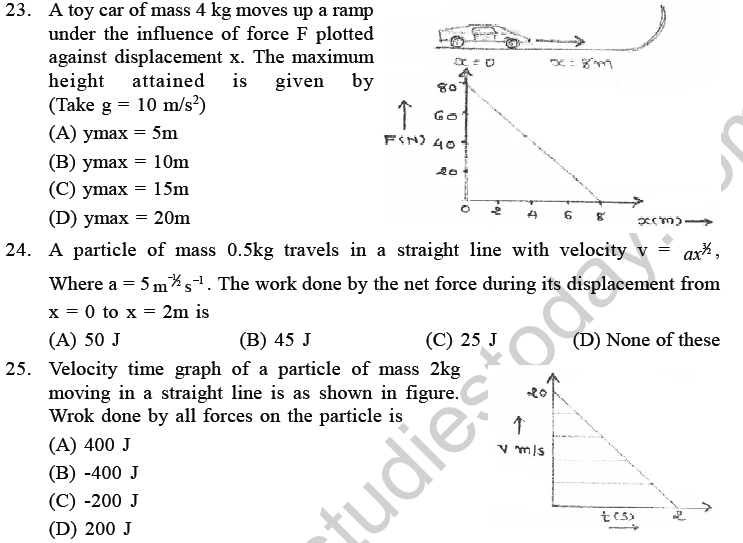
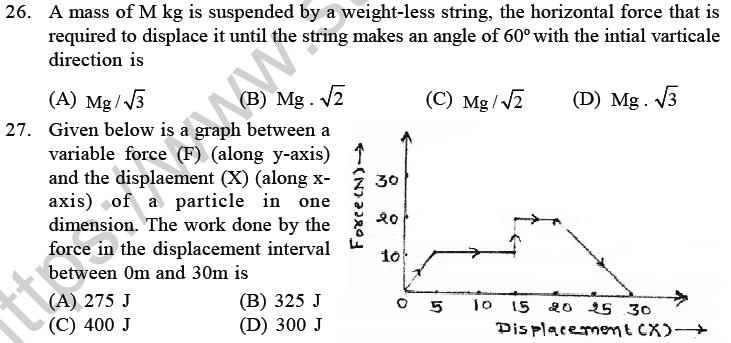
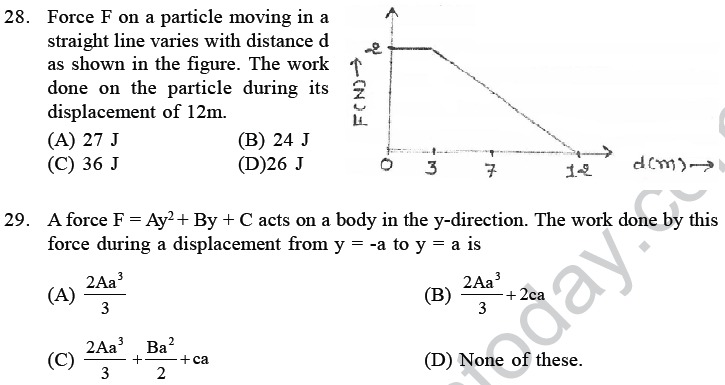
(ENERGY AND CONSERVATVE, NON CONSERVATIVE FORCE)
30. A spring with spring constant K when streched through 2cm the potential energy is U. If it is streched by 6cm. The potential energy will be _____
(A) 6U (B) 3U (C) 9U (D) 18U
31. If linear momentum of body is increased by 1.5%, its kinetic energy increases by ______
(A) 0% (B) 10% (C) 2.25% (D) 3%
32. With what velocity should a student of mass 40 kg run so that his kinetic energy becomes 160 J ?
(A) 4 m/s (B) √8 m/s (C) 16 m/s (D) 8 m/s
33. A body of mass 1 kg is thrown upwords with a velocity 20 m/s. It momentarily comes to rest after a height 18m. How much energy is lost due to air friction.
(g = 10 m/s2)
(A) 20 J (B) 30 J (C) 40 J (D) 10 J

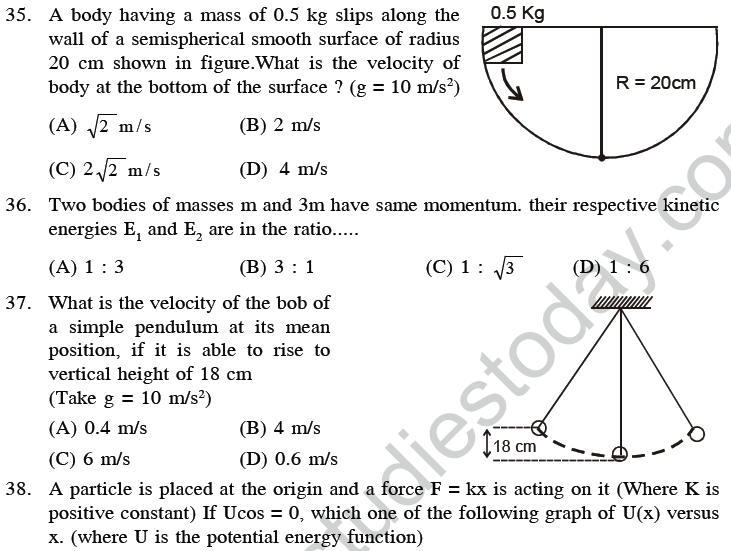
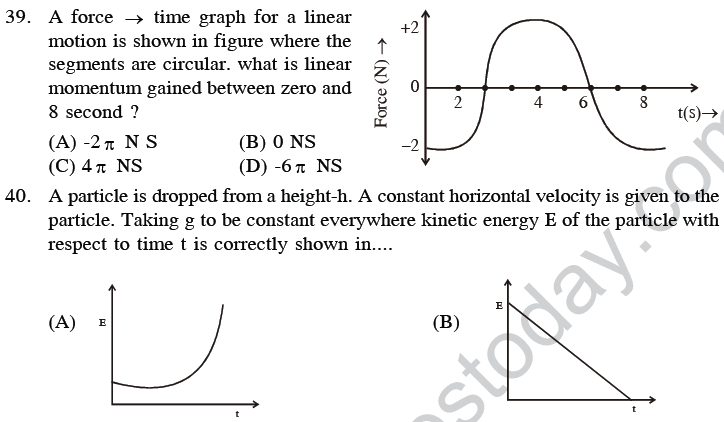
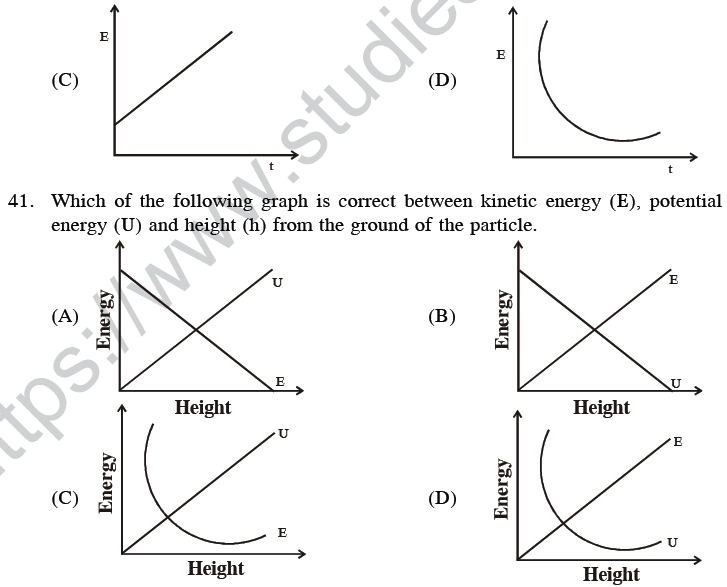
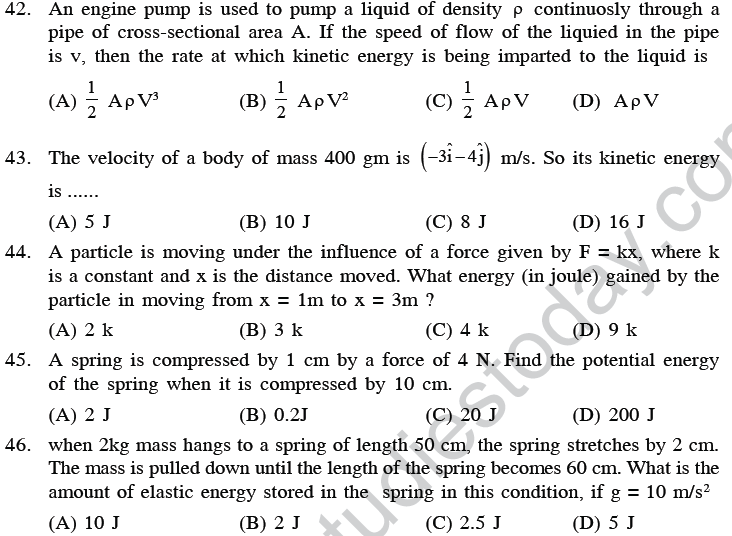
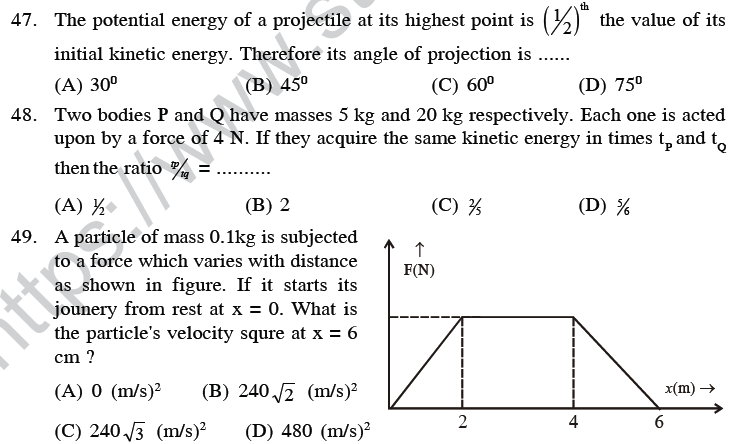
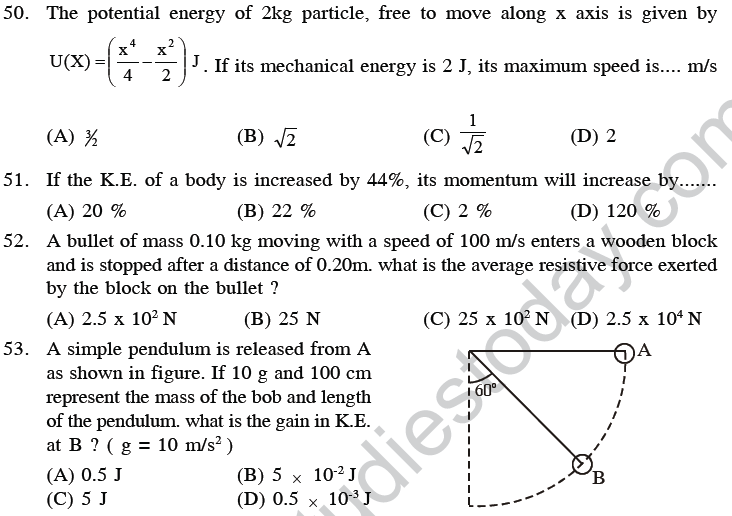
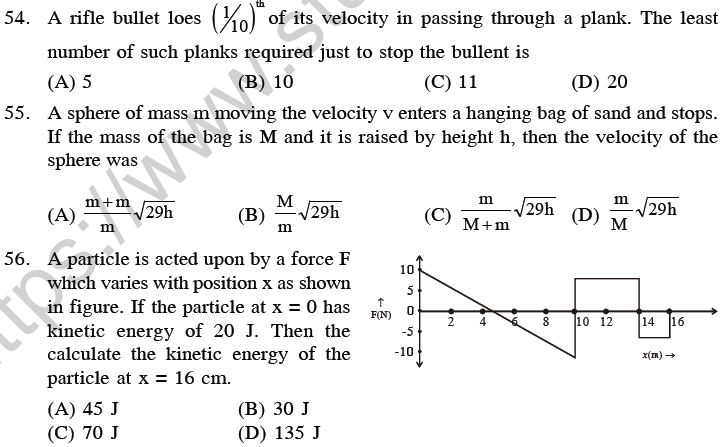
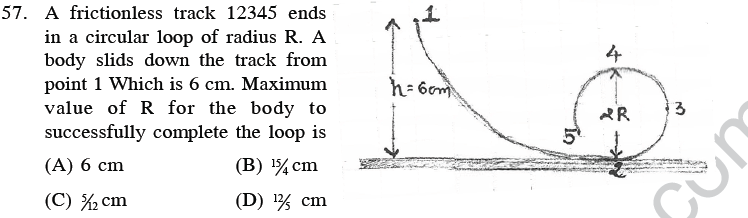
58. If the water falls from a dam into a turbine wheel 19.6m below, then the velocity of water at the turbine is ...... ( g = 9.8 m/s2)
(A) 9.8 m/s (B) 19.6 m/s (C) 39.2 m/s (D) 98.0 m/s
59. A bomb of 12 kg divedes in two parts whose ratio of masses is 1:4. If kinetic energy of smaller part is 288 J, then momentum of bigger part in kgm/sec will be
(A) 48 (B) 72 (C) 108 (D) Data is incomplete
60. An ice-cream has a marked value of 700kcal. How many kilo-watt-hour of energy will it deliver to the body as it is digested (J = 4.2 J/cal)
(A) 0.81 kwh (B) 0.90 kwh (C) 1.11 kwh (D) 0.71 kwh
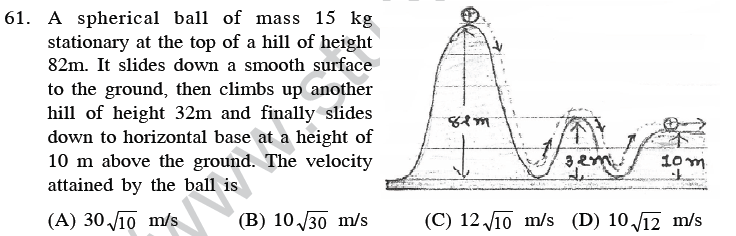
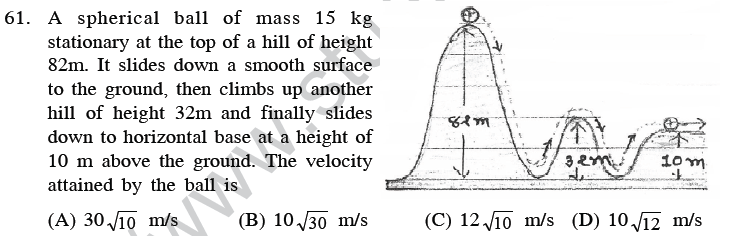
62. A bomb of mass 10 kg explodes into 2 pieces of mass 4 kg and 6 kg. The velocity of mass 4 kg is 1.5 m/s, the K.E. of mass 6 kg is ___
(A) 3.84 J (B) 9.6 J (C) 3.00 J (D) 2.5 J
63. A bomb of mass 3.0 kg explodes in air into two pieces of masses 2.0 kg and 1.0 kg. The smaller mass goes at a speed of 80m/s. The total energy imparted to the two fragments is
(A) 1.07 KJ (B) 2.14 KJ (C) 2.4 KJ (D) 4.8 KJ
64. The bob of simple pendulum (mass m and length l) dropped from a horizontal position strike a block of the same mass elastically placed on a horizontal frictionless table. The K.E. of the block will be
(A) 2 mgl (B) mgl /2 (C) mgl (D) zero
65. A gun fires a bullet of mass 40 g with a velocity of 50 m/s. Because of this the gun is pushed back with a velocity of 1 m/s. The mass of the gun is
(A) 1.5 kg (B) 3 kg (C) 2 kg (D) 2.5 kg
66. The decreases in the potential energy of a ball of mass 25 kg which falls from a height of 40 cm is
(A) 968 J (B) 100 J (C) 1980 J (D) 200 J
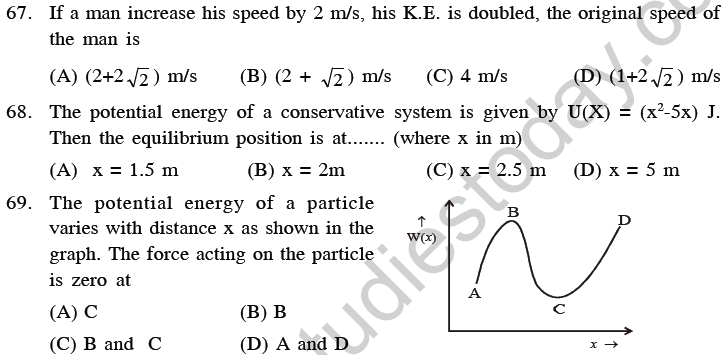
70. A nucleus at rest splits into two nuclear parts having same density and radii in the ratio 1:2. Their velocites are in the ratio
(A) 2:1 (B) 4:1 (C) 6:1 (D) 8:1
71. A body of mass 1.5 kg slide down a curved track which is quadrant of a circle of radias 0.75 meter. All the surfaces are frictionless. If the body starts from rest, its speed at the bottom of the track is ____ ( g = 10 m/s2)
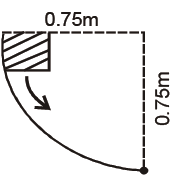
(A) 3. 87 m/s (B) 2 m/s
(C) 1.5 m/s (D) 0.387 m/s
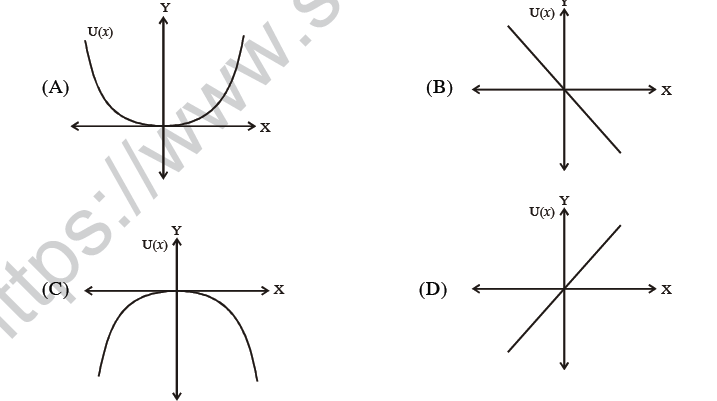
72. A single conservative force F(x) acts on a 2.5 kg particle that moves along the x-axis. The potential energy U(x) is given by U(x) = (10 + (x - 4)2) where x is in meter. At x = 6.0m the particle has kinetic energy of 20J. what is the mechanical energy of the system ?
(A) 34 J (B) 45 J (C) 48 J (D) 49 J
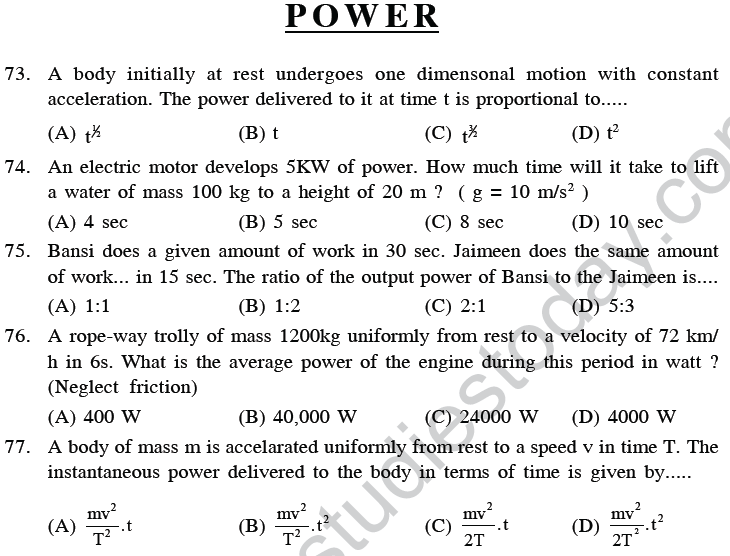
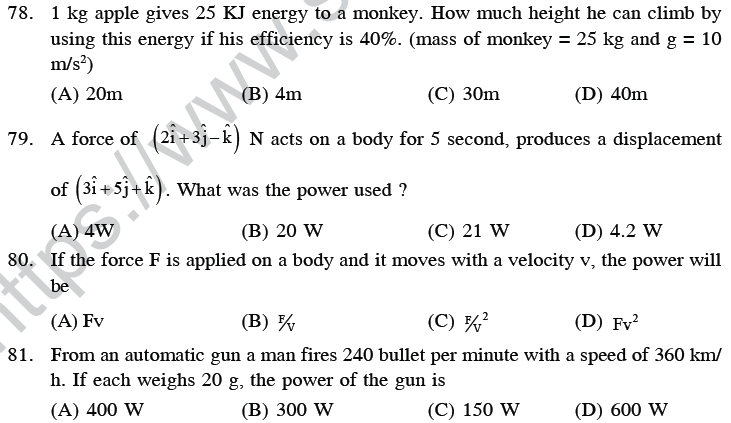
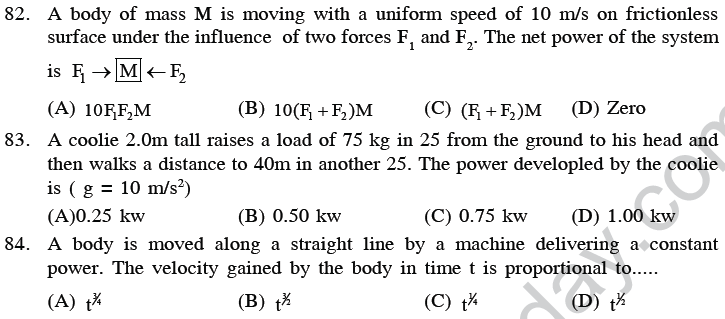
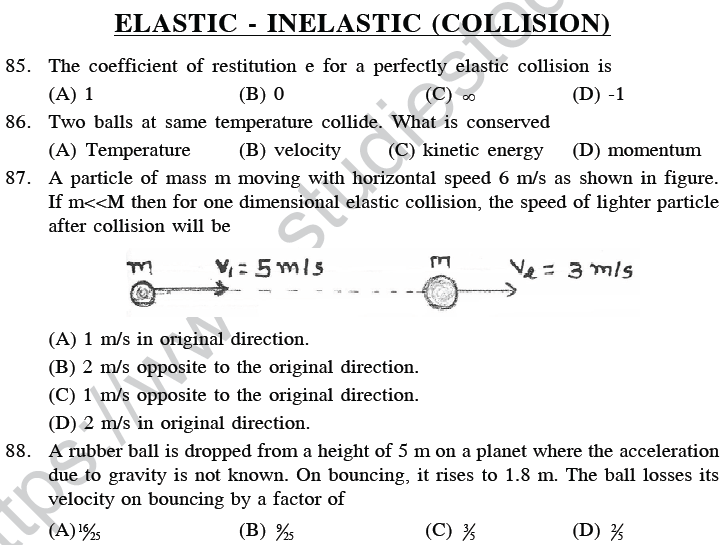
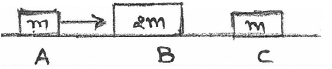
(A) 3 m/s
(B) 4 m/s
(C) 5 m/s (D) 1 m/s
90. Two solid rubber balls P and Q having masses 200 g and 400 g respectively are moving in opposite directions with velocity of P equal to 0.3 m/s. After collision the two balls come to rest, then the velocity of Q is
(A) 0.15 m/s (B) 1.5 m/s (C) -0.15 m/s (D) Zero
91. A sphere collides with another sphere of identical mass. After collision, the two sphere move. The collision is inelastic. Then the angle between the directions of the two spheres is
(A) Different from 90° (B) 90° (C) 0° (D) 45°
92. A ball is allowed to fall from a height 20m . If there is 30% loss of energy due to impact, then after one impact ball will go up to
(A) 18 m (B) 16 m (C) 12 m (D) 14 m
93. If a skater of weight 4 kg has intial speed 40 m/s and 2nd one of weight 6 kg has 6 m/s. After collision, they have speed (couple) 6 m/s. Then the loss in K.E. is ____
(A) 48 J (B) zero (C) 96 J (D) None of these
94. A metal ball of mass 2 kg moving with a velocity of 36 km/h has a head on collision with a stationary ball of mass 3 kg. If after the collision, the two balls move togather, the loss in kinetic energy due to collision is
(A) 40 J (B) 60 J (C) 100 J (D) 140 J
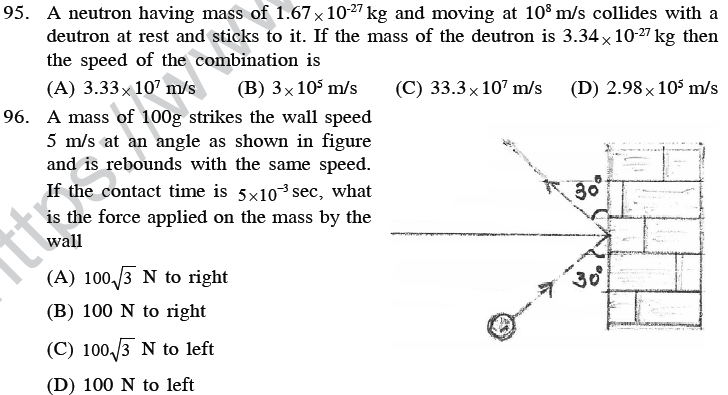
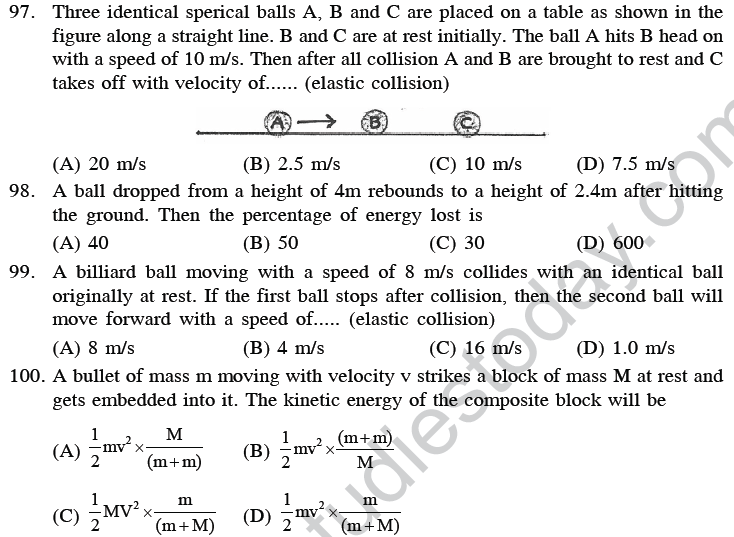
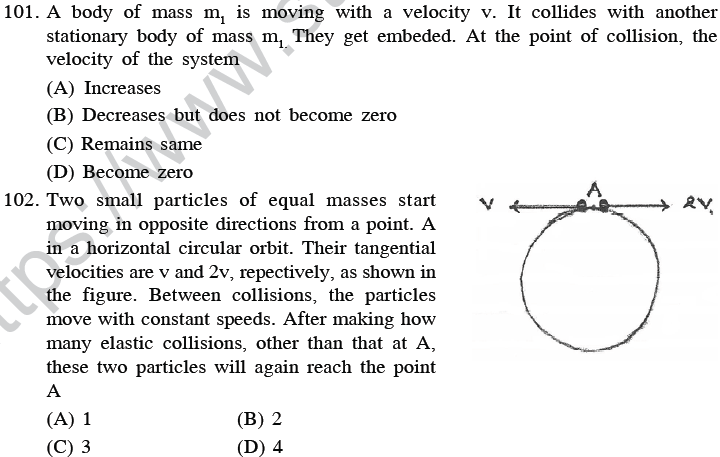
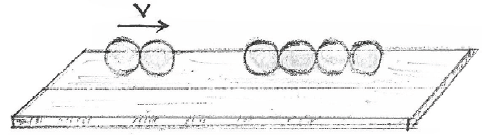
(A) One ball from the right rolls out with a speed 2v and the remaining balls will remain at rest.
(B) Two balls from the right roll out speed v each and the remaining balls will remain statinary.
(C) All the four balls in the row will roll out with speed v/4 each and the two colliding balls will come to rest.
(D) The colliding balls will come to rest and no ball rolls out from right.
(ASSERTION & REASON)
* Assertion and Reason are given in following questions. Each question have four option. One of them is correct it.
(1) If both assertion and reason and the reason is the correct explanation of the Assertion.
(2) If bothe assertion and reason are true but reason is not the correct explanation of the assertion.
(3) If the assertion is true but reason is false.
(4) If the assertion and reason both are fare.
104. Assertion : In the elastic collision between two bodies, the relative speed of the bodies after collision is equal to the relative speed before the collision.
Reason : In the elastic collision the linear momentum of the system is conserved.
(A)1 (B) 2 (C) 3 (D) 4
105. Assertion : When a gas is allowed to expand, work done by gas is positive.
Reason : Force due to gaseous pressure and displacement (of position) on in the same direction.
(A) 1 (B) 2 (C) 3 (D) 4
106. Assertion : A light body and heavy body have same momemtum. Then they also have same kinetic energy.
Reason : Kinetic energy does not depend on mass of the body.
(A) 1 (B) 2 (C) 3 (D) 4
107. Assertion : Mountain roads rarely go straight up the slope.
Reason : slope of mountains are large, therefore, more chances of vehicle to slip from roads.
(A) 1 (B) 2 (C) 3 (D) 4
108. Assertion : The change in kinetic energy of a particle is equal to the work done on it by the net force.
Reason : Change in kinetic energy of particle is equal to the work done only in case of a system of one particle.
(A) 1 (B) 2 (C) 3 (D) 4
109. Assertion : Work done in moving a body over a closed loop is zero for every force in nature.
Reason : Work done does not depend on nature of force.
(A) 1 (B) 2 (C) 3 (D) 4
110. Assertion : A weight lifter does no work in holding the weight up.
Reason : Work done is zero because distance moved is zero.
(A) 1 (B) 2 (C) 3 (D) 4
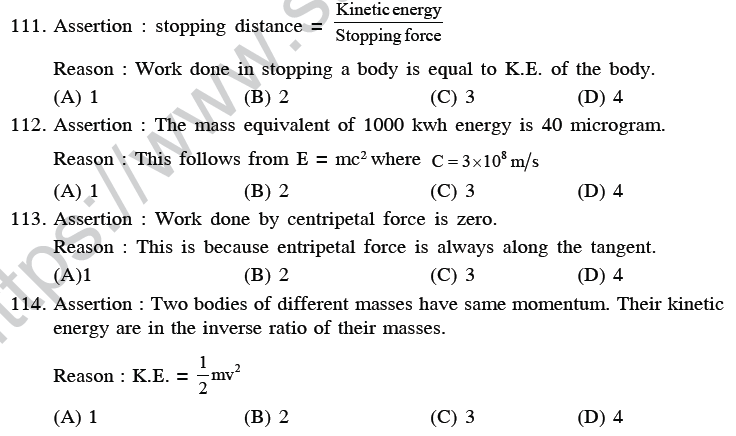
115. Assertion : Linear momentum is conserved in both, elastic and inelastic collisions.
Reason : Total energy is conserved in all such collisins.
(A) 1 (B) 2 (C) 3 (D) 4
116. Assertion : Both, a stretched spring and a compressed spring have potential energy.
Reason : Work is done against the restoring force in each case.
(A) 1 (B) 2 (C) 3 (D) 4
Work Energy Objective Questions & Solutions for NEET Physics
NEET Physics Work Energy Objective Test Questions
Explore reliable practice questions for Work Energy tailored for NEET Physics learners. Use these multiple-choice formats to evaluate preparedness and strengthen problem-solving skills.
NCERT-Aligned Objective Questions and Solutions
Each question includes structured solution keys mapped directly to standard NEET textbooks, helping students evaluate their reasoning and correct mistakes early in their revision.
Next Steps in Your Exam Preparation
Explore our broader library of printable assignments, chapter notes, and mock tests designed to support continuous revision and secure higher marks in NEET assessments.
FAQs
You can get most exhaustive NEET UG Physics Work Energy MCQs for free on StudiesToday.com. These MCQs for NEET Physics are updated for the 2026-27 academic session as per NEET examination standards.
Yes, our NEET UG Physics Work Energy MCQs include the latest type of questions, such as Assertion-Reasoning and Case-based MCQs. 50% of the NEET paper is now competency-based.
By solving our NEET UG Physics Work Energy MCQs, NEET students can improve their accuracy and speed which is important as objective questions provide a chance to secure 100% marks in the Physics.
Yes, Physics MCQs for NEET have answer key and brief explanations to help students understand logic behind the correct option as its important for 2026 competency-focused NEET exams.
Yes, you can also access online interactive tests for NEET UG Physics Work Energy MCQs on StudiesToday.com as they provide instant answers and score to help you track your progress in Physics.