

Practice MCQs for NEET Physics Kinematics
Review structured MCQ sets for NEET Physics Kinematics. Built according to official NEET guidelines, these downloadable questions support daily revision and core concept reinforcement.
Access Kinematics Questions and Solutions
Access the complete set of multiple-choice questions for Kinematics below. This focused format allows students to isolate specific topics for thorough review and uninterrupted practice alongside official NEET textbooks.
Q.1 The initial velocity of a body moving along a straight line is 7m/s. It has a uniform acceleration of 4m/s2. The distance covered by the body in the 5th second of its motion is
(1) 25m
(2) 35m
(3) 50m
(4) 85m
Q.2 The displacement [s] of a bodyis directly proportional to the square of the time [t] than the acceleration of the body is
(1) increases
(2) constant
(3) decreases
(4) zero
Q.3 A train covers 50 metre distance and stops when applied the breaks. If the velocity of train is just doubled and applied the same retarding force then the distance covered bythe train is
(1) 50m
(2) 100m
(3) 150m
(4) 200m
Q.4 The relation 3t = √3x + 6 describes the displacement of particle in one direction where x is in meters and t in seconds. The displacement,when velocity is zero, is :
(1) 24m
(2) 12m
(3) 5m
(4) zero
Q.5 A body starts from rest and has an acceleration 20 cm/sec2. What is the distance covered by the body in first 8 sec
(1) 160 cm
(2) 640 cm
(3) 1280 cm
(4) 1640 cm
Q.6 A particle moves towards east for 2 secwith velocity 15m/s and move towards north for 8 secwith velocity5m/s.Then average velocityof the particle is :
(1) 1m/s
(2) 5m/s
(3) 7m/s
(4) 10m/s
Q.7 A stone is thrown vertically upwards. When stone is at a height half of its maximum height, its speed is 10 m/s, then the maximum height attained by the stone is (g = 10 m/s2) :
(1) 8 m (2) 10 m (3) 15 m (4) 20 m
Q.8 A 150m long train is moving with a uniform velocityof 45 km/h. The time taken bythe train to cross a bridge of length 850meters is
(1) 56 sec
(2) 68 sec
(3) 80 sec
(4) 92 sec
Q.9 The displacement of a particle is represented by the following equation : s = 3t3 + 7t2 + 5t + 8 where s is inmetre and t in second. The acceleration of the particle at t = 1 is :
(1) 14m/s2 (2) 18m/s2 (3) 32m/s2 (4) zero
Q.10 A particle (1) is dropped from a height and another particle (2) is projected in horizontal direction with speed of 5 m/s from the same height. Then choose the correct statement :
(1) Particle (1) will reach the ground earlier than particle (2)
(2) Particle (2)will reach the ground earlier than particle (1)
(3)Both the particleswill reach the ground simultaneously
(4) both the particles will reach the groundwith the same speed
Q.11 A particle after starting fromrest, experiences constant acceleration for 20 sec. If it covers a distance s1 in first 10 sec, then the distance covered during next 10 secwill be
(1) s1 (2) 2s1 (3) 3s1 (4) 4s1
Q.12 When two particles each ofmassmare dropped fromheight h and 2h respectively, then the ratio of their times to reach the ground is
(1) 1 : √2 (2) √2 : 1 (3) 1 : 2 (4) 2 : 1
Q.13 A man throws balls with the same speed vertically upwards one after the other at an interval of 2s. What should be the speed of the throw so that more than two balls are in the sky at any time?(Take g = 9.8 m/s2)
(1) Any speed less than 19.6 m/s (2) Only with speed 19.6 m/s
(3) More than 19.6 m/s (4) At least 9.8 m/s
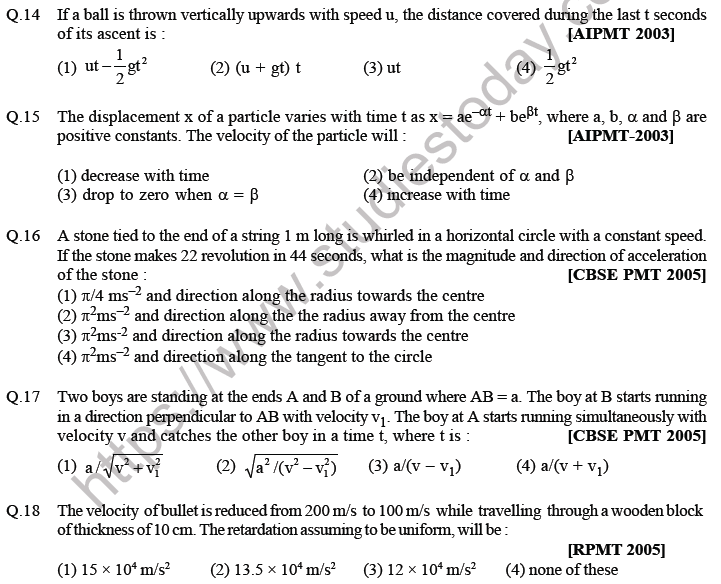
Q.19 A car runs at a constant speed on a circular track of radius 100 m, taking 62.8 seconds for every circular loop. The average velocity and average speed for each circular loop respectively :
(1) 10 m/s, 10 m/s (2) 10 m/s, 0 (3) 0, 0 (4) 0, 10 m/s
Q.20 A particle moves along a straight line OX. At a time t (in seconds) the distance x (in metres) of the particle from O is given by x = 40 + 12 t – t3. How long would the particle travel before coming to rest ?
(1) 24 m (2) 40 m (3) 56 m (4) 16 m

Q.22 A ball is thrown upwards, it takes 4 s to reach back to the ground. Find its initial velocity :
(1) 30 ms–1 (2) 10 ms–1 (3) 40 ms–1 (4) 20 ms–1
Q.23 If relation between distance and time is s = a + bt +ct2 and initial velocity and acceleration :
(1) b + 2 ct, 2 c (2) b, 2 c (3) 2 c, b (4) b + 2 c, 2 c
Q.24 A body falls froma height h = 200m. The ratio of distance travelled in each 2 s, during t = 0 to t = 6 s of the journey is :
(1) 1 : 4 : 9 (2) 1 : 2 : 4 (3) 1 : 3 : 5 (4) 1 : 2 : 3
Q.25 The position x of a particle with respect to time t along x-axis is given by x = 9t2-t3 where x is in metre and t in second. What will be the position of this particle when it achieves maximum speed along the + x direction ?
(1) 32 m (2) 54 m (3) 81 m (4) 24 m
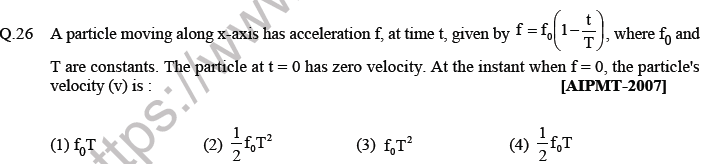
Q.27 A point initially at rest moves along x-axis. Its acceleration varieswith time as a = (6t + 5)m/s2. If it starts from origin, the distance covered in 2 s is.
(1) 20m (2) 18m (3) 16m (4) 25m
Q.28 A particle moves in a straight line with a constant acceleration. It changes its velocity from 10 ms–1 to 20 ms–1 while passing through a distance 135 m in t second. The value of t is :
(1) 10 (2) 1.8 (3) 12 (4) 9
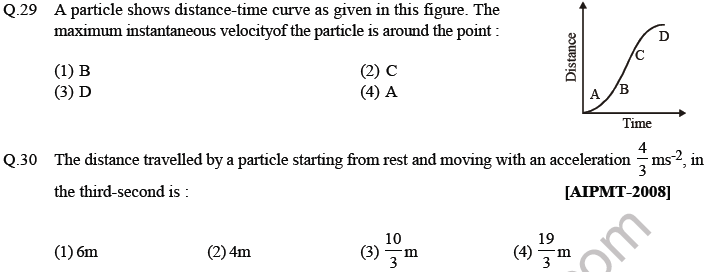
Q.31 A parachutist after bailing out falls 50 m without friction. When parachute opens, it decelerates at 2 m/s2. He reaches the ground with a speed of 3 m/s. At what height, did he bail out :
(1) 293 m (2) 111 m (3) 91 m (4) 182 m
Q.32 A particle starting from the origin (0, 0)moves in a straight line in the (x, y) plane. Its coordinates at a later time are ( √3,3) . The path of the particle makes with the x-axis an angle of
(1) 30º (2) 45º (3) 60º (4) 0º
Q.33 A car moving with a speed of 50 km/h, can be stopped by brakes after at least 6m. If the same car is moving at a speed of 100 km/h, the minimum stopping distance is
(1) 12m (2) 18m (3) 24m (4) 6m

Q.35 Speeds of two identical cars are u are 4u at a specific instant. The ratio of the respective distances in which the two cars are stopped in the same time
(1) 1 : 1 (2) 1 : 4 (3) 1 : 8 (4) 1 : 16
Q.36 A bus is moving with a speed of 10 ms–1 on a straight road. A scooterist wishes to overtake the bus in 100 s. If the bus is at a distance of 1 km from the scooterist, with what speed should the scooterist chase the bus ?
(1) 20 ms–1 (2) 40 ms–1 (3) 25 ms–1 (4) 10 ms–1
Q.37 A particle moves a distance x in time t according to equation x = (t + 5)–1. The acceleration of particle is proportional to :
(1) (Velocity)2/3 (2) (Velocity)3/2 (3) (distance)2 (4) (distance)–2
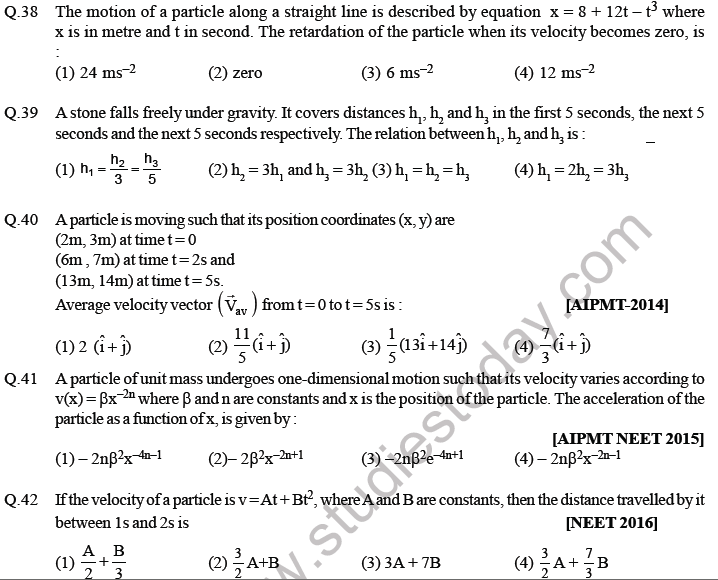
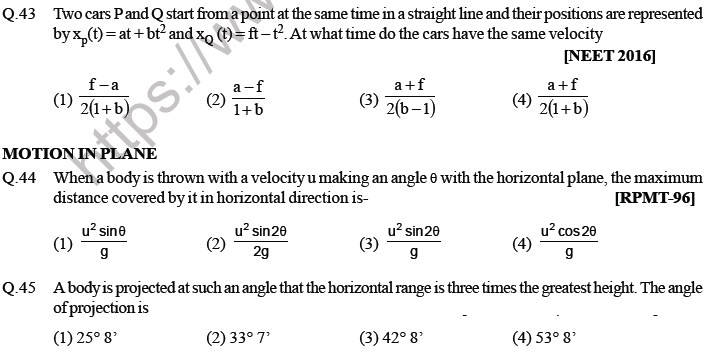
Q.46 Two bodies are projected with the same velocity. If one is projected at an angle of 30° and the other at an angle of 60° to the horizontal, the ratio of the maximum heights reached is
(1) 3 : 1 (2) 1 : 3 (3) 1 : 2 (4) 2 : 1
Q.47 A missile is fired for maximum range with an initial velocity of 20 m/s. If g = 10 m/s2, the range of the missile is :
(1) 20 m (2) 40 m (3) 50 m (4) 60 m

Q.49 A boy standing at the top of a tower of 20 m height drops a stone. Assuming g = 10 ms-2, the velocity with which it hits the ground is :
(1) 5.0 m/s (2) 10.0 m/s (3) 20.0 m/s (4) 40.0 m/s
Q.50 A particle moves in a circle of radius 5 cm with constant speed and time period 0.2 π s. The acceleration of the particle is :
(1) 5 m/s2 (2) 15 m/s2 (3) 25 m/s2 (4) 36 m/s2

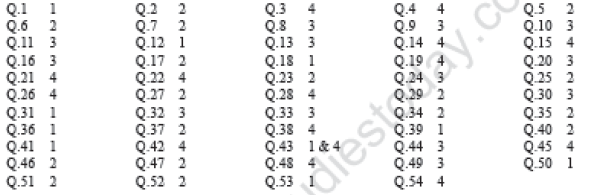
ANSWERS
Download Chapter MCQs: NEET Physics Kinematics
NEET Physics Kinematics Objective Test Questions
Review structured objective questions for NEET Physics Kinematics. Built according to official NEET guidelines, these MCQ sets support daily revision and core concept reinforcement.
NCERT-Aligned Objective Questions and Solutions
Cross-reference your completed choices with comprehensive NCERT solutions for NEET Physics to ensure absolute clarity across all sub-topics in this chapter.
Next Steps in Your Exam Preparation
Explore our broader library of printable assignments, chapter notes, and mock tests designed to support continuous revision and secure higher marks in NEET assessments.
FAQs
You can get most exhaustive NEET Physics Kinematics MCQs Set 04 for free on StudiesToday.com. These MCQs for NEET Physics are updated for the 2026-27 academic session as per NEET examination standards.
Yes, our NEET Physics Kinematics MCQs Set 04 include the latest type of questions, such as Assertion-Reasoning and Case-based MCQs. 50% of the NEET paper is now competency-based.
By solving our NEET Physics Kinematics MCQs Set 04, NEET students can improve their accuracy and speed which is important as objective questions provide a chance to secure 100% marks in the Physics.
Yes, Physics MCQs for NEET have answer key and brief explanations to help students understand logic behind the correct option as its important for 2026 competency-focused NEET exams.
Yes, you can also access online interactive tests for NEET Physics Kinematics MCQs Set 04 on StudiesToday.com as they provide instant answers and score to help you track your progress in Physics.