

Multiple Choice Questions (MCQs) for NEET Physics: Atomic Structure and Rutherfords Nuclear Model
Review structured MCQ sets for NEET Physics Atomic Structure and Rutherfords Nuclear Model. Built according to official NEET guidelines, these downloadable questions support daily revision and core concept reinforcement.
Practice Atomic Structure and Rutherfords Nuclear Model MCQs for NEET Physics
Navigate directly to the 50 objective questions for Atomic Structure and Rutherfords Nuclear Model using the digital viewer below. Each practice set includes verified answer keys, allowing students to instantly cross-check their work and identify areas requiring further revision.
Question: According to classical theory, the path of an electron in Rutherford atomic model is
a) spiral
b) circular
c) straight line
d) parabolic
Answer: spiral
Question: Rutherford’s a-particle experiment showed that the atoms have
a) Nucleus
b) Electrons
c) Proton
d) Neutron
Answer: Nucleus
Question: Rutherford’s atomic model was unstable because
a) electrons do not remain in orbit
b) nuclei will break down
c) orbiting electrons radiate energy
d) electrons are repelled by the nucleus
Answer: electrons do not remain in orbit
Question: As one considers orbits with higher values of n in a hydrogen atom, the electric potential energy of the atom
a) increases
b) does not increase
c) decreases
d) remains the same
Answer: increases
Question: The significant result deduced from the Rutherford's scattering experiment is that
a) whole of the positive charge is concentrated at the centre of atom
b) there are neutrons inside the nucleus
c) electrons are embedded in the atom
d) electrons are revolving around the nucleus
Answer: whole of the positive charge is concentrated at the centre of atom
Question: Which of the following parameters is the same for all hydrogen-like atoms and ions in their ground states?
a) Orbital angular momentum of the electron
b) Energy of the atom
c) Speed of the electron
d) Radius of the orbit
Answer: Orbital angular momentum of the electron
Question: The distance of closest approach of a certain nucleus is 7.2 fm and it has a charge of 1.28 × 10⁻¹⁷ C. The number of neutrons inside the nucleus of an atom is
a) 136
b) 142
c) 140
d) 132
Answer: 136
Question: Assertion : Electrons in the atom are held due to coulomb forces.
Reason : The atom is stable only because the centripetal force due to Coulomb's law is balanced by the centrifugal force.
a) If Assertion is correct but Reason is incorrect
b) If both the Assertion and Reason are incorrect
c) If both Assertion and Reason are correct, but Reason is not the correct explanation of Assertion.
d) If both Assertion and Reason are correct and Reason is the correct explanation of Assertion
Answer: If Assertion is correct but Reason is incorrect
Question: In an atom, the two electrons move round the nucleus in circular orbits of radii R and 4R. The ratio of the time taken by them to complete one revolution is
a) 1/8
b) 8/1
c) 4/1
d) 1/4
Answer: 1/8
Comprehension Based
Paragraph -I
Scientists are working hard to develop nuclear fusion reactor. Nuclei of heavy hydrogen, 21H known as deuteron and denoted by D can be thought of as a candidate for fusion reactor. The DD reaction is 21H + 21H → 32He + n + energy. In the core of fusion reactor, a gas of heavy hydrogen is fully ionized into deuteron nuclei and electrons. This collection of 21H nuclei and electrons is known as plasma. The nuclei move randomly in the reactor core and occasionally come close enough for nuclear fusion to take place. Usually, the temperatures in the reactor core are too high and no material wall can be used to confine the plasma. Special techniques are used which confine the plasma for a time t0 before the particles fly away from the core. If n is the density (number/volume) of deuterons, the product nt0 is called Lawson number. In one of the criteria, a reactor is termed successful if Lawson number is greater than 5×10¹⁴s cm–3. It may be helpful to use the following: Boltzmann constant K = 8.6 10-5 eV / K; e2/πε0 = 1.44 x 10⁻⁹ eVm
Question: In the core of nuclear fusion reactor, the gas becomes plasma because of:
a. strong nuclear force acting between the deuterons
b. Coulomb force acting between the deuterons
c. Coulomb force acting between deuteron-electron pairs
d. the high temperature maintained inside the reactor core
Answer : D
Question: Assume that two deuteron nuclei in the core of fusion reactor at temperature T are moving towards each other, each with kinetic energy 1.5 kT; when the separation between them is large enough to neglect Coulomb potential energy. Also neglect any interaction from other particles in the core. The minimum temperature T required for them to reach a separation of 4×10–15 m is in the range:
a. 1.0 × 10⁹ K < T < 2.0 × 10⁹ K
b. 2.0 × 10⁹ K < T < 3.0 × 10⁹ K
c. 3.0 × 10⁹ K < T < 4.0 × 10⁹ K
d. 4.0 × 10⁹ K < T < 5.0 × 10⁹ K
Answer : A
Question: Results of calculations for four different designs of a fusion reactor using D-D reaction are given below. Which of these is most promising based on Lawson criterion?
a. Deuteron density = 2.0×1012 cm–3, confinement time = 5.0×10⁻³ s
b. Deuteron density = 8.0 × 1014 cm–3, confinement time = 9.0×10⁻¹ s
c. Deuteron density = 4.0 × 1023 cm–3 , confinement time = 1.0 × 10⁻¹¹ s
d. Deuteron density = 1.0 × 1024 cm–3 , confinement time = 4.0×10⁻¹²s
Answer : D
Paragraph -II
The key feature of Bohr’s theory of spectrum of hydrogen atom is the quantization of angular momentum when an electron is revolving around a proton. We will extend this to a general rotational motion to find quantized rotational energy of a diatomic molecule assuming it to be rigid. The rule to be applied is Bohr’s quantization condition.
Question: A diatomic molecule has moment of inertia I. By Bohr’s quantization condition its rotational energy in the nth level (n = 0 is not allowed) is:
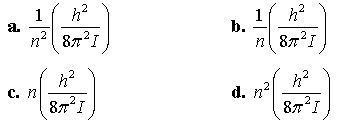
Answer : D
Question: It is found that the excitation frequency from ground to the first excited state of rotation for the CO molecule is close to 4/π x 1011 Hz. Then the moment of inertia of CO molecule about its centre of mass is close to: (Take h = 2π × 10–34J–s)
a. 2.76×10–46 kg–m2
b. 1.87×10–46 kg–m2
c. 4.67×10–47 kg–m2
d. 1.17×10–47 kg–m2
Answer : B
Question: In a CO molecule, the distance between C (mass = 12 amu) and O (mass = 16 amu), where 1 amu = 5/3 x 10-27 kg, is close to:
a. 2.4 × 10⁻¹⁰m
b. 1.9 × 10⁻¹⁰m
c. 1.3 × 10⁻¹⁰m
d. 4.4 × 10⁻¹¹m
Answer :
Download Chapter MCQs: NEET Physics Atomic Structure and Rutherfords Nuclear Model
About Atomic Structure and Rutherfords Nuclear Model MCQs for NEET Physics
Review structured objective questions for NEET Physics Atomic Structure and Rutherfords Nuclear Model. Built according to official NEET guidelines, these MCQ sets support daily revision and core concept reinforcement.
How to Verify Your MCQ Answers
Cross-reference your completed choices with comprehensive NCERT solutions for NEET Physics to ensure absolute clarity across all sub-topics in this chapter.
Enhance Speed with Online MCQ Tests
Follow up your worksheet practice by attempting the interactive online Physics MCQ test for this chapter to evaluate your execution speed. All platform resources are free to access.
FAQs
You can get most exhaustive NEET Physics Atomic Structure and Rutherfords Nuclear Model MCQs Set 01 for free on StudiesToday.com. These MCQs for NEET Physics are updated for the 2026-27 academic session as per NEET examination standards.
Yes, our NEET Physics Atomic Structure and Rutherfords Nuclear Model MCQs Set 01 include the latest type of questions, such as Assertion-Reasoning and Case-based MCQs. 50% of the NEET paper is now competency-based.
By solving our NEET Physics Atomic Structure and Rutherfords Nuclear Model MCQs Set 01, NEET students can improve their accuracy and speed which is important as objective questions provide a chance to secure 100% marks in the Physics.
Yes, Physics MCQs for NEET have answer key and brief explanations to help students understand logic behind the correct option as its important for 2026 competency-focused NEET exams.
Yes, you can also access online interactive tests for NEET Physics Atomic Structure and Rutherfords Nuclear Model MCQs Set 01 on StudiesToday.com as they provide instant answers and score to help you track your progress in Physics.