

Physics Objective Questions and Answers: Atom and Nucleus
Access targeted multiple-choice questions for Atom and Nucleus designed to align with the latest NEET academic syllabus for NEET Physics. These objective practice sets help students evaluate their conceptual understanding and improve exam readiness.
Download Atom and Nucleus MCQs with Answers
Access the complete set of multiple-choice questions for Atom and Nucleus below. This focused format allows students to isolate specific topics for thorough review and uninterrupted practice alongside official NEET textbooks.
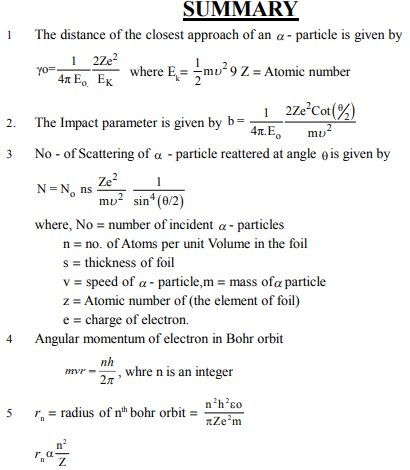
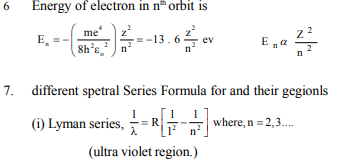
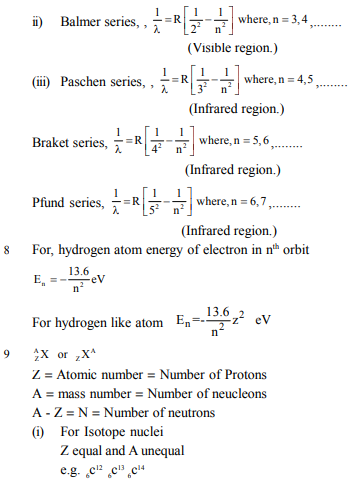
MCQ
For the answer of the following questions choose the correct alternative from among the given ones.
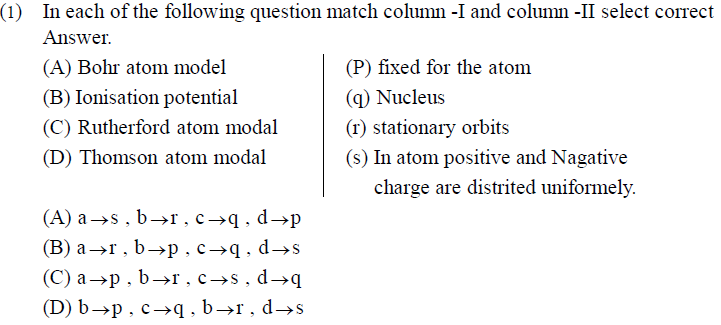
(2) Read the following question and choose correct Answer form given below.
(A) Both assertion and reason are true. Reason is the correct explanation of theAssertion
(B) BOth assertion and reason are true. Reason is not correct explanation of the assertion
(C) Assertion is true but reason is false.
(D) Both Assertion and Reason are false
(i) Assertion :- In a radio-active disintegration, an election is emitted by nucleus.
Reason :- eleccon are always Present in-side the nucleus.
(ii) Assertion :- An election and Positon can annibilate each other creating Photon
Reason:- Electon and Positon form a Particle and anti Particle.
(iii) Assetion:- An isolated radioactive atom may not decay at all what eVer be its half time
Reason:- Readioactive decay is a statistical Phenomena.
(iv) Assertion :- Fragment Produced in the fission of u235 are active
Reason:- The fragments have abnormally high Proton to neutron ratio
(3) Each of the following question contain two stalements.choose correct answer form the given below.
(i) statement-I:- Large angle scattering of al-pha Particle led to discovery of state ment-II :- Entire Positive charge of atom is concentrated in the central core.
(A) statement -I and II are true. and statement II is correct explanation of statement-I
(B) statement -I and II are true, but statement-II is not correct explanation of statement I
(C) statement I is true, but state ment II is false.
(D) statement I is false but statement II is true
(ii) statement-I 1 amu=931.48 MeV
statement-II It follows form E=mc2
(iii) statement -I:-half life time of tritium is 12.5 years
statement-II :- The fraction of tritium that remains after 50 years is 6.25%
(iv) statement-I:- Nuclei of different atoms have same size
state ment-I I :- R=Ro(A)1/3
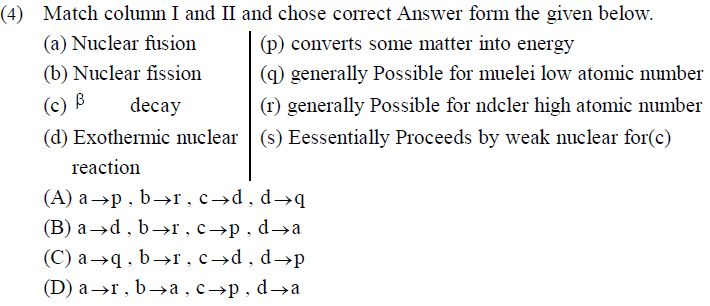
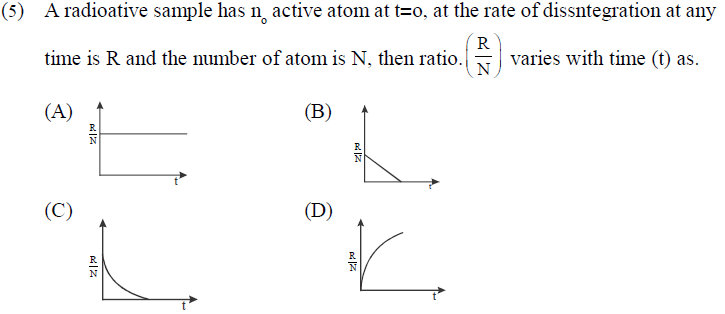
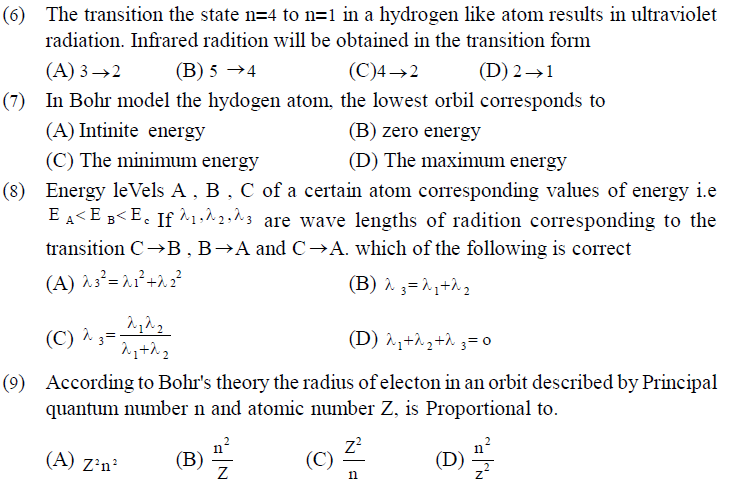
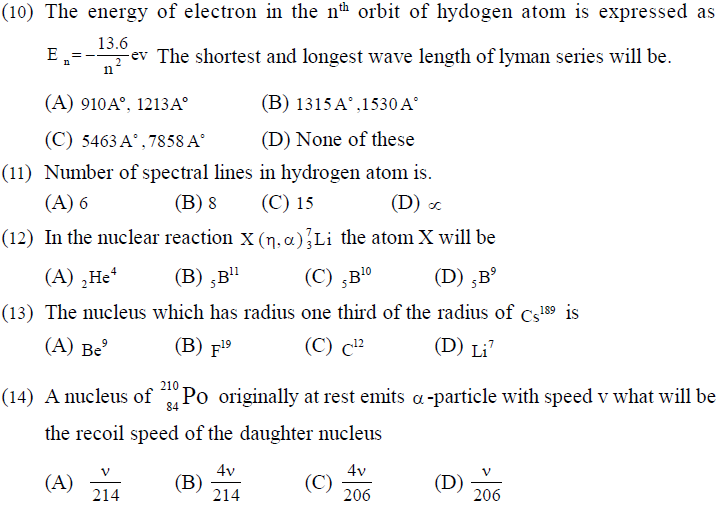
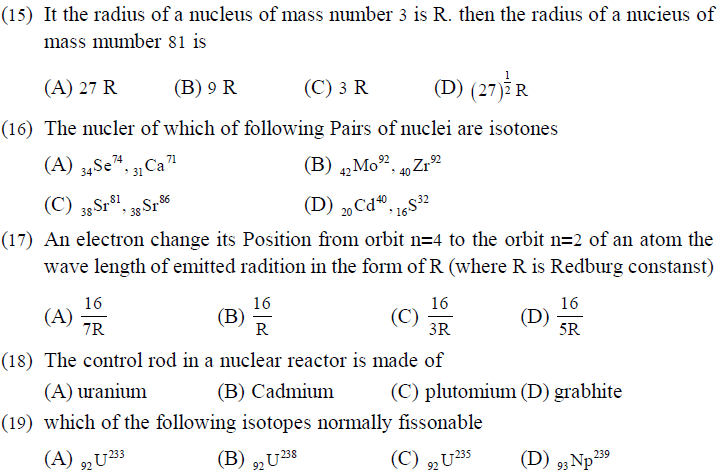
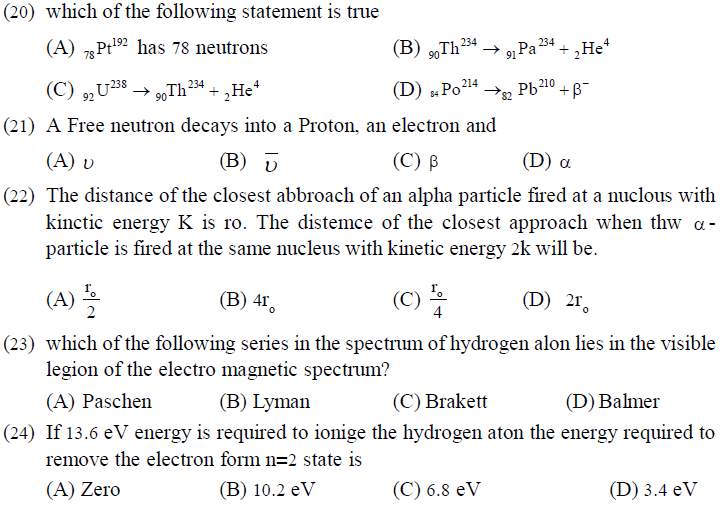
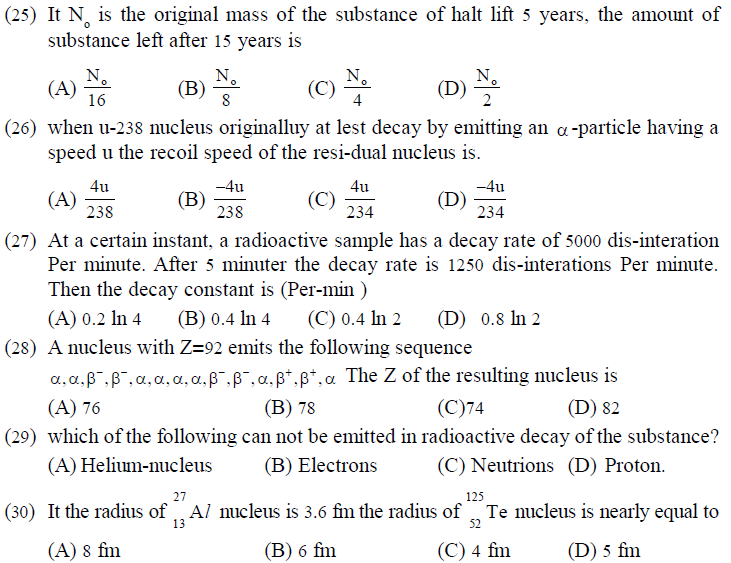
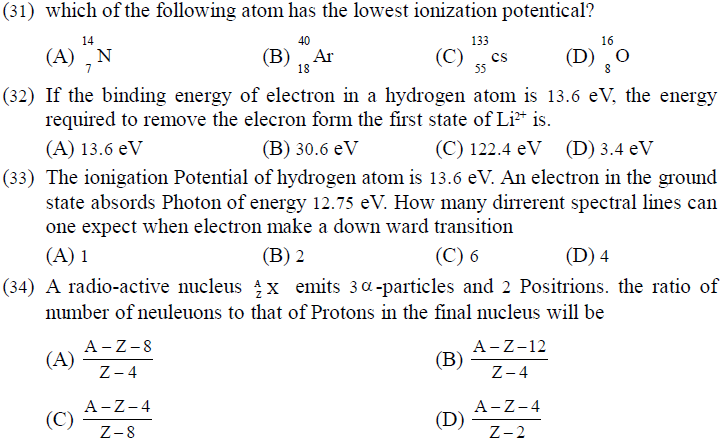
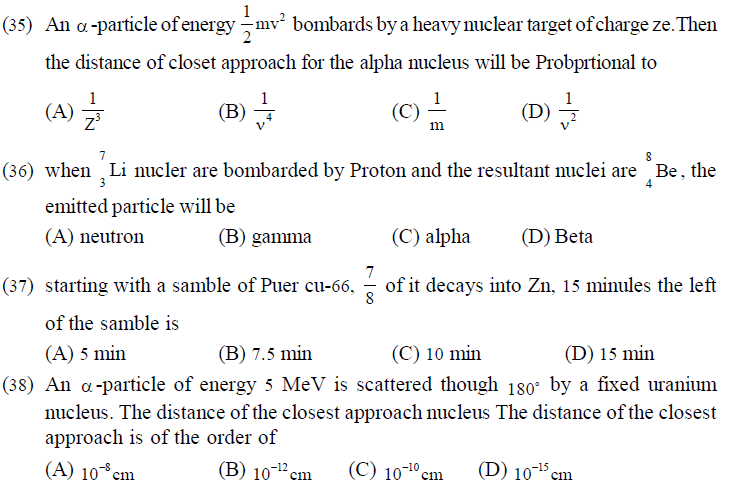
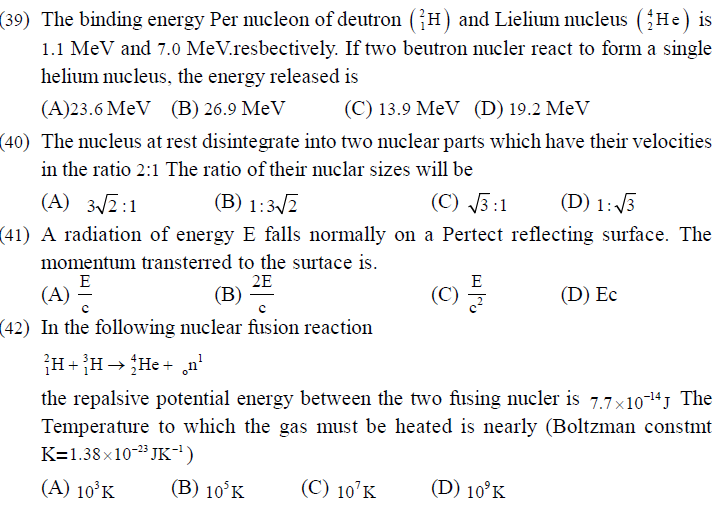
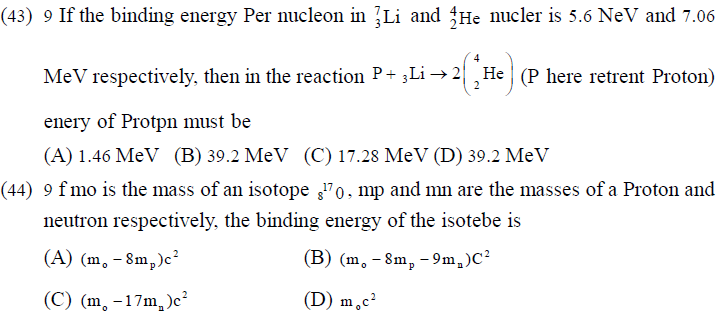
(45) In gamma ray emission form a nucleus
(A) there is no change in the proton-number and neutron number
(B) Both the number are changes
(C) only Proton number change
(D) only neutron number change
(46) The half life time of a radidactive elements of x is the same as the mean life of another radioactive element Y. Initially they have same number of atoms, then
(A) y will decay faster thean x
(B) x will decay faster then y
(C) x and y will decay at the same rate at all time
(D) x and y will decay at the same rate intially.
(47) which of the following transition in hydrogen atoms emits Photon of highest frequengy?
(A) n=2 to n=6
(B) n=1 to n=2
(C) n=2 to n=1
(D) n=6 to n=2
(48) An electron Passing through a Potential diffencne of 4.9 v colides with a mercury atom and trnasfer it to the first excited state what is trnasfer it to the first excited state. what is the wave length of Photon corresponding to the franition of mercury atom to its normal state.
(A) 2050A°
(B) 2935A°
(C) 2525A°
(D) 2240A°
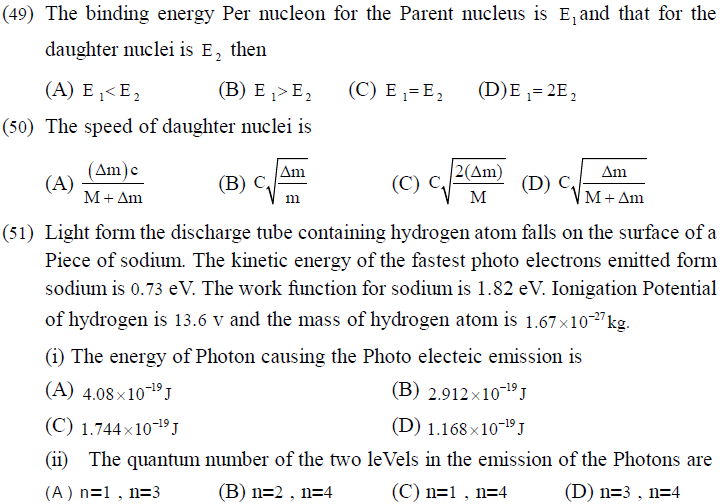
(84) The ionigation energy of hydrogen atom is 13.6 eV. The ionigation energy of helium atom would be
(A) 27.2 eV
(B) 13.6 eV
(C) 54.4 eV
(D) 6.8 eV
(85) A gamma ray Photon creates an electon- Positon Pair. If the rest mass energy of an electron is 0.5 MeV. and the total kinetrc energy 0.7 MeV, then the energy of the gamma ray Photon must be
(A) 3.9 MeV
(B) 1.78 MeV
(C) 0.78 MeV
(D) 0.16 MeV
(86) The masses of netron and Proton are 1.0087 amu and 1.0073 amu respectively. It the neufron and Protons combins to form binding energy of the helium nucleus will be
(A) 14.2 MeV
(B) 28.4 MeV
(C) 27.3 MeV
(D) 20.8 MeV
(87) Large angle scattering of α - particle could not be explained by
(A) Thomson modal
(B) Ruther Rutherford and Thpmoson modal
(C) Both rutherford and Thomoson modal
(D) Neither Ruthorford modal norThomson modal
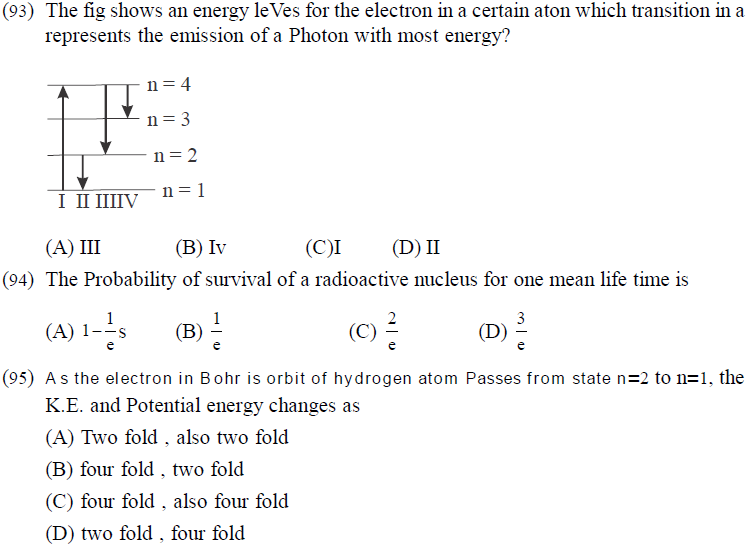
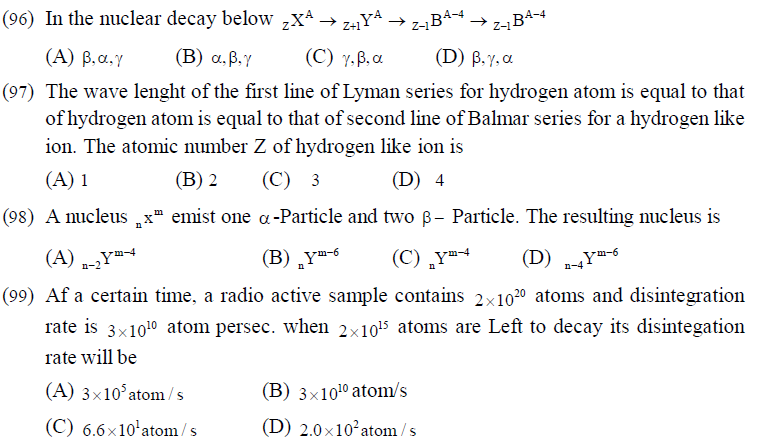
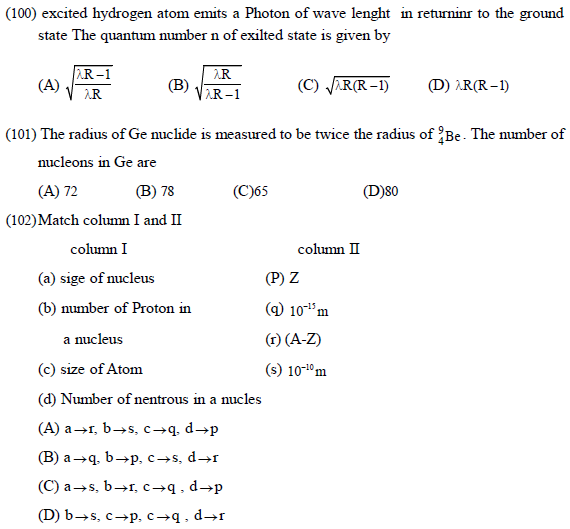
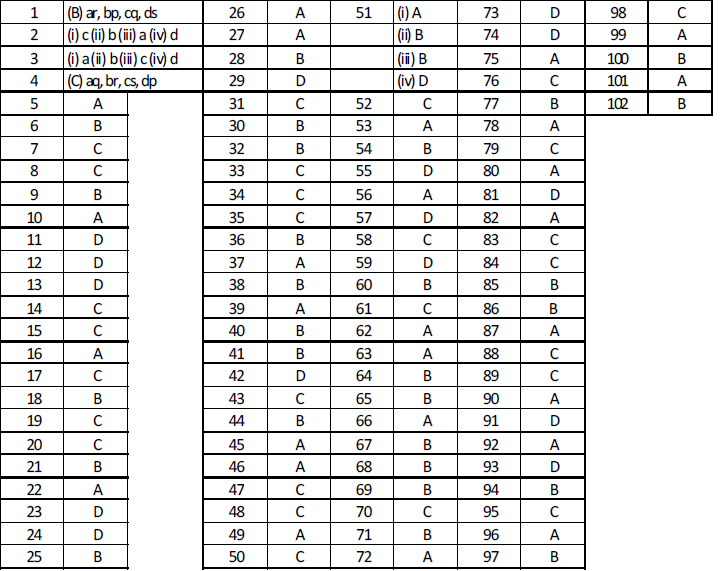
ANSWER KEY
Download Chapter MCQs: NEET Physics Atom and Nucleus
Download Multiple Choice Questions: Atom and Nucleus (NEET Physics)
Explore reliable practice questions for Atom and Nucleus tailored for NEET Physics learners. Use these multiple-choice formats to evaluate preparedness and strengthen problem-solving skills.
Concept Clarification for Atom and Nucleus
Built using the official NCERT book for NEET, these Physics objective sets provide reliable academic guidance. Pair your practice with our recommended NCERT solutions to master optimal problem-solving approaches.
Additional Study Resources for NEET Physics
Explore our broader library of printable assignments, chapter notes, and mock tests designed to support continuous revision and secure higher marks in NEET assessments.
FAQs
You can get most exhaustive NEET UG Physics Atom and Nucleus MCQs for free on StudiesToday.com. These MCQs for NEET Physics are updated for the 2026-27 academic session as per NEET examination standards.
Yes, our NEET UG Physics Atom and Nucleus MCQs include the latest type of questions, such as Assertion-Reasoning and Case-based MCQs. 50% of the NEET paper is now competency-based.
By solving our NEET UG Physics Atom and Nucleus MCQs, NEET students can improve their accuracy and speed which is important as objective questions provide a chance to secure 100% marks in the Physics.
Yes, Physics MCQs for NEET have answer key and brief explanations to help students understand logic behind the correct option as its important for 2026 competency-focused NEET exams.
Yes, you can also access online interactive tests for NEET UG Physics Atom and Nucleus MCQs on StudiesToday.com as they provide instant answers and score to help you track your progress in Physics.