

Read CBSE Class 12 Physical Education Biomechanics and Sports HOTs below. Access comprehensive High Order Thinking Skills (HOTS) questions with answers for Class 12 Physical Education Chapter 08 Biomechanics and Sports. Tailored for the 2026-27 exam session, these analytical problems help Class 12 students understand deep concepts based on the latest CBSE, NCERT, and KVS syllabus.
Download Class 12 Physical Education Chapter 08 Biomechanics and Sports HOTS Practice
Working through Class 12 Physical Education HOTS Questions helps you master complex topics in Physical Education. Rely on the clear explanations given below to sharpen your analytical skills and prepare well for your Class 12 evaluations.
Class 12 Physical Education Chapter 08 Biomechanics and Sports Advanced HOTS Questions
Question. Acceleration of an object will increase as the net force increases depending on its:
(a) Density
(b) Mass
(c) Shape
(d) Volume
Answer. B
Question. In normal walking at a person’s preferred speed, the ratio of the durations of the stance and swing phases is roughly:
(a) 1-1
(b) 2-3
(c) 2-1
(d) 3-2
Answer. D
Question. In plantar flexion of the foot about the ankle joint:
(a) The foot moves upwards towards the front of the calf
(b) The foot moves upwards towards the rear of the calf
(c) The foot moves sideways
(d) None the above
Answer. B
Question. At touchdown in walking, the knee is normally:
(a) Fully extended
(b) Slightly flexed
(c) Fully flexed
(d) Slightly expended
Answer. B
Question. Flexion and extension are:
(a) Movements in the frontal plane about the sagittal axis
(b) Movements in the sagittal plane about the frontal axis
(c) Movements in the horizontal plane about the vertical axis
(d) None of the above.
Answer. B
Question. Internal and external rotation are movements in which anatomical plane ?
(a) Sagittal
(b) Frontal
(c) Horizontal
(d) None of these
Answer. C
Question. Movements that occur primarily in the sagittal plane are:
(a) Adduction, lateral flexion, flexion, dorsiflexion
(b) Flexion, extension, dorsiflexion, plantar flexion
(c) Flexion, extension, dorsiflexion, internal-external rotation
(d) Supination and pronation of the forearm
Answer. B
Question. Abduction and adduction take place about which axis?
(a) Oblique
(b) Longitudinal or vertical
(c) Frontal or mediolateral
(d) Sagittal or anteroposterior
Answer. D
Question. Flexion and extension are:
(a) Movements in the frontal plane about the sagittal axis
(b) Movements in the sagittal plane about the frontal axis
(c) Movements in the horizontal plane about the vertical axis
(d) None of the above
Answer. B
Question. How do we define the phases into which we often break fundamental movements to simplify biomechanical analysis?
(a) Biomechanically distinct functions and easily identified boundaries
(b) Easily identified functions and clearly defined boundaries
(c) Anatomically distinct functions and easily identified boundaries
(d) Medically distinct functions and clearly defined boundaries
Answer. A
Question. In plantar flexion of the foot about the ankle joint:
(a) The foot moves upwards towards the front of the calf
(b) The foot moves upwards towards the rear of the calf
(c) The foot moves sideways
(d) None of the above
Answer. B
Question. Movements that occur primarily in the sagittal plane are:
(a) Adduction, lateral flexion, flexion, dorsiflexion
(b) Flexion, extension, dorsiflexion, plantar flexion
(c) Flexion, extension, dorsiflexion, internal-external rotation
(d) Supination and pronation of the forearm.
Answer. B
Question. The plane which divides the body into a left and a right is called :
(a) coronal plane
(b) sagittal plane
(c) vertical plane
(d) transverse plane
Answer. B
Question. Sports biomechanics cab be described as :
(a) mechanics of sports
(b) kinesiology
(c) physics of sports
(d) sports dynamics
Answer. C
Question. Newton’s Second Law of Motion is also known as :
(a) Law of Reaction
(b) Law of Inertia
(c) Resultant Force
(d) Law of Effect
Answer. C
Directions: In the context of above two statements,which one of the following is correct?
(a) Both (A) and (R) are true and (R) is the correct explanation of (A).
(b) Both (A) and (R) are true, but (R) is not the correct explanation of (A).
(c) (A) is true, but (R) is false.
(d) (A) is false, but (R) is true.
Question. Assertion (A): Sports biomechanics is a quantitative based study and analysis of professional athletes/sportspersons and sports activities in general.
Reason (R): In simple terms, it may be described as the physics of sports.
Answer. B
Question. Assertion (A): Sports biomechanics is limited to the study those individuals who are involved in exercise or sports or any physical activity.
Reason (R): Performance enhancement is one of the area of the study in sports biomechanics.
Answer. B
Question. Assertion (A): Sportsperson’s performance can be improved by improving her/his technique.
Reason (R): The application of biomechanical principles can be applied to improve technique.
Answer. A
Question. Match List – I with List – II and select the correct answer from the code given below:
LIST-I LIST-II
(i) Abrasion A. Joint Injuries
(ii) Green stick fractures B. Soft tissue injuries
(iii) Shoulder Dislocation C. Cause of sport injuries
(iv) Lack of fitness D. Bone injuries
Choose the correct option from the following:
(a) 1–D, 2–A, 3–C, 4–B
(b) 1–B, 2–A, 3–C, 4–D
(c) 1–B, 2–D, 3–A, 4–C
(d) 1–A, 2–D, 3–B, 4–C.
Answer.
Abrasion Soft tissue injuries
Green stick fractures Bone injuries
Shoulder Dislocation Joint Injuries
Lack of fitness Cause of sport injuries
Question. Identify the human movement and give their names:
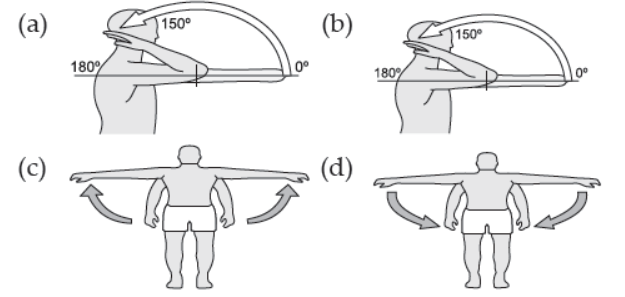
Answer.
(a) Flexion
(b) Extension
(c) Abduction
(d) Adduction
Question. Below given are the types of movements in the human body :
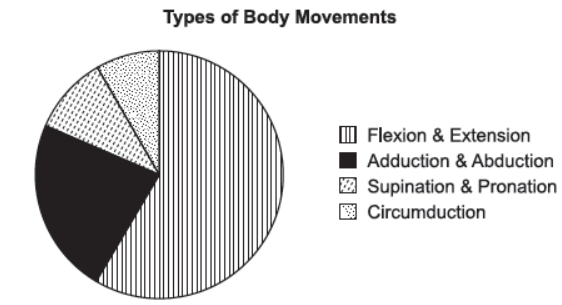
On the bases of the above data, answer the following questions:
Question. Which of the following is the most commonly used movement in the human body :
(a) Flexion and Extension
(b) Adduction and Abduction
(c) Supination and Pronation
(d) Circumduction
Answer. A
Question. Which is the least movement in the above mentioned graph:
(a) Supination and Pronation
(b) Circumduction
(c) Adduction and Abduction
(d) Flexion and Extension
Answer. B
Question. Which of the following is the second most used movement in the human body:
(a) Flexion and Extension
(b) Circumduction
(c) Adduction and Abduction
(d) Supination and Pronation
Answer. C
Question. Vishal is about to start a race of 100 meter sprinting.He is ready at the start line, and begins running at the sound of the gunshot and wins the race.
Based on this case answer the following questions:
Question. While at the start line which of the following Newton’s Law works on the body of Vishal:
(a) Law of Gravity
(b) Law of Acceleration
(c) Law of Action Reaction
(d) Law of Inertia
Answer. B
Question. As Vishal sprints on the track which of the following Newton’s Law is applicable:
(a) Law of Acceleration
(b) Law of Action Reaction
(c) Law of Hooke
(d) Law of Ohm
Answer. A
Question. While sprinting Vishal’s leg move back and forth at the hip joint. Which type of movement occurs at the hip joint?
(a) Flexion and Extension
(b) Adduction and Abduction
(c) Dorsi and Planter Flexion
(d) Supination and Pronation
Answer. A
Question. The teachers as well as coaches always make their best efforts to improve the performance of their students in various competitive games and sports. They can help to improve the performance of students if they have adequate knowledge of biomechanics.
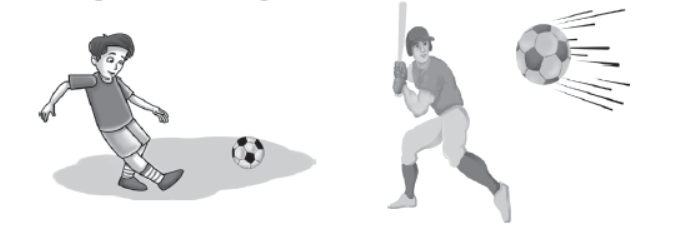
Question.The more force one exerts on the downward bounce, the higher the ball bounces into the air.
Which law is this statement being referred to?
(a) Newton’s 1st law
(b) Newton’s 2nd law
(c) Newton’s 3rd law
(d) Law of gravitation
Answer. C
Question. Among the above given pictures, Newton’s 3rd law is depicted in
(a) First
(b) Second
(c) Both
(d) None of these
Answer. C
Question. The acceleration of an object depends directly upon the net force acting upon the object and inversely upon the object’s
(a) Weight
(b) Mass
(c) Height
(d) Density
Answer. B
Question. The study of human body and various forces acting on it is
(a) Biology
(b) Biomechanics
(c) Physiology
(d) Anatomy
Answer. B
Question. A high jumper can jump higher off a solid surface because it opposes his or her body with as much force as he or she is able to generate. This example refers to
(a) Law of conservation
(b) Law of inertia
(c) Law of action & reaction
(d) Law of gravity
Answer. C
Question.. Sohan, a new student in the school was very much interested in taking part in the school sports events. He was taught the latest rules and regulations of football game. In due course, he learnt biomechanical aspects of the game including various movements.
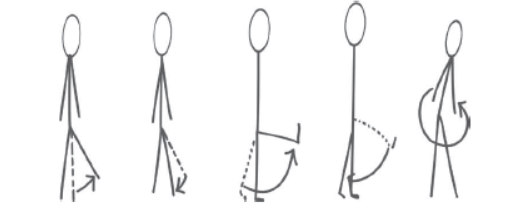
Question. The type of movement in which the angle between joint decreases is called
(a) Flexion
(b) Extension
(c) Gliding
(d) Sliding
Answer. A
Question. Straightening parts of a joint so that the angle increases
(a) Flexion
(b) Extension
(c) Abduction
(d) Adduction
Answer. B
Question. Moving a part away from mid line is
(a) Flexion
(b) Extension
(c) Abduction
(d) Adduction
Answer. C
Question. Moving a part towards the mid line is
(a) Flexion
(b) Extension
(c) Abduction
(d) Adduction
Answer. D
Question. Flexion and extension comes under _________ movement.
(a) Gliding
(b) Angular
(c) Rotation
(d) Circumduction
Answer. B
Question. In biomechanics class, Gopi, the teacher, brings the students to the physics lab of his school. The students get confused. After the completion of the class, they realize the fact.
Question. Why does the teacher bring the students to physics lab for biomechanics class?
(a) It deals with physics principle
(b) Sliding friction
(c) Rolling friction
(d) Static friction
Answer. A
Question. Biomechanics is associated with
(a) Mechanic
(b) Physics
(c) Mechanic and Physics
(d) Mechanic and Anatomy
Answer. D
Question. Friction can be increased by which of the following?
(a) Smooth surface
(b) Dry surface
(c) Decrease the Weight
(d) All of this
Answer. B
CBSE Class 12 Physical Education Chapter 08 Biomechanics and Sports HOTS Questions and Answers
Preparing with Chapter 08 Biomechanics and Sports HOTS Exercises
Master core concepts in Chapter 08 Biomechanics and Sports with these targeted Higher Order Thinking Skills (HOTS) problems. Built for Class 12 Physical Education students following the CBSE curriculum, these exercises challenge analytical thinking and improve problem-solving speed.
How to Use These Class 12 Physical Education HOTS
Each question in this set is mapped directly to the official NCERT book for Class 12. Review the detailed answer keys provided below each problem to verify your solution steps and correct mistakes early.
More Study Resources for Class 12 Physical Education
Looking for more practice? Explore our complete library of Class 12 Physical Education worksheets, chapter notes, and online mock tests. Everything is provided free of charge to support your academic goals.
FAQs
You can download the teacher-verified PDF for CBSE Class 12 Physical Education Biomechanics and Sports HOTs from StudiesToday.com. These questions have been prepared for Class 12 Physical Education to help students learn high-level application and analytical skills required for the 2026-27 exams.
In the 2026 pattern, 50% of the marks are for competency-based questions. Our CBSE Class 12 Physical Education Biomechanics and Sports HOTs are to apply basic theory to real-world to help Class 12 students to solve case studies and assertion-reasoning questions in Physical Education.
Unlike direct questions that test memory, CBSE Class 12 Physical Education Biomechanics and Sports HOTs require out-of-the-box thinking as Class 12 Physical Education HOTS questions focus on understanding data and identifying logical errors.
After reading all conceots in Physical Education, practice CBSE Class 12 Physical Education Biomechanics and Sports HOTs by breaking down the problem into smaller logical steps.
Yes, we provide detailed, step-by-step solutions for CBSE Class 12 Physical Education Biomechanics and Sports HOTs. These solutions highlight the analytical reasoning and logical steps to help students prepare as per CBSE marking scheme.