

Refer to CBSE Class 12 Physical Education Yoga and Lifestyle HOTs. We have provided exhaustive High Order Thinking Skills (HOTS) questions and answers for Class 12 Physical Education Chapter 03 Yoga and Lifestyle. Designed for the 2026-27 exam session, these expert-curated analytical questions help students master important concepts and stay aligned with the latest CBSE, NCERT, and KVS curriculum.
Analytical Questions: Chapter 03 Yoga and Lifestyle (Class 12 Physical Education)
Practicing Class 12 Physical Education HOTS Questions is important for scoring high in Physical Education. Use the detailed answers provided below to improve your problem-solving speed and Class 12 exam readiness.
Get Chapter 03 Yoga and Lifestyle HOTS PDF for Class 12 Physical Education
MCQ Questions for NCERT Class 11 Physical Education Yoga
Question: Which is the seventh element of Yoga?
(a) Dhyana
(b) Yama
(c) Pratyahara
(d) Samadhi
Answer: A
Question: Identify the asana shown in the image. 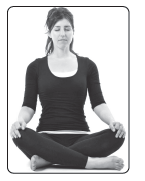
(a) Tadasana
(b) Sukhasana
(c) Shashankasana
(d) Naukasana
Answer: B
Question: Yoga has been mentioned in _______.
(a) Mahabharata
(b) Ramayana
(c) Upanishads
(d) All of these
Answer: D
Question: According to whom the definition of Yoga is simply to attain the pose?
(a) Patanjali
(b) Maharishi Ved Vyas
(c) Agam
(d) None of the above
Answer: B
Question: Cleaning of internal organs is a parts of ________ .
(a) Dhauti kriya
(b) Swadhaya
(c) Tapa
(d) Apoigraha
Answer: A
Question: Find the incorrect statement
(a) Yama contains 5 moral vows or codes of conduct
(b) Ishavara Pranidhana means study of scriptures
(c) Niyama are ethical practices related to body and senses
(d) Samadhi is ultimate union of a soul with God.
Answer: B
Question: From where do we derive the elements of yoga?
(a) Bhagwad Gita
(b) Yoga-sutra
(c) Upanishads
(d) Ramayana
Answer: B
Question: Match the following.3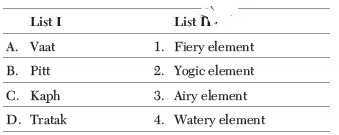
Codes
A B C D A B C D
(a) 4 3 1 2 (b) 2 1 4 3
(c) 1 3 2 4 (d) 3 1 4 2
Answer: D
Question: Pranayam means control and regulation of the vital life force i.e. breathing. Pranayam is the fourth element of yoga. It strengthens the respiratory system, soothes the nervous system and tones up the whole body.
Pranayam is an important yogic kriya and is practised in India from ancient times. it consists of three parts.
From the given options, find out the three parts of Pranayama.
(a) Neti, Dhauti, Nauli
(b) Kapalbhati, Basti, Trataka
(c) Puraka, Kumbhaka, Rechaka
(d) Dharana, Dhyana, Samadhi
Answer: C
Question: Swami ji described about one of the elements of yoga.
He said that it is the concentration of mind and the first stage of meditation. All energies are focussed at one point and the mind is not distracted. Swami ji is talking about which stage?
(a) Dharana
(b) Dhyana
(c) Pratyahara
(d) Pranayama
Answer: A
Short Answer Type Questions
Question: What is the meaning of the second element of Yoga?
What are its five parts?
Answer: The second element of Yoga is called Niyama, which contains five esssential teachings for self-maintenance.
These teachings are as follows
♦ Shaucha It means maintaining cleanliness of the body, both internal and external.
♦ Santosh (Contentment) It means to develop a feeling of satisfaction in what we have.
♦ Tapas (Discipline) It means to bear the complex situations of our life to achieve the goal.
♦ Swadhyaya It means the study of various scriptures for introspection.
♦ Isvaraparanidhana It means prayer or surrendering to God.
Question: Enlist nine reasons, why the practice of Yoga is important for us.
Answer: Nine reasons why the practice of Yoga is important for us are as follows
♦ It brings about physical purity.
♦ It prevents and cures diseases by providing immunity to the body.
♦ It reduces mental tension.
♦ It reduces obesity and beautifies the body.
♦ It relaxes the body and mind.
♦ It corrects and maintains posture.
♦ It increases flexibility.
♦ It develops people spiritually.
♦ It improves moral and ethical values.
Question: What are asanas and how are they beneficial?
Answer: Asanas are a set of a steady and comfortable postures perfomed in a way to make the activities of the organs and glands of the body more efficient, besides bringing many other benefits. Benefits of Asanas are as follows l They benefit the internal organs by helping to regulate blood and oxygen flow.
♦ They bring flexibility and agility by stretching of muscles.
♦ They help to maintain correct posture.
Question: What do you mean by Yama? What are the five basic vows mentioned in it?
Answer: Yama is the first element of Yoga, which teaches that we should not corrupt our souls by indulging in wrongful activities. It contains five basic vows which everyone should have. These are as follows l Ashimsa (Non-violence) It means not harming any other living being.
♦ Satya (Truthfulness) It means that we must be truthful in our thoughts, words and deeds.
♦ Asteya (Non-stealing) It means that we should not steal and remain satisfied with what we have.
♦ Brahmacharya (Celibacy) It means that we must not indulge in any sexual desires.
♦ Aparigraha (Non-possessiveness) It means that we should not desire material possessions.
Question: Asanas can be classified into how many categories.
Explain the categories briefly.
Answer: Asanas can be classified in three categories. These are as follows
(i) Meditative This types of asanas improve the power of meditation. Examples are Padmasana (lotus pose), Siddhasana (accomplished pose) and Gaumukhasana (cow face pose).
(ii) Reparative or relaxing This types of asanas removes fatigue and relaxes a person mentally and physically.
Examples are Shashankasana (hare/ rabbit pose),Shavasana (corpse pose) and Makarasana (crocodile pose).
(iii) Cultural/Corrective This types of asanas regulate and systematise the bodily activities and provide energy. Examples are Sheershasana (head stand),
Bhujangasana (cobra pose) and Matasyasana (fish pose).
Question: Write a short note on meditation.
Answer: Meditation is the process of complete constancy or stability of mind. It is described by Patanjali as ‘tatra pratyaya ekatanata dhyanam’ meaning a continuous and uninterrupted flow of attention towards the object of meditation.
It essentially means to think, imagine, contemplate and recollect everything about the object.
The various benefits of meditation are as follows l It removes the agitation of the mind and creates calmness and peace inside.
♦ It improves memory and attention in our day to day activities.
♦ Dhyana brings forth our hidden creativity.
♦ The peace the one feels during meditation, radiates to others in our daily activities and creates a harmonious society, free of negative thoughts and feelings.
♦ Regular practice of meditation can give good physical health and a sense of well-being.
Long Answer Type Questions
Question: Explain the Pranayama, Pratyahara, Dharana,Dhyana and Samadhi element of Yoga.
Answer: Pranayama It consists of three simple exercises Puraka (Inhale), Kumbhaka (Retain) and Rechaka (Exhale). It involves controlled breathing, improves heart and lung functioning and increases longevity.
Pratyahara It means to control our mind and senses. In other words, an individual stops responding to the external sensory word such as touch, taste, smell, etc. that hinders mental concentration and self-welfare.
Dharana It is the first stage of me ditation. You focus all your energy at one point without letting your mind get distracted. The mind, then get focused on one topic object or thing.Dhyana Dharana sets the stage for dhyana. It is a process
of complete constancy of mind. When one starts focusing on a topic, the mind starts actively engaging with its focus. Thus, dhyana is the active modification of knowledge in complete stability and calmness.
Samadhi It is the ultimate union of ones soul with God. It is the stage where one loses oneself to God. The concepts of I, me and mine hold no significance for that person.
Question: What is Yoga? Discuss any three elements of Yoga in Brief.
Answer: The word ‘Yoga’ is derived from the Sanskrit word Yuj,which means ‘to join’ or to unite. Thus, Yoga unites the individual’s soul with the divine soul (i.e. God).
It also implies the unification of the physical, mental,intellectual and spiritual aspects of a human being.
According to Patanjali, Yoga has eight elements known as Ashtanga.
Three elements of Yoga are discussed as follows
(i) Yama This contains five basic ethical rules that every person should possess. These five moral codes of conduct are Ahimsa (Non-violence), Satya (Truthfulness), Asteya (Non-stealing), Brahmacharya (Celibacy) and Aparigraha (Non-possessiveness).
(ii) Niyama It contains essential teachings for self-maintenance including Saucha (Maintaining cleanliness of the body/purity), Santosh (Contentment), Tapa (Discipline), Swadhyana (Introspection or studying the self) and Isvara Pranidhana (Prayer or surrendering to God.)
(iii) Asanas These are a set of physical postures that improve strength and balance. These asanas are beneficial for the inner organs, help to regulate blood and oxygen flow, bring flexibility and agility by stretching of muscles and help to maintain posture.
Advanced HOTS Questions with Solutions: Class 12 Physical Education Chapter 03 Yoga and Lifestyle
Class 12 Physical Education Chapter Chapter 03 Yoga and Lifestyle Advanced Problem Sets
Strengthen your preparation for Class 12 Physical Education examinations with specialized Chapter 03 Yoga and Lifestyle HOTS worksheets. These structured problems are curated to match official CBSE guidelines and help tackle difficult board-level questions.
Verified Solutions for Better Concept Clarity
Each question in this set is mapped directly to the official NCERT book for Class 12. Review the detailed answer keys provided below each problem to verify your solution steps and correct mistakes early.
Additional Revision and Practice Tests
Wrap up your chapter revision by testing your speed with our interactive Physical Education quizzes. Access all curriculum-aligned study resources online without any restrictions.
FAQs
You can download the teacher-verified PDF for CBSE Class 12 Physical Education Yoga and Lifestyle HOTs from StudiesToday.com. These questions have been prepared for Class 12 Physical Education to help students learn high-level application and analytical skills required for the 2026-27 exams.
In the 2026 pattern, 50% of the marks are for competency-based questions. Our CBSE Class 12 Physical Education Yoga and Lifestyle HOTs are to apply basic theory to real-world to help Class 12 students to solve case studies and assertion-reasoning questions in Physical Education.
Unlike direct questions that test memory, CBSE Class 12 Physical Education Yoga and Lifestyle HOTs require out-of-the-box thinking as Class 12 Physical Education HOTS questions focus on understanding data and identifying logical errors.
After reading all conceots in Physical Education, practice CBSE Class 12 Physical Education Yoga and Lifestyle HOTs by breaking down the problem into smaller logical steps.
Yes, we provide detailed, step-by-step solutions for CBSE Class 12 Physical Education Yoga and Lifestyle HOTs. These solutions highlight the analytical reasoning and logical steps to help students prepare as per CBSE marking scheme.