

Refer to CBSE Class 11 Biology HOTs Structural Organisation In Animals. We have provided exhaustive High Order Thinking Skills (HOTS) questions and answers for Class 11 Biology Chapter 07 Structural Organisation in Animals. Designed for the 2026-27 exam session, these expert-curated analytical questions help students master important concepts and stay aligned with the latest CBSE, NCERT, and KVS curriculum.
Analytical Questions: Chapter 07 Structural Organisation in Animals (Class 11 Biology)
Every Class 11 Biology student should practice these HOTS Questions to tackle difficult exam problems. Use the provided solutions to improve your critical thinking and boost your overall performance in Class 11.
Get Chapter 07 Structural Organisation in Animals HOTS PDF for Class 11 Biology
Structural Organisation In Animals
Questions:
Q.1.Pawan bites by an ant on finger and after few minutes the finger swells up. How does it occur? Which cells are responsible for it?
Ans.1. Mast cell release heparin which swells the fingers.
Q.2. In stomach HCl is secreted by a gland. Explain the nature of gland.
Ans.2.HCl secreted by oxyntic cells. Oxyntic cells are unicellular and present mucosa of stomach.
Q.3. Cardiac muscle tissues have both character of skeletal and smooth muscles, how? Explain.
Ans.3. Cardiac muscle is a type of involuntary muscle found in heart. Cardiac muscle exhibits striations which is characteristics of striated muscles, while it does not work will of animal so it is involuntary characters.
Q.4.Expalin mouth parts of cockroach with diagram.
Ans.4. refer diagram given in ncert fig.7.15 page no.112 and explanation.
Q.5. Malphigian tubules are proto structure of nephron. How?
Ans.5.Malphigian tubules are present at the junction of midgut and hindgut of cockroach. They help in removal of excretory products from haemolymph. In higher animals it resembles to nephron.
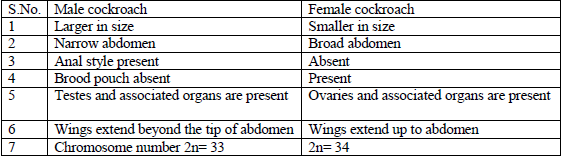
Q.6.Differentiate between male and female cockroach.
Ans.6.
Important Questions for NCERT Class 11 Biology Structural Organisation in Animals
Ques. Which one of the following is correct pairing of a body part and the kind of muscle tissue that moves it?
(a) Biceps of upper arm – Smooth muscle fibres
(b) Abdominal wall – Smooth muscle
(c) Iris – Involuntary smooth muscle
(d) Heart wall – Involuntary unstriated muscle
Answer: B
Ques. The epithelial tissue present on the inner surface of bronchioles and Fallopian tubes is
(a) glandular (b) ciliated
(c) squamous (d) cuboidal.
Answer: B
Ques. The cell junctions called tight, adhering and gap junctions are found in
(a) connective tissue (b) epithelial tissue
(c) neural tissue (d) muscular tissue.
Answer: B
Ques. The kind of tissue that forms the supportive structure in our pinna (external ears) is also found in
(a) nails (b) ear ossicles
(c) tip of the nose (d) vertebrae.
Answer: C
Ques. Which one of the following pairs of structures distinguishes a nerve cell from other types of cell?
(a) Vacuoles and fibres
(b) Flagellum and medullary sheath
(c) Nucleus and mitochondria
(d) Perikaryon and dendrites
Answer: D
Ques. In which one of the following preparations are you likely to come across cell junctions most frequently?
(a) Thrombocytes (b) Tendon
(c) Hyaline cartilage (d) Ciliated epithelium
Answer: D
Ques. Areolar connective tissue joins
(a) bones with bones
(b) fat body with muscles
(c) integument with muscles
(d) bones with muscles.
Answer: C
Ques. Mast cells secrete
(a) haemoglobin (b) hippurin
(c) myoglobin (d) histamine.
Answer: D
Ques. Four healthy people in their twenties got involved in injuries resulting in damage and death of few cells of the following. Which of the cells are least likely to be replaced by new cells?
(a) Liver cells (b) Neurons
(c) Malpighian layer of the skin (d) Osteocytes
Answer: B
Ques. Mast cells of connective tissue contain
(a) vasopressin and relaxin
(b) heparin and histamine
(c) heparin and calcitonin
(d) serotonin and melanin.
Answer: B
Ques. Which one of the following contains the largest quantity of extracellular material ?
(a) Striated muscle (b) Areolar tissue
(c) Stratified epithelium (d) Myelinated nerve fibres
Answer: B
Ques. Collagen is
(a) fibrous protein (b) globular protein
(c) lipid (d) carbohydrate.
Answer: A
Ques. During an injury nasal septum gets damaged and for its recovery which cartilage is preferred?
(a) Elastic cartilage (b) Hyaline cartilage
(c) Calcified cartilage (d) Fibrous cartilage
Answer: B
Ques. Which cells do not form layer and remains structurally separate?
(a) Epithelial cells (b) Muscle cells
(c) Nerve cells (d) Gland cells
Answer: C
Ques. Proteoglycan in cartilages which is a part of polysaccharide is
(a) chondroitin (b) ossein
(c) casein (d) cartilagin.
Answer: A
Free study material for Biology
Advanced HOTS Questions with Solutions: Class 11 Biology Chapter 07 Structural Organisation in Animals
Class 11 Biology Chapter Chapter 07 Structural Organisation in Animals Advanced Problem Sets
Strengthen your preparation for Class 11 Biology examinations with specialized Chapter 07 Structural Organisation in Animals HOTS worksheets. These structured problems are curated to match official CBSE guidelines and help tackle difficult board-level questions.
How to Use These Class 11 Biology HOTS
Each question in this set is mapped directly to the official NCERT book for Class 11. Review the detailed answer keys provided below each problem to verify your solution steps and correct mistakes early.
More Study Resources for Class 11 Biology
Looking for more practice? Explore our complete library of Class 11 Biology worksheets, chapter notes, and online mock tests. Everything is provided free of charge to support your academic goals.
FAQs
You can download the teacher-verified PDF for CBSE Class 11 Biology HOTs Structural Organisation In Animals from StudiesToday.com. These questions have been prepared for Class 11 Biology to help students learn high-level application and analytical skills required for the 2026-27 exams.
In the 2026 pattern, 50% of the marks are for competency-based questions. Our CBSE Class 11 Biology HOTs Structural Organisation In Animals are to apply basic theory to real-world to help Class 11 students to solve case studies and assertion-reasoning questions in Biology.
Unlike direct questions that test memory, CBSE Class 11 Biology HOTs Structural Organisation In Animals require out-of-the-box thinking as Class 11 Biology HOTS questions focus on understanding data and identifying logical errors.
After reading all conceots in Biology, practice CBSE Class 11 Biology HOTs Structural Organisation In Animals by breaking down the problem into smaller logical steps.
Yes, we provide detailed, step-by-step solutions for CBSE Class 11 Biology HOTs Structural Organisation In Animals. These solutions highlight the analytical reasoning and logical steps to help students prepare as per CBSE marking scheme.