

Here is CBSE Class 11 Biology HOTs Cell Cycle And Cell Division for your advanced practice. Find detailed High Order Thinking Skills (HOTS) questions and solutions for Class 11 Biology Chapter 10 Cell Cycle and Cell Division. Built for the 2026-27 exam session, these expert-tested questions sharpen your problem-solving skills according to standard CBSE, NCERT, and KVS rules.
Download Class 11 Biology Chapter 10 Cell Cycle and Cell Division HOTS Practice
Check out these Class 11 Biology HOTS Questions to test your advanced knowledge of Biology. The detailed answers below will help you practice smarter and build high-level accuracy for your Class 11 tests.
Download HOTS: Chapter 10 Cell Cycle and Cell Division (Class 11 Biology)
Cell Cycle And Cell Division
Important Questions for NCERT Class 11 Biology Cell Cycle and Cell Division
Question. In which of the following stages terminalisation occurs?
(a) Zygotene
(b) Pachytene
(c) Diakinesis
(d) Diplotene
Answer : C
Question. Lampbrush chromosomes are actually
(a) condensed zygotene chromosomes
(b) decondensed diplotene chromosomes
(c) condensed leptotene chromosomes
(d) decondensed pachytene chromosomes.
Answer : B
Question. Read the given statements and select the correct option.
Statement A : The ploidy number of the cell doubles during S-phase.
Statement B : The DNA content of the cells remains the same during S-phase.
(a) Both statements A and B are true and B is the correct explanation of A.
(b) Both statements A and B are true but B is not the correct explanation of A.
(c) Statement A is true but B is false.
(d) Both statements A and B are false.
Answer : D
Question. In tetrad, crossing over does not take place between
(a) non-sister chromatids of outer group
(b) sister chromatids of dyad
(c) outermost and innermost non-sister chromatids
(d) all of these.
Answer : D
Question. The significance of mitotic division is
(a) it takes place where there is a need of increase in number of cells only
(b) it is the method of multiplication of unicellular organisms
(c) daughter cells and parent cells have the same number of chromosomes (2n)
(d) all of these.
Answer : D
Question. “G0” state of cells in eukaryotic cell cycle denotes
(a) check point before entering the next phase
(b) pausing in the middle of a cycle to cope with a temporary delay
(c) death of a cell
(d) exit of cells from cell cycle.
Answer : D
Question. Which of the following is a key event of anaphase of mitotic division?
(a) Chromosomes are moved to spindle equator and get aligned through spindle fibres to both poles.
(b) Centromeres split and chromatids separate.
(c) Chromosomes cluster at opposite spindle poles and their identity is lost as discrete elements.
(d) Both (b) and (c)
Answer : B
Question. Which is not true about mitosis?
(a) Mitosis is initiated after G1 phase.
(b) Crossing over does not take place.
(c) Parent cell produces two daughter cells.
(d) The two daughter cells have the same number of chromosomes as in the parent cell.
Answer : A
Question. Reason of chromosomal movement in anaphase is
(a) astral rays
(b) centrioles
(c) kinetochore
(d) spindle fibres.
Answer : D
Question. Who coined the term mitosis?
(a) Flemming
(b) Farmer
(c) Strasburger
(d) Boveri
Answer : A
Ques. Identify the correct statement with regard to G1 phase (Gap 1) of interphase.
(a) DNA synthesis or replication takes place.
(b) Reorganisation of all cell components takes place.
(c) Cell is metabolically active, grows but does not replicate its DNA.
(d) Nuclear division takes place.
Answer: C
Ques. Some dividing cells exit the cell cycle and enter vegetative inactive stage. This is called quiescent stage (G0). This process occurs at the end of
(a) M phase
(b) G1 phase
(c) S phase
(d) G2 phase.
Answer: B
Ques. Cells in G0 phase
(a) terminate the cell cycle
(b) exit the cell cycle
(c) enter the cell cycle
(d) suspend the cell cycle.
Answer: B
Ques. The correct sequence of phases of cell cycle is
(a) G1 → S → G2 → M
(b) M → G1 → G2 → S
(c) G1 → G2 → S → M
(d) S → G1 → G2 → M.
Answer: A
Ques. During cell growth, DNA synthesis takes place on
(a) S-phase
(b) G1-phase
(c) G2-phase
(d) M phase.
Answer: A
Ques. When cell has stalled DNA replication fork, which checkpoint should be predominantly activated?
(a) G1/S
(b) G2/M
(c) M
(d) Both G2/M and M
Answer: B
Ques. A somatic cell that has just completed the S phase of its cell cycle, as compared to gamete of the same species, has
(a) twice the number of chromosomes and four times the amount of DNA
(b) four times the number of chromosomes and twice the amount of DNA
(c) twice the number of chromosomes and twice the amount of DNA
(d) same number of chromosomes but twice the amount of DNA.
Answer: A
Ques. During which phase(s) of cell cycle, amount of DNA in a cell remains at 4C level if the initial amount is denoted as 2C?
(a) G0 and G1
(b) G1 and S
(c) Only G2
(d) G2 and M
Answer: C
Ques. In ‘S’ phase of the cell cycle
(a) amount of DNA doubles in each cell
(b) amount of DNA remains same in each cell
(c) chromosome number is increased
(d) amount of DNA is reduced to half in each cell.
Answer: A
Ques. At what stage of the cell cycle are histone proteins synthesized in a eukaryotic cell?
(a) During G2 stage of prophase
(b) During S-phase
(c) During entire prophase
(d) During telophase
Answer: B
Ques. In the somatic cell cycle
(a) in G1 phase DNA content is double the amount of DNA present in the original cell
(b) DNA replication takes place in S phase
(c) a short interphase is followed by a long mitotic phase
(d) G2 phase follows mitotic phase.
Answer: B
Ques. In which stage of cell cycle, DNA replication occurs?
(a) G1-phase
(b) S-phase
(c) G2-phase
(d) M-phase
Answer: B
Ques. Which typical stage is known for DNA replication?
(a) S-phase
(b) G2-phase
(c) metaphase
(d) G1-phase
Answer: A
Ques. In a somatic cell cycle, DNA synthesis takes place in
(a) G1 phase
(b) prophase of mitosis
(c) S-phase
(d) G2 phase.
Answer: C
Assertion Reason
For question numbers 51-60, two statements are given-one labelled Assertion and the other labelled Reason.
Select the correct answer to these questions from the codes (a), (b), (c) and (d) as given below.
(a) Both assertion and reason are true and reason is the correct explanation of assertion.
(b) Both assertion and reason are true but reason is not the correct explanation of assertion.
(c) Assertion is true but reason is false.
(d) Assertion is false but reason is true.
Question. Assertion : Interphase occurs between two dividing M-phase.
Reason : Interphase cell is metabolically quite active.
Answer : B
Question. Assertion : Plants can show mitotic division only in diploid somatic cells.
Reason : Cells in G0 stage is metabolically active but no longer proliferate.
Answer : D
Question. Assertion : Meiosis increases genetic variability in the population.
Reason : Chromosomal and genomic mutations can take place by irregularities of meiotic divisions.
Answer : B
Question. Assertion : Interkinesis is metabolic stage between telophase of meiosis I and prophase of meiosis II.
Reason : During interkinesis, chromatin reticulum is formed.
Answer : C
Question. Assertion : Meiosis introduces new combination of traits in the progeny.
Reason : Meiosis involves crossing over.
Answer : A
Short Answer Type Questions
Question. Mention about the synaptonemal complex.
Answer. Synaptonemal complex is a protein complex, visible with the electron microscope, that is the physical basis of the pairing of homologous chromosomes (synapsis) during meiosis. It assembled during zygotene as homologous chromosomes pair up, and it disassembled during diplotene as homologous chromosomes separate.
Question. Complete the following sentences with suitable words.
(i) Chromosome condensation occurs during ________
(ii) _________ is marked by the alignment of chromosomes at the equatorial plate.
(iii) _________ is the equational division in which the chromosome number of the parent is conserved in the daughter cell.
(iv) Each parent cell has a pair of _________ chromosomes.
Answer. (i) prophase (ii) metaphase (iii) mitosis (iv) homologous
Question. Discuss about the attributes does a chromatid require to be classified as a chromosome.
Answer. In telophase-I of meiosis-I, chromosome number becomes half but the chromosomes are still composed of two chromatids. If crossing over occurred, these chromatids are not genetically identical. They divide in second meiotic division. Hence, crossing over is an attribute, which classify chromatids as chromosomes.
Question. Distinguish anaphase of mitosis from anaphase-I of meiosis.
Answer. Differences between anaphase of mitosis and anaphase-I of meiosis are as follows :
Question. Why do the chromosomes become short and thick in prophase?
Answer. The chromosomes become short and thick in prophase because it is physically easier for short and compact chromosomes to move through the cytoplasm than the very long and twisted interphase chromosomes.
Question. Both unicellular and multicellular organisms undergo mitosis. What are the differences, if any, observed in the process between the two?
Answer. In unicellular organisms, mitosis is a method of asexual reproduction. E.g., in bacteria, mitosis results in formation of identical daughter cells. However in multicellular organisms, mitosis helps in growth and repair of cells and tissues. E.g, Repair of damaged skin through production of new skin cells.
Question. Give examples where the four daughter cells from meiosis are equal in size and where they are found unequal in size.
Answer. During formation of male gametes (i.e., spermatozoa) in a typical mammal (i.e., human being), the four daughter cells formed from meiosis are equal in size. On the other hand, during formation of female gamete (i.e., ovum) in a typical mammal (i.e., human being), the four daughter cells are unequal in size.
Question. In which phase of meiosis are the following formed?
(i) Synaptonemal complex.
(ii) Recombination nodules.
(iii) Appearence/activation of enzyme recombinase.
(iv) Terminalisation of chiasmata.
(vi) Formation of dyad of cell.
Answer. (i) Zygotene
(ii) Pachytene
(iii) Pachytene
(iv) Diakinesis
(v) Anaphase-I
Question. How do cell stop dividing?
Answer : When cell enters in G0 Cycle
Question. Which stage of meiotic division last for years in some vertebrates. Explain some features of this stage.
Answer : Diplotene of meiosis
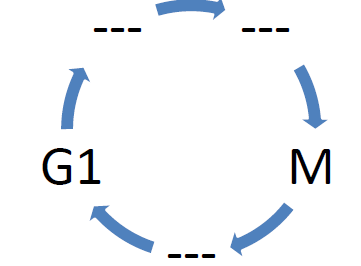
Question. Complete the following figure for Cell Cycle.
Answer : G0 , S, G2
Free study material for Biology
CBSE Class 11 Biology Chapter 10 Cell Cycle and Cell Division HOTS Questions and Answers
High Order Thinking Skills: Chapter 10 Cell Cycle and Cell Division Overview
Download high-level analytical questions for Chapter 10 Cell Cycle and Cell Division. Designed in alignment with the latest CBSE syllabus for Class 11 Biology, these problem sets test deep conceptual understanding and prepare students for complex exam questions.
How to Use These Class 11 Biology HOTS
Pair these practice sets with our comprehensive NCERT solutions for Class 11 Biology to clear up doubts. Checking your working against our detailed explanations guarantees absolute mastery over this chapter.
More Study Resources for Class 11 Biology
Wrap up your chapter revision by testing your speed with our interactive Biology quizzes. Access all curriculum-aligned study resources online without any restrictions.
FAQs
You can download the teacher-verified PDF for CBSE Class 11 Biology HOTs Cell Cycle And Cell Division from StudiesToday.com. These questions have been prepared for Class 11 Biology to help students learn high-level application and analytical skills required for the 2026-27 exams.
In the 2026 pattern, 50% of the marks are for competency-based questions. Our CBSE Class 11 Biology HOTs Cell Cycle And Cell Division are to apply basic theory to real-world to help Class 11 students to solve case studies and assertion-reasoning questions in Biology.
Unlike direct questions that test memory, CBSE Class 11 Biology HOTs Cell Cycle And Cell Division require out-of-the-box thinking as Class 11 Biology HOTS questions focus on understanding data and identifying logical errors.
After reading all conceots in Biology, practice CBSE Class 11 Biology HOTs Cell Cycle And Cell Division by breaking down the problem into smaller logical steps.
Yes, we provide detailed, step-by-step solutions for CBSE Class 11 Biology HOTs Cell Cycle And Cell Division. These solutions highlight the analytical reasoning and logical steps to help students prepare as per CBSE marking scheme.