

Refer to CBSE Class 11 Biology HOTs Biomolecule. We have provided exhaustive High Order Thinking Skills (HOTS) questions and answers for Class 11 Biology Chapter 09 Biomolecules. Designed for the 2026-27 exam session, these expert-curated analytical questions help students master important concepts and stay aligned with the latest CBSE, NCERT, and KVS curriculum.
Chapter 09 Biomolecules Class 11 Biology HOTS with Solutions
Every Class 11 Biology student should practice these HOTS Questions to tackle difficult exam problems. Use the provided solutions to improve your critical thinking and boost your overall performance in Class 11.
HOTS Questions and Answers for Class 11 Biology Chapter 09 Biomolecules
MULTIPLE CHOICE QUESTIONS
Question. Who coined the term zymase?
(a) Pasteur
(b) Buchner
(c) Kuhne
(d) Sumner
Answer. B
Question. Which is the derivative of amino acid ?
(a) Epinephrine
(b) Estrogen
(c) Progesterone
(d) All of these
Answer. A
Question. Apoenzyme is
(a) protein
(b) lipid
(c) sugar
(d) vitamin
Answer. A
Question. Which one of the following statements regarding starch and cellulose is not correct?
(a) Both of them are of plant origin.
(b) Both of them are polymers.
(c) Both of them give colour with iodine.
(d) Both of them are made up of glucose molecules.
Answer. C
Question. Which of the following type of enzyme is not matched correctly with the molecule that it breaks down?
(a) Amylase–starch
(b) Lipase–starch
(c) Protease–proteins
(d) Disaccharidase–sugars
Answer. B
Question. Gamma globulins are synthesized inside
(a) liver
(b) kidney
(c) bone marrow
(d) lymph and lymphoid tissues
Answer. A
Question. Refer the given structure of adenylic acid. In this identify A.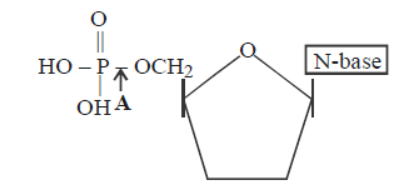
(a) Glycosidic bond
(b) Phosphate bond
(c) Ester bond
(d) Ionic bond
Answer. C
Question. The figure given below show three velocitysubstrate concentration curves for an enzyme reaction. What do the curves a, b and c depict respectively?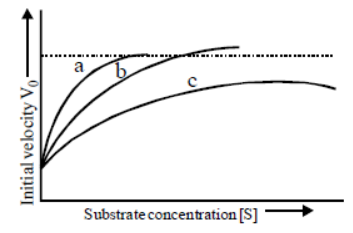
(a) a - normal enzyme reaction,b - competitive inhibition,c - non-competitive inhibition.
(b) a - enzyme with an allosteric modulator added, b - normal enzyme activity,c - competitive inhibition.
(c) a - enyzme with an allosteric stimulator,b - competitive inhibitor added,c - normal enzyme reaction.
(d) a - normal enzyme reaction,b - non-competitive inhibitor added,c - allosteric inhibitor added.
Answer. A
ASSERTION REASON QUESTIONS
Directions : These questions consist of two statements, each printed as Assertion and Reason. While answering these questions, you are required to choose any one of the following five responses.
(a) If both Assertion and Reason are correct and the Reason is a correct explanation of the Assertion.
(b) If both Assertion and Reason are correct but Reason is not a correct explanation of the Assertion.
(c) If the Assertion is correct but Reason is incorrect.
(d) If both the Assertion and Reason are incorrect.
(e) If the Assertion is incorrect but the Reason is correct.
Question. Assertion : Enzymes have active sites and substrates have reactive sites on their surface respectively.
Reason : Active and reactive sites push the enzyme and substrate molecules away from each other.
Answer. D
Question. Assertion : Vegetable oils are fats which are present in plant cells in soluble form.
Reason : Vegetable oils occur only in cells of embryo.
Answer. D
Biomolecule
Question. What do you mean by PUFA?
Answer. Poly Unsaturated Fatty Acid
Question. Identify the secondary protein and quaternary proteins in following examples. Trypsin, Haemoglobin protein, Myosin protein, Actin protein, Albumin, globulin.
Answer. Secondary Protein: Myosin protein, Actin protein, Albumin, globulin, Trypsin Tertiary Protein: ( Hemoglobin protein )
Question. What is histone protein. Where it is found in cell. Mention the function of it in eukaryotic cell.
Answer. Basic proteins rich in lysine , found in nucleoplasm. Binds with negatively charged DNA forming Octamers called nucleosome.
Free study material for Biology
Download Class 11 Biology Chapter 09 Biomolecules HOTS Practice Questions
Class 11 Biology Chapter Chapter 09 Biomolecules Advanced Problem Sets
Master core concepts in Chapter 09 Biomolecules with these targeted Higher Order Thinking Skills (HOTS) problems. Built for Class 11 Biology students following the CBSE curriculum, these exercises challenge analytical thinking and improve problem-solving speed.
How to Use These Class 11 Biology HOTS
Pair these practice sets with our comprehensive NCERT solutions for Class 11 Biology to clear up doubts. Checking your working against our detailed explanations guarantees absolute mastery over this chapter.
More Study Resources for Class 11 Biology
Wrap up your chapter revision by testing your speed with our interactive Biology quizzes. Access all curriculum-aligned study resources online without any restrictions.
FAQs
You can download the teacher-verified PDF for CBSE Class 11 Biology HOTs Biomolecule from StudiesToday.com. These questions have been prepared for Class 11 Biology to help students learn high-level application and analytical skills required for the 2026-27 exams.
In the 2026 pattern, 50% of the marks are for competency-based questions. Our CBSE Class 11 Biology HOTs Biomolecule are to apply basic theory to real-world to help Class 11 students to solve case studies and assertion-reasoning questions in Biology.
Unlike direct questions that test memory, CBSE Class 11 Biology HOTs Biomolecule require out-of-the-box thinking as Class 11 Biology HOTS questions focus on understanding data and identifying logical errors.
After reading all conceots in Biology, practice CBSE Class 11 Biology HOTs Biomolecule by breaking down the problem into smaller logical steps.
Yes, we provide detailed, step-by-step solutions for CBSE Class 11 Biology HOTs Biomolecule. These solutions highlight the analytical reasoning and logical steps to help students prepare as per CBSE marking scheme.