

Download NCERT Solutions for Class 5 Environmental Studies Chapter 18 No place for us
Access comprehensive textbook solutions for Chapter 18 No place for us using the official curriculum guides for Class 5 Environmental Studies. Designed to align with the 2026-27 NCERT standards, these detailed answers help students reinforce core academic concepts.
Access NCERT Solutions and Answers
View or download the dedicated Chapter 18 No place for us solution resource below. Engaging with these textbook answers under focused study conditions ensures continuous academic progress and mastery of the 2026-27 curriculum for Environmental Studies.
NCERT Solutions for Class 5 EVS for Chapter 18 No place for us
1. Jatrya felt alone, even in a crowd of people. Have you ever felt like this?
Ans.Yes, once I got separated from my mother in a market for few minutes. Though there was a huge crowd of people but still I was feeling all alone as I knew no one.
2. Imagine how it feels to leave one’s own place and go for away to live in a new place?
Ans.It is a very difficult to leave one’s own place and live far away at a new place. This is because, there is nobody with whom we can share our feelings, problems and other matters. Thus, it feels very bad and sad to leave our own place.
3. Why do you think families like that of Jatrya’s are coming to big cities?
Ans.The families like that of Jatriya often come to big cities due to poverty, to earn more money and live a better life. There may also be many problems with them in the village. For example, sometimes due to scantly rainfall there is not much profit from the farms, sometimes they are asked to leave their villages by the government or private companies because of the construction of factories or dams etc. Thus, they are forced to come to big cities.
4. Have you seen any children (in your school or neighbourhood) who also go to work?
Ans.Yes, I have seen few children in my neighbourhood who go to work.
5. What kind of work do they do? Why do they have to work?
Ans.They have to do the following types of work:
(i) Fish catching and cleaning
(ii) Picking up the luggage of people at the bus or railway station
(iii) Kabariwala (picking up rags from the houses or big dustbins)
(iv) Working as a servant in house or shops.
They have to work because of poverty. They belong to those families who are as poor that they don’t have money even to eat the basic food. Thus, their children are forced to work.
6. In Khedi village what all did children learn?
Ans.Children in Khedi village learnt the following:
(i) Dancing
(ii) Playing flute and dhol
(iii) Making vessels and other things from bamboo and clay.
(iv) Recognising birds and imitating their sounds etc.
7. What do you learn from your elders?
Ans.I learn the following from my elders-
(i) To respect elders.
(ii) To sleep, wake up, study and play on time and in a proper routine.
(iii) To maintain love and affection with the friends and brothers and sisters.
(iv) To help in some household jobs.
8. Jatrya learnt so many things in Khedi. How many of those would be useful for him in Mumbai?
Ans.Jatrya had learnt many things in Khedi. Out of these, he can use some of them to earn money in Mumbai, such as:
Fish catching, selling goods in the market, playing dhol etc.
9. Do you hear the sounds of birds everyday? Show how?
Ans.Yes, I often hear the sounds of birds such as:
Guttar-Guttar of pigeon
Chi-Chi of sparrow
Kav-Kav of cow
10. What are some of the sounds that you hear everyday, but the people of Khedi may not be hearing?
Ans.Some of the sounds that we hear everyday but the people of Khedi may not be hearing them are:
Horns of the vehicles.
Sound of trains
Sound of loudspeakers.
11. Have you experienced silence? When and where?
Ans.Yes, I feel silence daily at night when I go for sleeping. At this time there is no sound at all. The people, animals and birds are all sleeping. There is no vehicle on the roads as well. Thus, there is complete silence.
12. Many forest in Jatrya’s village did not agree to move away their land and forest. Why? They had to leave even though they did not want to?
Ans.Many people of Jatrya’s village did not want to leave their land and forest because – it was their grandfather’s land and they had many old members associated with that place. But still they had to leave from that place because they were ordered to leave the village by the government officials along with the police. Moreover, they were promised that they will be shifted to a much better where there will be electricity, water etc.
13. In Khedi how many people were there in Jatrya’s family? Who came to his mind? What he thought about his family?
Ans.There were three people in Jatrya’s family in Khedi. His father, mother and Jatrya himself. When he thought about his family, he thought of his would be wife and would be children.
14. Who all came to your mind which you think about your family?
Ans.When I think about my family, my grandparents, parents and brother come in my mind.
15. Have you heard of people who don’t want to be moved from their old place? Talk about them.
Ans.Yes, my grandparents live in the village. They don’t want to leave their old place. They say its their grandfather’s land and they have many sweet memories associated with that place, their farms and their pet animals. Therefore, they do not want to come and live in the city.
16. Do you know some people who have never been to school? Do you also know of any place where there is no school.
Ans.Yes, our maid servant has never been to school. There is a small village in Rajasthan, where there is no school.
17. Think of the kind of difficulties people have to face where a dam is being built.
Ans.People have to face many difficulties at the place where a dam is being built, such as:
(i) Their houses, farms etc. Are all destroyed.
(ii) They are promised to be given some compensation by the government but sometimes, they have to face many difficulties in getting this compensation.
(iii) They are given new houses to live but they are not as good as were told to them. They have electricity but it remains for few hours only. There are taps no water.
(iv) The other people treat the village people as poor, uneducated and inferior.
18. Was Sinduri village like the village like the Jatrya’s dreams?
Ans.No, Sinduri village not like the village of Jatriaya’s dreams.
19. What difference he find between Sinduri and in his dreams village?
Ans.The difference that he found in Sinduri village and his dream village are as follows:
(i) He thought that his house in the new village would have electricity, water in taps and all basis things. But it was not so in Sinduri village. There was no electricity but it was just very difficult to pay the heavy bills. There were taps but no water.
(ii) There was no place for keeping the animals.
(iii) They were given land for farming but it was not good for farming, it was filled with stones and pebbles.
(iv) There was school, but the teacher did not pay attention to the children from Khedi village. These children found it difficult to learn in a new language.
(v) There were doctors, but they were not available on time.
(vi) The people of Sinduri village also treated them as unwanted guests and found their language and way of living strange and made fun of them.
20. Have you ever been to anyone’s house as an ‘unwanted guest’? How did you feel?
Ans.When guests come to stay at our home for a few days, then we respect them. We arrange for their meals, bedding and other basic requirements etc. We prepare their favourite food items. We also take them to some good places to entertain them.
21. What had Jatryabhai thought while moving to Mumbai? Did he find Mumbai as he had imagined?
Ans.Jatriyabhai though when they are being treated as unwanted guests so it is of no use of live in Sunduri village. He was also not getting any goods facilities in this village. So, he decided to move to Mumbai and thought here his children could study in a good school and will have a better future. No, Mumbai was not as he has thought of. There was no place to stay for outsiders like Jatryabhai. It was very difficult to find some work and earn money. The conditions were even more worse, it was very hard for him to pay for the food, house, medicines, school fees and even water was also to be purchased by money. Even his small son, Sidya had to work to earn money.
22. What kind of school do you think Jatrya’s children would be going to in Mumbai?
Ans.Jatrya’s children would be studying in a government school in Mumbai.
23. Do you know of any family that has come to your town after having moved out of his place? Talk to them and find out.
Ans.Yes, I know few students in my school have come from a small village in Rajasthan. They were asked to move from that place.
24. From where have they come? Why did they have come here?
Ans.They have come from a small village in Rajasthan. They were asked to leave that place by the government officials because of the construction of a factory at that place.
25. What kind of place did they live in there? How do they find this new place compared to the old one?
Ans.They used to live in a small village that was very beautiful, peaceful and simple. There were farms, freely available water, animals and small schools. The environment was also not much polluted. As compared to that old village, this new place, that is the city is very noisy, crowded, polluted. The people have a different culture and way of talking. They do not get easily mixed up. Everything is a very expensive, even they have to pay for the water. They are finding it very difficult to survive in this new place.
26. Is their language and way of living any different from that of the people here? In what ways?
Ans.Yes, their language and way of living is very different from the people of this place. They used to speak in Rajasthani language and their ways of talking in Hindi is also very difficult. Their way of living is also very different. They used to prepare food on chulhas. They used to wear simple clothes, men used to wear ‘dhoti-kurta’ and ‘pagri’ on the head and women used to wear ‘ghaghra-choli’. But here in the city there is gas-stove for cooking, men wear shirts and paints and women wear suits, sarees, skirts etc.
27. Do you know how to make some things that you cannot know? What?
Ans.Yes, they know making special things which I don’t know such as:
Making utensils, pitcher or other things out of clay.
Bucket out of bamboo.
28. Have you ever read or heard of a city slum being removed? How do you feel about this?
Ans.Yes, I have heard about a slum that was removed from the area near the Yamuna river. The people living there had to face many difficulties as they were ordered to vacate that area immediately. I felt very bad and pity for these people.
29. People also shift from one place to another when they get transferred in their jobs? How do they feel then?
Ans.Many times people have to shift from one place to another, when they get transferred in their jobs. In this situation also they feel very bad and have to face many difficulties. They have to leave their houses, schools, friends, neighbours. In the new place, again they have to search for a new good school, have to adjust with the new people. But in this situation, at least they have a house to live and also since they already have a job, so at least they have enough money to survive.
30. “Some people say that city people do not create garbage. Cities are dirty because of slums”. How do you feel about it? Discuss and debate between yourselves.
Ans.It is incorrect to say that city people do not create garbage. It is because slum’s this is because in the cities are responsible for shifting the village people to the cities. They construct dams, factories etc. in the villages and force the villagers to empty those places. The villagers are not provided proper houses in the cities, they are just given small buts with no proper provision for toilet and bathing. As a consequence, these poor people are forced to use the roads and drains for this purpose. This causes dirty and foul smelling areas. So, actually the difficult situations in which they are forced to live are responsible for this. On the other hand, the city people causes a lot of pollution due to the vehicles, factories etc. Thus, the given statement is incorrect.
31. Like Jatrya’s family thousands of families come to stay in big cities for many different reasons. Do you think their life may be a better in a big city from what it was before? Imagine how they feel in a big city.
Ans.When families like Jatrya’s come to stay in big cities, their life becomes very different from what is was before. They have to face many problems in these big cities such as-
(i) They are not provided proper houses in the big cities, they are just given small hunts to stay with no proper facility for bathing and toilet.
(ii) They have the provision of electricity but it remains for only sometime. Also, they have to pay the electricity bills, which they cannot afford.
(iii) There are taps but with no waste. They have to pay for the water also.
(iv) They are not well qualified, therefore it is very difficult for them to get the good jobs. Even their children also have to work.
(v) There are schools for the children, but it is very difficult for them to understand the new language. Also the teacher does not pay much attention to them.
Question. To dial a telephone number in another town or city far away from our own in India, which number do we have to dial first?
(a) 0
(b) 1
(c) 8
(d) 9
Answer : A
Question. In the 20 century, which technology allowed people, for the first time, to live far from their place of work but travel to and fro everyday?
(a) Airplanes
(b) Automobiles
(c) Telephones
(d) Television
Answer : B
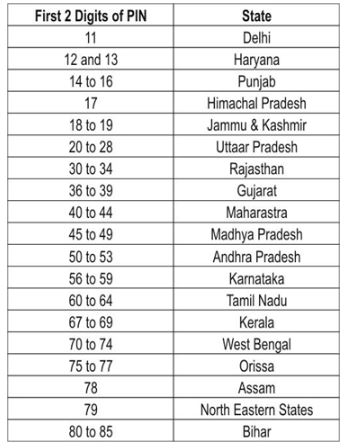
Question. Postal Index Number (PIN Code) is a 6-digit code. There are 8 PIN regions in India. The first 2 digits together indicate the sub region or state. See the table below.
Which of the following could be the PIN code of a town in Northern India?
(a) 160041
(b) 380016
(c) 400020
(d) 71200
Answer : A
Question. Sujatha wants to send a message and a cloth sample to her friend in Australia. Which of these forms of communication can she use?
(a) Post (Mail)
(b) e-mail
(c) Fax
(d) Phone
Answer : A
Question. Which of these means of communication was invented the first?
(a) Radio
(b) Newspaper
(c) Wireless
(d) Telephone
Answer : B
Free study material for Environmental Studies
Free NCERT Textbook Explanations: Class 5 Environmental Studies Chapter 18 No place for us
Textbook Solutions for Class 5 Environmental Studies Chapter 18 No place for us
Review comprehensive exercise answers for Class 5 Environmental Studies Chapter 18 No place for us. Fully updated to match current NCERT syllabus guidelines, these textbook solutions help students verify their work and maintain accurate study notes.
Mastering Theoretical and Practical Questions
Beyond providing final answers, these guides offer step-by-step breakdowns for complex queries in the Class 5 Environmental Studies module. This approach helps students balance theoretical depth with practical problem-solving skills required for NCERT exams.
Effective Self-Study and Homework Assistance
These resources act as an effective roadmap for daily homework tasks and independent study. Supplement your review of Chapter 18 No place for us with official sample papers and interactive practice tests available on our platform free of charge.
FAQs
The complete and updated NCERT Solutions Class 5 Environmental Studies Chapter 18 No place for us is available for free on StudiesToday.com. These solutions for Class 5 Environmental Studies are as per latest NCERT curriculum.
Yes, our experts have revised the NCERT Solutions Class 5 Environmental Studies Chapter 18 No place for us as per 2026 exam pattern. All textbook exercises have been solved and have added explanation about how the Environmental Studies concepts are applied in case-study and assertion-reasoning questions.
Toppers recommend using NCERT language because NCERT marking schemes are strictly based on textbook definitions. Our NCERT Solutions Class 5 Environmental Studies Chapter 18 No place for us will help students to get full marks in the theory paper.
Yes, we provide bilingual support for Class 5 Environmental Studies. You can access NCERT Solutions Class 5 Environmental Studies Chapter 18 No place for us in both English and Hindi medium.
Yes, you can download the entire NCERT Solutions Class 5 Environmental Studies Chapter 18 No place for us in printable PDF format for offline study on any device.