

Official NCERT Solutions for Class 5 Environmental Studies: Chapter 12 What if it Finishes files
Access comprehensive textbook solutions for Chapter 12 What if it Finishes files using the official curriculum guides for Class 5 Environmental Studies. Designed to align with the 2026-27 NCERT standards, these detailed answers help students reinforce core academic concepts.
Chapter-wise Solutions for Environmental Studies: Chapter 12 What if it Finishes files
Access the complete solution PDF for Class 5 Environmental Studies below. Regular practice with these targeted textbook answers builds familiarity with standard question patterns and helps secure higher marks in final school evaluations.
NCERT Solutions for Class 5 EVS for Chapter 12 What if it Finishes files
1. What are the different kinds of vehicles that you can see?
Ans. I can see vehicles like cars, buses, autorickshaws, motorcycles, cycle etc.
2. What do you think they need as fuel?
Ans. Cars, buses and motorcycles need petrol, diesel or CNG while cycles do not need any such fuels.
3. Do you ride a bicycle? If yes, where all do you go on it?
Ans. Yes, I ride a bicycle, I go to my school, playground, market and to meet my friends using it.
4. How do they come to school?
Ans. I come to school by school bus or by my cycle.
5. How do your family members go to work from home?
Ans. My father uses car, my mother go by metro rail while my uncle go by motorcycle.
6. What problems can we have from smoke coming out of vehicles?
Ans. We can have problems like coughing, nausea, headache and diseases related to lungs can have from smoke coming out of vehicles.
7. Which states of India have oil-fields?
Ans. In India oil fields are in Assam, Gujarat and the coastal areas of Maharasthra and Andhra Pradesh.
8. Besides oil, what else is found deep inside the earth?
Ans. Besides oil, minerals like iron, copper, bauxite, gold etc. deep are found inside the earth.
9. What all can vehicle run on?
Ans. Vehicles can run on petrol, diesel, CNG, LPG, battery and solar energy.
10. What kind of problems will we face, if the number of vehicles keep on increasing? For example, more traffic on the road. Talk to you elders and write about it.
Ans. If the number of vehicles keep on increasing on the road then besides heavy traffic, problems like air pollution, noise pollution, accident etc. can arise.
11. Manju said, “why doesn’t everyone use a bus?” What do you think, why don’t people travel by buses?
Ans. I think poor people prefer bicycle than to spend daily on buses while the rich ones use cars for convenience and also maintain their status.
12. Suggest some ways to deal with the problems arising out of the growing number of vehicles.
Ans. To control the growing number of vehicles people should prefer public transport system like buses, trains, metro train etc. This problem can also be effectively dealt with by making car pool i.e. sharing one’s car with their colleagues, other people etc.
13. What is the price of petrol and diesel in your area?
Ans. In our area the price of petrol is 48 rupees/litre while that of diesel is 34 rupees/litres.
14. Why are the prices of petrol and diesel going up?
Ans. The prices of petrol and diesel are going up because its production is limited while consumption is increasing day by day.
15. In one month how much petrol and diesel is used in your home? What is it used for?
Ans. In our home about 100 litres of petrol and 10 litres of diesel are used on conveyance and generator.
16. What for oil is used?
Ans. Oil is used as fuel for vehicles, for cooking food, lighting, dry, cleaning, to run machines and making plastic and paints.
17. Where is diesel used? Find out.
Ans. Diesel is used to rum cars, buses, trucks, tractors, trains and generators. Besides, it is also used to run machines in factories.
18. What would happen if you don’t get petrol or diesel for a week in your village or town?
Ans. If we don’t get petrol or diesel for a week in our area, life will come to a standstill as the crisis would badly affect the transport system. Machine used in factories and agriculture works will also become non-functional. We will not be able to get electricity from generators either. In other words, life will be messed up.
19. Suggest some ways to save oil.
Ans. Following measures could be taken to save oil:
(i) In place of using personal vehicles, we should use public transport system like buses, trains or metro trains etc.
(ii) We should prefer walking on foot or using bicycle.
(iii) We should keep our vehicles switched off on red lights.
(iv) We should utilize solar energy for different purposes.
20. Have you ever collected dry wool or made cow dung cakes? How are they made?
Ans. Yes, once I have collected dry wood and also made cow dung cakes. To make cow dung cakes, balls of cow dung are made and then these are flattened to make round and flat surfaces. After that these are dried up in the sun.
21. Do you know anyone who collects drywood or leaves to be used for lighting?
Ans. Yes, I know a few people living in my village who collects dry wood or leaves for fuel.
22. Who cooks food in your family? What about other families in your area?
Ans. My mother cooks food in my family. In other families in my area the ladies or servants cook food.
23. If they cook food using wood or upla, what difficulties do they face due to smoke?
Ans. The people who cook food using wood or upla may suffer from problems like coughing, nausea, headache, and lung diseases.
24. Can Durga use anything else instead of wood. Why not?
Ans. Since Durga is poor, she is unable to use anything else instead of wood.
25. Change in fuel use over thirty years
In year 1976, out of 100 how may houses used upla and wood?
Ans. In 84 houses.
26. Which was fuel used the least in 1976?
Ans. Electricity. In 1976, LPG and Kerosene were used in 10 houses and in 1996 this increased to 18. This means that in twenty years their use increased by 80%.
27. Out of 100 how many houses were using electricity in 1996?
Ans. In 75 houses.
28. Which fuel was used the least in 1996? In 1976, it was used in what percent of houses?
Ans. Coal was used the least in 1996. In 1976 was used in 5% of houses.
29. When they were young what was then used to cook food at home?
Ans. When they were young, coal, wood, upla were used to cook food at home.
30. In the past 10 years use of which cooking fuel has increased in your area? Use of which fuel has decreased?
Ans. In the past 10 years use of electricity and LPG has increased while use of wood, upla, coal, etc. has decreased.
31. Guess the use of which fuel increase and which would decrease in the next 10 years?
Ans. I guess in the next 10 years, use of electricity and LPG would increase while that of wood, coal and upla will decrease.
32. Imagine that a company has given you a chance to design a new vehicle like a mini bus. What kind of vehicle would you design? Write about it. Draw a picture and colour it.
Ans. I will design a bus which is environment friendly, highly fuel efficient and especially designed keeping in view the need of handicapped, children and elder people.
33. While making designs, what did you plan to take care of:
Ans. Old people: Low floor, special arrangement of seats near the doors.
Children: Low floor, closed door
Those who cannot see? Low floor, closed door and special arrangement of seats near the doors.
Question. Students of a class were asked to select a source of energy that is ENVIRONMENT FRIENDLY. Which among these should they select?
(a) Petrol
(b) Solar energy
(c) Cooking gas
(d) Coal
Answer : B
Question. Ramesh was applying paint on the wall during which some of the paint fell on his hands. Instead of using water, Ramesh used kerosene oil to wash his hands. Which of the following options explains Ramesh's decision?
(a) Kerosene is softer than water.
(b) Kerosene smells better than water.
(c) Paints dissolve in kerosene and not in water.
(d) Kerosene is more easily available than water.
Answer : C
Question. One evening in Kajol's house there was no electricity supply for 2 hours. Which of these things would have still worked?
(a) Door bell
(b) Gas stove
(c) Air conditioner
(d) Television
Answer : B
Question. Which of these activities, if done regularly, can help reduce air pollution?
(a) Spend very little time outside home.
(b) Use only TV or radio for entertainment purposes.
(c) Walk or use bicycles to go to nearby places.
(d) Burn all the garden waste in an open space at least once a week.
Answer : C
Question. A power cut made Vishaka light candles. What form(s) of energy does a burning candle release?
(a) Heat energy only
(b) Light energy only
(c) Chemical and sound energy.
(d) Light and heat energy.
Answer : D
Question. Air pollution is caused by
(a) dust only
(b) smoke and harmful gases only
(c) dust, smoke and harmful gases
(d) dust and harmful gases only
Answer : C
Question. The hardness of four different rocks was tested by trying to scratch a sample of each with the others. The results are shown in the table. Which of the following statements is correct?

(a) Chalk is scratched by sandstone.
(b) Granite is scratched by sandstone
(c) Flint is scratched by granite.
(d) Shale scratched all the other rocks.
Answer : A
Question. Ramu buried the following in a corner of his garden to dispose them off: If the corner is dug up 5 years later, which of these is most likely to have remained the same?
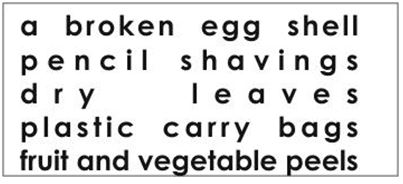
(a) the broken egg shell
(b) dry leaves
(c) plastic carry bags
(d) fruit and vegetable peels
Answer : C
Free study material for Environmental Studies
NCERT Solutions for Class 5 Environmental Studies Chapter 12 What if it Finishes files
Official NCERT Solutions for Chapter 12 What if it Finishes files
Explore reliable textbook solutions for Chapter 12 What if it Finishes files tailored for Class 5 learners. Utilizing these complete exercise answers ensures your preparation aligns exactly with official NCERT standards for Environmental Studies.
Step-by-Step Explanations for Chapter 12 What if it Finishes files
Clear, methodical explanations accompany every challenging problem within the Class 5 Environmental Studies text. Engaging with these detailed answers lays a solid foundation for advanced learning and improves foundational clarity for upcoming assessments.
Next Steps in Your Environmental Studies Revision
Frequent review of these structured answers builds strong analytical capabilities and response efficiency. Maximize your academic readiness by combining these textbook solutions with our curated study materials and mock evaluations for Class 5 Environmental Studies.
FAQs
The complete and updated NCERT Solutions Class 5 Environmental Studies Chapter 12 What if it Finishes files is available for free on StudiesToday.com. These solutions for Class 5 Environmental Studies are as per latest NCERT curriculum.
Yes, our experts have revised the NCERT Solutions Class 5 Environmental Studies Chapter 12 What if it Finishes files as per 2026 exam pattern. All textbook exercises have been solved and have added explanation about how the Environmental Studies concepts are applied in case-study and assertion-reasoning questions.
Toppers recommend using NCERT language because NCERT marking schemes are strictly based on textbook definitions. Our NCERT Solutions Class 5 Environmental Studies Chapter 12 What if it Finishes files will help students to get full marks in the theory paper.
Yes, we provide bilingual support for Class 5 Environmental Studies. You can access NCERT Solutions Class 5 Environmental Studies Chapter 12 What if it Finishes files in both English and Hindi medium.
Yes, you can download the entire NCERT Solutions Class 5 Environmental Studies Chapter 12 What if it Finishes files in printable PDF format for offline study on any device.