

NCERT Solutions for Class 5 Environmental Studies: Chapter 11 Sunita in space
Explore reliable textbook solutions for Chapter 11 Sunita in space tailored for Class 5 learners. Utilizing these Environmental Studies answers ensures thorough preparation and strengthens foundational knowledge before final NCERT evaluations.
Practice Class 5 Environmental Studies Solutions: Chapter 11 Sunita in space
Navigate directly to the solved Environmental Studies textbook exercises using the digital viewer below. Each solution includes detailed step-by-step explanations, allowing students to instantly cross-check their work and identify areas requiring further revision.
NCERT Solutions for Class 5 EVS for Chapter 11 Sunita in space
1. What do you think the earth looks like? Make a drawing of the earth in your notebook. On your drawing show where you are. Take a look at your friend’s drawings too.
Ans. I think the earth is round.
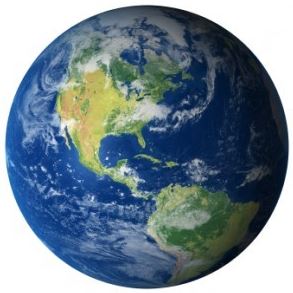
2. If the earth is round like a globe, how is that we do not fall off?
Ans. It is due to the earth’s gravitational force. Earth attracts everything towards its centre. That is why we do not fall off.
3. Do not people in Argentina stand upside down?
Ans. No, they are not. They are also standing upright. There is actually no ‘up’ and ‘down’ on the earth. It is relative.
4. Can you think why Sunita’s hair was standing?
Ans. We know that on earth, our hair remain in downwards portion due to earth’s gravitational force. But in space, there is no such gravitational force. That is why Sunita’s hair were standing.
5. Look at Sunita’s photographs and the dates written on each of them. Write what all is happening and when?
Ans. 9-12-2006 The spacecraft is taking off.
11-12-2006 Astronauts are floating inside the spacecraft.
11-12-2006 Astronauts are taking off.
13-12-2006 Sunita is working.
16-12-2006 Sunita is roaming outside the spacecraft.
6. Can you now say why Sunita’s hair kept standing?
Ans. Sunita’s hair kept standing because there is no gravitational pull in the space.
7. Think why water flows downwards on any slope? On mountain too water flows downwards, not upwards?
Ans. Water flows downwards on any slope or on mountains due to the gravitational force acting upon it.
8. Take a 5-rupee coin and a small piece of paper. The paper should be about one-fifth the size of the coin.
1. Hold the coin in one hand and the paper in the other. Drop them at the same time. What happened.
2. Now place the tiny paper on the coin and drop them. What happened this time? Surprised?
Ans. 1. Both fall down but the coin has fallen quickly.
2. Now, both fall down together, at the same time.
9. To play this you will need a small stone, a bigger stone, a thick roll of paper (which can be made by with layers of paper), mouse and an elephant made of paper.
Take a string about 2 feet long.
At one end of the string tie the small stone. Stick or tie the mouse to the stone.
Put the string into the roll of paper.
At the other end of the string tie the bigger stone and stick the elephant.
Hold the roll of paper and move your hand to rotate the small stone.
Who is pulling whom? You will be surprised! The mouse lifts the elephant!
How did this magic happen?
Ans. When the small stone (mouse) whirls, it create a force due to which the bigger stone (elephant) is pulled up.
10. Can you see India?
Ans. Yes, but not so clearly.
11. Can you recognize any other place.
Ans. It is very difficult to recognize any other place exactly.
12. Where is the sea?
Ans. The blue part of the picture is sea.
13. Do you find anything similar between the globe and this picture of earth? In what way are they different?
Ans. The similarity is both the cases the land and the sea areas can be distinguished. However, the entire land area is divided into various countries on the globe which is not so in case of this picture of the earth.
14. Do you think Sunita could make out Pakistan, Nepal and Burma separately when she saw the earth from space?
Ans. No, I do not think so.
15. Could you find India?
Ans. Yes.
16. Where do you find the sea?
Ans. The blue parts of the globe are seas.
17. Which countries can you see?
Ans. I can see all countries like India, Pakistan, China, Bangladesh, SriLanka, Indonesia, Singapore, USA, Russia, France, Britian, Germany, Mexico etc.
18. Can you see some of the countries with which India plays cricket matches? For example: England, Australia, Pakistan, Bangladesh and South Africa.
Ans. Yes, I can see all these countries.
19. What else can you see on the globe?
Ans. Yes, I live in Delhi and I can find my state in the map.
20. Which are states next to your states.
Ans. Delhi is an between Haryana and Uttar Pradesh.
21. Have you been to any other state?
Ans. Yes. I have been to many states like Uttar Pradesh, Haryana, Punjab, Himachal Pradesh etc.
22. Shahmir thinks that there are lines drawn on the ground, between the states. What do you think?
Ans. There is no such line made on the ground, between the states. It’s all on the map only.
23. Why don’t you try to do the same with a coin? How many centimetres away from the eye did you keep the coin to hide the moon?
Ans. To hide the moon completely, the coin has to kept at 25 centimetres away from the eye.
24. Do you think you try to do the same with a coin? How many centimetres away from the eye did you keep the coin to hide the moon?
Ans. To hide the moon completely, the coin has to be kept at 25 centimetres away from the eye.
25. When is the next full moon? At what time will the moon rise on this day? What does the moon look like on this day? Draw it.
Ans. The next full moon is on 15th of this month. That day the moon will rise a little rate – at round 9.00 pm. The moon will look spherical on this day.
26. What are the festivals related to the moon?
Ans. There are many festivals related to the moon like Eid, Karwachauth etc.
27. At night look at the sky carefully for 5 minutes. What could you see?
Ans. I could see the moon, stars etc.
28. Did you see anything moving in the sky? What do you think it could be? A star or a shooting or a satellite (satellites are used for the TV, telephones and for weather reports). Find out more about this.
Ans. Yes, I saw something moving in the sky. It may be a meteorite, which is also called a shooting star. These are the bodies moving around in the space which then enter the earth’s atmosphere, catch fire. Thus, they look bright, which when enter the earth’s atmosphere. Thus, they look bright.
29. If you saw the moon rising at 7 pm today, would you see it at the same time tomorrow?
Ans. No.
30. On 31 st October the time of setting of the moon given as 12:03. Have you ever seen the moon at 12 in the afternoon? Why don’t we easily see the moon or stars during the day?
Ans. No, I have never seen at 12 in the afternoon. We don’t early see the moon or stars during the day because of the sunlight.
31. See how the earth is looking. Can you see the surface of the moon? Do you have some questions after looking at this picture? Write down those questions and discuss them in the class.
Ans. The earth is looking spherical in shape. Yes, I can see the surface of the moon. The following questions arise in my mind after looking at this picture:
(i) Who look this picture?
(ii) Is there any life on the moon?
(iii) Whether we can see different countries on earth from the moon?
32. Why do children always slide down the slide and not slide up? If this slide where there in Sunita’s space, would children slide like this? Why?
Ans. Children always slide down the slide because of the earth’s gravitational force. However, if this slide were there in Sunita’s spacecraft, children would not slide like this because there is no gravitational force in the space.
33. Why do we see stars mostly at night?
Ans. Stars are mostly seen at night because there is no sunlight in the night. Thus, the light coming from the stars could reach us and we are able to see them.
34. Looking at earth from space, Sunita said, “Different countries cannot be seen as separate from her. These lines are on paper. They are made by us. What do you understand by this?
Ans. Sunita wanted to say that the land on earth is divided in the different countries just on paper. It is actually in our mind. There is no such differentiation in reality. Earth is all intact. So, looking at earth from the space, the earth looks quite different.
Question. Which would be the most suitable tool to tighten this bolt?
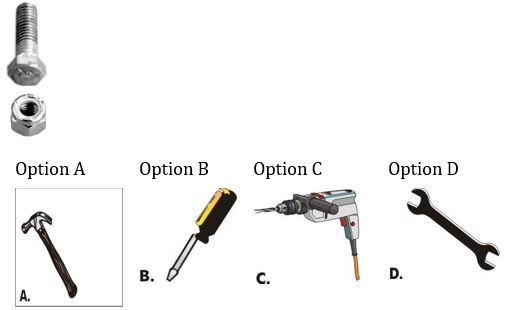
Answer : D
Question. In the diagram shown, when an object 'X' is brought near the ring shaped magnet, the magnet moves away from it. Four friends are discussing what they can say about X:
Nikhil : X can be a piece of any metal .
Shailaja : X can only be a piece of iron.
Aakash : X is definitely a magnet.
Vinay : X can either be a magnet or an iron piece. Who is correct?
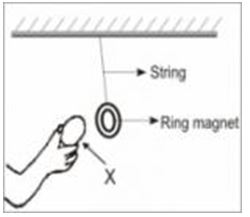
(a) Nikhil
(b) Shailaja
(c) Aakash
(d) Vinay
Answer : C
Question. The picture given below shows different layers of the Earth. On which layer does most life survive on?
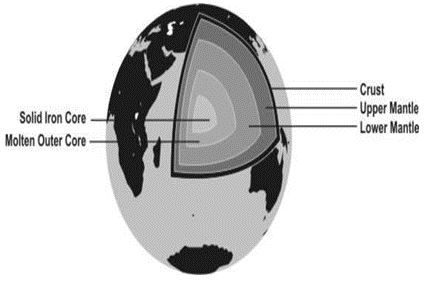
(a) Core
(b) Lower mantle
(c) Upper mantle
(d) Crust
Answer : D
Question. A cardboard is coated with vaseline and cut into four equal pieces. Each of these cards is hung at four different locations (as shown by the arrows in the figure below) for 2 days. Which piece would have the maximum soot/dirt particles on it?
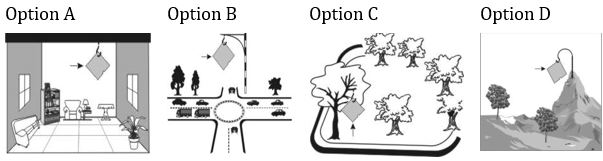
Answer : B
Question. One day after Shivratri, a lunar eclipse can occur. Which of the following phases of the moon is possible on that day?
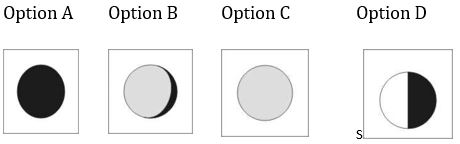
Answer : A
Question. A radio converts electrical energy into which one of the following energy forms?
(a) Heat
(b) Light
(c) Sound
(d) Chemical
Answer : C
Question. Equal-sized cut outs of the letters of the word SUN are placed as shown below between a torch and a screen. The shadow will look like
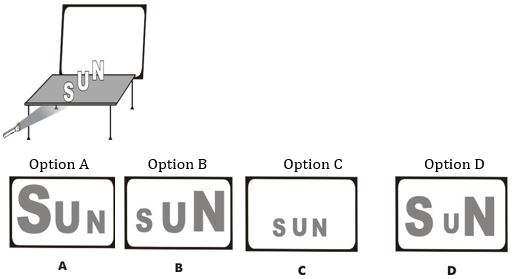 Z
Z
Answer : A
Question. Which of the following correctly shows a possible shadow of the house above?
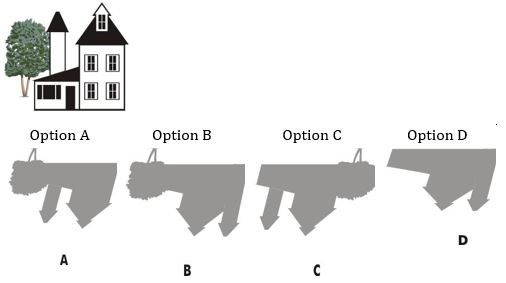
Answer : A
Question. Study the key hole shown here. Which of these keys will fit into the key hole?
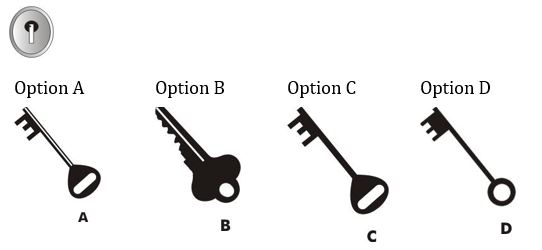
Answer : A
Question. One of these is the picture of an artificial SATELLITE. Identify it.
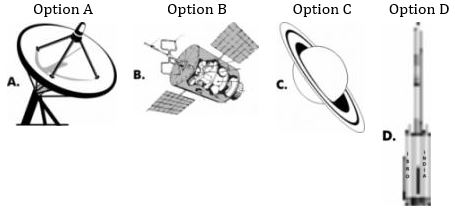
Answer : B
Question. There is a Full Moon on September 14th. On which date will the New Moon occur?
(a) September 21st
(b) September 28th
(c) October 13th
(d) October 31st
Answer : B
Question. Jayanthi is trying to study the formation of day and night using a lamp (as the Sun) and a ball (as the Earth). How should she move the ball to get the effect similar to day and night?
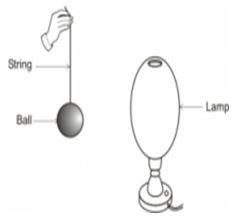
(a) Walk with the ball around the lamp.
(b) Spin the ball on the string.
(c) Raise and lower the ball.
(d) Move the ball closer to the lamp.
Answer : B
Question. The diagram below shows the days of a month on which there was ONLY SUNSHINE, ONLY RAIN and BOTH RAIN AND SUNSHINE in a town. Which three consecutive days respectively had only sunshine, sunshine and rain and only rain?
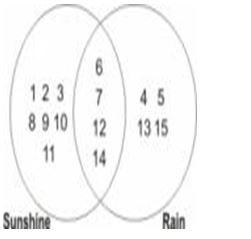
(a) 1st, 2nd and 3rd
(b) 5th, 6th and 7th
(c) 11th, 12th and 13th
(d) There were no such days in the period shown.
Answer : C
Question. See the figure below. It is currently summer at X and winter at Y. Which of these could be the date?
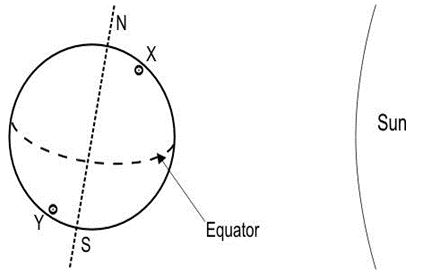
(a) December 22nd
(b) January 15th
(c) May 3rd
(d) January 1st
Answer : C
Question. Which one of these instruments will you use to observe the night sky?
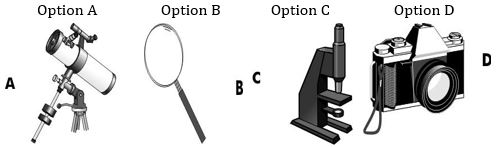
Answer : A
Question. The windows shown in the figure face the west. Which of the following correctly shows the position of the shadow in the morning?
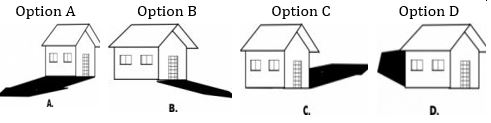
Answer : A
Question. Shown here is a CONSTELLATION called Orion. What is a constellation?
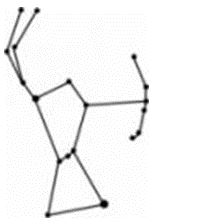
(a) A group of stars which are close to each other.
(b) A group of stars which form a pattern when seen from the earth.
(c) A group of stars at the same distance from the earth.
(d) A solar system consisting of a star and many planets
Answer : B
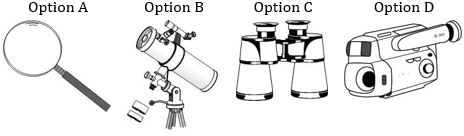
Question. Which of the following instruments is the BEST to see far-off planets?
Answer : B
Free study material for Environmental Studies
Environmental Studies Class 5 Curriculum Solutions: Chapter 11 Sunita in space
Official NCERT Solutions for Chapter 11 Sunita in space
Review comprehensive exercise answers for Class 5 Environmental Studies Chapter 11 Sunita in space. Fully updated to match current NCERT syllabus guidelines, these textbook solutions help students verify their work and maintain accurate study notes.
Step-by-Step Explanations for Chapter 11 Sunita in space
Each solution includes detailed reasoning to foster genuine comprehension of Chapter 11 Sunita in space concepts. Reviewing these step-by-step breakdowns allows learners to master both analytical and descriptive questions expected in school evaluations.
Next Steps in Your Environmental Studies Revision
Consistent practice with these solution guides cultivates faster problem-solving habits and clearer logical structuring. For a complete preparation experience, pair these textbook answers with our dedicated revision notes and sample papers for Class 5 Environmental Studies.
FAQs
The complete and updated NCERT Solutions Class 5 Environmental Studies Chapter 11 Sunita in space is available for free on StudiesToday.com. These solutions for Class 5 Environmental Studies are as per latest NCERT curriculum.
Yes, our experts have revised the NCERT Solutions Class 5 Environmental Studies Chapter 11 Sunita in space as per 2026 exam pattern. All textbook exercises have been solved and have added explanation about how the Environmental Studies concepts are applied in case-study and assertion-reasoning questions.
Toppers recommend using NCERT language because NCERT marking schemes are strictly based on textbook definitions. Our NCERT Solutions Class 5 Environmental Studies Chapter 11 Sunita in space will help students to get full marks in the theory paper.
Yes, we provide bilingual support for Class 5 Environmental Studies. You can access NCERT Solutions Class 5 Environmental Studies Chapter 11 Sunita in space in both English and Hindi medium.
Yes, you can download the entire NCERT Solutions Class 5 Environmental Studies Chapter 11 Sunita in space in printable PDF format for offline study on any device.