

Science Concept Notes for Class 10: Chapter 12 Magnetic Effects of Electric Current
Explore reliable concept summaries and revision materials through the CBSE Class 10 Science Magnetic Effect of Electric Current Notes. Tailored for Class 10 learners, utilizing these notes for Science Chapter 12 Magnetic Effects of Electric Current ensures thorough preparation and strengthens core academic definitions before final evaluations.
Download Chapter 12 Magnetic Effects of Electric Current Revision Notes PDF
Access the complete concept summary PDF for Chapter 12 Magnetic Effects of Electric Current below. Regular review of these targeted notes builds familiarity with complex Class 10 Science themes and helps secure higher marks in final school evaluations.
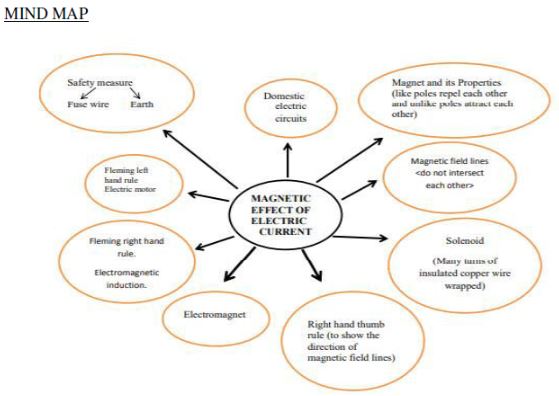
DEFINITION
Magnetic field: The area around a magnet where a magnetic force is experienced is called the magnetic field. It is a quantity that has both direction and magnitude, (i.e., Vector quantity) Magnetic field lines: The imaginary lines of magnetic field around a magnet are called field line or field line of magnet.
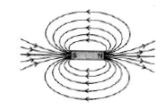
Properties of magnetic field lines
(i) They do not intersect each other.
(ii) It is taken by convention that magnetic field lines emerge from North pole and merge at the South pole. Inside the magnet, their direction is from South pole to North pole. Therefore magnetic field lines are closed curves.
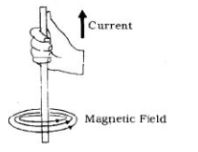
Right-Hand Thumb Rule: If a current carrying conductor is held by right hand, keeping the thumb straight and if the direction of electric current is in the direction of thumb, then the direction of wrapping of other fingers will show the direction of magnetic field.
Magnetic field lines due to a current through a circular loop
In case of a circular current carrying conductor, the magnetic field is produced in the same manner as it is in case of a straight current carrying conductor.
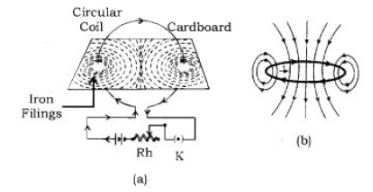
The strength of the magnetic field at the centre of the loop(coil) depends on :
(i) The radius of the coil: The strength of the magnetic field is inversely proportional to the radius of the coil. If the radius increases, the magnetic strength at the centre decreases
(ii) The number of turns in the coil : As the number of turns in the coil increase, the magnetic strength at the centre increases, because the current in each circular turn is having the same direction, thus, the field due to each turn adds up.
(iii) The strength of the current flowing in the coil: As the strength of the current increases, the strength of three magnetic fields also increases.
Magnetic field due to a current in a Solenoid: Solenoid is the coil with many circular turns of insulated copper wire wrapped closely in the shape of a cylinder. A current carrying solenoid produces similar pattern of magnetic field as a bar magnet. One end of solenoid behaves as the north pole and another end behaves as the south pole.
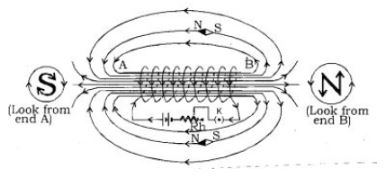
Magnetic field lines are parallel inside the solenoid, similar to a bar magnet, which shows that magnetic field is same at all points inside the solenoid.
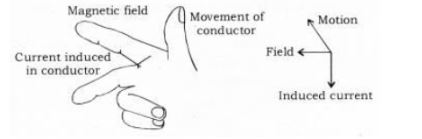
Fleming’s Right-Hand Rule: Electromagnetic induction can be explained with the help of Fleming’s Right Hand Rule. If the right hand is structured in a way that the index (fore ginger) finger, middle finger and thumb are in mutually perpendicular directions, then the thumb shows direction of induced current in the conductor, in conductor The directions of movement of conductor, magnetic field and induced current can be compared to three mutually perpendicular axes, i.e. x, y and z axes.
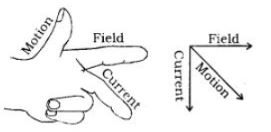
Fleming’s Left-Hand Rule : The Fleming’s Left Hand Rule states that if the left hand is stretched in a way that the index finger, the middle finger and the thumb are in mutually perpendicular directions, then the index finger and middle finger of a stretched left hand show the direction of magnetic field and direction of electric current respectively and the thumb shows the direction of motion or force acting on the conductor. The directions of electric current, magnetic field and force are similar to three mutually perpendicular axes, i.e. x, y, and z-axes.
Many devices, such as electric motor, electric generator, loudspeaker, etc. work on Fleming’s Left Hand Rule.
Free study material for Science
Revision Notes and Key Concepts for Class 10 Science Chapter 12 Magnetic Effects of Electric Current
Download Chapter Summary: Class 10 Science Chapter 12 Magnetic Effects of Electric Current
Review targeted chapter notes for Class 10 Science Chapter 12 Magnetic Effects of Electric Current. Built according to official CBSE guidelines, these summaries highlight high-yield topics frequently tested in school evaluations.
Concept Clarification for Chapter 12 Magnetic Effects of Electric Current
Cross-reference your comprehension with comprehensive NCERT solutions for Class 10 to ensure absolute clarity across all sub-topics in this chapter.
Additional Study Resources for Class 10 Science
Wrap up your chapter revision by testing your knowledge against standard question formats. Everything on our platform is provided free of charge.
FAQs
You can download the teacher prepared revision notes for CBSE Class 10 Science Magnetic Effect of Electric Current Notes from StudiesToday.com. These notes are designed as per 2026-27 academic session to help Class 10 students get the best study material for Science.
Yes, our CBSE Class 10 Science Magnetic Effect of Electric Current Notes include 50% competency-based questions with focus on core logic, keyword definitions, and the practical application of Science principles which is important for getting more marks in 2026 CBSE exams.
Yes, our CBSE Class 10 Science Magnetic Effect of Electric Current Notes provide a detailed, topic wise breakdown of the chapter. Fundamental definitions, complex numerical formulas and all topics of CBSE syllabus in Class 10 is covered.
These notes for Science are organized into bullet points and easy-to-read charts. By using CBSE Class 10 Science Magnetic Effect of Electric Current Notes, Class 10 students fast revise formulas, key definitions before the exams.
No, all study resources on StudiesToday, including CBSE Class 10 Science Magnetic Effect of Electric Current Notes, are available for immediate free download. Class 10 Science study material is available in PDF and can be downloaded on mobile.