

Revision Notes for Class 10 Science: Chapter 06 Control and Coordination
Explore reliable concept summaries and revision materials through the CBSE Class 10 Science Control And Coordination Notes Set 06. Tailored for Class 10 learners, utilizing these notes for Science Chapter 06 Control and Coordination ensures thorough preparation and strengthens core academic definitions before final evaluations.
Review Chapter 06 Control and Coordination for Class 10 Science
Navigate directly to the revision notes for Chapter 06 Control and Coordination using the digital viewer below. Each summary is structured to highlight high-weightage sections, allowing students to instantly access critical definitions and focus on core exam topics.
CHAPTER 7 – CONTROL & COORDINATION
KEY CONCEPTS & GIST OF THE LESSON
Coordination-The working together of various organs of the body of an organism in a proper manner to produce appropriate reaction to a stimulus is called coordination.
♦ Stimulus- The changes in the environment to which an organism responds and reacts is called Stimulus
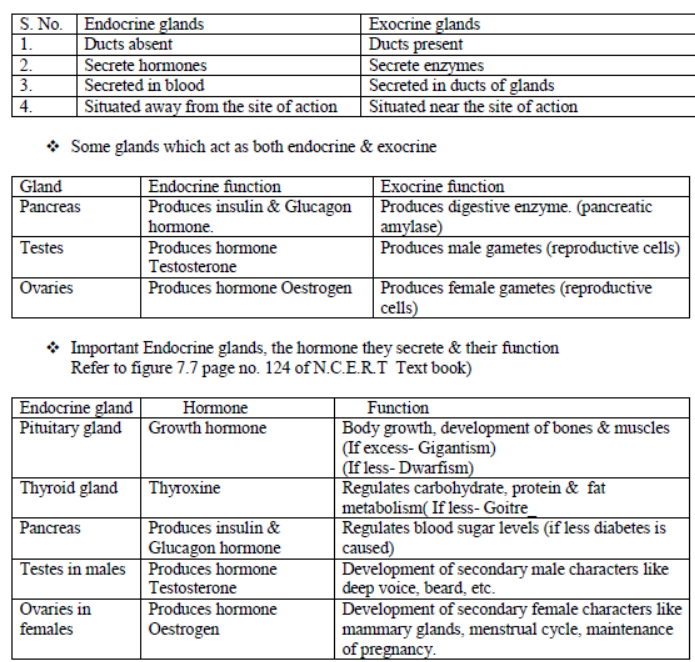
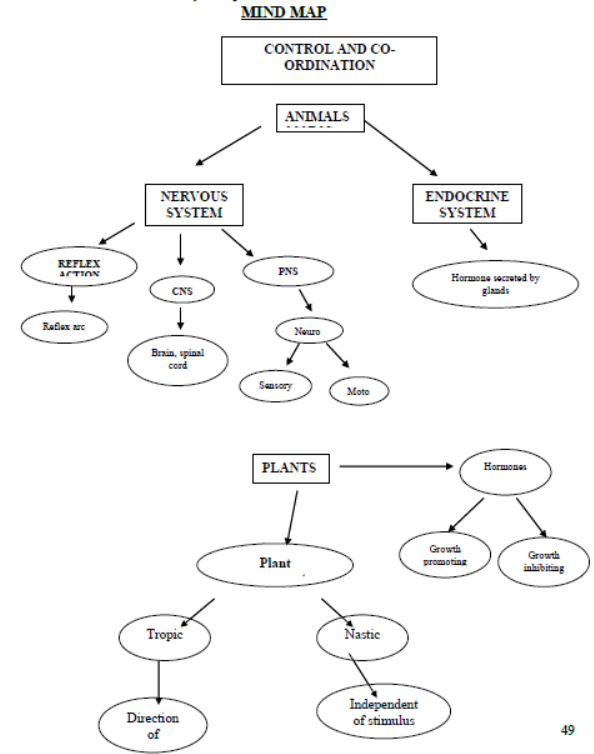
♦ Control & coordination in animals- takes place by (i) Nervous system & (ii) Endocrine system
♦ Nervous system
Stimulus → Receptor organ → Sensory nerve → Brain/Spinal cord
↓
Response ← Effector organ ← Motor nerve
♦ Endocrine system
Stimulus → Endocrine organ → Secrete hormone → Hormone in blood
↓
Response ← Target organ
♦ Parts of the Nervous system – (i) Brain (ii) Spinal cord (iii) Nerves (Neurons)
♦ A Neuron is the structural & functional unit of Nervous system
♦ Parts of a neuron- (i) Dendrites (ii) Cell body (iii) Axon
♦ Synapse- Space/junction between two adjacent nerves is called Synapse.
♦ Passing of information takes place –(i) By Electric impulse (inside the neuron) and (ii) In the form of chemicals (At synapse)
♦ Reflex action- Spontaneous, involuntary and automatic response to a stimulus to protect us from harmful situations. Eg. On touching a hot object unknowingly we instantly withdraw our hand.
♦ Reflex arc- The pathway of the reflex action is called Reflex arc.
Stimulus → Receptor organ → Sensory nerve → Spinal cord →→Effector organ→ Response Refer to figure 7.2 page no. 117 of N.C.E.R.T Text book)
♦ Nervous system- (1) Central Nervous system (CNS)
(2) Peripheral Nervous system (PNS)
(i) Brain (i) Autonomic Nervous system
(ii) Spinal cord (ii) Voluntary Nervous system
v Brain (i) Centre of coordination of all activities (ii) Thinking is involved (iii) Complex process
♦ Parts of brain- Refer to figure 7.3 page no. 118 of N.C.E.R.T Text book
♦ Fore brain Cerebrum- (i) Main thinking and largest part of the brain.
(ii) It has 3 main areasa.
Sensory area- to receive impulses from sense organs via Receptors
b. Motor area- control voluntary movements.
c. Association areas- Reasoning, learning & intelligence.
Thalamus – It relays sensory information to the Cerebrum Hypothallamus- It forms the link between Nervous system & Endocrine system
♦ Mid brain- It connects Fore brain and Hind brain. Controls reflex of eyes & ears
♦ Hind brain- Connects the Fore brain & Hind brain
Cerebellum – Controls & coordinates muscular movements, maintaining body posture and equilibrium.
Pons- Acts as a bridge between brain & spinal cord Medulla oblongata- Controls involuntary actions like blood pressure, salivation, vomiting, etc.
♦ Spinal cord- Cylindrical or tubular structure extending downwards from the Medulla oblongata.
♦ Protection of the brain & the spinal cord-
(i) Bony outer covering: skull for the brain & vertebral column for the spinal cord.
(ii) Cerebrospinal fluid present in between the three membranes.
♦ Action caused by Nervous tissue
Information → Nervous tissue → Brain Muscles → Causes action
♦ Path or action-
Nerve impulse → Muscle cell → Changes shape due to special proteins↓
Action caused ← Shorter form of muscles ← Change shape & arrangement of cell
♦ Chemical communication by hormones- (advantages)
(i) Electrical impulses have their limitations because they reach only those cells connected to the nervous tissue.
(ii) Also the nerve cells cannot generate & transmit impulses continuously.
(iii) Electrical communication is slower.
♦ Hormones- (i) are chemical messengers secreted by endocrine glands
(ii) Are secreted in small amounts & may act in nearby places or distant places.
(iii) Do not take part in the reaction & are destroyed immediately.
◊ Coordination in plants- Only chemical coordination is present in plants.
◊ Tropic movements- The movements of plants in the direction of stimulus (positive) or away from it (negative) are called tropic movements. E.g. Phototropism, Geotropism.
Chemotropism.
Refer to figure 7.4 & 7.5 page no. 121 of N.C.E.R.T Text book)
◊ Nastic movements -The movements of plants independent of stimuli are called nastic movements. E.g.- Touch me not plant leaves close when touched.
◊ Plant hormones (Phytohormones)
Examples- 1. Auxins- Help in growth of root & shoot tips.
2. Gibberellins- Help in vegetative growth
3. Cytokinins- Promote cell division
4. Abscissic acid - Inhibits growth & causes wilting (falling) of leaves
◊ Important diagrams-
1. Structure of neuron (nerve cell)2.Reflex arc 3.Human brain4.Endocrine glands .
◊ Important activities-
1. To compare taste of sugar and food with open & blocked nostrils.
2. To demonstrate the response of a plant to the direction of light.
3. To demonstrate hydrotropism.
Please click the link below to download pdf file for CBSE Class 10 Science Control And Coordination Notes Set F.
Free study material for Science
Download CBSE Revision Notes: Class 10 Science Chapter 06 Control and Coordination
Download Chapter Summary: Class 10 Science Chapter 06 Control and Coordination
Access structured revision notes for Chapter 06 Control and Coordination designed in alignment with the latest CBSE curriculum for Class 10 Science. These summaries help clarify core themes and support effective daily study.
Concept Clarification for Chapter 06 Control and Coordination
Cross-reference your comprehension with comprehensive NCERT solutions for Class 10 to ensure absolute clarity across all sub-topics in this chapter.
Additional Study Resources for Class 10 Science
Explore our broader library of printable assignments, chapter notes, and mock tests designed to support continuous revision and secure higher marks in CBSE assessments.
FAQs
You can download the teacher prepared revision notes for CBSE Class 10 Science Control And Coordination Notes Set 06 from StudiesToday.com. These notes are designed as per 2026-27 academic session to help Class 10 students get the best study material for Science.
Yes, our CBSE Class 10 Science Control And Coordination Notes Set 06 include 50% competency-based questions with focus on core logic, keyword definitions, and the practical application of Science principles which is important for getting more marks in 2026 CBSE exams.
Yes, our CBSE Class 10 Science Control And Coordination Notes Set 06 provide a detailed, topic wise breakdown of the chapter. Fundamental definitions, complex numerical formulas and all topics of CBSE syllabus in Class 10 is covered.
These notes for Science are organized into bullet points and easy-to-read charts. By using CBSE Class 10 Science Control And Coordination Notes Set 06, Class 10 students fast revise formulas, key definitions before the exams.
No, all study resources on StudiesToday, including CBSE Class 10 Science Control And Coordination Notes Set 06, are available for immediate free download. Class 10 Science study material is available in PDF and can be downloaded on mobile.