

Science Concept Notes for Class 10: Chapter 08 Heredity
Explore reliable concept summaries and revision materials through the CBSE Class 10 Science Heredity And Evolution Notes Set 03. Tailored for Class 10 learners, utilizing these notes for Science Chapter 08 Heredity ensures thorough preparation and strengthens core academic definitions before final evaluations.
Download Chapter 08 Heredity Revision Notes PDF
View or download the dedicated Chapter 08 Heredity revision resource below. Engaging with these structured concept notes daily ensures continuous academic progress and mastery of the 2026-27 curriculum for Science.
Heredity and Evolution
Genetics : Branch of science that deals with Heredity and variation.
Heredity : It means the transmission of features/ characters/ traits from one generation to the next generation.
Variation : The differences among the individuals of a species/ population are called variations.
MENDEL AND HIS WORK ON INHERITANCE
Gregor Johann Mendel (1822&1884) : Started his experiments on plant breeding and hybridisation
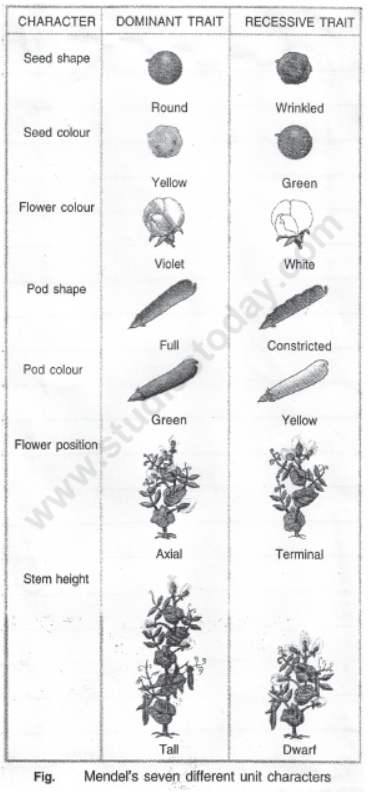
Mendel ® was known as Father of Genetics Plant selected by Mendel : Pisum sativum (garden pea). Mendel used a number of contrasting characters for garden pea.
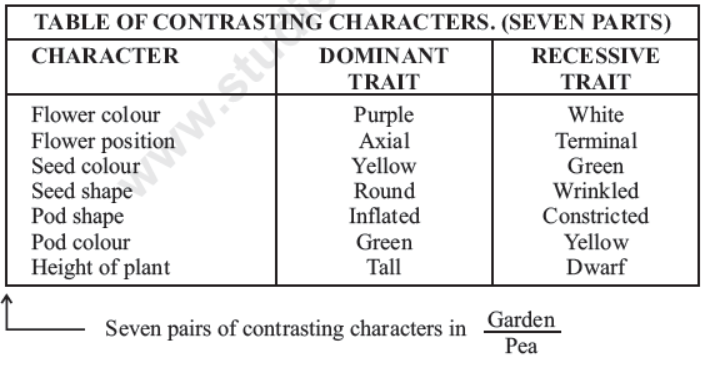
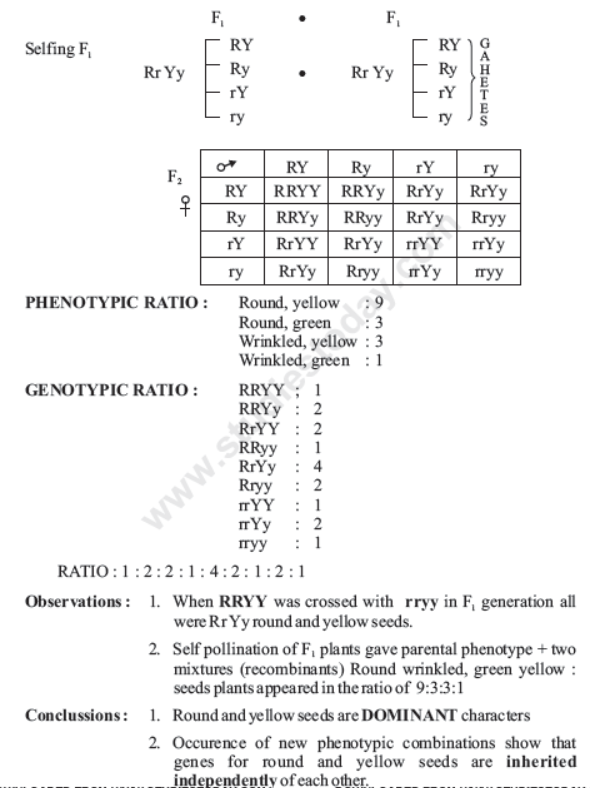
Mendels Experiments : Mendel conducted a series of experiments in which he crossed the pollinated plants to study one character (at a time)
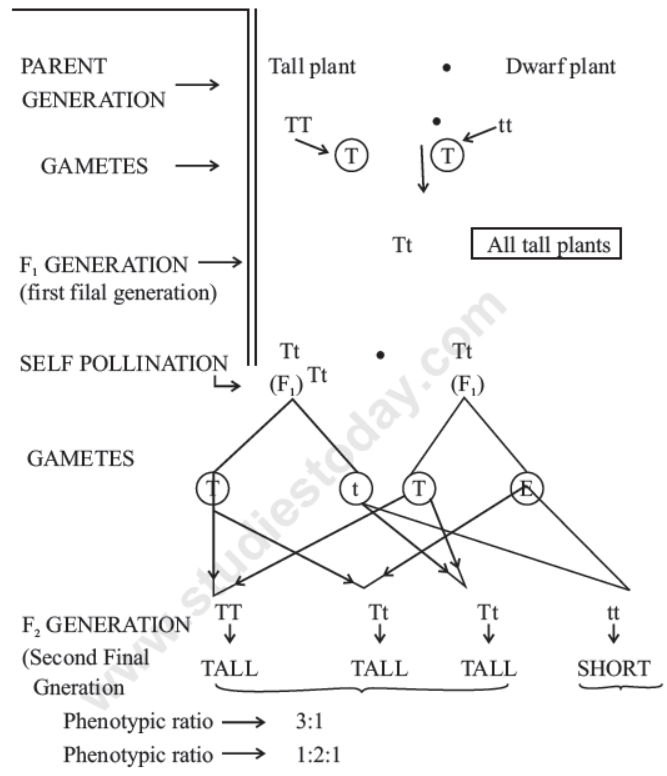
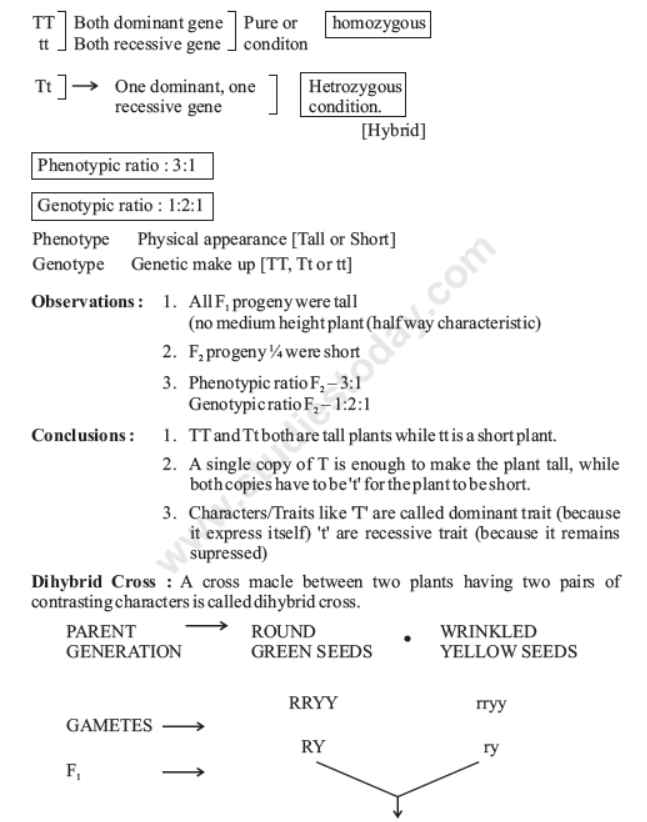
Monohybrid Cross :
Cross between two pea plants with one pair (monohybrid cross) contrasting characters
Example : Tall / Short Plants.
Evolution
SITUATION-I
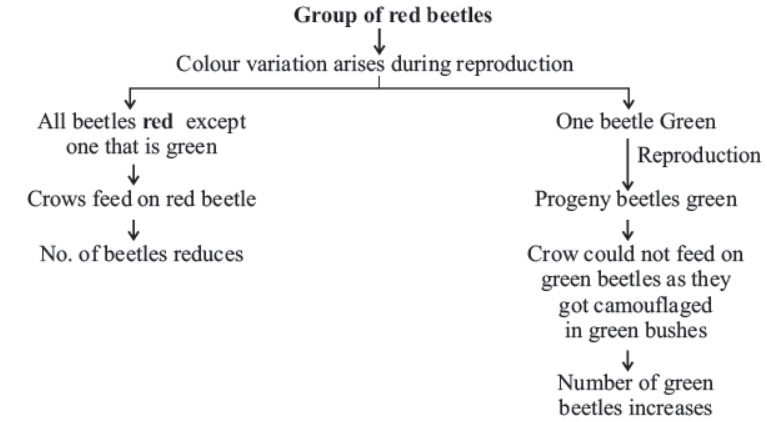
Situation 1 : Green beetles got the survival advantage or they were naturally selected as they were not visible in green bushes. This natural selection is exerted by crows resulting in adaptations in the beetles to fit better in their environment
SITUATION-II

Situation 2 : Blue beetles did not get survivals advantage. Elephant suddenly caused major havoc in beetle population otherwise there number would have been considerably large.
From this we can conclude that accidents can change the frequency of some genes even if they do not get survival advantage: This is called genetic drift and it leads to variation.
Mechanism of Heredity
Characters or traits of an organism are controlled by the genes
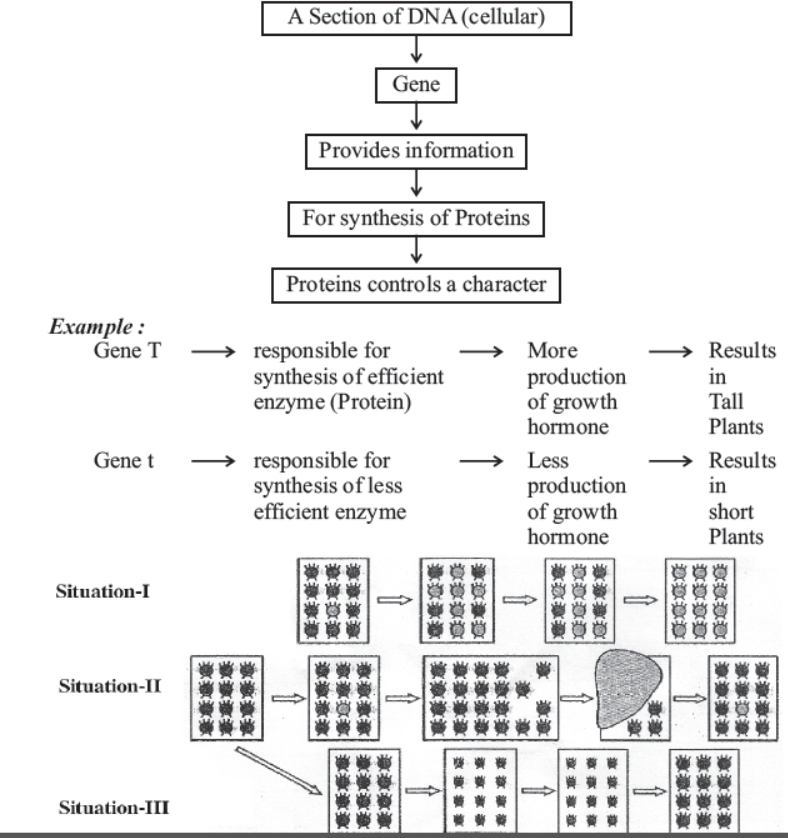
Genetic drift. It leads to diversity without any adaptation
SITUATION-III
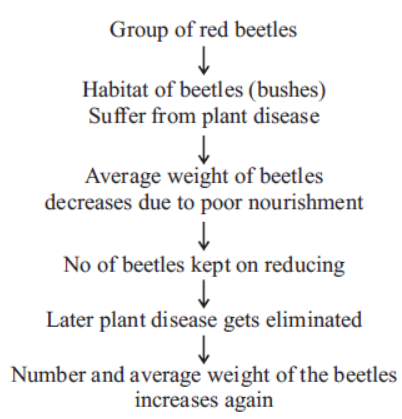
Situation 3 : No genetic change has occured in the population of beetle. The population gets affected for a short duration only due to environmental changes
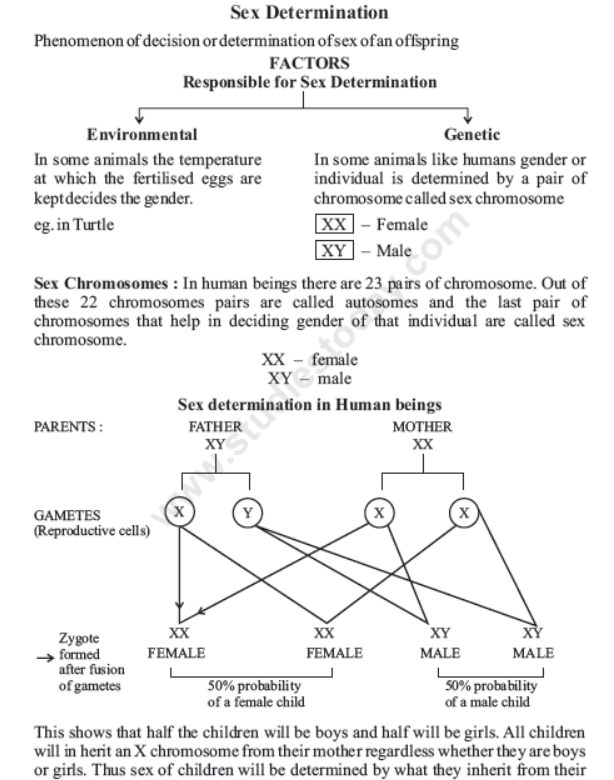
Acquired and Inherited Traits
| Acquired Traits | Inherited Traits |
| 1. These are the traits which are developed in an individual due to special conditions | 1. These are the traits which are passed from one generation to the next. |
| 2. They cannot be transferred to the progeny | 2. They get transferred to the progeny. |
| 3. They cannot direct evolution eg. Low weight of starving beetles. | 3. They are helpful in evolution. eg. Colour of eyes and hair |
Speciation
Micro evolution : It is the evolution which is on a small scale. eg. change in body colour of beetles.
Speciation : it is the process of formation of new species.
Species : A group of similar individuals that along to a population that can interbreed and produce ferrite off spring.
Geneflow : It is exchange of genetic material by interbreeding between populations of same species or individuals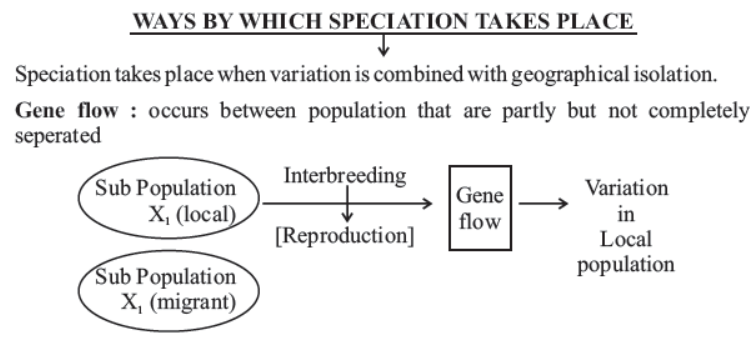
Genetic Drift
It is the random change in the frequency of alleles (gene pair) in a population over successive generations.
*Natural Selection : The process by which nature selects and consolidate those organisms which are more suitably adapted and posesses favorable variations 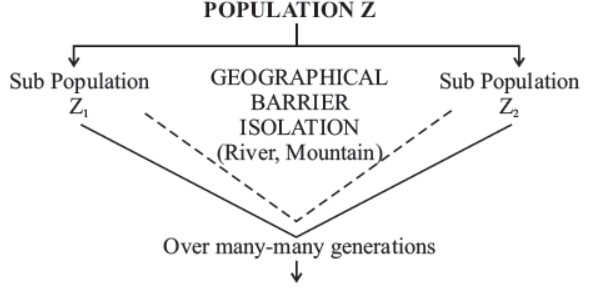
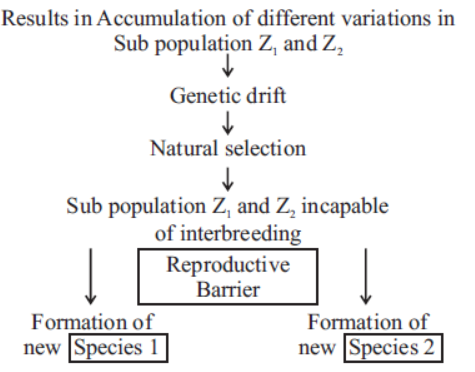
Genetic drift takes place due to
a) Severe changes in the DNA
b) Change in number of chromosomes
Evolution and classification
Both evolution and classification are interlinked.
1. Classification of species is reflectionof their evolutionary relationship.
2. The more characteristic two species have in common the more closely they are related.
3. The more closely they are related, the more recently they have a common ancestor.
4. Similarities among organisms allow us to group them together and to study their characteristic 
Tracing Evolutionary Relationships
(Evidences of Evolution)
I. Homologous Organs : (Morphological and anatomical evidences. These are the organs that have same basic structural plan and origin but different functions. 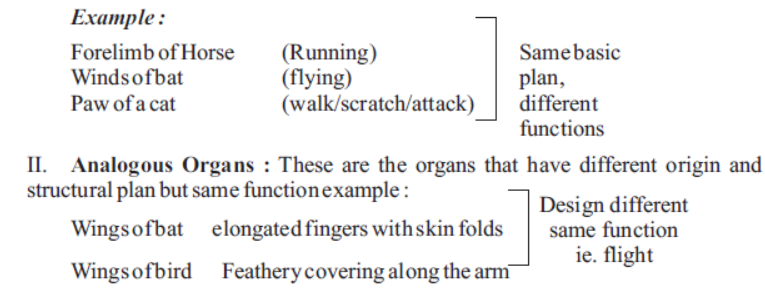
III. Fossils : (Palaeontological evidences)
The remains and relics of dead organisms of the past.
Example :
i) Fossil of wooly mammoth
ii) Archeopteryx (fossil bird)
iii) Dead insect caught in hot mud.
FOSSILS ARE PRESERVED TRACES OF LIVING ORGANISMS
Eg. AMMONITE - Fossil invertebrate
TRILOBITE - Fossil in vertebrate
KNIGHTIA - Fossil fish
RAJASAURUS - Fossil dinosaur skull
AGE OF THE FOSSILS
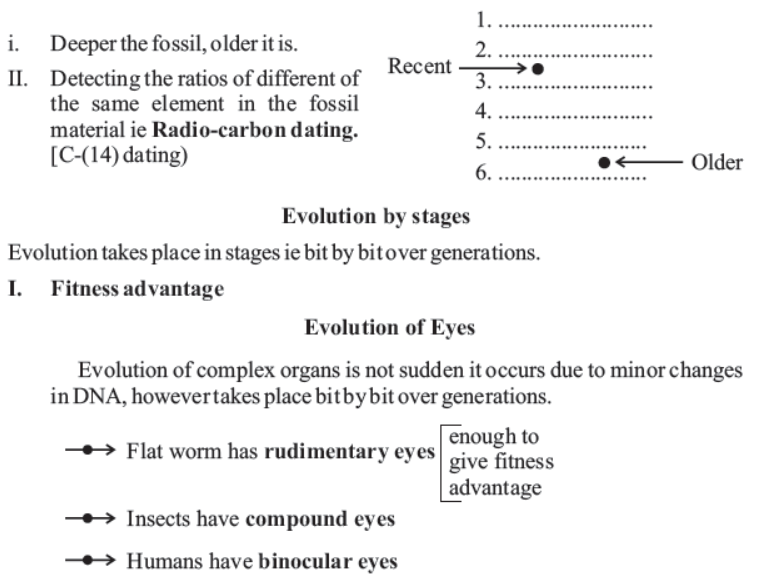
II. Functional Advantage
♦ Evolutions of feathers
Feathers provide insulation in cold weather
but later they might become useful for flight.
Example :
Dinosaurs had feathers, but could not fly using feathers. Birds seem to have later adapted the feathers to flight.
Artificial Selection :
Humans have been a powerful agent in modifying wild species to suit their own requirement through out ages by using artificial selection. eg (i) Wild cabbage the dissimilar looking structures have evolved from a common ancestral design. (ii) Wheat (many varieties obtained due to artificial selection) 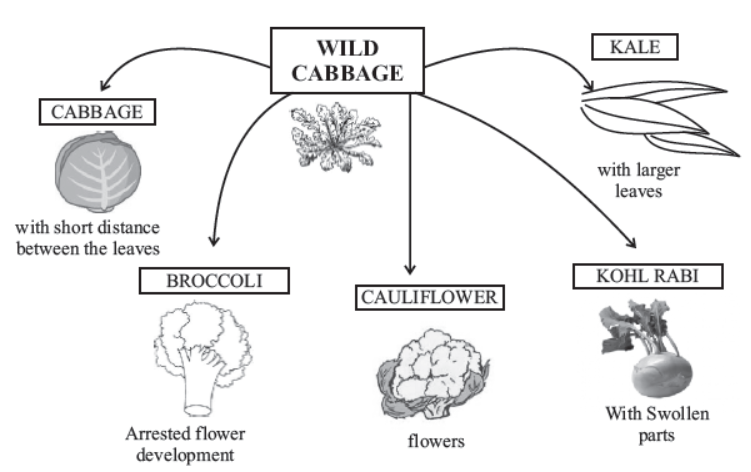
Molecular Phylogeny :
♦ It is based on the idea that changes in DNA during reproduction are the basic events in evolution
♦ Organisms which are more distantly related will accumulate greater differences in their DNA 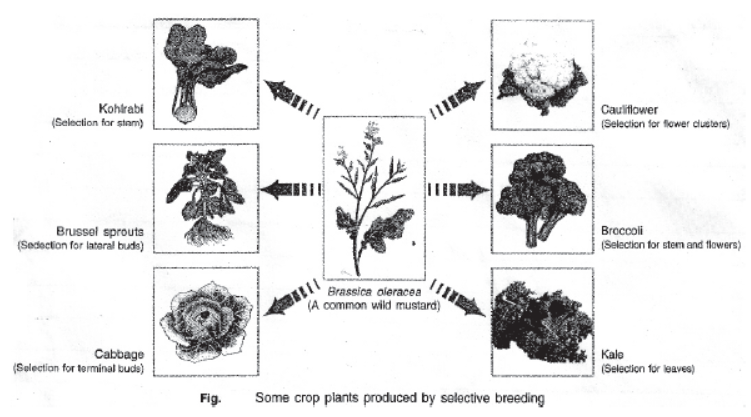
Human Evolution
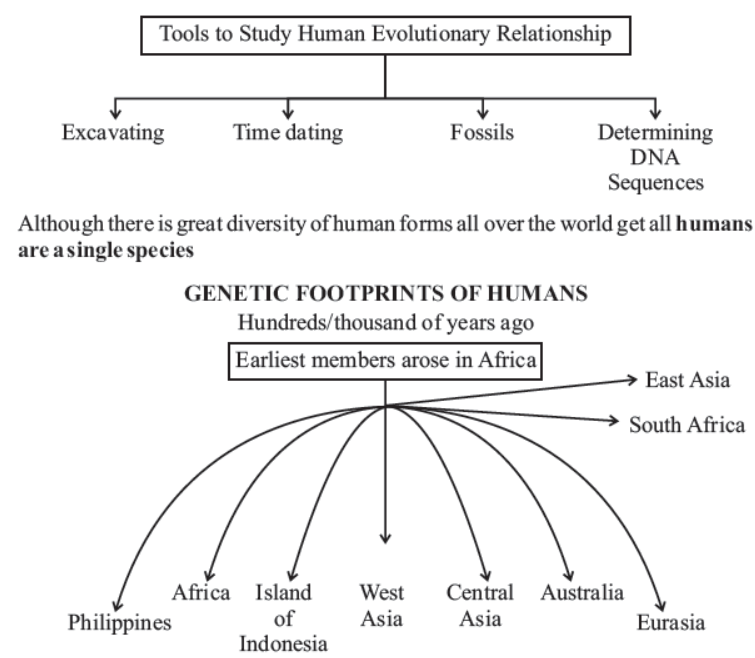
♦ They did'nt go in a single line
♦ They went forward and backward
♦ Moved in and out of Africa
♦ Sometimes came back to mix with each other.
Please click the link below to download pdf file for CBSE Class 10 Science Heredity And Evolution Notes Set C.
Free study material for Science
Revision Notes and Key Concepts for Class 10 Science Chapter 08 Heredity
Quick Revision Notes: Chapter 08 Heredity (CBSE)
Review targeted chapter notes for Class 10 Science Chapter 08 Heredity. Built according to official CBSE guidelines, these summaries highlight high-yield topics frequently tested in school evaluations.
Expert Study Material for Class 10 Science
Cross-reference your comprehension with comprehensive NCERT solutions for Class 10 to ensure absolute clarity across all sub-topics in this chapter.
Complete Your Chapter Revision
Wrap up your chapter revision by testing your knowledge against standard question formats. Everything on our platform is provided free of charge.
FAQs
You can download the teacher prepared revision notes for CBSE Class 10 Science Heredity And Evolution Notes Set 03 from StudiesToday.com. These notes are designed as per 2026-27 academic session to help Class 10 students get the best study material for Science.
Yes, our CBSE Class 10 Science Heredity And Evolution Notes Set 03 include 50% competency-based questions with focus on core logic, keyword definitions, and the practical application of Science principles which is important for getting more marks in 2026 CBSE exams.
Yes, our CBSE Class 10 Science Heredity And Evolution Notes Set 03 provide a detailed, topic wise breakdown of the chapter. Fundamental definitions, complex numerical formulas and all topics of CBSE syllabus in Class 10 is covered.
These notes for Science are organized into bullet points and easy-to-read charts. By using CBSE Class 10 Science Heredity And Evolution Notes Set 03, Class 10 students fast revise formulas, key definitions before the exams.
No, all study resources on StudiesToday, including CBSE Class 10 Science Heredity And Evolution Notes Set 03, are available for immediate free download. Class 10 Science study material is available in PDF and can be downloaded on mobile.