

Download Class 10 Science Concept Summaries: CBSE Class 10 Science Adaptation Notes
Access comprehensive revision notes for Adaptation using the CBSE Class 10 Science Adaptation Notes. Designed to align with the 2026-27 academic syllabus for Class 10 Science, these concept summaries help students streamline their exam preparation and review complex topics efficiently.
Access Adaptation Notes and Study Material
View or download the dedicated Adaptation revision resource below. Engaging with these structured concept notes daily ensures continuous academic progress and mastery of the 2026-27 curriculum for Science.
ADAPTATION
DEFINITION:
Adaptations may be defined as the characteristics of living forms to develop, over a period of time certain morphological, anatomical, physiological, and ecological features which enable them to survive and reproduce within the limits of a particular environment, e.g. fish, whales, aquatic plants are adapted to live in water, birds and bats in air, and cacti, Insects, camels in deserts.
(a) Aquatic adaptations:
Aquatic adaptations are shown by those organisms that live in water. Various water bodies are ponds, lakes, rivers, streams, estuarines and oceans. The biotic factors that organism experience in water are the availability of light and oxygen, pressure fluctuations, resistance to movements, salt concentrations and so on, Accor4dingly plants and animals adapt these physical factors.
(i) Aquatic adaptations in plants: Hydrophytic plants are those plants which live in water or swampy places. They or, therefore, the aquatic plants. They may be wholly or partly submerged in water. Usually they are not fixed to the bottom but some plants may be fixed to the soil with the help of their roots. Hydrophytes may be further categorized into three groups.
(A) Submerged plants:
- Submerged floating plants are though completely submerged in water but not anchored in the mud, e.g. Utricularia, Ceratophyllum etc.
- Submerged root pants remain completely sub-merged inn water and are anchored at the bottom, e.g. Hydrilla, Vallisneria, Potamogeton etc.

(B) Floating plants:
- Free floating hydrophytes not rooted below. They float freely on the surface of water. e.g. Pistia,Trapa, Elchnornia etc.
- Floating, leaved, rooted plants are anchored at the bottom, but their leaves float on the surface of water, e.g. Marsulea etc.
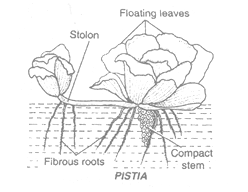
(C) Rooted emergent hydrophytes : These plants grow in shallow water and their shoot extend above the surface of water wholly or partially e.g.. Typha, Ranunculus etc.
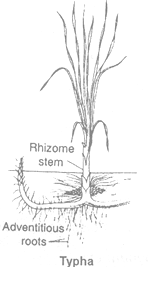
Characters of hydrophytes :
- Roots may be absent e.g. Utricularia or poorly developed, e.g. Hydrilla.
- Root caps replace by root packets.
- Stems are weak, slender with long intermodes.
- The sub-merged leaves are either ribbon like or finally dissected, e.g. Vallisenaria.
- Floating leaves are generally large, broad and thick e.g. Victoria etc.
- Plants are dull, pale green in colour to absorb maximum of light falling on them.
- In the plants having huge, disc like or circular leaves that float on the surface of water like Giant
Water lily (Victoria regia) which has got the largest leaves in the plant kingdom) have oily covering over the surface of leaves that makes it water proof and also products it against wetting or decaying over the surface of leaves that makes it water proof and also products it against wetting or decaying in water. The leaves have stomata on upper surface only.
- The leaves have lot of air spaces and are adapted for buoyancy. Similarly, lotus plant is rooted in the mud and only some of their parts like leaves and flowers float on the surface of water.
- There are a number of air spaces or cavities in the stem of aquatic plants which help them in buoyancy and thus keep the plant stay up in water. The conducting tissues xylem and phloem are also poorly developed.
- The submerged leaves of Ranumculus plant are very much dissected to offer least resistance in water, while the leaves that are on the surface of wear are less dissected.
- Some plants and animals live in fresh water while others are seen in sea water. Organisms living in a particular habitat are adapted only for their habitat. Organisms get their mineral requirements form the type of water in which they live. That is why plants occurring in fresh water are not seen in sea water.
(ii) Aquatic adaptations in animals: These adaptations are shown by those animals which live in water i.e. water is their home or habitat. Animals may live in water primarily or they have shifted to water habitat later on as a secondary adaptation. Accordingly, these animals show the following modifications;
- They have a streamlined body that helps in swimming in water e.g. fish. Streamlined body gives least resistance to swim in water.
- Locomotion is either by webbed feet e.g. ducks, frogs or by fins e.g. fish. The fins at the sides help in speed and in changing direction.
- Respiration occurs with the help of gills, Gills are the organs that that help the animal to get oxygen from water. Gills have a large surface area that helps in the process by providing a layer of contact.
- Some fish (bony fish) have air bladder as a hydrostatic organ.
- Some fish and water insects carry air bladder in their bodies that help in the buoyancy of the animal in water.
- Hair and skin glands like sweat and oil-lands are absent as in whales.
(b) Terrestrial Adaptations :
Terrestrial adaptations are shown by those organisms that live on land. Land provides a vast variety of physical factors such as soil, temperature, humidity, wind, light etc. Unlike water bodies, habitat on land becomes discontinuous as it is interrupted by streams, rivers, oceans, mountains etc. Organisms that live on land get enough amounts of light and oxygen. We also get wide fluctuations in temperature on land. The availability of water is also not uniform on land.

On the basis of availability of water and temperature, two regions are categorized on land Xeric - dry and hot (desert) & mesicmoist and cool (mountains and plains)
(i) Xeric adaptations in plants : Plants that live in xeric conditions or scarcity of water are known as xerophytes plants. They develop various devices to conserve water in them and also to absorb the maximum water that is available in the soil. One of the typical saprophytic plant is Prickly Pear (Opuntia)

Its leaves are reduced to spines so that water. Loss due to transpiration is minimum. Its stem becomes green in colour and looks like a leaf. Such a stem is called as phylloclade. Some of the xerophytic adaptations in plants are given below.
(A)The leaves are reduced to spines (Opuntia) or scales (Euphorbia). This helps to prevent loss of water form the leaf surface.
(B)The one inter mode long stem modified into leaf like structure is called as cladode,g. Asparagus.
(C) Petiole becomes fleshy in some xerophytes and a called as phyllode, e.g. Acacia.
(D) Pores on the leaves called stomata are sunken in saprophytic plant. This also helps to reduce the rate of t0ranspiration.
(E) Both stem and leaf-sur4faces are thick-walled and also have a thick cuticle.
- The stem of xerophytic plants is spongy. This helps to store water in them.
- The shedding of leaves by some xerophytic plants help to reduce the surface area so the water loss.
- Some xerophytic plants remain dormant either as seeds or as roots. This helps to overcome scarcity of water particularly in summer months. When it reins then they sprout.
(ii) Xeric adaptation in animals : Animals that live in deserts show xeric adaptations. Some of these adaptations are given below.
- Since these animals live in excessive heat, so they develop a protective covering around the body to check desiccation or water loss by evaporation. Moloch, the desert lizard has hygroscopic skin to absorb water.
- They have water-sacs in their stomach wall, e.g. Camel.
- Most of these animals are nocturnal so they avoid the day temperature.
- For defence, they have poison or some other mechanism. Snakes, spiders, scorpions have poison glades or stings.
- Some of the desert animals like rats and snakes dig holes and burrows in the sand and live within, In holes and burrows the temperature is less and it is moist also. These animals come out at night only when the deserts are cooler. So these animals ovoid the excessive heat of the day.
- These animals, wither become active when water is available and remain dormant for rest of the time or adapt for water storage and water conservation.
- Certain animals like desert rabbit and wood rat derive water by eating succulent plants.
- Body temperature of certain animals, e.g. Camels fluctuates with the atmosphere which reduces the water loss through sweating.
(c) Polar - Region Adaptations:
Polar regions are characterized by heavy and snowy winters. The animals seen here are white or light in colour. This enables them to match the colour of the background (camouflage) ; and also to regulate the temperature of the body (thermal regulation). The animals can store fat in their body in summers so that it can be consumed in winter months. During winter months, animals also hibernate. This reduces their metabolic activities to the minimum. Even the plants found here are of short height.
(d) Amphibious Animals :
There is yet another category of animals which live one land but they go to water for laying eggs of they live in water and come of land of reproduction. Their life – cycle is not completed in one habitat alone, e.g. in the life cycle of frog or toad water is essential to lay eggs and for the larvae (tadpoles) to develop. Similarly, the life cycle of mosquito requires both water and and land. Such animals are known as amphibious animals (animals showing tow modes of habitats. Their different stages show characteristics particular to the habitat in which they are found.
(e) Adaptations in Birds :
Birds include a variety of forms which can be divided into the following two main groups :
(i) Flightless birds: these are usually large and have legs. They have resduced wings and corly feathers. Ostrich is a huge birds with only two toes in each foot .It is one of the fastest runner. On an average the ostrich weighs about 125 kg and its egg is the largest cell. Emu of Australia has three toes in each foot. Penguins have their wings modified into swimming paddles. They live in the cold sea water of southern pole. Most penguins do not build nests but incubate their eggs in fold of skin between their feet.
(ii) Flying birds: They are most of the modern birds and are found in all the parts of the world./They show various types of adaptations. Some common fluiing birds are pigeon, kite, cuckoo, house sparrow, crow, parrot, dove, sunbird, cattle egret, swifts, kingfisher, bulbul etc. The humming birds is the smallest flying bird.
(f) Adaptations in Halophytic Plants :
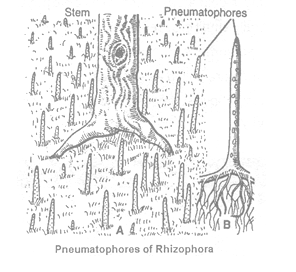
Such plants usually grow in salty marshes or along the margins of slat lakes. They do not get sufficient oxygen form the soil so they form egatively getropc breathing roots or pneumatophores. E.g. Rhizophora etc. these plants are called a smangroves. In these plants, seeds germinate inside the fruit while still attached to plant to show viviparity.
(g) Mesophytes :
Mesophytes are the plants growing in the habitats of moderate climatic conditions.
- The root system of mesophytes is well developed, branched and provided with root cap.
- Shoot system is well organized. The stem is generally aerial, baranched, straight, thick and hard.
- Leave are thin, broad in middle, dark green and of variable shape and measurement.
(h) Some Important Points :
The vegetation growing in tundra and on the ice covered high hill tops is known as cryphytes.
- Oxylopphytes are plants growing on acidic soil.
- Chasmophuytes are plants growing in rock crevices.
- Hibernation (winter-sleep) is the period of dormancy during winter.
- Aestivation (summersleep) is the period of dormancy during summer months so as to escape3 form scorching heat of sun.
- Plants growing in oxygen deficient soils hydrosphere have shallow root systems.
- Plants growing on burnt soil are called as pyrophilous.
- Plant growing on rocks are called as lithophytes.
- Camouflage (Cryptic appearance) is the ability ot bled with the surrounding or background.
- Examples of camouflage are Praying Mantis, Dead Leaf Butterfly etc.
- Mimicry is the resemblance of one species with another in order to obtain advantage, especially against predators.
- Plants growing in bright light are called sun plants or heliopytes, while plants growing in partial shade or low intensity light are called shade plants or sciophytes.
- In hydrophytes pollination and dispersal of fruits and seeds is done by agency of water.
- Most of the hydrophytes multiply by various methods of vegetative propagation.
- In leaves, stem and roots of these plants large number of aerenchyma are present to accumulate gasses released during photosynthesis and respiration.
- The osmotic pressure of cells of hydrophytes is comparatively low.
- Xerophytic plants are generally stunted i.e. small and woody.
- The osmotic concentration of cells of xerophytes.
- Halophytes are special type of xerophytes.
- The pneumatophores show negative geotropism.
- The vegetation growing in cold areas is known as cryophyte.
- Cryophytes are generally small grasses, herbs, mosses and lichens. Trees are almost absent.
- The reproduce during summer seasons only.
- The animals live on trees are called as arboreal.
- The rooted emergent plants have submerged and aerial leaves of different shapes, this phenomenon is called as heterophylly.
Free study material for Science
Revision Notes and Key Concepts for Class 10 Science Adaptation
Key Concepts and Summary for Class 10 Science Adaptation
Explore reliable chapter overviews for Adaptation tailored for Class 10 learners. Use these structured points to grasp difficult themes and ensure solid preparation for upcoming assessments.
NCERT-Aligned Chapter Summary and Notes
Cross-reference your comprehension with comprehensive NCERT solutions for Class 10 to ensure absolute clarity across all sub-topics in this chapter.
Next Steps in Your Exam Preparation
Follow up your revision by attempting the interactive online Science MCQ test and practice worksheets for this chapter to verify your mastery. All platform resources are free to access.
FAQs
You can download the teacher prepared revision notes for CBSE Class 10 Science Adaptation Notes from StudiesToday.com. These notes are designed as per 2026-27 academic session to help Class 10 students get the best study material for Science.
Yes, our CBSE Class 10 Science Adaptation Notes include 50% competency-based questions with focus on core logic, keyword definitions, and the practical application of Science principles which is important for getting more marks in 2026 CBSE exams.
Yes, our CBSE Class 10 Science Adaptation Notes provide a detailed, topic wise breakdown of the chapter. Fundamental definitions, complex numerical formulas and all topics of CBSE syllabus in Class 10 is covered.
These notes for Science are organized into bullet points and easy-to-read charts. By using CBSE Class 10 Science Adaptation Notes, Class 10 students fast revise formulas, key definitions before the exams.
No, all study resources on StudiesToday, including CBSE Class 10 Science Adaptation Notes, are available for immediate free download. Class 10 Science study material is available in PDF and can be downloaded on mobile.