

Official Class 10 Science Revision Material: CBSE Class 10 Science Cell Division Notes
Access comprehensive revision notes for Cell Division using the CBSE Class 10 Science Cell Division Notes. Designed to align with the 2026-27 academic syllabus for Class 10 Science, these concept summaries help students streamline their exam preparation and review complex topics efficiently.
Chapter-wise Concept Summaries: Cell Division
Access the complete concept summary PDF for Cell Division below. Regular review of these targeted notes builds familiarity with complex Class 10 Science themes and helps secure higher marks in final school evaluations.
CELL DIVISION
STRUCTRUE OF CHROMOSOME :
Chromosome are the vehicles of heredity which possess DNA and enclosed inside the nucleus.
They are capable of self reproduction and maintaining morphological and properties through successive generations.
Chromatid : Each chromosome consists of two strands which are called as chromatids.
Centromere : The two chromatide of a chromosome are joined together at a point called as centromere or primary constriction.
Chromomeres : The bead like structures linearly arranged on chromonema are called chromomeres. Their number and position on each chromosome is definite.
Telomere : Both the terminals of a chromosome are called telomeres.
Secondary constriction : In some chromosomes in addition to the primary constriction or centromere
Some more constrictions many also be present. They are termed secondary constrictions.
Satellite : Those chromosomes in which secondary constriction is found, the portion or segment of the chromosome beyond this constriction is called satellite.
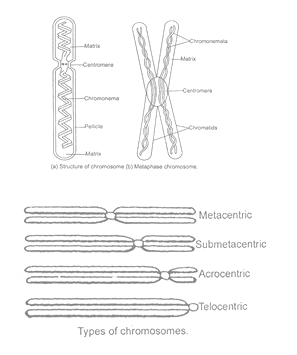
(a) Size and shape of chromosomes :
(i) Size : Size of chromosomes is variable in different organisms, different tissues and at different stages of the cell cycle.
(ii) Shape : It is usually determined by the position of its centromere. On this basis chromosomes can be of following types :
(A) Metacentric : They are V – shaped, These have centromere in the middle of the chromosome so that the two arms are almost equal
(B) Submetacentric : They are L shaped. In them centromeres are slightly away from midpoints, so that the two arms are unequal
(C) Acrocentric : They are J – shaped with centromere at subteminal position.
(D) Telocentirc : They are I – shaped , having terminal centromere.
NOTE : These shapes can be observed during anaphase stage of cell division.
(b) Number of chromosomes :
Each species has a fixed number of chromosomes in it’s cells. In an ordnary cell 23 pairs of chromosomes as present. So, there are two chromosomes, of each kind. These two chromosomes of each kind are called as homologous chromosomes
A cell which has the complete set of chromosomes with two of each kind is called diploid cell. in other words a diploid cell has two sets having two chromosomes of each type.
The gemetes (or sex cells) of human beings are different from their other body cells because they contain only half the number of chromosomes. A cell which has half the number of chromosomes, is called as haploid cell, in other words a haploid cells has only one set of each type of chromosomes
Human gametes called sperm and egg. have only 23 chromosomes which is half the number of chromosomes of other body cells. So, a gamete is a haploid cell
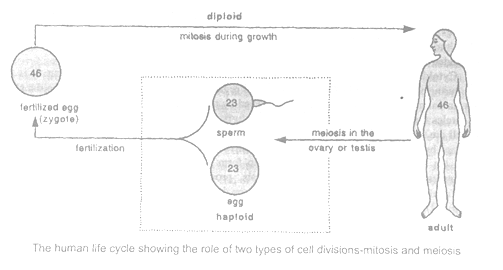
Females consist of two similar gametes the therefore called as homogametic and males consist of dissimilar gametes and therefore called as heterogametic. During spermatogenesis two types of sperm cells will be produced one which contains X – chromosome and the other which contains Y chromosome. During oogenesis each egg cell contain one X – chromosomes.
If X –chromosome of male fuses with X – chromosomes of females it will produce a female child.
If Y – chromosome of male fuses with X chromosome of females it will produce a male child.
(C) Properties of Chromosomes :
The chromosomes must possess five important properties
(i) Replication : Synthesis of new DNA molecule which is identical to parent DNA molecule.
(ii) Transcripiton : Synthesis of RNA molecule is identical to DNA molecule.
(iii) Change in appearance.
(iv) Repair : It means correction of damaged parts by DNA
(v) Mutation : Development of genetic changes
(d) Function of chromosomes :
(i) They carry hereditary characters from parent to offsprings.
(ii) They help the calls of grow. Divide and maintain itself by synthesis of proteins.
(iii) They undergo mutation and thus contribute to the evolution of animals.
(iv) They guide cell differentiation during development.
(v) They also help in metabolic process.
(vi) They bring about continuity of life.
CELL DIVISION :
Cell division was first observed by Nageli in plant cell (1842) and it was first studied by Prevost and Dumas in the fertilized egg of frog.
(a) Cell Cycle :
It is series of programmed cyclic changes by which the cell duplicates its contents and divides into two parts. Cell cycle was discovered by Howard and Pelc. It is divided into phases:
(i) Long non dividing (I – phase) of interphase
(ii) Short dividing M – phase or mitotic phase
(i) Long non dividing (I – phase) or interphase : It is a complex of changes that occurs in a newly formed cell before it is able to divide. It lasts throughout the life. It involves replication of DNA and synthesis of nuclear proteins and duplication of centriole. Synthesis of energy rich compound also takes place. This occurs in there stages i.e. G1 (First growth phase), S (Synthesis phase), G2 (Second growth phase)
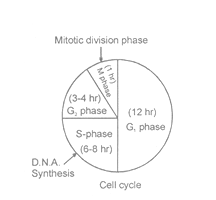
(ii) Short dividing M – phase : It is the phase of cell division it consists of karyokinesis (nuclear division) and cytokinesis (cytoplasmic division). It is of two types
Mitosis : It is also called as somatic division as it occurs during formation of body cells. It is an equation division in which a parent cell divides into two identical daughter cells, each of them contains the same number and kind of chromosomes as are present in parent cell.
(i) karyokinesis (ii) Cytokinesis
(A) Prophase : Chromatin fibres condense to form chromosomes. They shorten and become distinct which each having two chromatids attached to centromere. Centrosomes reach the poles and form spindle fibres. Nucleolus disappears, nuclear membrane disappears.
(i) Karyokinesis : Division of nucleus. It is divided in four steps:
It occur in two steps :
It is studied in plants, in meristemsa and in animals in bone marrow, skin and base of nails.
Them mitosis was given by Fleming
It is also called as somatic division as it occurs during formation of body cells.
It is studied in plants, in meristemsa and in animals in bone marrow, skin and base of nails.
It is an equational division in which a parent cell divides into two identical daughter cells, each of them contains the same number and kind of chromosomes as are present in parent cell.
It occur in two steps :
(i) karyokinesis (ii) Cytokinesis
(i) Karyokinesis : Division of nucleus. It is divided in four steps:
(A) Prophase: Chromatin fibres condense to form chromosomes. They shorten and become distinct which each having two chromatids attached to centromere. Centrosomes reach the poles and form spindle fibres. Nucleolus disappears, nuclear membrane disappears.
(B) Mataphase: Chromosomes attach to spindle fibres arise from each pole and lie at the equator, forming a metaphase plate. Chromosomes are shortest and thikest in this stage.
(C) Anaphase : Shortest phase, In this phase centromere of each chromosome divides to from two daughter chromosomes. They remain attached to poles through spindle fibres and start moving towards pole and become shortened. They appear in different shapes
V – shaped (Metacentric) L – Shaped (Submetecentric)
J – Shaped (Acrocnetric) I – Shaped (Telocentric
(D) Telophase : Nucleus is reconstituted, chromosomes uncoil, elongate and form chromatin fibre. Nucleous & nuclear envelope reappears forming two daughter nuclei
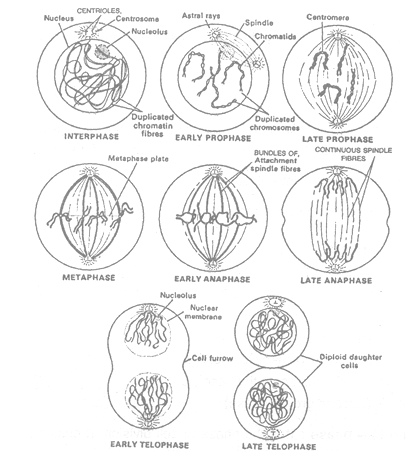
(ii) Cytokinesis : it is referred to the division of cytoplasm. It begins towards the middle of anaphase and completes with the completion of telophase. By this the complete cytoplasm including matrix as well as organelles divides equally. In animals it occurs by formation of cleavages furrow in the middle by constriction in plasma membrane. In plants it occurs by cell plate formatio
NOTE : Colchicine is a mitotic poison. It blocks the completion of metaphase
(c) Meiosis
It occurs only in the life cycle of gamete’s.
Term meiosis was give by Farmer and Moore.
It is a double division in which a diploid cell divides twice to form four haploid cells.
It can be studied in anthers of unopened flowers in plants and in testis of grasshopper in animals. It consists of two phase
(i) Interphase : Size of nucleus increases to three times. It also involves G1 – S – G2 phase
(ii) M – phase : It occurs in two steps (A) Meiosis – I (B) Meiosis – II
(A) Meiosis – I Also called as reduction division. Diploid state changes to haploid state. It occurs in four steps.
Prophase – I : It is the longest phase of meiosis. It has following stages :
Leptotene : Chromatin fibres condense to form chromosomes. There are two chromosomes of each type which are diploid and are called as “homologous chromosomes”
Zygotene : Homologous chromosomes join by synapsis and form bivalents which are actually tetrads with half the number of individual chromosomes, pairing proceeds in zipper like fashion forming synaptinelmal complex
Pachytene : There occurs exchange of segments between non sister chromatids of bivale3nts and is called as crossing over
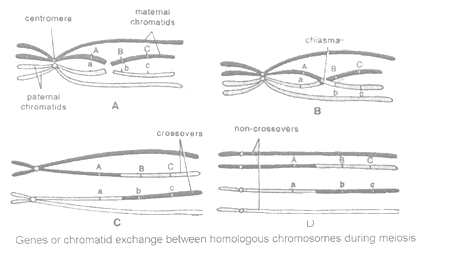
Diplotene : Synaptinemal complex is dissolved, tetrads are formed. At some places nonsister chromatids of two homologus chromosomes remain attached ends, nucleolus degenerates.
Diakinesis : Chisasmata shifts towards ends, nucleolus degenerates.
Metaphase – I : Spindles are formed and bivalents form a double whorl or double metaphase plate.
Anaphase – I : Chaismata disappears, homologus chromosomes separate by disjunction forming dyads. They move towards poles and form tow groups of haploid chromosomes.
Telophase – I : Chromosomes elongate, nucleoplasm & nuclear envelope reappears.
Meiosis – II : It is also called as equation al division and maintains the haploid number of chromosomes.·
Prophase – II : Chromatin fibers shorten and form chromosomes. Nuclear envelope and nucleolus start disappearing.· Anaphase – II : Centromere divides into tow and separates two chromatids of chromosome into two independent daughter chromosomes or chromatids.
Telophase – II : The four groups of chromosomes organize themselves into 4 haploid nuclei. Chromatin fibers are formed, nucleolus and nuclear envelope are reappeared.
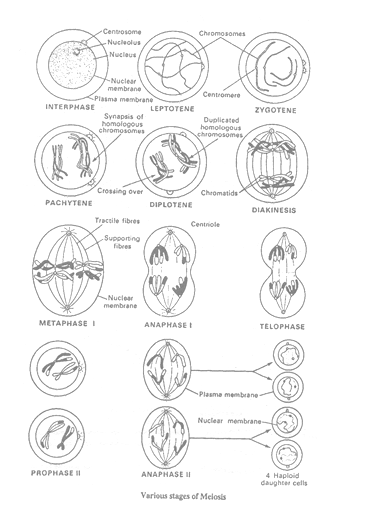
Metaphase – II : Chromosomes form single metaphasic plate by arranging themselves on equator.
No replication of DNA occurs in this stage
(d) Amitosis
It was discovered by Remak. It is a direct cell division in which genetic material does not duplicate and its distribution to daughter cells is not precisely half. Both cell and its nucleus elongate, constrict in middle and break off into nearly equal halves. It is under abnormal case e.g. cartilage cells.
Significance of mitosis : It is essential of growth, repair, differentiation, maintenance of chromosome number etc.
Significance of meiosis : It produces variations and essential for sexual reproduction. It maintains the chromosome numbering each generation living organisms.
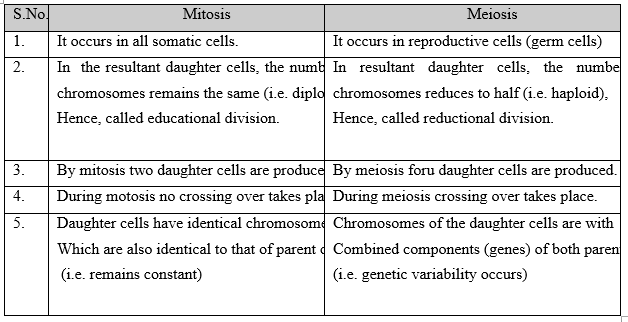
DIFFERENCES BETWEEN MITOITC AND MEIOTIC CELL DIVISION
Free study material for Science
Cell Division Concepts and Summary for Class 10 Science
Quick Revision Notes: Cell Division (CBSE)
Access structured revision notes for Cell Division designed in alignment with the latest CBSE curriculum for Class 10 Science. These summaries help clarify core themes and support effective daily study.
Expert Study Material for Class 10 Science
Cross-reference your comprehension with comprehensive NCERT solutions for Class 10 to ensure absolute clarity across all sub-topics in this chapter.
Complete Your Chapter Revision
Wrap up your chapter revision by testing your knowledge against standard question formats. Everything on our platform is provided free of charge.
FAQs
You can download the teacher prepared revision notes for CBSE Class 10 Science Cell Division Notes from StudiesToday.com. These notes are designed as per 2026-27 academic session to help Class 10 students get the best study material for Science.
Yes, our CBSE Class 10 Science Cell Division Notes include 50% competency-based questions with focus on core logic, keyword definitions, and the practical application of Science principles which is important for getting more marks in 2026 CBSE exams.
Yes, our CBSE Class 10 Science Cell Division Notes provide a detailed, topic wise breakdown of the chapter. Fundamental definitions, complex numerical formulas and all topics of CBSE syllabus in Class 10 is covered.
These notes for Science are organized into bullet points and easy-to-read charts. By using CBSE Class 10 Science Cell Division Notes, Class 10 students fast revise formulas, key definitions before the exams.
No, all study resources on StudiesToday, including CBSE Class 10 Science Cell Division Notes, are available for immediate free download. Class 10 Science study material is available in PDF and can be downloaded on mobile.