

Science Concept Notes for Class 10: Chapter 05 Life Processes
Review targeted revision notes for Class 10 Science with the CBSE Class 10 Science Life Processes Notes Set 03. Built according to official educational guidelines for the 2026-27 academic year, these downloadable summaries for Chapter 05 Life Processes support daily study and last-minute exam readiness.
Download Chapter 05 Life Processes Revision Notes PDF
Navigate directly to the revision notes for Chapter 05 Life Processes using the digital viewer below. Each summary is structured to highlight high-weightage sections, allowing students to instantly access critical definitions and focus on core exam topics.
Question. Define the following terms:
1) nutrition
2) photosynthesis
3) peristalsis
4) excretion
5) osmoregulation
6) holozoic nutrition
Answer: 1) 1 Nutrition-It is the mode of taking food by an organism and its utilization by the body.
2) Photosynthesis-It is the process by which green plants can prepare their own food in the presence of sunlight, carbondioxide , water, minerals and chlorophyll.
3) peristalsis:-it is a wave of contraction and expansion that takes place in the Alimentary canal. It pushes the food forward.
4) excretion:-the process of elimination of metabolic waste from the body.
5) osmoregulation :-regulating the amount of water and salts in the body.
6) holozoic nutrition:-it is the mode of heterotrophic nutrition that involves The intake of solid food.
Question. How do plants get rid of their waste products?
Answer: Plants get rid of their waste products by:
1) waste products are stored in old leaves that soon fall off.
2) Bark consists of dead cells which is peeled off periodically.
3) Some waste substances are excreted by roots.
4) Resins, gums , tannins etc are stored in old xylem.
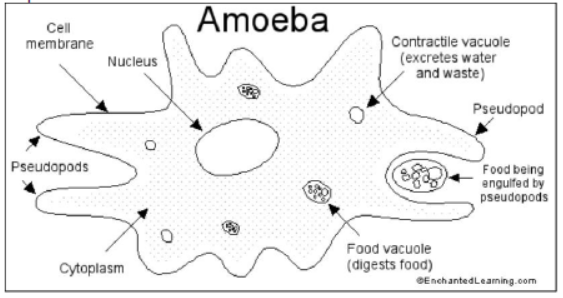
Question. How does amoeba dispose off its waste products?
Answer: amoeba lacks excretory organs. Waste products like ammonia and CO2 are passed outside through the process of diffusion. Contractile vacuole also plays an important role in
Question. Describe the mechanism of urine formation in humans.
Answer: its completed in 4 steps:
a) glomerular filtration: blood flows under pressure inside the glomerulus . as a result, it undergoes ultrafiltration. Urea, uric acid, amino acids, hormones, glucose, ions and water are filtered out and enter the Bowmans capsule.
b) Reabsorption:the filtrate passes thru proximal convoluted tubule. The capillaries absorb all the useful components like: glucose, amino acids, ions etc.
c) Tubular secretion: it occurs in distal convoluted tubule. It is the active secretion of waste by the blood capillaries into the urinary tubule. It ensures the removal of all the waste from the blood.
d) Concentration of urine: 75% of water is reabsorbed in proximal convoluted tubule.some 10% of water reabsorbed in henles loop.
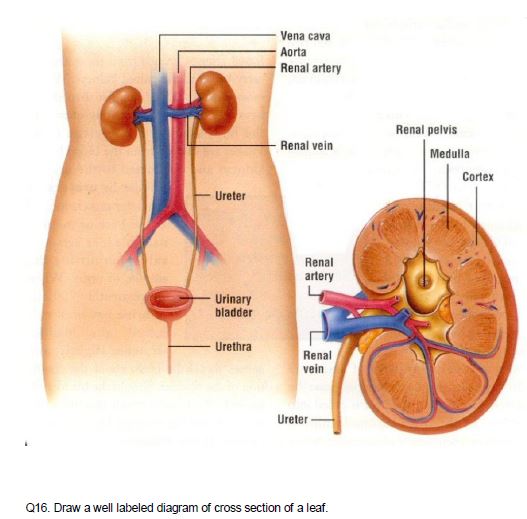
e) Ureters : these are the narrow muscular tubesthat carry urine from kidneys to urinary bladder.
f) Urinary bladder: it is a pear shaped sac that stores urine.
g) Utrethra: it is a tube that takes urine from bladder to outside.
Question. Why is trachea lined with the rings of cartilage?
Answer: Trachea is lined with the rings of cartilage to prevent it from collapsing.
Question. Identify the respiratory organ in :
a)leech
Answer: a) skin b) trachea/ spiracles c) gills
b) cockroach c) crab d)mussel e)tadpole
d) gills e) gills
Question. How do plants exchange gases?
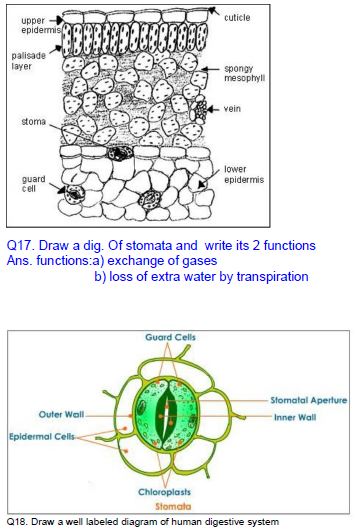
Answer: Plants exchange gases by the process of diffusion. Stomata help in the exchange of gases. CO2 gas is taken in and O2 is released by the process of photosynthesis.
Question. What is the role of HCL in the stomach.
Answer: it has two roles:
1) kills the microbes that enter along with food.
2) Creates an acidic medium for pepsin functioning.
Question. Name the raw materials of photosynthesis .
Answer: 4 requirements of photosynthesis are-
1 carbondioxide –is taken through stomata.
2 water and minerals- are transported to the leaves by the vessels.
3 chlorophyll-is present in the leaves of the plants.
4 sunlight-is absorbed by the chlorophyll present in the leaves.
Question. Identify the specific mode of nutrition in :
a) cuscuta
Answer: a) parasitic
b) ascaris
b) parasitic
c) mushroom
d) deer
c) saprophytic
e) humans
d)and e) holozoic
Question. What is fermentation? What is its use?
Answer: fermentation is the kind of anaerobic respiration carried out by a unicellular organism called yeast. Yeast converts a sugar solution into alcohol and also releases CO2 Gas during this process. Its used in bakery and brewery industries.
Question. Mention the raw materials needed for photosynthesis.
Answer: 4 requirements of photosynthesis are-
1 carbondioxide –is taken through stomatas
2 water and minerals- are transported to the leaves by the vessels.
3 chlorophyll-is present in the leaves of the plants.
4 sunlight-is absorbed by the chlorophyll present in the leaves.
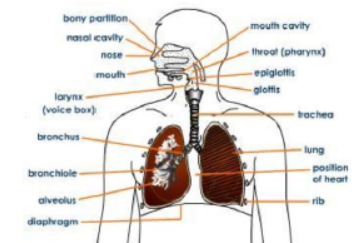
Question. Draw a well labeled diagram of human respiratory system.
Answer:

Question. why do aquatic organisms show a higher breathing rate?
Answer: this is bcos, water has low O2 content than the content of O2 in air.
Question. why do we feel muscle cramps after heavy exercise?
Answer: this is bcos our cells and tissues become O2 deficient and start undergoing anaerobic respiration. This produces lactic acid and we feel muscle cramps.
Question. Why is it advised to breathe thru nose?
Answer: The mucus and hair present in the nasal cavity help to filter the inhaled air.
Question. What is a diaphragm?
Answer: it’s a muscular partition between thorax and abdomen,it can bcum flat or dome shaped due to contraction and relaxation of muscles.
Question. What is the other name of larynx?
Answer: it is also called adam’s apple.
Please click the link below to download CBSE CBSE Class 10 Science Life Processes Notes Set C.
Free study material for Science
Download CBSE Revision Notes: Class 10 Science Chapter 05 Life Processes
Quick Revision Notes: Chapter 05 Life Processes (CBSE)
Access structured revision notes for Chapter 05 Life Processes designed in alignment with the latest CBSE curriculum for Class 10 Science. These summaries help clarify core themes and support effective daily study.
Expert Study Material for Class 10 Science
Built using the official NCERT book for Class 10 Science, these notes provide reliable academic guidance. Pair your summary review with our recommended NCERT solutions to master optimal problem-solving approaches.
Complete Your Chapter Revision
Wrap up your chapter revision by testing your knowledge against standard question formats. Everything on our platform is provided free of charge.
FAQs
You can download the teacher prepared revision notes for CBSE Class 10 Science Life Processes Notes Set 03 from StudiesToday.com. These notes are designed as per 2026-27 academic session to help Class 10 students get the best study material for Science.
Yes, our CBSE Class 10 Science Life Processes Notes Set 03 include 50% competency-based questions with focus on core logic, keyword definitions, and the practical application of Science principles which is important for getting more marks in 2026 CBSE exams.
Yes, our CBSE Class 10 Science Life Processes Notes Set 03 provide a detailed, topic wise breakdown of the chapter. Fundamental definitions, complex numerical formulas and all topics of CBSE syllabus in Class 10 is covered.
These notes for Science are organized into bullet points and easy-to-read charts. By using CBSE Class 10 Science Life Processes Notes Set 03, Class 10 students fast revise formulas, key definitions before the exams.
No, all study resources on StudiesToday, including CBSE Class 10 Science Life Processes Notes Set 03, are available for immediate free download. Class 10 Science study material is available in PDF and can be downloaded on mobile.