

Revision Notes for Class 9 Mathematics: Chapter 01 Number Systems
Access comprehensive revision notes for Chapter 01 Number Systems using the CBSE Class 9 Mathematics Number Systems Notes Set 01. Designed to align with the 2026-27 academic syllabus for Class 9 Mathematics, these concept summaries help students streamline their exam preparation and review complex topics efficiently.
Review Chapter 01 Number Systems for Class 9 Mathematics
Access the complete concept summary PDF for Chapter 01 Number Systems below. Regular review of these targeted notes builds familiarity with complex Class 9 Mathematics themes and helps secure higher marks in final school evaluations.
CBSE Class 9 Concepts for Number Systems. Learning the important concepts is very important for every student to get better marks in examinations. The concepts should be clear which will help in faster learning. The attached concepts made as per NCERT and CBSE pattern will help the student to understand the chapter and score better marks in the examinations.
Chapter 1
Number Systems
Chapter Notes
Key Concepts
1. Numbers 1, 2, 3…….¥, which are used for counting are called Natural numbers and are denoted by N.
2. 0 when included with the natural numbers form a new set of numbers called Whole number denoted by W
3. -1,-2,-3……………..-¥ are the negative of natural numbers.
4. The negative of natural numbers, 0 and the natural number together constitutes integers denoted by Z.
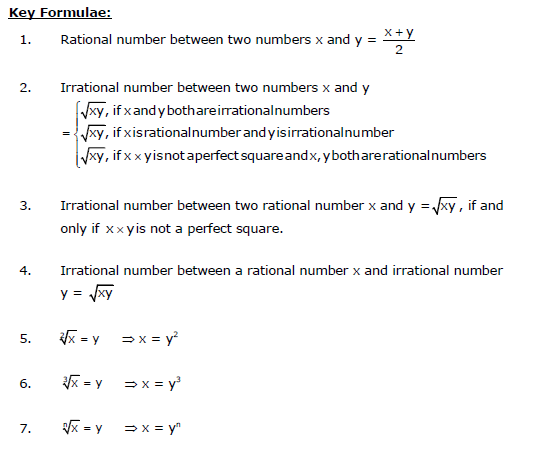
5. The numbers which can be represented in the form of p/q where q ¹ 0 and p and q are integers are called Rational numbers. Rational numbers are denoted by Q. If p and q are coprime then the rational number is in its simplest form.
6. Irrational numbers are the numbers which are non-terminating and non-repeating.
7. Rational and irrational numbers together constitute Real numbers and it is denoted by R.
8. Equivalent rational numbers (or fractions) have same (equal) values when written in the simplest form.
9. Terminating fractions are the fractions which leaves remainder 0 on division.
10. Recurring fractions are the fractions which never leave a remainder 0 on division.
11. There are infinitely many rational numbers between any two rational numbers.
12. If Prime factors of the denominator are 2 or 5 or both only. Then the number is terminating else repeating/recurring.
13. Two numbers p & q are said to be co-prime if, numbers p & q have no common factors other than 1.
14. The decimal expansion of rational number is either terminating or non-terminating recurring
15. The decimal expansion of an irrational number is non-terminating, non-recurring.
16. Real numbers satisfy the commutative, associate and distributive law of addition and multiplication.
17. Commutative law of addition: If a and b are two real numbers then, a + b = b + a
19. Commutative law of multiplication: If a and b are two real numbers then, a. b = b. a
20. Associative law of addition: If a, b and c are real numbers then, a + (b + c) = (a + b) + c
21. Associative law of multiplication: If a, b and c are real numbers then, a. (b. c) = (a. b). c
22. Distributive of multiplication with respect to addition: If a, b and c are real numbers then, a. (b+ c) = a. b + a. c
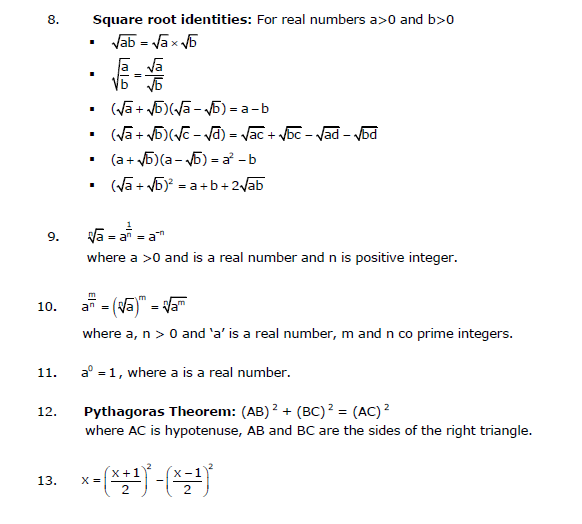
23. Removing the radical sign from the denominator is called rationalisation of denominator.
24. The multiplication factor used for rationalising the denominator is called the rationalising factor.
25. The exponent is the number of times the base is multiplied by itself.
26. In the exponential representation m a , a is called the base and m is called the exponent or power.
27. If a number is to the left of the number on the number line, it is less than the other number. If it is to the right, then it is greater than the number.
28. There is one to one correspondence between the set of real numbers and the set of point on the number line.
29. Irrational numbers like √2, √3 , √5 … √n , for any positive integer n can be represented on number line by using Pythagoras theorem.
30. The process of visualisation of representation of numbers on the number line through a magnifying glass is known as the process of successive magnification.
Please click the link below to download pdf file for CBSE Class 9 Concepts for Number Systems.
Free study material for Mathematics
Chapter 01 Number Systems Concepts and Summary for Class 9 Mathematics
Key Concepts and Summary for Class 9 Mathematics Chapter 01 Number Systems
Access structured revision notes for Chapter 01 Number Systems designed in alignment with the latest CBSE curriculum for Class 9 Mathematics. These summaries help clarify core themes and support effective daily study.
NCERT-Aligned Chapter Summary and Notes
Cross-reference your comprehension with comprehensive NCERT solutions for Class 9 to ensure absolute clarity across all sub-topics in this chapter.
Next Steps in Your Exam Preparation
Follow up your revision by attempting the interactive online Mathematics MCQ test and practice worksheets for this chapter to verify your mastery. All platform resources are free to access.
FAQs
You can download the teacher prepared revision notes for CBSE Class 9 Mathematics Number Systems Notes Set 01 from StudiesToday.com. These notes are designed as per 2026-27 academic session to help Class 9 students get the best study material for Mathematics.
Yes, our CBSE Class 9 Mathematics Number Systems Notes Set 01 include 50% competency-based questions with focus on core logic, keyword definitions, and the practical application of Mathematics principles which is important for getting more marks in 2026 CBSE exams.
Yes, our CBSE Class 9 Mathematics Number Systems Notes Set 01 provide a detailed, topic wise breakdown of the chapter. Fundamental definitions, complex numerical formulas and all topics of CBSE syllabus in Class 9 is covered.
These notes for Mathematics are organized into bullet points and easy-to-read charts. By using CBSE Class 9 Mathematics Number Systems Notes Set 01, Class 9 students fast revise formulas, key definitions before the exams.
No, all study resources on StudiesToday, including CBSE Class 9 Mathematics Number Systems Notes Set 01, are available for immediate free download. Class 9 Mathematics study material is available in PDF and can be downloaded on mobile.