

Revision Notes for Class 9 Mathematics: Chapter 15 Probability
Review targeted revision notes for Class 9 Mathematics with the CBSE Class 9 Mathematics Probability Notes Set 03. Built according to official educational guidelines for the 2026-27 academic year, these downloadable summaries for Chapter 15 Probability support daily study and last-minute exam readiness.
Review Chapter 15 Probability for Class 9 Mathematics
Access the complete concept summary PDF for Chapter 15 Probability below. Regular review of these targeted notes builds familiarity with complex Class 9 Mathematics themes and helps secure higher marks in final school evaluations.
Terminology Related to Probability
Observing an Experiment
It is not always possible to tell the exact outcome of a particular action. Take, for example, a dart board.
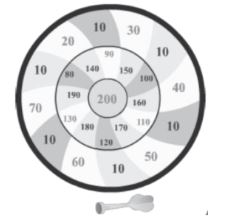
A dart is repeatedly thrown toward the dartboard, targeting a random number in each throw. We do not know which number is targeted in a particular throw. What we do know is that there is a fixed group of numbers and each time the targeted number is one of them.
We know that the likelihood of occurrence of an unpredictable event is studied under the theory of probability. So, we can say that there is a certain probability for each number to be targeted in the above experiment.
Let us learn more about probability and the meanings of terms associated with it, for example, ‘experiment’ and ‘outcome’.
Did You Know?
The word ‘probability’ has evolved from the Latin word ‘probabilitas’, which can be considered to have the same meaning as the word ‘probity’. In olden days in Europe, ‘probity’ was a measure of authority of a witness in a legal case, and it often correlated with the nobility of the witness.
The modern meaning of probability, however, focuses on the statistical observation of the likelihood of occurrence of an event.
Know More
Probability is widely applicable in daily life and in researches pertaining to different fields.
It is an important factor in the diverse worlds of share market, philosophy, artificial intelligence or machine learning, statistics, etc. All gambling is based on probability. In gambling, one considers all possibilities and then tries to predict a result that is most likely to happen. The concept of probability is perhaps the most interesting topic to discuss in mathematics.
Terms Related to Probability
Experiment: When an operation is planned and done under controlled conditions, it is known as an experiment. For example, tossing a coin, throwing a die, drawing a card from a pack of playing cards without seeing, etc., are all experiments. A chance experiment is one in which the result is unknown or not predetermined.
Outcomes: Different results obtained in an experiment are known as outcomes. For example, on tossing a coin, if the result is a head, then the outcome is a head; if the result is a tail, then the outcome is a tail.
Random: An experiment is random if it is done without any conscious decision. For example, drawing a card from a well-shuffled pack of playing cards is a random experiment if it is done without seeing the card or figuring it out by touching.
Trial: A trial is an action or an experiment that results in one or several outcomes. For example, if a coin is tossed five times, then each toss of the coin is called a trial.
Sample space: The set of all possible outcomes of an experiment is called the sample space. It is denoted by the English letter ‘S’ or Greek letter ‘Ω’ (omega). In the experiment of tossing a coin, there are only two possible outcomes—a head (H) and a tail (T).
∴ Sample space (S) = {H, T}
Event: The event of an experiment is one or more outcomes of the experiment. For example, tossing a coin and getting a head or a tail is an event. Throwing a die and getting a face marked with an odd number (i.e., 1, 3 or 5) or an even number (2, 4 or 6) is also an event.
Know More
Initially, the word ‘probable’ meant the same as the word ‘approvable’ and was used in the same sense to support or approve of opinions and actions. Any action described as ‘probable’ was considered the most likely and sensible action to be taken by a rational and sensible person.
Whiz Kid
Equally Likely: If each outcome of an experiment has the same probability of occurring, then the outcomes are said to be equally likely outcomes.

Experimental Probability
An Experiment with a Die
When a single six-sided die is rolled, we get a single outcome every time. Every outcome can be either an odd number or an even number. In an experiment, a single six-sided die is rolled seven times. The seven outcomes are listed in the following table.

What do you observe? Is there any pattern in the outcomes? There is no pattern. So, we cannot predict the outcome of rolling the die for an eighth time. However, we can calculate the probability of getting an odd or even number by observing the outcomes of the previous seven rolls of the die.
In this lesson, we will learn to calculate the probability of occurrence of an event in an experiment. We will also solve problems related to the same.
Theoretical Probability
If we divide the number of ways in which a favourable event can occur by the total number of outcomes, then we get the theoretical probability of occurrence of that particular event.
The formula of theoretical probability is as follows:
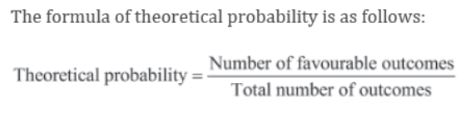
For example, with respect to a single roll of a six-sided die, we have:
Number of favourable outcomes for getting 6 = 1
Total number of outcomes = 6(∵ Any number from 1−6 can be obtained)
Theoretical Probability of getting 6 on rolling a die = 1/6
Similarly,
Number of favourable outcomes for getting an even number = 3 (i.e., 2, 4 or 6)
Total number of outcomes = 6(i.e., 1, 2, 3, 4, 5 and 6)
Theoretical Probability of getting an even number on rolling a die = 3/6 = 1/2
In this manner, we can find the theoretical probability of occurrence of any event.
Experimental probability
The probability of an event ascertained by observing the outcomes of an experiment is known as empirical or experimental probability.The formula for finding the experimental probability of an event (E) is as follows:

Let us once again consider the observation table made at the beginning. In this experiment, we got an odd number 3 times and an even number 4 times on rolling the die a total of 7 times.
Let the probability of getting an odd number be P(E1) and that of getting an even number be P(E2). Then, we get:
P(E1) = 3/7 and P(E2) = 4/7
In this manner, we can find the experimental probability of any event in an experiment.
Did You Know?
• The probability of an event always lies between 0 and 1.
• The sum of the probabilities of all events in a single experiment is always 1, i.e., P(E1) + P(E2) + … + P(En) = 1, where E1, E2, …., En are n events in a single experiment.
• Did You Know?
Applications of probability
1.Life expectancy: It is the prediction of the age of individuals on the basis of the ages of their ancestors or the ages of people belonging to similar groups in the past.
This prediction is used as a guideline by financial advisers to help their clients in planning for their retirement years.
2.Casino games: Casino owners always consider the concept of probability to ensure that they don’t lose money in the business. The odds are always in favour of casino owners. Smart gamblers who know to use probability in casino games try to defy these odds.
• Did You Know?
• The concept of probability is applied in different contexts, for example, in risk assessment and in trading in financial markets. Governments apply methods of probability in environmental regulation. This is known as pathway analysis.
Free study material for Mathematics
Revision Notes and Key Concepts for Class 9 Mathematics Chapter 15 Probability
Download Chapter Summary: Class 9 Mathematics Chapter 15 Probability
Access structured revision notes for Chapter 15 Probability designed in alignment with the latest CBSE curriculum for Class 9 Mathematics. These summaries help clarify core themes and support effective daily study.
Concept Clarification for Chapter 15 Probability
Built using the official NCERT book for Class 9 Mathematics, these notes provide reliable academic guidance. Pair your summary review with our recommended NCERT solutions to master optimal problem-solving approaches.
Additional Study Resources for Class 9 Mathematics
Wrap up your chapter revision by testing your knowledge against standard question formats. Everything on our platform is provided free of charge.
FAQs
You can download the teacher prepared revision notes for CBSE Class 9 Mathematics Probability Notes Set 03 from StudiesToday.com. These notes are designed as per 2026-27 academic session to help Class 9 students get the best study material for Mathematics.
Yes, our CBSE Class 9 Mathematics Probability Notes Set 03 include 50% competency-based questions with focus on core logic, keyword definitions, and the practical application of Mathematics principles which is important for getting more marks in 2026 CBSE exams.
Yes, our CBSE Class 9 Mathematics Probability Notes Set 03 provide a detailed, topic wise breakdown of the chapter. Fundamental definitions, complex numerical formulas and all topics of CBSE syllabus in Class 9 is covered.
These notes for Mathematics are organized into bullet points and easy-to-read charts. By using CBSE Class 9 Mathematics Probability Notes Set 03, Class 9 students fast revise formulas, key definitions before the exams.
No, all study resources on StudiesToday, including CBSE Class 9 Mathematics Probability Notes Set 03, are available for immediate free download. Class 9 Mathematics study material is available in PDF and can be downloaded on mobile.