

Official Class 9 Mathematics Revision Material: CBSE Class 9 Mathematics Quadrilaterals Notes Set 01
Access comprehensive revision notes for Chapter 08 Quadrilaterals using the CBSE Class 9 Mathematics Quadrilaterals Notes Set 01. Designed to align with the 2026-27 academic syllabus for Class 9 Mathematics, these concept summaries help students streamline their exam preparation and review complex topics efficiently.
Chapter-wise Concept Summaries: Chapter 08 Quadrilaterals
Access the complete concept summary PDF for Chapter 08 Quadrilaterals below. Regular review of these targeted notes builds familiarity with complex Class 9 Mathematics themes and helps secure higher marks in final school evaluations.
Chapter 8
Quadrilaterals
Chapter Notes
Top Definitions
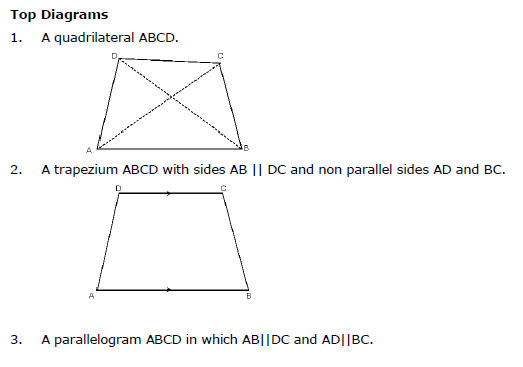
1. A quadrilateral is a closed figure obtained by joining four points (with no three points collinear) in an order.
2. A diagonal is a line segment obtained on joining the opposite vertices.
3. Two sides of a quadrilateral having no common end point are called its opposite sides.
4. Two angles of a quadrilateral having common arm are called its adjacent angles.
5. Two angles of a quadrilateral not having a common arm are called its opposite angles.
6. A trapezium is quadrilateral in which one pair of opposite sides are parallel.
7. In the non – parallel sides of trapezium are equal, it is known as isosceles trapezium.
8. A parallelogram is a quadrilateral in which both the pairs of opposite sides are parallel.
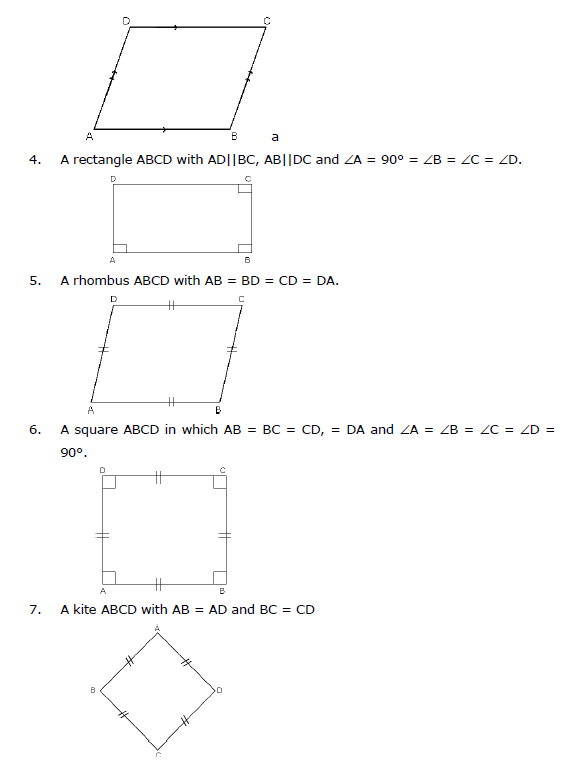
9. A rectangle is a quadrilateral whose each angle is 90°
10. A rhombus is quadrilateral whose all the sides are equal.
11. A square is a quadrilateral whose all sides are equal and each angle is 90°.
12. A kite is a quadrilateral in which two pairs of adjacent sides are equal.
Top Concepts
1. Properties of parallelogram:
i) The opposite sides of a parallelogram are parallel.
ii) A diagonal of a parallelogram divides it in two congruent triangles.
iii) The opposite sides of a parallelogram are equal.
iv) The opposite angles of a parallelogram are equal.
v) The consecutive angles (conjoined angles) of a parallelogram are supplementary.
vi) The diagonals of a parallelogram bisect each other.
2. A diagonal of a parallelogram divides the parallelogram into two congruent triangles.
3. In a parallelogram opposite sides are equal.
4. If each pair of opposite sides of a quadrilateral is equal, then it is a parallelogram.
5. In a parallelogram opposite angles are equal.
6. If in quadrilateral, each pair of opposite angles is equal, then it is a parallelogram.
7. The diagonals of a parallelogram bisect each other.
8. If the diagonals of a quadrilateral bisect other, then it is a parallelogram.
9. A quadrilateral is a parallelogram, if a pair of opposite sides is equal and parallel.
10. Square, rectangle and rhombus are all parallelograms.
11. Kite and trapezium are not parallelogram.
12. A square is a rectangle.
13. A square is a rhombus.
14. A parallelogram is a trapezium.
15. Every rectangle is a parallelogram; therefore, it has all the properties of a parallelogram. Additional properties of a rectangle are:
i) All the (interior) angles of are rectangle are right angles.
ii) The diagonals of a rectangle are equal.
16. Every rhombus is a parallelogram; therefore, it has all the properties of a parallelogram. Additional properties of a rhombus are:
i) All the sides of rhombus are equal.
ii) The diagonals of a rhombus intersect at right angles.
iii) The diagonals bisect the angles of a rhombus.
17. Every square is a parallelogram; therefore, it has all the properties of a parallelogram. Additional properties of a rhombus are:
i) All the sides are equal
ii) All the angles are equal to 90° each
iii) Diagonals are equal
iv) Diagonal bisect each other at right angle
v) Diagonals bisects the angles of vertex
18. Sum of all the angles of a quadrilateral is 3600.
19. Mid Point Theorem (Basic Proportionality Theorem): The line segment joining the mid point of any two sides of a triangle is parallel to the third sides and equal to half of it.
20. Converse of mid-point theorem: The line drawn through the mid-point of one side of a triangle parallel to the another side, bisects the third side.
21. If there are three or more parallel lines and the interests made by them on a transversal are equal, then the corresponding intercepts on any other transversal are also equal.
22. A quadrilateral formed by joining the mid-points of the sides of a quadrilateral, in order is a parallelogram.

Please click the link below to download pdf file for CBSE Class 9 Concepts for Quadrilaterals.
Free study material for Mathematics
Study Material and Revision Notes for Class 9 Mathematics Chapter 08 Quadrilaterals
Quick Revision Notes: Chapter 08 Quadrilaterals (CBSE)
Explore reliable chapter overviews for Chapter 08 Quadrilaterals tailored for Class 9 learners. Use these structured points to grasp difficult themes and ensure solid preparation for upcoming assessments.
Expert Study Material for Class 9 Mathematics
Each chapter summary is structured around standard CBSE textbooks, allowing students to check their understanding and clarify complex ideas early in their revision.
Complete Your Chapter Revision
Wrap up your chapter revision by testing your knowledge against standard question formats. Everything on our platform is provided free of charge.
FAQs
You can download the teacher prepared revision notes for CBSE Class 9 Mathematics Quadrilaterals Notes Set 01 from StudiesToday.com. These notes are designed as per 2026-27 academic session to help Class 9 students get the best study material for Mathematics.
Yes, our CBSE Class 9 Mathematics Quadrilaterals Notes Set 01 include 50% competency-based questions with focus on core logic, keyword definitions, and the practical application of Mathematics principles which is important for getting more marks in 2026 CBSE exams.
Yes, our CBSE Class 9 Mathematics Quadrilaterals Notes Set 01 provide a detailed, topic wise breakdown of the chapter. Fundamental definitions, complex numerical formulas and all topics of CBSE syllabus in Class 9 is covered.
These notes for Mathematics are organized into bullet points and easy-to-read charts. By using CBSE Class 9 Mathematics Quadrilaterals Notes Set 01, Class 9 students fast revise formulas, key definitions before the exams.
No, all study resources on StudiesToday, including CBSE Class 9 Mathematics Quadrilaterals Notes Set 01, are available for immediate free download. Class 9 Mathematics study material is available in PDF and can be downloaded on mobile.