

Mathematics Concept Notes for Class 9: Chapter 09 Circle
Review targeted revision notes for Class 9 Mathematics with the CBSE Class 9 Mathematics Circles Notes Set 01. Built according to official educational guidelines for the 2026-27 academic year, these downloadable summaries for Chapter 09 Circle support daily study and last-minute exam readiness.
Download Chapter 09 Circle Revision Notes PDF
View or download the dedicated Chapter 09 Circle revision resource below. Engaging with these structured concept notes daily ensures continuous academic progress and mastery of the 2026-27 curriculum for Mathematics.
CBSE Class 9 Concepts for Circles. Learning the important concepts is very important for every student to get better marks in examinations. The concepts should be clear which will help in faster learning. The attached concepts made as per NCERT and CBSE pattern will help the student to understand the chapter and score better marks in the examinations.
Chapter 10
Circles
Chapter Notes
Top Definitions
1. A circle is a collection (set) of all those points in a plane, each one of which is at a constant distance from a fixed point in the plane.
2. The fixed point is called the centre and the constant distance is called the radius of the circle.
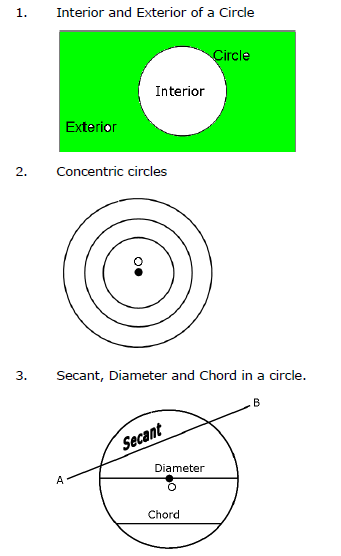
3. All the points lying inside a circle are called its interior points and all those points which lie outside the circle are called its exterior points.
4. The collection (set) of all interior points of a circle is called the interior of the circle while the collection of all exterior points of a circle is called the exterior of the circle.
5. A line segment joining two points on a circle is called the chord of the circle.
6. A chord passing through the center of the circle is called a diameter of the circle.
7. A line which meets a circle in two points is called a secant of the circle.
8. A polygon is a closed figure made up of three or more line segments (sides) such that each line segment intersects exactly two others at its end – points (vertices) and no two line segments which intersect are collinear.
9. A polygon is called a regular polygon, if it has all its sides equal and has all its angles equal.
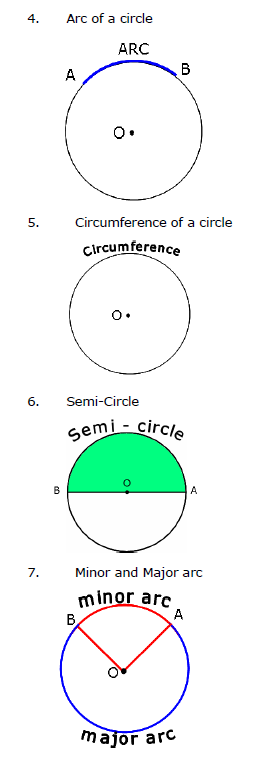
10. A (continuous) part of a circle is called an arc of the circle. The arc of a circle is denoted by the symbol ‘ ’.
11. Circumference: The whole arc of a circle is called the circumference of the circle.
12. Semi- circle: One – half of the whole arc of a circle is called a semi – circle of the circle.
13. Minor and Major arcs: An arc less than one - half of the whole arc of a circle is called a minor arc of the circle, and an arc greater than one – half of the whole arc of a circle is called a major arc of the circle.
14. Central Angle: Any angle whose vertex is centre of the circle is called a central angle.
15. Degree measure of an Arc: The degree measure of a minor arc is the measure of the central angle subtended by the arc.
16. Congruent Circle: Two circles are said to be congruent if and only if either of them can be superposed on the other so as to cover it exactly.
17. Congruent Arc: Two arcs of a circle (or of congruent) circles) are congruent if either of them can be superposed on the other so as to cover it exactly.
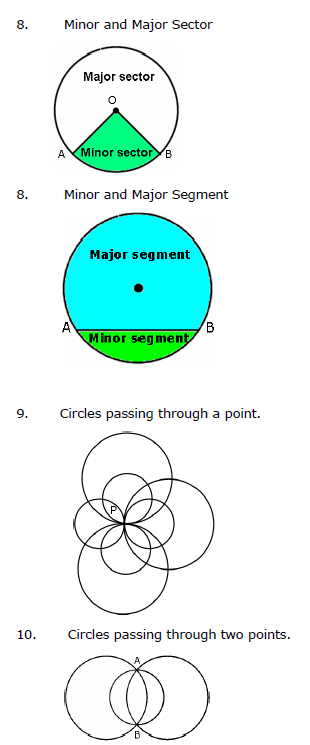
18. Sector of a circle: The part of the plane region enclosed by an arc of a circle and its two bounding radii is called a sector of a circle.
19. Segment of a circle: A chord of a circle divides it into two parts. Each part is called a segment.
20. The part containing the minor arc is called the minor segment, and the part containing the major arc is called the major segment.
21. A quadrilateral, all the four vertices of which lie on a circle is called a cyclic quadrilateral. The four vertices A, B, C and D are said to be Concyclic points.
Top Concepts
1. A diameter of circle is its longest chord.
2. A line can meet a circle at the most in two points.
3. In a circle, perpendicular from the center to a chord bisects the chord.
4. In a circle, the line joining the mid – point of a chord to the centre is perpendicular to the chord.
5. Equal chords of a circle are equivalent from the centre of the circle.
6. In a circle, chords which subtend equal angles at the centre are equal.
7. The two points of intersections determine a chord of the circle.
8. In a circle, equal chords subtend equal angles at the centre.
9. In a circle, chords which subtend equal angles at the centre are equal.
10. Triangle is a polygon with 3 sides.
11. Quadrilateral is a polygon with 4 sides.
12. The chords corresponding to congruent arcs are equal.
13. If two arcs of a circle (or of congruent circles) are congruent, then the corresponding chords are equal.
14. If two chords of a circle (or of congruent circles) are equal, then their corresponding arcs (minor, major or semi – circular) are congruent.
15. One and only one circle can be drawn through three non – collinear point
16. An infinite number of circles can be drawn through a given point P.
17. An infinite number of circles can be drawn through the two given point
18. Perpendicular bisectors of two chords of a circle, intersect each other at the centre of the circle.
19. The angle subtended by an arc at the centre is double the angle subtended by it at any point on the remaining part of the circle.
20. Angles in the same segment of a circle are equal.
21. An angle in a semi–circle is a right angle.
22. The arc of a circle subtending a right angle at any point of the circle in its alternate segment is a semi–circle.
23. If a line segment joining two points subtends equal angles at two other points lying on the same side of the line segment, the four points are concyclic, i.e., lie on the same circle.
24. An angle in a semi–circle is a right angle.
25. The arc of a circle subtending a right angle at any point of the circle in its alternate segment is a semi–circle.
26. If a line segment joining two points subtends equal angles at two other points lying on its same side of the line segment, the four points are concyclic i.e., lie on the same circle.
27. If the sum of any pair of opposite angles of a quadrilateral is 180°, then the quadrilateral is cycli
28. Any exterior angle of a cyclic quadrilateral is equal to the interior opposite angle.
Top Formulae
1. Diameter = 2 x Radius
2. If the degree measure of A» B is θ°, we write m A» B is θ°.
3. The degree measure of a semi – circles is 180°
4. The degree measure of a circle is 360°.
5. The degree measure of a major arc is (360° - θ°), where θ° is the degree measure of the corresponding minor arc.
6. For a quad. ABCD, ÐA + ÐC = 180° or ÐB = ÐD = 180°, then ABCD is cycli
7. Area of a circle = pr2
Top Diagrams

Please click the link below to download pdf file for CBSE Class 9 Concepts for Circles.
Free study material for Mathematics
Chapter 09 Circle Concepts and Summary for Class 9 Mathematics
Quick Revision Notes: Chapter 09 Circle (CBSE)
Access structured revision notes for Chapter 09 Circle designed in alignment with the latest CBSE curriculum for Class 9 Mathematics. These summaries help clarify core themes and support effective daily study.
Expert Study Material for Class 9 Mathematics
Each chapter summary is structured around standard CBSE textbooks, allowing students to check their understanding and clarify complex ideas early in their revision.
Complete Your Chapter Revision
Wrap up your chapter revision by testing your knowledge against standard question formats. Everything on our platform is provided free of charge.
FAQs
You can download the teacher prepared revision notes for CBSE Class 9 Mathematics Circles Notes Set 01 from StudiesToday.com. These notes are designed as per 2026-27 academic session to help Class 9 students get the best study material for Mathematics.
Yes, our CBSE Class 9 Mathematics Circles Notes Set 01 include 50% competency-based questions with focus on core logic, keyword definitions, and the practical application of Mathematics principles which is important for getting more marks in 2026 CBSE exams.
Yes, our CBSE Class 9 Mathematics Circles Notes Set 01 provide a detailed, topic wise breakdown of the chapter. Fundamental definitions, complex numerical formulas and all topics of CBSE syllabus in Class 9 is covered.
These notes for Mathematics are organized into bullet points and easy-to-read charts. By using CBSE Class 9 Mathematics Circles Notes Set 01, Class 9 students fast revise formulas, key definitions before the exams.
No, all study resources on StudiesToday, including CBSE Class 9 Mathematics Circles Notes Set 01, are available for immediate free download. Class 9 Mathematics study material is available in PDF and can be downloaded on mobile.