

Official Class 12 Business Studies Revision Material: CBSE Class 12 Business Studies Directing Notes Set 02
Access comprehensive revision notes for Chapter 07 Directing using the CBSE Class 12 Business Studies Directing Notes Set 02. Designed to align with the 2026-27 academic syllabus for Class 12 Business Studies, these concept summaries help students streamline their exam preparation and review complex topics efficiently.
Chapter-wise Concept Summaries: Chapter 07 Directing
View or download the dedicated Chapter 07 Directing revision resource below. Engaging with these structured concept notes daily ensures continuous academic progress and mastery of the 2026-27 curriculum for Business Studies.
Meaning
Directing as a function of management, refers to the process of instructing, guiding counselling, motivating and leading people in the organisation to achieve its objectives. It does not mean only instructions but also include supervising the employees when they are performing the job, motivating them to perform more efficiently and leading them towards the achievement of organisational goal.
Features:
1. Directing initiate action: The other functions of management prepare a setting for action, but directing initiates action in the organisation.
2. Directing takes place at every level of Management: – Every manager from top executive to supervisor performs the function of directing.
3. Directing is a continuous process of supervision, communication, leadership and motivation, It takes place throughout the life of the organisation.
4. Directing flows from top to bottom: – It is first initiated at the top level and flows to the bottom through organisational hierarchy.
Importance:
1. Initiates Action: It helps to initiate action by people in the organisation towards attainment of desired objectives. The employees start working only when they get instructions and directions from their superiors. It is the directing function which starts actual work to convert plans into results.
2. Integrate Employee s Efforts: – All the activities of the organisation are interrelated so it in necessary to coordinate all the activities. It integrates the activities of subordinates by supervision, guidance and counselling.
3. Means of motivation – It motivates the subordinates to work efficiently and to contribute their maximum efforts towards the achievement of organisational goals.
4. Facilitates change: – Employees often resist changes due to fear of adverse effects on their employment and promotion. Directing facilitate adjustment in the organisation to cope with changes in the environment.
5. Stability and Balance in the organisation: – It helps to achieve balance between individual interests of employees and organisational interests.
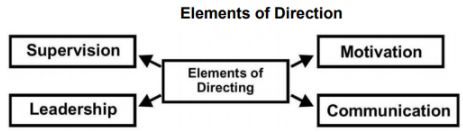
1. Supervision – It means observing the subordinates at work to see that they are working in according with plans and to help them in solving their problems. The important thing in supervision is it involves face to face contact between superior and subordinates. Supervisor position is immediately above the worker.
Motivations :-
Meaning :- It is the process of stimulating people to act to their best ability to accomplish desired goals. It depends upon satisfying needs of people.
Leadership –
Leadership is the activity of influencing people to strive willingly for mutual objectives. Managers at all levels are expected to the leaders of their subordinates.
Different types of Leadership styles:-
1. Autocratic or Authoritarian Leader.
2. Democratic or Participative Leader.
3. Laissez Faire or Free Rein Leader. Communication – It is transfer of information from the sender to the receiver with the information being understood by the receiver.
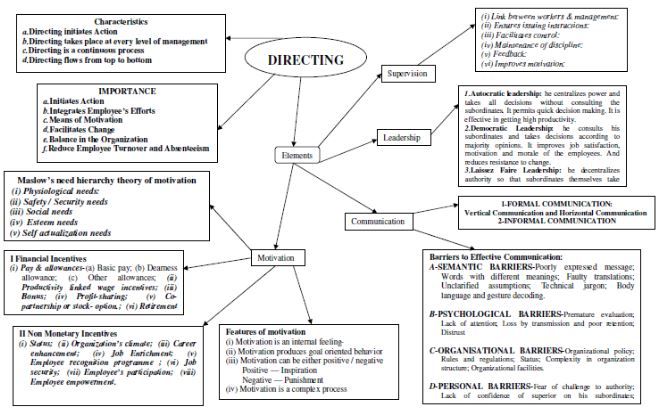
Directing
Directing is the process in which a superior gives instructions, guidance and counselling to its subordinate so as to inspire and lead them for the successful achievement of objectives.
Characteristics of Directing
- Initiates action: Directing starts action through instructions supervision and motivation to achieve goals.
- All pervasive: Directing takes place in every organization, and at every level of management.
- Continuous process: Directing is a continuous process and takes place throughout the life of an organization.
- Flows downward: Directing flows downward from superior to subordinate.
Importance of Directing
- Initiates Action: It helps to start action by the people in the organization towards attainment of desired objectives. The employees start working only when they get instructions and directions from their superiors. It is the directing function which starts actual work to turn plans into results.
- Integrates Employee's Efforts: All the activities of the organization are interrelated so it is necessary to coordinate all the activities. It brings together the activities of subordinates by supervision, guidance and counseling.
- Means of motivation: It motivates the subordinates to work efficiently and to give their maximum efforts towards the achievement of organizational goals.
- Facilitates change: Employees often resist changes due to fear of adverse effects on their employment and promotion. Directing helps adjustment in the organization to cope with changes in the environment.
- Stability and balance in the organization: Managers while performing a directing function instruct, guide, supervise and inspire their subordinates in a manner that they are able to strike a balance between individual and organizational interests.
Principles of Directing
- Maximum individual contribution: Through effective directing a manager must help the employee to realize his full potential, and give maximum towards the achievement of organizational goals.
- Harmony of objectives: Through effective directing, managers must offer harmony between employee's individual objectives and organizational objectives.
- Unity of command: Employees must get instructions and direction from one superior for effective directing.
- Appropriateness of direction technique: A manager must choose different direction tools according to the situation for effective direction.
- Managerial communication: Communication should be in accordance with subordinate need for effective direction.
- Use of informal organization: For effective direction managers should use informal organization for building cordial relationships with subordinates.
- Leadership: A manager must possess good leadership qualities to influence subordinates.
- Follow through: Manager must review employee's performance for effective directing.
Elements of Direction
These are grouped into four categories:
- Supervision
- Motivation
- Leadership
- Communication
I. Supervision
- Supervision involves watching and guiding the efforts of human and other resources with an objective to accomplish the desired objectives.
- It means watching what is being done by subordinates and giving instruction to make sure optimum use of resources and achievement of work targets.
Importance of Supervision/Role of Supervisor/Functions
- Link between workers and management because the supervisor explains management policies to workers and brings workers problems to the notice of the management.
- Ensures issuing Instructions: To make sure that the instructions are shared to each and every employee.
- Facilities Control: Control means match between actual and planned output. It makes sure checking on the methods in use and progress of work according to the planned schedule.
- Maintenance of discipline: The strict supervision and guidance of the supervisor encourages the employees and workers to be more disciplined in the activities. Under the guidance of superior the workers follow a fixed or strict timetable and execute the plans in right directions.
- Feedback: The supervisors are directly dealing with the subordinates. As a result, feedback in the form of suggestions, grievances keep coming to the management. It improves quality management decisions and revision of plans and policies.
- Improved Motivation: A supervisor with good leadership qualities can build up high morale among workers. The relationship with the supervisor is a very good incentive to improve the motivation level of the employees while guiding the employees; the supervisors encourage the subordinates to perform to their best capacities.
- Optimum utilization of resources: All the activities are under the supervision of the supervisor so less wastage and optimum utilization of resources is possible.
II. Motivation
- Motivation can be defined as stimulating, inspiring and inducing the employees to perform to their best capacity.
- Motivation is a psychological term which means it cannot be forced on employees.
Interrelated Teams of Motivation
- Motive: It is the inner state of an individual which directs his behaviour towards a goal.
- Motivation: It is the process of stirring people into action.
- Motivator: These are The techniques used for stirring people.
Features of Motivation
- Motivation is an internal feeling: It is the urge or desire to satisfy needs or wants which influences human behavior.
- Motivation produces goal-directed behaviour: All actions are directed to achieve specific goals.
- Motivation may be positive or negative: Positive motivators are like high salaries that influence constructively while negative motivators are like punishments that inculcates fear in the employees.
- Motivation is a complex process: It involves dealing with people of different types and expectations.
Motivation Process
Unsatisfied need
\( \downarrow \)
Tension
\( \downarrow \)
Drives
\( \downarrow \)
Search behavior
\( \downarrow \)
Satisfied need
\( \downarrow \)
Reduction of tension
- Unsatisfied Want: The motivation process begins with an individual's unsatisfied need.
- Tension: As the desire goes unsatisfied, frustration builds up in the individual's mind.
- Motives/Drives: Frustration motivates the individual to seek out alternatives to meet his needs.
- Search Behaviour: He selects one of several options and begins acting in accordance with it.
- Satisfied Needs: After a period of time, he evaluates whether or not his need has been met.
- Reduced Tension: Once the need is met, the individual's frustration and tension are relieved.
Importance of Motivation
- Motivation helps change a negative attitude to a positive attitude.
- Motivation improves the performance level of employees.
- Helps in achieving the organisational goal.
- Motivation creates a supportive work environment.
- Motivation helps the managers to introduce changes.
- Reduction in employee's turnover.
Maslow's Hierarchy of Needs
Maslow's need hierarchy is considered to be fundamental to the understanding of motivation and plays an important role in motivation.
- People have a wide range of needs like physiological needs, social needs, safety needs, esteem needs and self actualisation needs which motivate them to work.
- The manager must understand the needs and wants of people in order to motivate them and improve their performance levels.
- For the satisfaction of these needs, managers must offer different incentives (monetary and non-monetary).
| Need | Examples of Need (Individual Example) | Management Can Satisfy This Need By (Organizational Example) |
|---|---|---|
| 1. Basic Physiological Needs | Most basic in the hierarchy and corresponds to primary needs. Hunger, thirst, shelter, sleep. | Offer monetary incentives e.g. Good salary/wages and comfortable working conditions |
| 2. Safety / Security Needs | Security and protection from physical and emotional harm, stability of Income etc. | Offer job security, pension, insurance etc |
| 3. Affiliation / Belonging Needs | Refer to affection, sense of belongingness, acceptance and friendship | The firm can encourage team building and permit the workers to opportunity to interact socially and so develop cordial relations with colleagues |
| 4. Esteem Needs | Include factors such as self-respect, autonomy status, recognition and attention | Recognize good performance, provide opportunity for employees to feel a sense of accomplishment, provide important job titles etc |
| 5. Self Actualisation Needs | The drive to become what one is capable of becoming. These needs include growth, self-fulfillment and achievement of goals. | Offer the freedom to take decisions, providing them with opportunity to learn things, encouraging creativity, leading to achievement of goals etc. |
Financial and Non Financial Incentives
Incentives are the means to satisfy an employee's needs and motives. These can be:
- Financial
- Non-Financial
A. Financial Incentives
Incentives offered to employees which are either in direct monetary form or can be valued in monetary terms.
Types of Financial Incentives
- Pay and allowances: These include salary, dearness allowance and other allowances paid to employees.
- Productivity linked wage incentives: Wages paid at different rates to increase productivity.
- Bonus: Incentive offered above the wages or salary.
- Profit Sharing: Providing a fixed percentage of profit to employees.
- Co-partnership/ Stock option: Shares offered to employees at a price which is lower than the market price.
- Retirement benefits: Benefits offered after retirement such as provident fund, pension, etc.
- Perquisites: Benefits over and above the salary offered such as car allowance, housing, medical aid, etc.
B. Non-Financial Incentives
Incentives which are given to offer psychological and emotional satisfaction rather than monetary satisfaction.
Types of Non-Financial Incentives
- Status: It is the level of authority, responsibility and recognition an employee commands in the organization.
- Organizational climate: Characteristics influencing an individual's behaviour such as individual autonomy, reward orientation, consideration to employees, etc.
- Career advancement opportunity: Opportunities of growth and development in the organization to the higher level.
- Job enrichment: It refers to a variety of work offered to challenge the knowledge and skills of highly motivated employees.
- Employee recognition programmes: It involves recognising and appreciating the contribution of employees in public.
- Job security: It refers to the certainty and stability offered in a job about future income and work.
- Employee participation: Involvement of employees in the decision making process, seeking their advice or suggestions.
- Employee empowerment: Opportunities provided to employees to take decisions independently and perform jobs assigned to them.
III. Leadership
It is a process of influencing the behaviour of people at work towards the achievement of specified goal.
Features of Leadership
(a) It indicates the ability of an individual to influence others.
(b) It tries to bring change in behaviour.
(c) It shows interpersonal relationships between leaders and followers.
(d) It is to achieve a common goal.
(e) It is a continuous process.
Importance of Leadership
- Makes people contribute positively: Influences behaviour and makes people give positively and produce good results.
- Creates congenial work environment: Maintains personal relations, helps followers fulfill their needs, gives confidence, support and encouragement.
- Introduces change: Persuades, clarifies and inspires people to accept changes. So overcomes resistance to change with minimum discontent.
- Handles conflict: Does not allow adverse effects. Allows followers to express their feelings and disagreements and gives suitable clarifications.
- Trains subordinates: Builds up successors and helps in a smooth succession process.
Qualities of a Good Leader
- Physical features: Should be fit and presentable with positive energy.
- Knowledge: Should have required knowledge and competence.
- Integrity: Must possess a high level of integrity and honesty.
- Initiative: Should grab opportunity and use it to the advantage of organization.
- Communication skills: Must possess skill to communicate and convince people effectively.
- Motivation skills: Should motivate the individuals to improve their performance.
- Self confidence: Should have a high level of confidence to handle difficult situations.
- Decisiveness: Should be decisive and remain firm on decisions.
- Social skills: Should be social and friendly with his colleagues and subordinates.
Styles of Leadership
Leadership styles refer to a leader's behaviour. Behavioural pattern which the leader reflects in his role as a leader is often described as the style of leadership.
A Leadership style is the result of the leader's philosophy, personality, experience and value system. It also depends upon the type of followers and the atmosphere revealing in the organization.
Different Types of Leadership Style
- Autocratic leadership
- Participative leadership/Democratic
- Free rein leadership/Laissez Faire
A leader may use all styles over a period of time but one style tends to predominate as his normal way of using power.
- Autocratic leadership: In this style of leadership, a leader takes all the decisions on his own and gives orders to his or her subordinate to implement them.
- Democratic leadership: In this style of leadership a leader takes decisions after consulting with subordinates and encourages them to participate in decision making.
- Laissez faire leader: In this style of leadership a leader gives freedom to his subordinate to take decisions and execute work assigned to them and the leader acts as observer or guide.
IV. Communication
It can be defined as transmission or exchange of ideas, views, message information or instruction between two or more persons by different means.
Elements of Communication Process
- Sender: Who conveys his thoughts or ideas.
- Message: Ideas, feelings, suggestions, order etc.
- Encoding: Converting the message into communication symbols such as words/pictures etc.
- Media: Path/Channel through which encoded message is transmitted to receiver e.g., face to face, phone call, internet etc.
- Decoding: Converting encoded symbols of the sender.
- Receiver: Who receives communication from the sender.
- Feedback: All those actions of the receiver indicating that he has received and understood the message of the sender.
- Noise: Some obstruction or hindrance to communication like poor telephone connection, inattentive receiver.
Importance of Communication
- Basis of coordination: Acts as a basis to coordinate their efforts of employees by explaining organizational goals.
- Smooth working of an enterprise: It makes interaction among all individuals possible helping smooth and unrestricted working of an enterprise.
- Basis of decision making: Communication acts as a medium for offering information needed for decision making.
- Increases managerial efficiency: Helps managers to convey important information to subordinates to enable them to perform with efficiency.
- Cooperation and industrial peace: The two way communication promotes cooperation and mutual understanding between the management and workers.
- Effective leadership: Effective communication enables a manager to lead and influence his or her subordinate.
- Boosts morale and provides motivation: Managers understand and satisfy employees' needs and motives by effective communication.
Form of Organisational Communication
The process of communication within an organization may be:
- Formal
- Informal
1. Formal Communication
It refers to official communication taking place in the organisation.
According to Direction of Flow, Formal Communication can be Divided into Four Types
(a) Downward communication
(b) Upward communication
(c) Horizontal communication
(d) Diagonal communication
Common Networks of Formal Communication
- Single chain: Communication flows from superior to his immediate subordinate.
- Wheel: Superior acts as a hub of information and all subordinates communicate through the superior only.
- Circular: Employees communicate with his or her adjoining people.
- Free flow: All employees are free to communicate with each other without any restrictions.
- Inverted V: An employee communicates with his or her immediate superior but may also communicate with his/her superior's superior.
2. Informal Communication
Informal communication between different members of an organisation who are not officially attached to each other is known as Informal communication.
Grapevine Network
Grapevine communication, also known as informal communication, is a communication that develops as a result of social interaction among employees and spreads without following the formal communication path. The types of grapevine communication networks are as follows:
- Single Strand Network: An employee communicates with other employees in sequence. That is, one person communicates with another, who then communicates with yet another. Hence, information is passed through a line of persons.
- Gossip Network: In a gossip network, one person spreads information to a large number of people. An employee communicates with all on a selective basis. Such as gossip about the new employee who recently joined the organization etc.
- Probability Network: In a probability network, an individual shares information with other people at random. That is, the individual is unconcerned about who he shares the information with.
- Cluster Network: Information in this network is first shared between two people who trust each other. One of them then passes the information on to another, who then passes it on to another, and so the information spreads.
Barriers to Effective Communication
A. Semantic Barriers
Concerned with problems and obstructions in the process of encoding or decoding of messages into words or impressions.
Reasons of Semantic Barriers
- Badly expressed message: Sometimes intended meaning may not be shared.
- Symbols with different meanings: Words with different meanings confuse the receiver.
- Faulty translations: It may transfer wrong messages.
- Unclarified assumption: Different interpretations may result in confusion.
- Technical Jargon: Technical words may not be understood by the workers.
B. Psychological/Emotional Barriers
Sender or receiver's state of mind may influence the meaning of the message.
Reasons of Psychological Barriers
- Premature evaluation: judgement before listening leads to misunderstanding.
- Lack of attention: Sender's or receiver's pre-occupation of mind with other thoughts may result in ineffective communication.
- Loss by transmission and poor retention: When oral communication passes through various levels it destroys the structure of the message or leads to transmission of inaccurate messages.
- Distrust: If the parties do not believe each other. They cannot understand each other's message in its original sense.
C. Organizational Barriers
Organizational authority relationships, rules and regulations, may result in communication barriers.
Reasons of Organizational Barriers
- Organizational policy: Policies may not support free flow of communication.
- Rules and regulations: Strict rules and regulations may result in delay of information, such as following a certain path for communication etc.
- Status: A status conscious manager, hampering the effectiveness of communication between him and his subordinates.
- Complexity in organizational structure: organization with too many levels may result in delay or distort of communication due to several filter points.
- Organizational facilities: Improper facilities may affect free flow of communication and may create problems. A free and effective flow of communication requires the presence of certain organizational facilities such as social gatherings, complaint boxes, and transparency in operations, etc. The absence of such facilities hinders the flow of information
D. Personal Barriers
These barriers arise due to the personal factors on the part of both, the sender and the receiver which may affect effective communication.
Reasons of Personal Barriers
- Fear of challenge to authority may withhold or suppress a particular communication.
- Lack of confidence of superior in his subordinates.
- Unwillingness to communicate. e.g., fear of punishment/demotion.
- Lack of proper incentives stops the subordinates from offering useful suggestions.
Measures to Improve Communication Effectiveness
- Clarify the ideas before communication: Superiors must have a clear and detailed understanding of the message before it is shared to the subordinates.
- Communicate according to the needs of the receiver: Sender must consider receiver's education, knowledge and understanding level while sharing message.
- Consult others before communicating: Superiors must involve subordinates while taking decisions and making plans for effective communication.
- Be aware of languages, tone and content of message: Sender must use proper language and tone while transmitting message to the receiver.
- Convey things of help and value to listeners: Sender must consider the interests and needs of the receiver while transmitting messages.
- Ensure proper feedback: Feedback from receiver makes sure that the message is received or understood with the same intended meaning.
- Communicate for present as well as future: Superiors must communicate with the subordinates about the present and future goals of the organization.
- Follow ups: Regular follow ups and reviews make communication effective.
- Be a good listener: Communicator must be patient and attentive listening to understand the receiver's problem related to understanding and implementing the message.
Free study material for Business Studies
Download CBSE Revision Notes: Class 12 Business Studies Chapter 07 Directing
Download Chapter Summary: Class 12 Business Studies Chapter 07 Directing
Access structured revision notes for Chapter 07 Directing designed in alignment with the latest CBSE curriculum for Class 12 Business Studies. These summaries help clarify core themes and support effective daily study.
Concept Clarification for Chapter 07 Directing
Cross-reference your comprehension with comprehensive NCERT solutions for Class 12 to ensure absolute clarity across all sub-topics in this chapter.
Additional Study Resources for Class 12 Business Studies
Follow up your revision by attempting the interactive online Business Studies MCQ test and practice worksheets for this chapter to verify your mastery. All platform resources are free to access.
FAQs
You can download the teacher prepared revision notes for CBSE Class 12 Business Studies Directing Notes Set 02 from StudiesToday.com. These notes are designed as per 2026-27 academic session to help Class 12 students get the best study material for Business Studies.
Yes, our CBSE Class 12 Business Studies Directing Notes Set 02 include 50% competency-based questions with focus on core logic, keyword definitions, and the practical application of Business Studies principles which is important for getting more marks in 2026 CBSE exams.
Yes, our CBSE Class 12 Business Studies Directing Notes Set 02 provide a detailed, topic wise breakdown of the chapter. Fundamental definitions, complex numerical formulas and all topics of CBSE syllabus in Class 12 is covered.
These notes for Business Studies are organized into bullet points and easy-to-read charts. By using CBSE Class 12 Business Studies Directing Notes Set 02, Class 12 students fast revise formulas, key definitions before the exams.
No, all study resources on StudiesToday, including CBSE Class 12 Business Studies Directing Notes Set 02, are available for immediate free download. Class 12 Business Studies study material is available in PDF and can be downloaded on mobile.